Menachot Daf 8 (מנחות דף ח׳)
Daf: 8 | Amudim: 8a – 8b | Date: 21 Tevet 5785 (January 21, 2025)
📖 Breakdown
Amud Aleph (8a)
Segment 1
TYPE: קושיא
Challenge to Rabbi Elazar from blood
Hebrew/Aramaic:
וְאִם אִיתַהּ, לֵילַף מִדָּם? וְכִי תֵּימָא: רַבִּי אֶלְעָזָר מִילְּתָא מִמִּילְּתָא לָא גָּמַר? וְהָא אָמַר רַבִּי אֶלְעָזָר: מִנְחָה שֶׁקְּמָצָהּ בַּהֵיכָל כְּשֵׁרָה, שֶׁכֵּן מָצִינוּ בְּסִילּוּק בָּזִיכִין.
English Translation:
And if it is so that Rabbi Elazar holds that blood may not be sanctified in halves, let him derive the halakha of the High Priest’s griddle-cake offering from that of blood. And if you would say that in this case Rabbi Elazar does not derive the halakha of the matter of a meal offering from that of another matter, that is difficult: But doesn’t Rabbi Elazar say: A meal offering from which the priest removed a handful while inside the Sanctuary is valid, despite the fact that the handful should be removed in the Temple courtyard; the reason is that we find a similar case in the Sanctuary, with regard to the removal of the bowls of frankincense from the Table of the shewbread? Just as the bowls permit the shewbread for consumption when removed in the Sanctuary, so too, the handful permits the remainder of the meal offering for consumption. This indicates that Rabbi Elazar does derive the halakha of a meal offering from that of another matter.
קלאוד על הדף:
The Gemara continues from the previous daf, challenging Rabbi Elazar’s position. If Rabbi Elazar holds that blood cannot be sanctified in halves, why doesn’t he apply the same rule to the High Priest’s griddle-cake offering? The Gemara then questions whether Rabbi Elazar derives laws from one matter to another—and proves he does, since he validated kemitza in the Sanctuary based on the frankincense bowls.
Key Terms:
- חֲבִיתֵּי כֹּהֵן גָּדוֹל (chavitei kohen gadol) = The High Priest’s daily griddle-cake offering
- סִילּוּק בָּזִיכִין = Removal of the frankincense bowls
Segment 2
TYPE: תירוץ
Resolution: meal offering from meal offering
Hebrew/Aramaic:
מִנְחָה מִמִּנְחָה יָלֵיף, מִנְחָה מִדָּם לָא יָלֵיף.
English Translation:
The Gemara responds: Rabbi Elazar does derive the halakha with regard to a meal offering from that of another meal offering; the shewbread is considered a meal offering. But he does not derive the halakha with regard to a meal offering from that of blood.
קלאוד על הדף:
The Gemara distinguishes: Rabbi Elazar derives laws within the same category (meal offering from meal offering), but not across categories (meal offering from blood). The showbread and frankincense are both forms of meal offerings, so cross-derivation works there. But blood is a fundamentally different category.
Segment 3
TYPE: קושיא
Challenge from the showbread baraita
Hebrew/Aramaic:
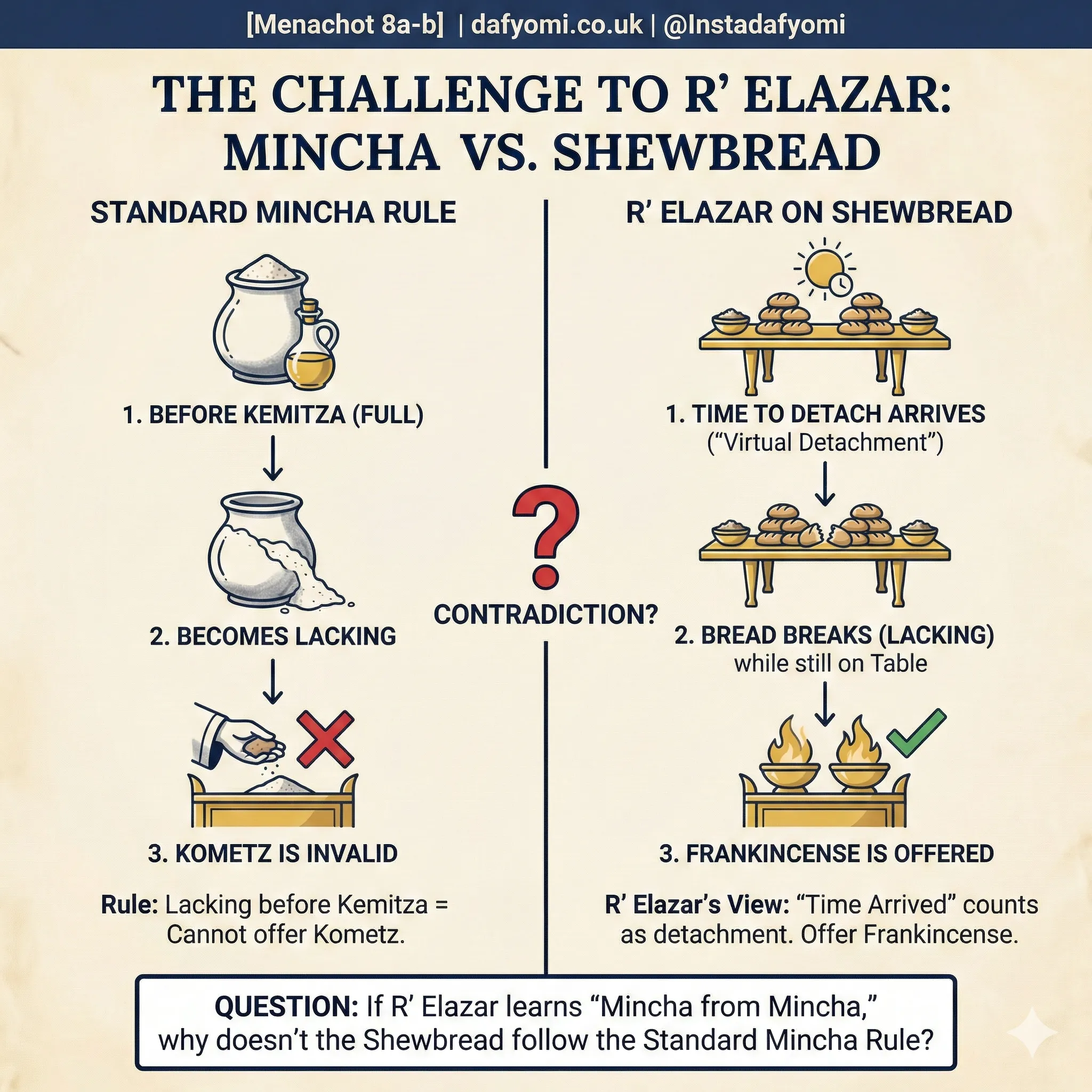
וּמִנְחָה מִמִּנְחָה מִי יָלֵיף? וְהָתַנְיָא: עַד שֶׁלֹּא פֵּרְקָהּ נִפְרַס לַחְמָהּ – הַלֶּחֶם פָּסוּל, וְאֵין מַקְטִיר עָלָיו אֶת הַבָּזִיכִין. מִשֶּׁפֵּרְקָהּ נִפְרַס לַחְמָהּ – הַלֶּחֶם פָּסוּל, וּמַקְטִיר עָלָיו אֶת הַבָּזִיכִין.
English Translation:
The Gemara asks: And does Rabbi Elazar derive the halakha of one meal offering from that of another meal offering? But isn’t it taught in a baraita: If before the priest detached the arrangement of shewbread and the bowls of frankincense from upon the Table, the bread broke into pieces, the bread is unfit for consumption and the priest does not burn the frankincense contained in the bowls on account of it. If the bread broke after the priest detached it, the bread is unfit but the priest burns the frankincense contained in the bowls on account of it.
קלאוד על הדף:
A powerful challenge: if Rabbi Elazar derives meal offerings from each other, why does the showbread have different rules for frankincense depending on timing? If the bread breaks before detachment, the frankincense isn’t burned; after detachment, it is. This seems inconsistent with cross-derivation.
Key Terms:
- פֵּרְקָהּ (perkah) = Detached it (the showbread from the Table)
- נִפְרַס לַחְמָהּ = The bread broke into pieces
Segment 4
TYPE: מימרא
Rabbi Elazar’s interpretation of “detachment”
Hebrew/Aramaic:
וְאָמַר רַבִּי אֶלְעָזָר: לֹא פֵּרְקָהּ מַמָּשׁ, אֶלָּא כֵּיוָן שֶׁהִגִּיעַ זְמַנָּהּ לְפָרֵק, אַף עַל פִּי שֶׁלֹּא פֵּרְקָהּ, כְּמִי שֶׁפֵּרְקָהּ דָּמְיָא.
English Translation:
The Gemara continues: And Rabbi Elazar says: When the baraita refers to the detachment of the shewbread, it does not mean that the priest actually detached it. Rather, it means that once the time to detach it has arrived, even though he has not yet detached it and has not removed the bowls, it is considered as though he has detached it. Accordingly, if the shewbread broke after that time, the frankincense is burned.
קלאוד על הדף:
Rabbi Elazar offers a novel interpretation: “detachment” doesn’t mean physical removal—it means the arrival of the designated time (Shabbat). Once the time arrives, the showbread is legally considered detached even if still on the Table. This explains why frankincense rules change at that moment.
Segment 5
TYPE: קושיא
Why burn frankincense if bread broke?
Hebrew/Aramaic:
וְאַמַּאי? תֶּיהְוֵי כְּמִנְחָה שֶׁחָסְרָה קוֹדֶם קְמִיצָה!
English Translation:
The Gemara explains its question: And if Rabbi Elazar derives the halakha of one meal offering from another, why does he say that frankincense contained in the bowls are burned in a case where the shewbread broke when the time to detach the bread had arrived? It should be like the case of a meal offering that became lacking in its measure before the removal of the handful. Such a handful is not removed and is not sacrificed upon the altar. Likewise, the frankincense was still on the Table when the shewbread broke and should therefore be disqualified.
קלאוד על הדף:
The Gemara presses: even granting Rabbi Elazar’s interpretation of “detachment” as the arrival of time, why is the frankincense still valid? If the bread broke at that moment, it should be like a meal offering that became lacking before kemitza—the handful (here, frankincense) should not be offered!
Segment 6
TYPE: תירוץ
Designated vs. undesignated handful
Hebrew/Aramaic:
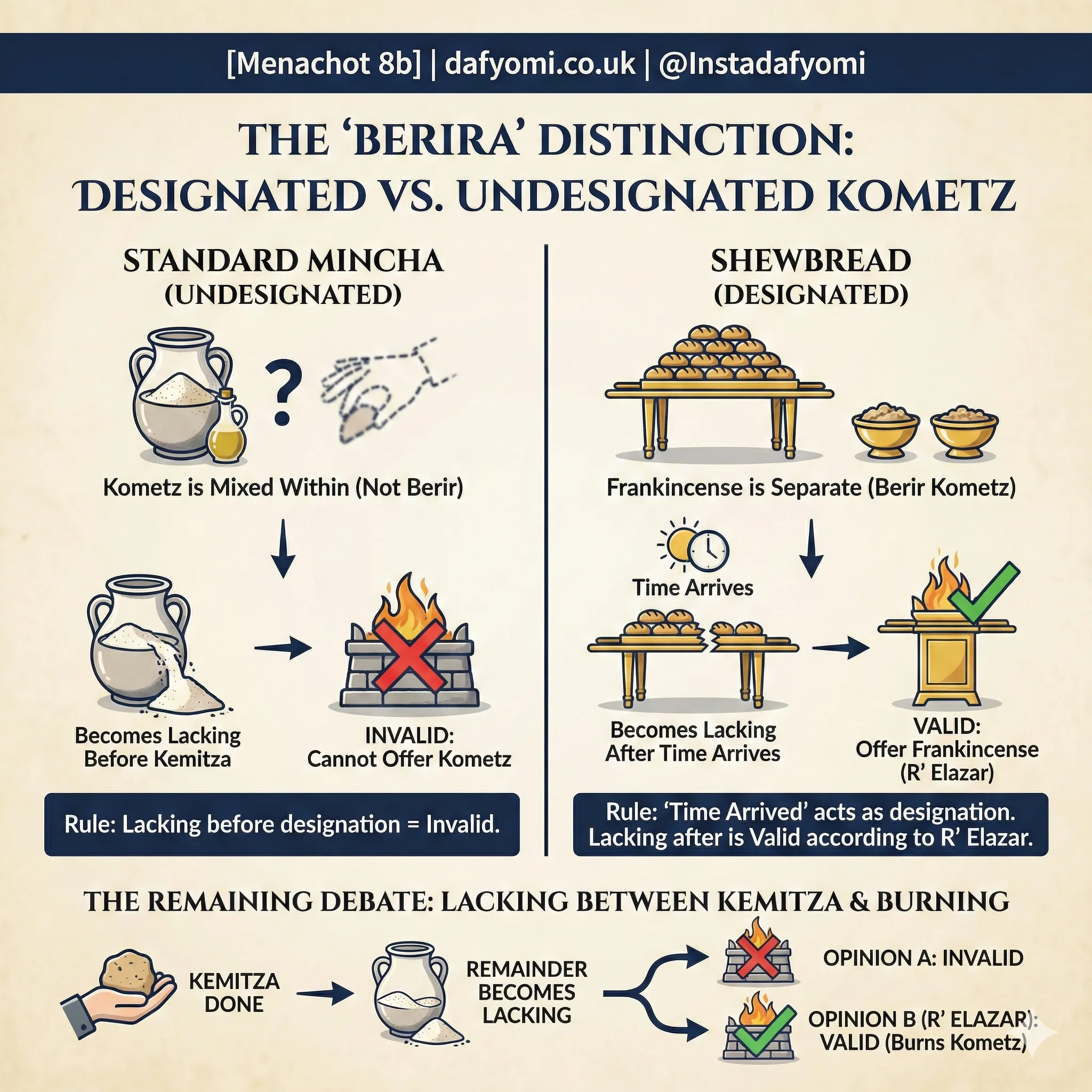
הָא לָא קַשְׁיָא, מִנְחָה לָא בְּרִיר (בְּרֵירָה) קוֹמֶץ דִּידַהּ, וְהָא בְּרִיר (בְּרֵירָה) קוֹמֶץ דִּידַהּ, וְכֵיוָן שֶׁהִגִּיעַ זְמַנָּהּ לְפָרֵק – כְּמַאן דְּפָרְקַהּ דָּמְיָא.
English Translation:
The Gemara answers: This is not difficult, as there is a difference between these meal offerings. In the case of a meal offering that became lacking before the removal of a handful, its handful was not clearly designated. Consequently, if the meal offering became lacking before a handful was removed, one may no longer remove a handful from it. But in the case of the shewbread and the bowls of frankincense, its handful, i.e., the frankincense, was clearly designated at the time when the frankincense was placed in the bowls, since the frankincense is in a separate container from the bread. And therefore, once the time to detach the bread has arrived, it is considered as though he has detached it.
קלאוד על הדף:
The distinction is crucial: regular meal offerings have no designated kometz until the priest removes it—so if the offering becomes lacking first, nothing can be done. But showbread has its “kometz” (the frankincense bowls) clearly designated from the beginning in separate vessels. Once the time arrives, the frankincense’s status is fixed regardless of what happens to the bread.
Key Terms:
- בְּרִיר קוֹמֶץ דִּידַהּ = Its handful is clearly designated
Segment 7
TYPE: קושיא ותירוץ
What about remnants becoming lacking?
Hebrew/Aramaic:
אֶלָּא מֵעַתָּה, תֶּיהְוֵי כְּשִׁירַיִם שֶׁחָסְרוּ בֵּין קְמִיצָה לְהַקְטָרָה, דְּאֵין מַקְטִירִין קוֹמֶץ עֲלֵיהֶן! לָאו פְּלוּגְתָּא נִינְהוּ? רַבִּי אֶלְעָזָר סָבַר לַהּ כְּמַאן דְּאָמַר: שִׁירַיִם שֶׁחָסְרוּ בֵּין קְמִיצָה לְהַקְטָרָה – מַקְטִיר קוֹמֶץ עֲלֵיהֶן.
English Translation:
The Gemara asks: But if that is so, then even if the time to detach the shewbread arrived, why is the frankincense burned? It should be like a case where the remainder of a meal offering became lacking between the removal of the handful and the burning upon the altar; the halakha in this case is that one does not burn the handful on account of such a meal offering. The Gemara responds: Isn’t it a dispute among the amora’im (9a) whether or not the handful is burned in such a case? One can say that Rabbi Elazar holds in accordance with the opinion of the one who says that if the remainder of a meal offering became lacking between the removal of the handful and the burning, the priest burns the handful on account of such a meal offering.
קלאוד על הדף:
Another challenge: shouldn’t broken showbread be like shirayim (remnants) that became lacking after kemitza? In that case, one shouldn’t burn the kometz! The answer: this is a dispute, and Rabbi Elazar follows the lenient view that the kometz is still burned even when remnants are lacking.
Segment 8
TYPE: גופא
Main discussion: High Priest’s griddle-cake
Hebrew/Aramaic:
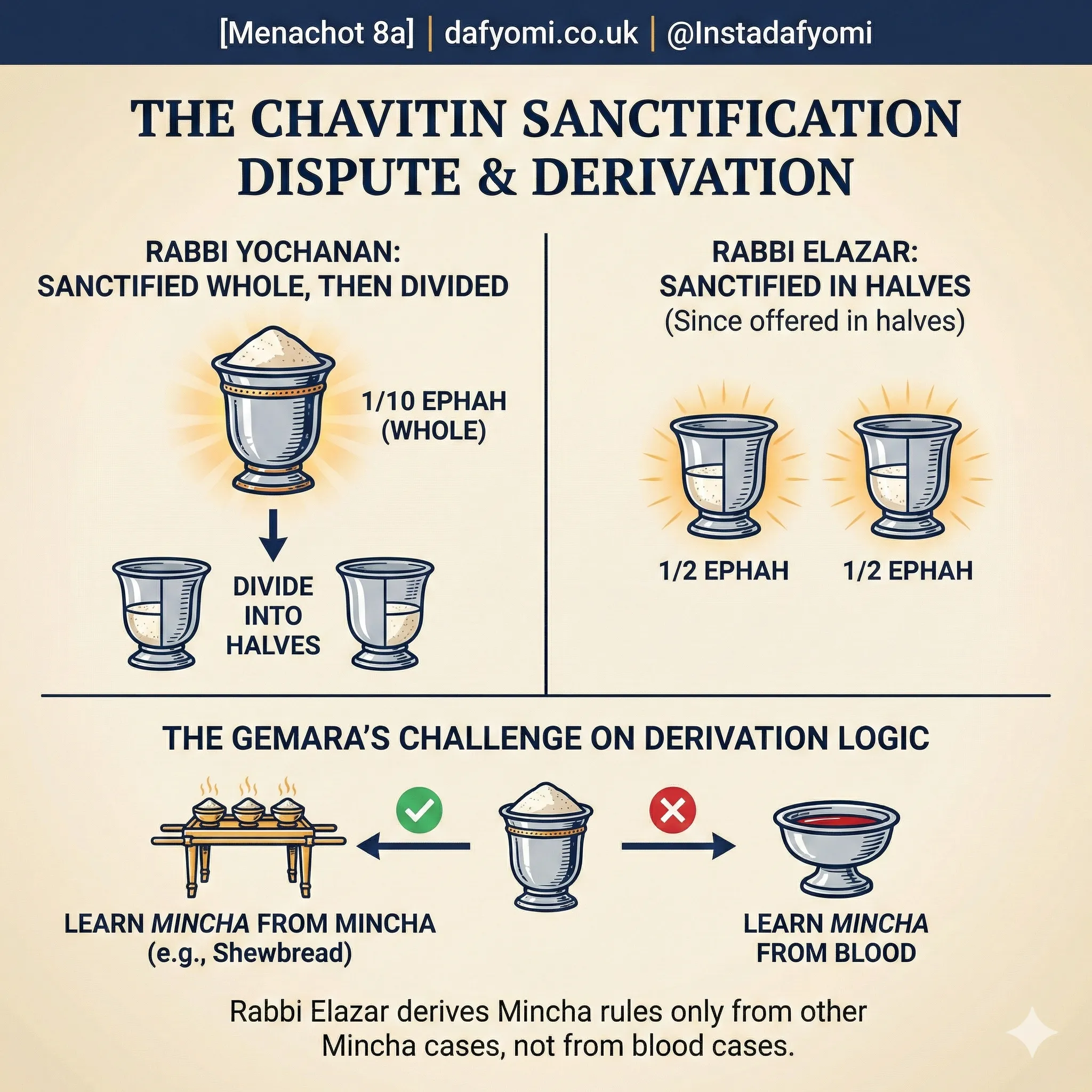
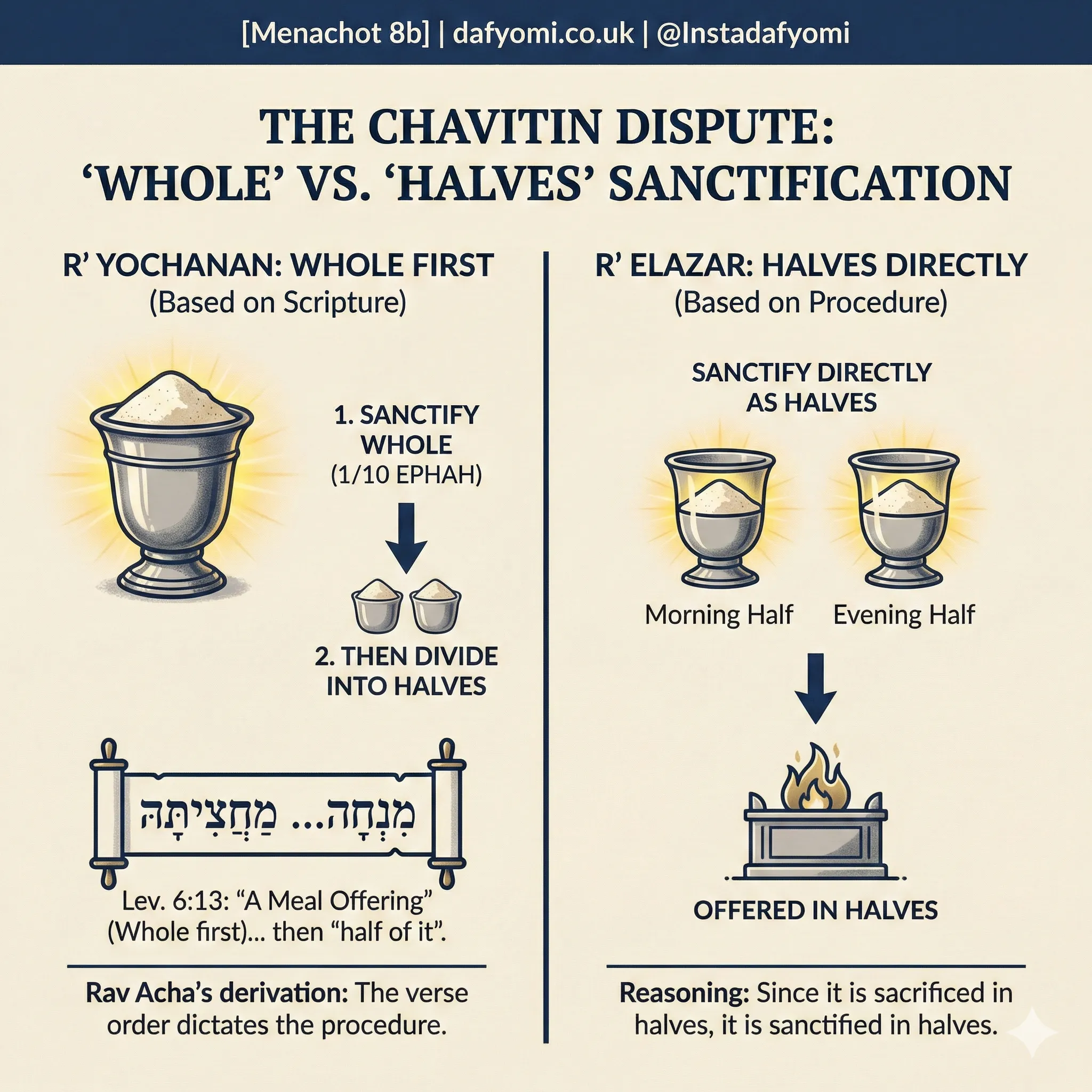
גּוּפָא: חֲבִיתֵּי כֹּהֵן גָּדוֹל, רַבִּי יוֹחָנָן אָמַר: אֵינָהּ קְדוֹשָׁה לַחֲצָאִין, וְרַבִּי אֶלְעָזָר אָמַר: מִתּוֹךְ שֶׁקְּרֵבָה לַחֲצָאִין, קְדוֹשָׁה לַחֲצָאִין. אָמַר רַבִּי אַחָא: מַאי טַעְמָא דְּרַבִּי יוֹחָנָן? אָמַר קְרָא: ״מִנְחָה מַחֲצִיתָהּ״, הָבֵיא מִנְחָה וְאַחַר כָּךְ חֳצֵיהוּ.
English Translation:
§ The Gemara discusses the matter itself: With regard to the griddle-cake offering of the High Priest, Rabbi Yoḥanan says that it is not sanctified in halves, and Rabbi Elazar says: Since it is sacrificed in halves, as half of the meal offering is sacrificed in the morning and half in the afternoon, it may likewise be sanctified in halves. Rav Aḥa said: What is the reasoning of Rabbi Yoḥanan? The verse states: “A meal offering perpetually, half of it in the morning, and half of it in the evening” (Leviticus 6:13). This means: First bring a whole meal offering, and only afterward divide it into halves.
קלאוד על הדף:
The central dispute of the daf: Can the High Priest’s daily griddle-cake be sanctified in two half-portions, or must it be sanctified whole and then divided? Rabbi Elazar says since it’s offered in halves, it can be sanctified in halves. Rabbi Yochanan disagrees based on the verse’s word order: “meal offering, half of it”—first complete, then divided.
Key Terms:
- מִנְחָה מַחֲצִיתָהּ = “A meal offering, half of it” (Leviticus 6:13)
Segment 9
TYPE: קושיא
Objection from the mishna and baraita
Hebrew/Aramaic:
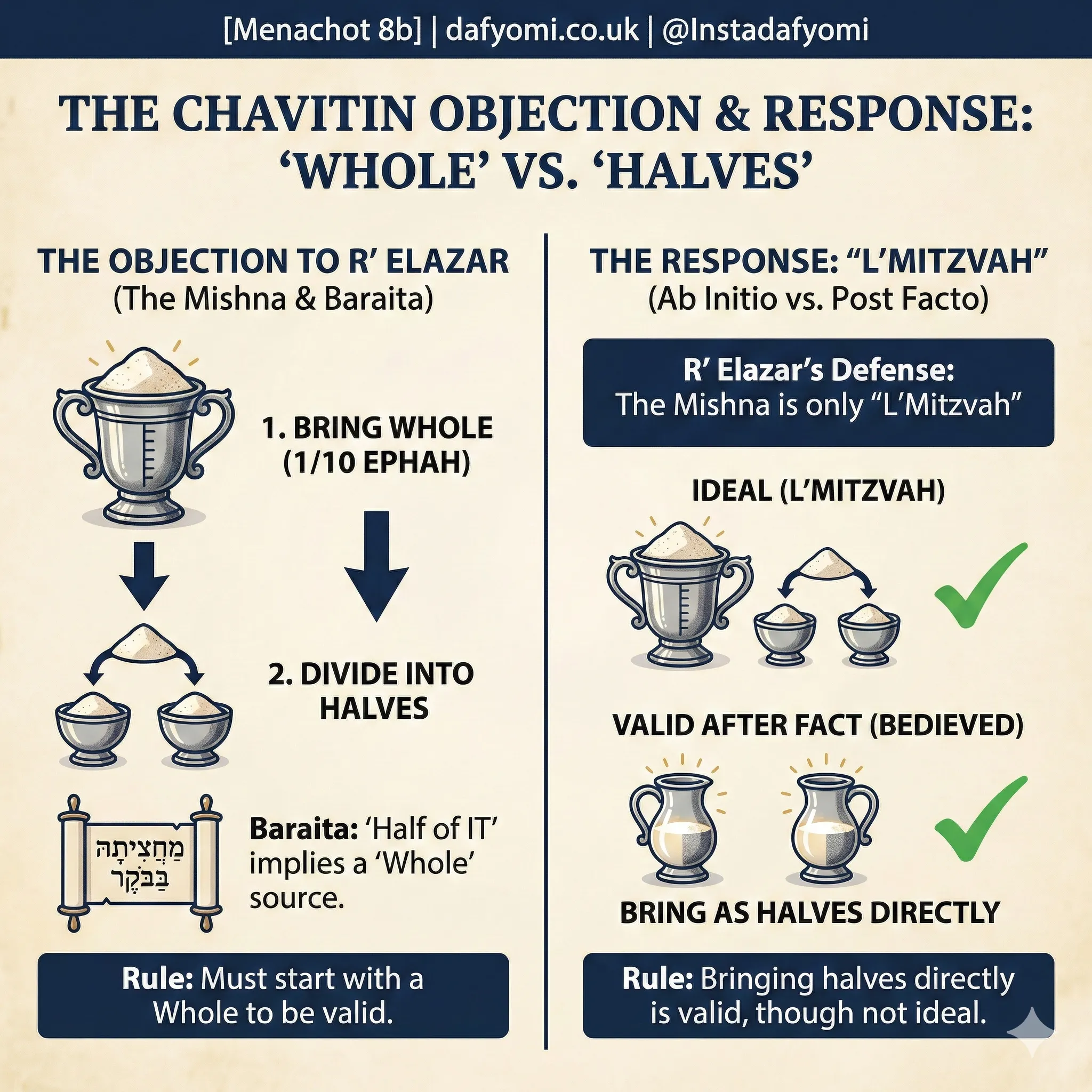
מֵיתִיבִי: חֲבִיתֵּי כֹּהֵן גָּדוֹל לֹא הָיוּ בָּאוֹת חֲצָאִין, אֶלָּא מֵבִיא עִשָּׂרוֹן שָׁלֵם וְחוֹצֵהוּ; וְתַנְיָא: אִילּוּ נֶאֱמַר ״מִנְחָה מַחֲצִית״, הָיִיתִי אוֹמֵר: מֵבִיא חֲצִי עִשָּׂרוֹן מִבֵּיתוֹ שַׁחֲרִית וּמַקְרִיב, חֲצִי עִשָּׂרוֹן מִבֵּיתוֹ עַרְבִית וּמַקְרִיב; תַּלְמוּד לוֹמַר ״מַחֲצִיתָהּ בַּבֹּקֶר״ – מֶחֱצָה מִשָּׁלֵם הוּא מֵבִיא.
English Translation:
The Gemara raises an objection to the opinion of Rabbi Elazar. The mishna teaches (50b): The griddle-cake offering of the High Priest did not come in halves. Rather, the High Priest brings a full tenth of an ephah and then divides it into two. And it is taught in a baraita with regard to this mishna: If it were stated: A meal offering, half in the morning, and half in the evening, I would say: He brings half of a tenth from his home in the morning and sacrifices it, and another half of a tenth from his home in the evening and sacrifices it. Therefore, the verse states: “Half of it in the morning,” indicating that he brings a half from a whole, and he does not bring a half by itself.
קלאוד על הדף:
The Mishna and baraita seem to support Rabbi Yochanan against Rabbi Elazar. The explicit teaching is that the offering must be brought whole and then divided—not as separate halves. The verse’s precise wording “half of it” (not just “half”) implies division from a whole.
Segment 10
TYPE: תירוץ
Resolution for Rabbi Elazar: mitzva vs. me’akev
Hebrew/Aramaic:
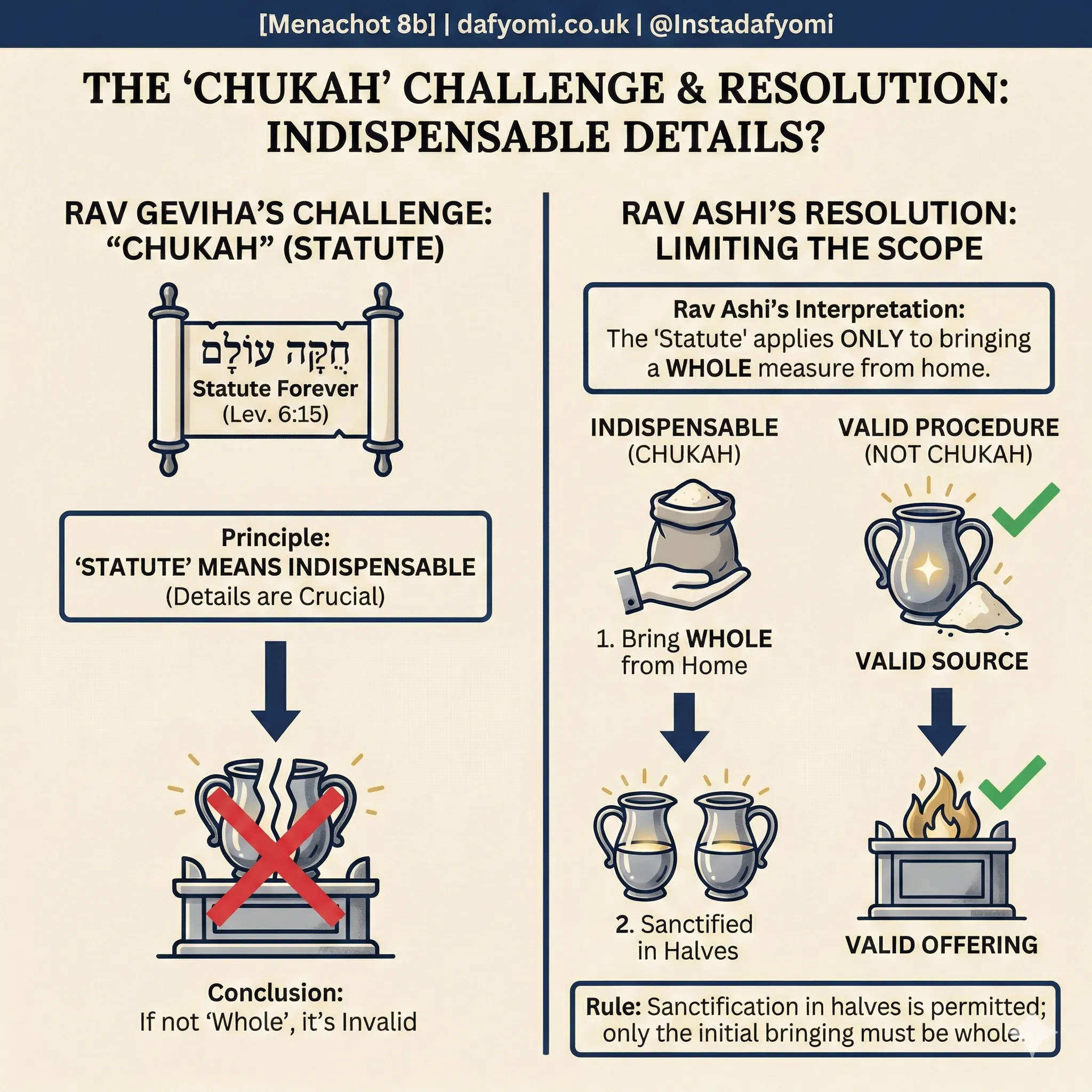
לְמִצְוָה. אֲמַר לֵיהּ רַב גְּבִיהָא מִבֵּי כְתִיל לְרַב אָשֵׁי: וְהָא ״חוּקָּה״ כְּתִיב בַּהּ, אֲמַר לֵיהּ: לֹא נִצְרְכָה אֶלָּא לַהֲבִיאָהּ שָׁלֵם מִבֵּיתוֹ.
English Translation:
The Gemara responds: Rabbi Elazar maintains that the verse requires that a whole meal offering be brought in the morning only for a mitzva, i.e., ab initio. Nevertheless, if half of a tenth was brought in the morning it is valid after the fact. Rav Geviha from Bei Katil said to Rav Ashi: But the term “statute” is written with regard to the griddle-cake offering, as the verse states: “A statute forever” (Leviticus 6:15), and there is a principle that whenever the Torah calls a mitzva a statute, the details of its performance are indispensable. Rav Ashi said to him: It was necessary for the Torah to define this mitzva as a statute only with regard to the requirement that the High Priest bring a full tenth from his home. With regard to its sanctification in a service vessel, it can be sanctified in halves.
קלאוד על הדף:
Rabbi Elazar’s defense: bringing it whole is the ideal (mitzva lechatchila), but not absolutely required. After the fact, separate halves would work. The word “statute” in the verse refers to bringing from home whole, not to the sanctification process itself.
Key Terms:
- חוּקָּה (chuka) = Statute, fixed law
- לְמִצְוָה = For the mitzva (preferred, not mandatory)
Segment 11
TYPE: קושיא
Challenge to Rabbi Yochanan from half-tenth with intent to add
Hebrew/Aramaic:
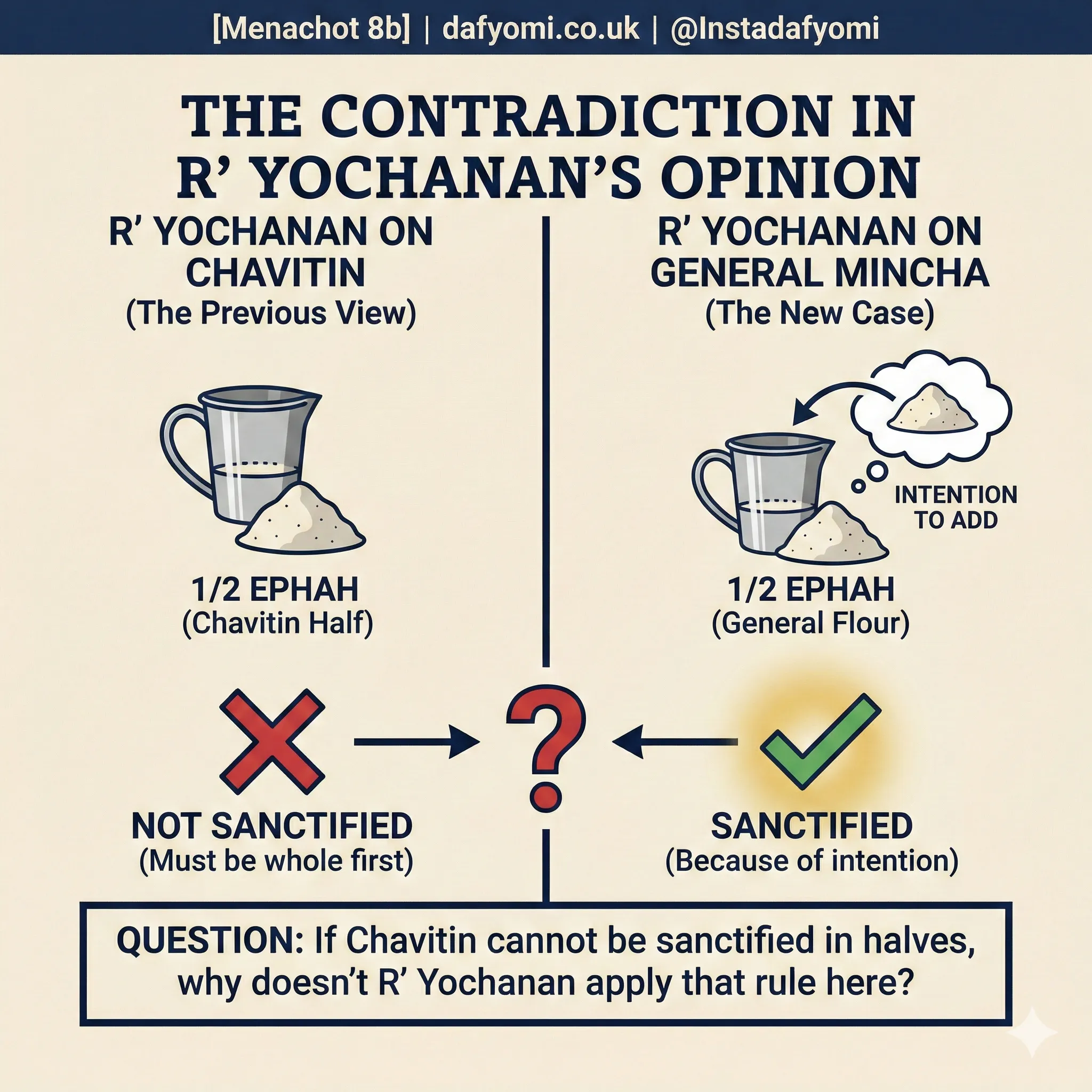
וּמִי אָמַר רַבִּי יוֹחָנָן הָכִי? וְהָא אִיתְּמַר: הִפְרִישׁ חֲצִי עִשָּׂרוֹן, וְדַעְתּוֹ לְהוֹסִיף – רַב אָמַר: אֵינוֹ קָדוֹשׁ, וְרַבִּי יוֹחָנָן אָמַר: קָדוֹשׁ. וְאִם אִיתָא, לֵילַף מֵחֲבִיתִּין!
English Translation:
The Gemara asks: And did Rabbi Yoḥanan really say this? But it was stated: If one set aside half a tenth of an ephah for any meal offering, and his intention was to add to the half in order to reach a full tenth, Rav says that it is not sanctified, as he did not bring a full tenth, and Rabbi Yoḥanan says that it is sanctified. And if it is so that Rabbi Yoḥanan holds that the griddle-cake offering cannot be sanctified in halves, let him derive from the griddle-cake offering that no meal offering may be sanctified in halves.
קלאוד על הדף:
Apparent contradiction in Rabbi Yochanan: he says the griddle-cake isn’t sanctified in halves, but elsewhere he says a half-tenth with intent to add IS sanctified! If he derives between meal offerings, he should rule strictly on both.
Segment 12
TYPE: קושיא
Does Rabbi Yochanan derive from one matter to another?
Hebrew/Aramaic:
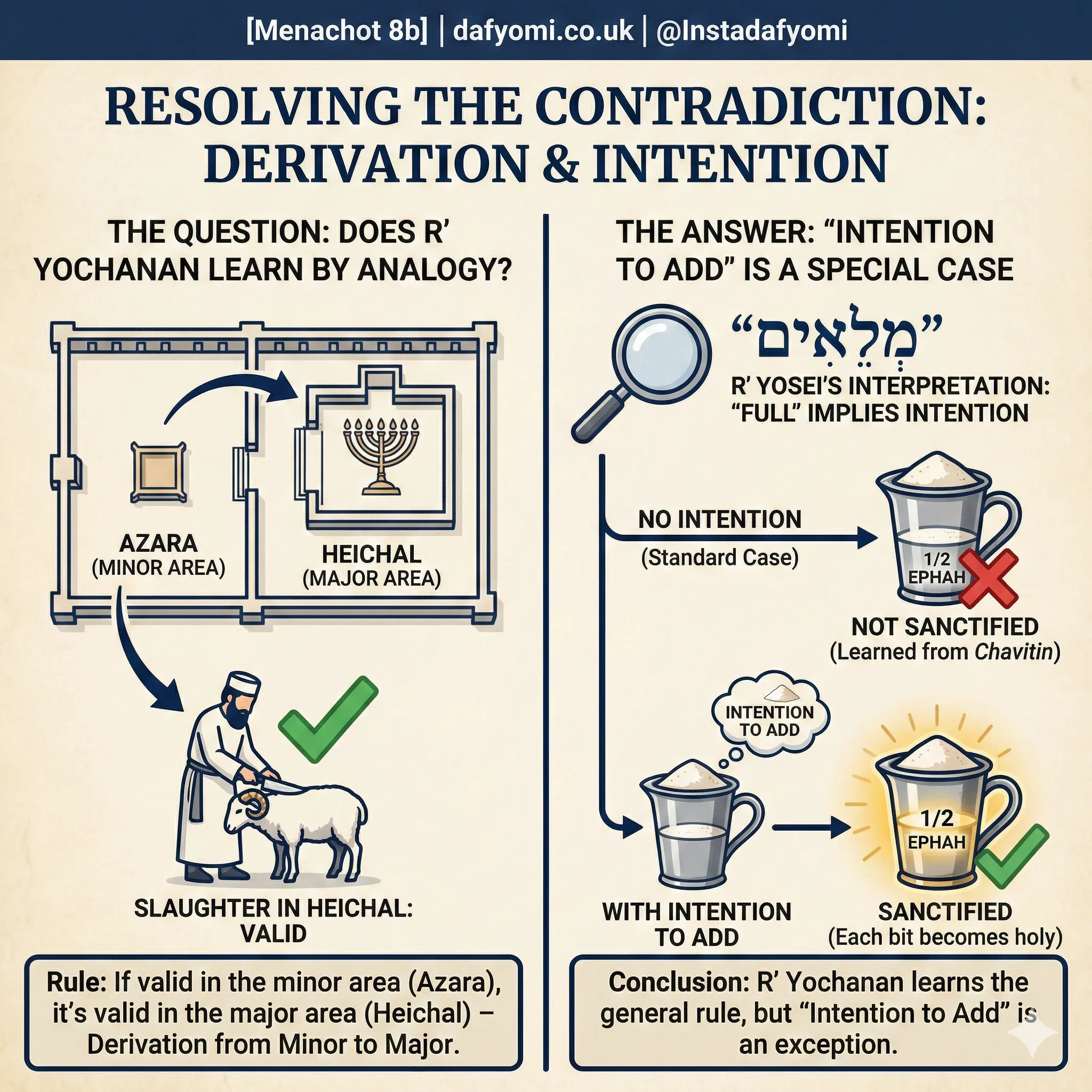
וְכִי תֵּימָא, רַבִּי יוֹחָנָן מִילְּתָא מִמִּילְּתָא לָא יָלֵיף, וְהָאָמַר רַבִּי יוֹחָנָן: שְׁלָמִים שֶׁשְּׁחָטָן בַּהֵיכָל כְּשֵׁירִין, דִּכְתִיב: ״וּשְׁחָטוֹ פֶּתַח אֹהֶל מוֹעֵד״, שֶׁלֹּא יְהֵא טָפֵל חָמוּר מֵעִיקָּר.
English Translation:
And if you would say that Rabbi Yoḥanan does not derive the halakha of one matter with regard to consecrated items from that of another matter, that is difficult: But doesn’t Rabbi Yoḥanan say: Peace offerings that were slaughtered in the Sanctuary are valid, as it is written: “And slaughter it at the entrance of the Tent of Meeting” (Leviticus 3:2), i.e., in the courtyard. Rabbi Yoḥanan explains: It is logical that the halakha with regard to the minor area, i.e., the courtyard, should not be more stringent than the halakha with regard to the major area, the Tent of Meeting. Evidently, Rabbi Yoḥanan derives a halakha with regard to the Sanctuary from the Temple courtyard.
קלאוד על הדף:
The Gemara deepens the challenge: perhaps Rabbi Yochanan simply doesn’t derive between different areas of Temple law? But that can’t be—he himself teaches that peace offerings slaughtered in the Sanctuary are valid based on the logic that the “secondary” (courtyard) shouldn’t be stricter than the “primary” (Sanctuary). So he does derive across matters!
Segment 13
TYPE: תירוץ
Resolution: intent to add is different
Hebrew/Aramaic:
דַּעְתּוֹ לְהוֹסִיף שָׁאנֵי, דְּתַנְיָא: ״מְלֵאִים״ – אֵין ״מְלֵאִים״ אֶלָּא שְׁלֵמִים (כְּלוֹמַר שֶׁאֵינוֹ קָדוֹשׁ עַד שֶׁיְּהֵא עִשָּׂרוֹן שָׁלֵם), וְאָמַר רַבִּי יוֹסֵי: אֵימָתַי? בִּזְמַן שֶׁאֵין דַּעְתּוֹ לְהוֹסִיף, אֲבָל בִּזְמַן שֶׁדַּעְתּוֹ לְהוֹסִיף – רִאשׁוֹן רִאשׁוֹן קָדוֹשׁ.
English Translation:
The Gemara responds: Rabbi Yoḥanan does in fact derive the halakha of one matter from another, and therefore he learns the halakha with regard to all meal offerings from the griddle-cake offering, that in general they are not sanctified in halves. But a case where one expresses his intention to add to the half measure is different, as it is taught in a baraita with regard to the verse: “Both of them full of fine flour” (Numbers 7:13). “Full” is a reference only to full measurements; that is to say, the flour is not sanctified until there is a full tenth inside the vessel. And Rabbi Yosei said: When is it the halakha that the flour is sanctified only if a full tenth is inside the vessel? It is at a time when his intention was not initially to add to that which he placed inside the vessel. But at a time when his intention was initially to add, each initial bit of flour is sanctified by the vessel.
קלאוד על הדף:
Key distinction: intent matters! The verse “full” requires complete measures—but Rabbi Yosei teaches this only applies when one doesn’t intend to add more. If someone puts in half with explicit intent to complete it, each portion is sanctified incrementally. The griddle-cake is different—there’s no intent to add, since by design it must come from one complete tenth.
Key Terms:
- דַּעְתּוֹ לְהוֹסִיף = His intent was to add
- מְלֵאִים = “Full” (Numbers 7:13)
Segment 14
TYPE: קושיא
What does Rav hold about chavitin?
Hebrew/Aramaic:
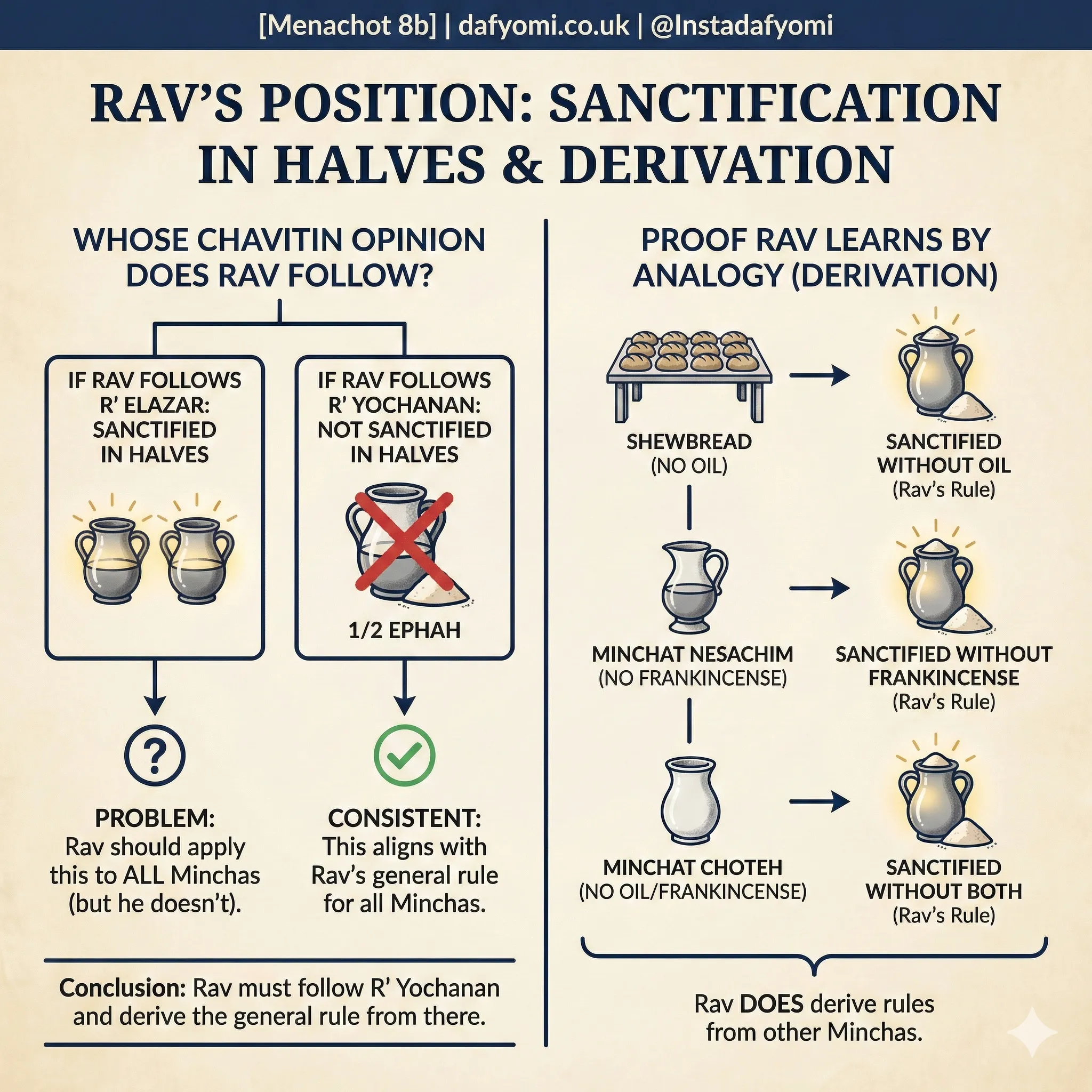
וְרַב, בְּחָבִיתִין כְּמַאן סְבִירָא לֵיהּ? אִי כְּרַבִּי אֶלְעָזָר, לֵילַף מֵחֲבִיתִּין!
English Translation:
The Gemara asks: And Rav, who holds that standard meal offerings are not sanctified in halves even if one’s initial intention was to add to the half measure, with regard to a griddle-cake offering, in accordance with whose opinion does he hold? If he holds in accordance with the opinion of Rabbi Elazar, who says that a griddle-cake offering can be sanctified in halves, then let him derive from the halakha of griddle-cake offerings that all meal offerings may be sanctified in halves.
קלאוד על הדף:
The Gemara turns to Rav’s position. Rav ruled strictly that a half-tenth is not sanctified even with intent to add. But whose view does he follow on the griddle-cake? If he holds like Rabbi Elazar (griddle-cake can be in halves), why doesn’t he apply that leniency to regular meal offerings?
Segment 15
TYPE: קושיא
Does Rav derive from one matter to another?
Hebrew/Aramaic:
וְכִי תֵּימָא רַב מִילְּתָא מִמִּילְּתָא לָא יָלֵיף, וְהָאָמַר רַב: מִנְחָה קְדוֹשָׁה בְּלֹא שֶׁמֶן (וּבְלֹא לְבוֹנָה) – שֶׁכֵּן מָצִינוּ בְּלֶחֶם הַפָּנִים. בְּלֹא לְבוֹנָה – שֶׁכֵּן מָצִינוּ בְּמִנְחַת נְסָכִים.
English Translation:
And if you would say that Rav does not derive the halakha of one matter from that of another matter, that is difficult: But doesn’t Rav say: A standard meal offering, which is brought with oil and frankincense, is sanctified by a service vessel even without its oil and without its frankincense. It is sanctified without its oil, as we find such a halakha with regard to the shewbread, which is sacrificed without oil and is nevertheless sanctified by a service vessel. Similarly, it is sanctified even without its frankincense, as we find such a halakha with regard to the meal offering accompanying the libations of an offering, which is sacrificed without frankincense and is nevertheless sanctified by a service vessel.
קלאוד על הדף:
Perhaps Rav doesn’t derive between different meal offerings? But the Gemara proves he does! Rav teaches that a meal offering is sanctified without oil (based on showbread) and without frankincense (based on libation offerings). He clearly derives across different types of meal offerings.
Segment 16
TYPE: מסקנה
Rav must hold like Rabbi Yochanan on chavitin
Hebrew/Aramaic:
בְּלֹא שֶׁמֶן וּבְלֹא לְבוֹנָה – שֶׁכֵּן מָצִינוּ בְּמִנְחַת חוֹטֵא, עַל כׇּרְחָיךְ רַב כְּרַבִּי יוֹחָנָן סְבִירָא לֵיהּ.
English Translation:
Finally, a standard meal offering is sanctified by a service vessel even without its oil and without its frankincense, as we find with regard to the meal offering of a sinner, which includes neither of these. This indicates that Rav does derive the halakha of a meal offering from other meal offerings. Rather, perforce, with regard to the griddle-cake offering, Rav holds in accordance with the opinion of Rabbi Yoḥanan, that this offering is not sanctified in halves, and it is derived from there that no meal offerings are sanctified in halves.
קלאוד על הדף:
The conclusion: since Rav clearly derives between meal offerings (as proven by his teaching about sanctification without components), he must hold like Rabbi Yochanan that the griddle-cake cannot be sanctified in halves. This is why Rav rules that even with intent to add, a half-tenth isn’t sanctified.
Key Terms:
- מִנְחַת חוֹטֵא = The sinner’s meal offering (flour only, no oil or frankincense)
Segment 17
TYPE: גופא
Rav’s comprehensive ruling on independent sanctification
Hebrew/Aramaic:
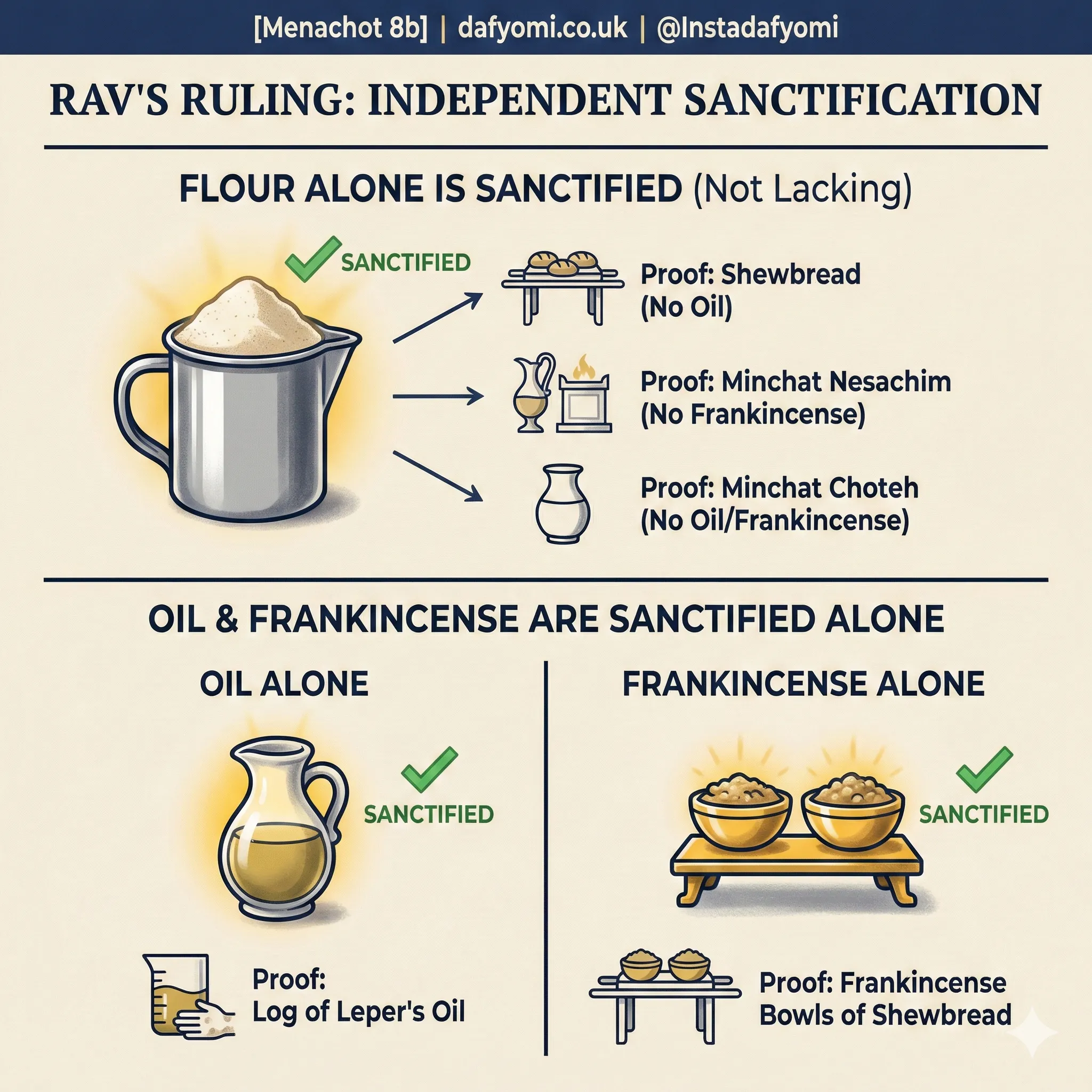
גּוּפָא, אָמַר רַב: מִנְחָה קְדוֹשָׁה בְּלֹא שֶׁמֶן, וְאֵין דִּינָה כְּעִשָּׂרוֹן חָסֵר – שֶׁכֵּן מָצִינוּ בְּלֶחֶם הַפָּנִים. בְּלֹא לְבוֹנָה – שֶׁכֵּן מָצִינוּ בְּמִנְחַת נְסָכִים. בְּלֹא שֶׁמֶן וּבְלֹא לְבוֹנָה – שֶׁכֵּן מָצִינוּ בְּמִנְחַת חוֹטֵא.
English Translation:
§ The Gemara discusses the matter itself: Rav says that a meal offering is sanctified without its oil, and its halakha is not the same as when a tenth of an ephah of flour is lacking, as we find such a halakha with regard to the shewbread, which is sacrificed without oil and is nevertheless sanctified by a service vessel. Similarly, it is sanctified even without its frankincense, as we find such a halakha with regard to the meal offering accompanying the libations of an offering, which is sacrificed without frankincense and is nevertheless sanctified. Additionally, a meal offering is sanctified even without its oil and without its frankincense, as we find such a halakha with regard to the meal offering of a sinner, which lacks both oil and frankincense and is nevertheless sanctified by a service vessel.
קלאוד על הדף:
Rav establishes an important principle: a meal offering’s components (flour, oil, frankincense) can be sanctified independently. He proves this from three precedents: showbread (flour without oil), libation meal offering (flour without frankincense), and sinner’s meal offering (flour with neither). The components don’t all need to be together for sanctification.
Segment 18
TYPE: מימרא
Oil and frankincense sanctified independently; Rabbi Chanina disagrees
Hebrew/Aramaic:
וְשֶׁמֶן וּלְבוֹנָה קׇדְשִׁי הַאי בְּלָא הַאי וְהַאי בְּלָא הַאי; שֶׁמֶן – שֶׁכֵּן מָצִינוּ בְּלוֹג שֶׁמֶן שֶׁל מְצוֹרָע, לְבוֹנָה – שֶׁכֵּן מָצִינוּ בִּלְבוֹנָה הַבָּאָה בְּבָזִיכִין, וְרַבִּי חֲנִינָא אָמַר:
English Translation:
Rav continues: And oil and frankincense are each sanctified by service vessels, this substance without that one, and that substance without this one. Oil is sanctified on its own, as we find such a halakha with regard to the log of oil of a leper, which is sanctified on its own. Frankincense is sanctified on its own, as we find such a halakha with regard to the frankincense that comes in the bowls that are brought with the shewbread; there is no oil in that case and yet the frankincense is sanctified in the bowls. And Rabbi Ḥanina says:
קלאוד על הדף:
Rav continues: even oil and frankincense can be sanctified independently of each other. Oil alone is sanctified for the leper’s purification. Frankincense alone is sanctified for the showbread. Each component has independent sanctity. The segment ends with Rabbi Chanina beginning to disagree—his full statement continues on 8b.
Key Terms:
- לוֹג שֶׁמֶן שֶׁל מְצוֹרָע = The log of oil of the leper
Amud Bet (8b)
Segment 1
TYPE: מימרא
Rabbi Chanina’s dissenting view
Hebrew/Aramaic:
לֹא זוֹ קְדוֹשָׁה בְּלֹא זוֹ וְלֹא זוֹ קְדוֹשָׁה בְּלֹא זוֹ.
English Translation:
Neither is this substance sanctified without that, nor is that sanctified without this. Rather, any meal offering that requires oil and frankincense is sanctified by a service vessel only when the flour, oil, and frankincense are all placed in the same vessel at the same time.
קלאוד על הדף:
Rabbi Chanina disagrees fundamentally: the components of a meal offering are interdependent. Flour isn’t sanctified without oil, oil isn’t sanctified without flour, and neither is sanctified without frankincense (where required). They must all be together for sanctification to take effect.
Segment 2
TYPE: קושיא ותירוץ
Why was the tenth-ephah measure anointed?
Hebrew/Aramaic:
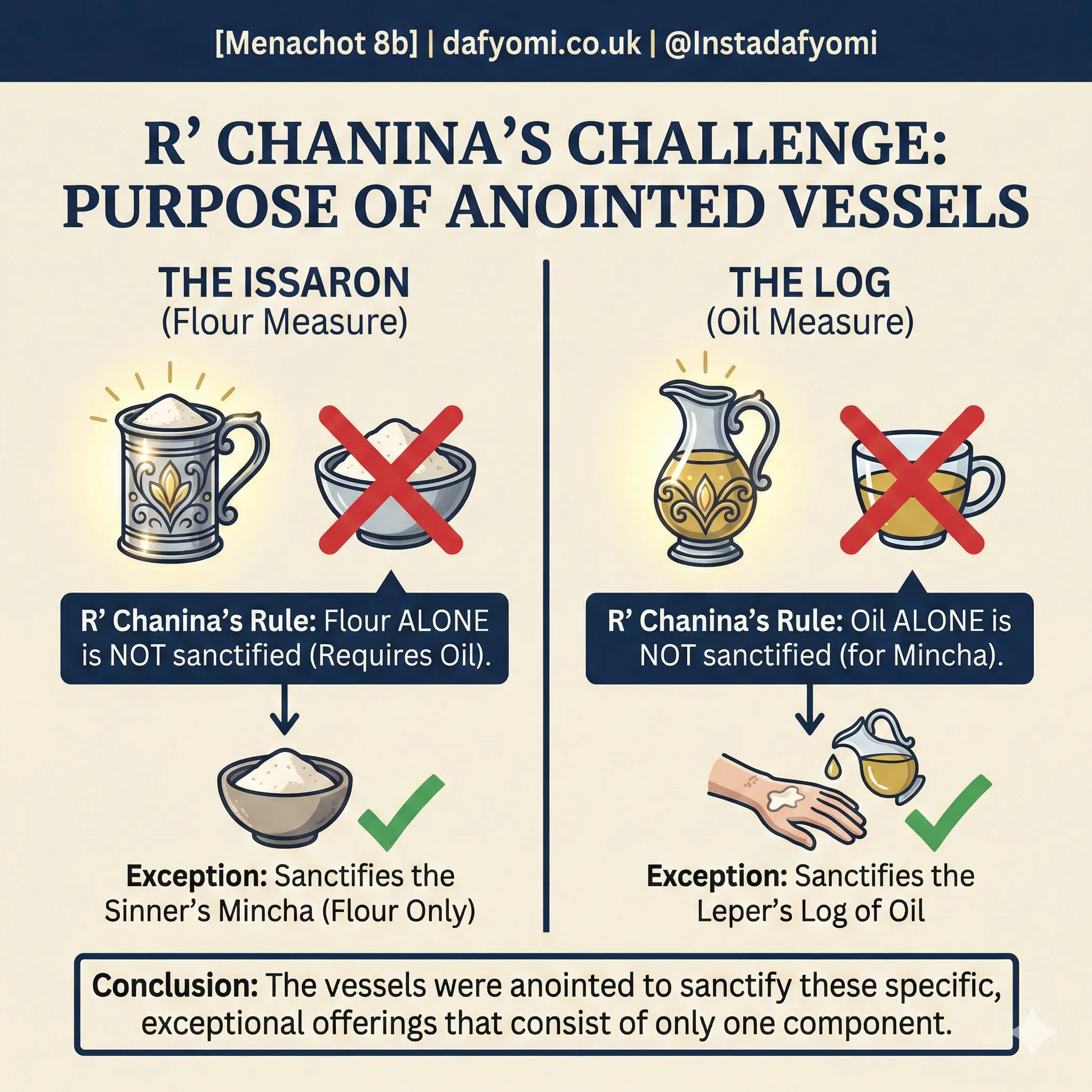
וּלְרַבִּי חֲנִינָא, עִשָּׂרוֹן לָמָּה נִמְשַׁח? (וַהֲלֹא אֵינוֹ עָשׂוּי אֶלָּא לִמְדִידַת קֶמַח בִּלְבַד, וְהַקֶּמַח אֵינוֹ קָדוֹשׁ בְּלֹא שֶׁמֶן!) לְמִנְחַת חוֹטֵא.
English Translation:
The Gemara asks: And according to the opinion of Rabbi Ḥanina, for what purpose was the vessel that measured a tenth of an ephah anointed, making it possible for it to sanctify items placed inside it? This vessel was fashioned only for measuring flour, and according to Rabbi Ḥanina the flour is not sanctified without oil. What then does this vessel sanctify? The Gemara answers: The vessel was anointed for the purpose of sanctifying the meal offering of a sinner, which contains neither oil nor frankincense.
קלאוד על הדף:
If components must be together, why anoint the tenth-ephah measuring vessel separately? The Gemara answers: it was needed for the sinner’s meal offering (flour only). This is a special case that doesn’t disprove Rabbi Chanina’s general rule about standard meal offerings.
Key Terms:
- עִשָּׂרוֹן = Tenth of an ephah (dry measure)
Segment 3
TYPE: קושיא ותירוץ
Why was the log measure anointed?
Hebrew/Aramaic:
וְלוֹג, לָמָּה נִמְשַׁח? לְלוֹג שֶׁל מְצוֹרָע.
English Translation:
The Gemara further asks: And for what purpose was the vessel that measured one log of oil anointed? After all, according to Rabbi Ḥanina oil for a meal offering cannot be sanctified by itself. The Gemara explains: It was anointed for the purpose of sanctifying the log of oil of a leper, which is not brought as part of a meal offering. This oil is sanctified without flour or frankincense.
קלאוד על הדף:
Similarly, the log measure was needed for the leper’s oil, which stands alone. These exceptions don’t disprove Rabbi Chanina’s rule—they’re special cases where only one component is required.
Key Terms:
- לוֹג = Log (liquid measure, about 300ml)
Segment 4
TYPE: ראיה
Shmuel agrees with Rav
Hebrew/Aramaic:
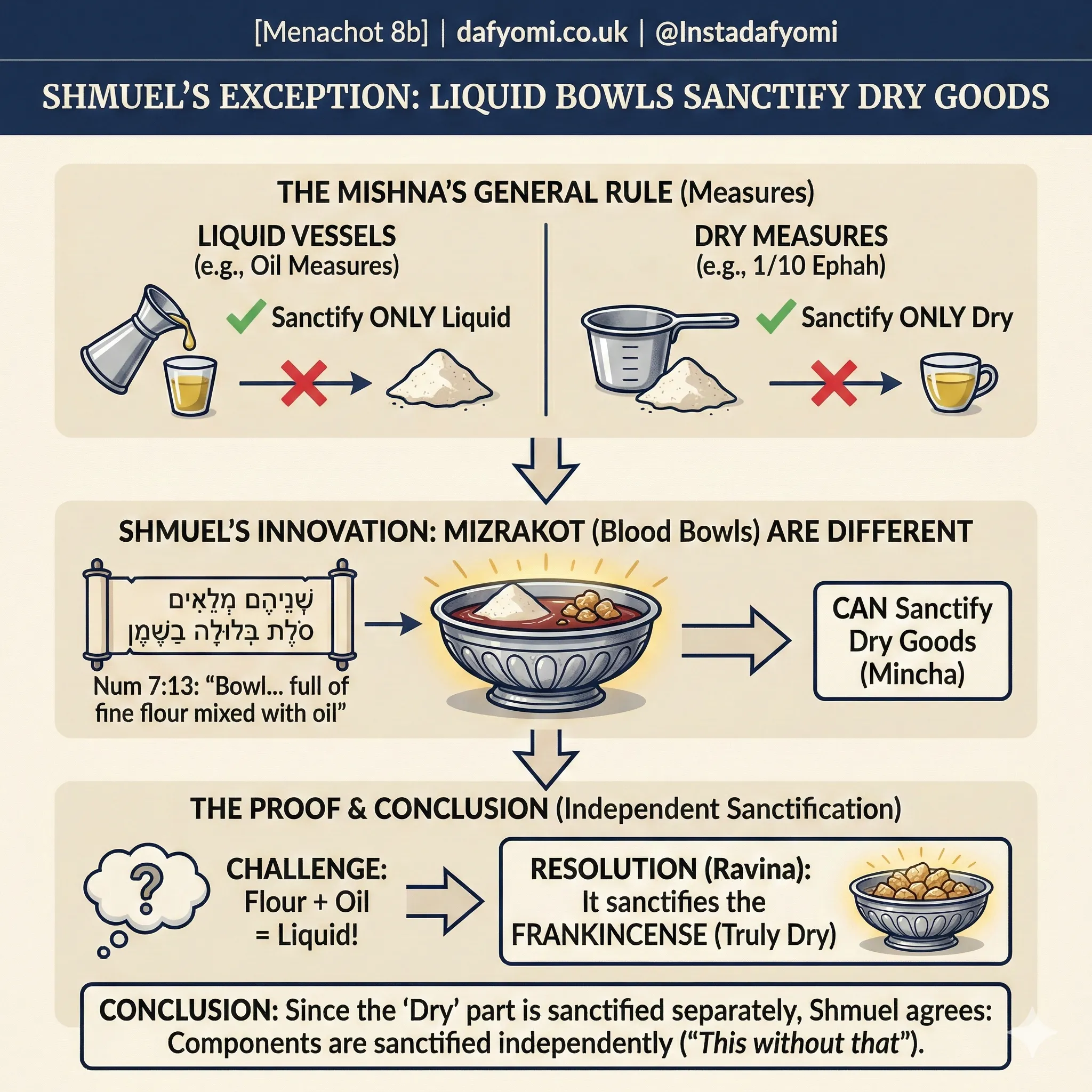
וְאַף שְׁמוּאֵל סָבַר לַהּ לְהָא דְּרַב, דִּתְנַן: כְּלֵי הַלַּח מְקַדְּשִׁין אֶת הַלַּח, וּמִדּוֹת הַיָּבֵשׁ מְקַדְּשִׁין אֶת הַיָּבֵשׁ, וְאֵין כְּלֵי הַלַּח מְקַדְּשִׁין אֶת הַיָּבֵשׁ, וְלֹא מִדּוֹת הַיָּבֵשׁ מְקַדְּשִׁין אֶת הַלַּח.
English Translation:
The Gemara notes: And Shmuel also holds in accordance with this statement of Rav, that a service vessel sanctifies the flour of a meal offering even without its oil, as we learned in a mishna (Zevaḥim 88a): The vessels used for liquids sanctify only the liquids, and the vessels that serve as dry measures sanctify only the dry goods. But the vessels used for liquids do not sanctify the dry goods, and the vessels that serve as dry measures do not sanctify the liquids.
קלאוד על הדף:
The Gemara brings support for Rav from Shmuel’s interpretation of a Mishna. The Mishna distinguishes between wet and dry vessels—each only sanctifies its matching type.
Key Terms:
- כְּלֵי הַלַּח = Vessels for liquids
- מִדּוֹת הַיָּבֵשׁ = Dry measuring vessels
Segment 5
TYPE: מימרא
Shmuel’s clarification: bowls sanctify dry goods
Hebrew/Aramaic:
וְאָמַר שְׁמוּאֵל: לֹא שָׁנוּ אֶלָּא מִדּוֹת, אֲבָל מִזְרָקוֹת (שֶׁל דָּם) מְקַדְּשׁוֹת אֶת הַיָּבֵשׁ, שֶׁנֶּאֱמַר: ״שְׁנֵיהֶם מְלֵאִים סֹלֶת בְּלוּלָה בַשֶּׁמֶן לְמִנְחָה״.
English Translation:
And Shmuel says with regard to this mishna: They taught that vessels used for liquids do not sanctify dry goods only with regard to vessels used as measures. But bowls that are used for collecting and tossing the blood of offerings sanctify the dry goods as well, as it is stated with regard to the offerings of the princes brought during the inauguration of the Tabernacle: “Both of them full of fine flour mixed with oil for a meal offering” (Numbers 7:13), which indicates that the bowl sanctifies meal offerings, which are dry.
קלאוד על הדף:
Shmuel clarifies: the Mishna’s limitation only applies to measuring vessels. Blood bowls (mizrakot) can sanctify even dry goods like flour, as proven from the princes’ offerings at the Tabernacle inauguration. The verse shows bowls being used for meal offerings.
Key Terms:
- מִזְרָקוֹת = Blood bowls/basins
Segment 6
TYPE: קושיא ותירוץ
Meal offering is wet, not dry!
Hebrew/Aramaic:
אֲמַר לֵיהּ רַב אַחָא מִדִּפְתִּי לְרָבִינָא: מִנְחָה לַחָה הִיא! אֲמַר לֵיהּ: לֹא נִצְרְכָא אֶלָּא לַיָּבֵשׁ שֶׁבָּהּ, דְּהַיְינוּ לְבוֹנָה.
English Translation:
The Gemara continues its proof: And Rav Aḥa of Difti said to Ravina, with regard to this derivation of Shmuel: But the meal offering of the verse is also considered a liquid, as it is mingled with oil. How then can one derive from it the halakha with regard to items that are entirely dry? Ravina said to him: The verse cited by Shmuel is necessary only to teach that the dry part of a meal offering, that is, the frankincense, which invariably does not come into contact with the oil, is sanctified by the bowls as well.
קלאוד על הדף:
Sharp objection: meal offerings mixed with oil are wet—why use them as proof for dry goods? The answer: the verse teaches about frankincense, which is dry and sits on top of the wet flour. The bowl sanctifies even the dry frankincense.
Segment 7
TYPE: ראיה
Proof that Shmuel holds components sanctified independently
Hebrew/Aramaic:
(וְאִי סָלְקָא דַעְתָּךְ קָסָבַר שְׁמוּאֵל: אֵין מִנְחָה קְדוֹשָׁה עַד שֶׁיְּהוּ כּוּלָּן, יָבֵשׁ שֶׁבָּהּ הֵיכִי מַשְׁכַּחַתְּ לַהּ? וַהֲלֹא כּוּלָּן לַחִים הֵן מִפְּנֵי הַשֶּׁמֶן! אֶלָּא שְׁמַע מִינַּהּ קָסָבַר שְׁמוּאֵל: הַאי בְּלֹא הַאי.)
English Translation:
The Gemara concludes its proof with regard to Shmuel’s opinion: And if it enters your mind that Shmuel holds that a meal offering is not sanctified by a service vessel until all of its components are together in the vessel, then how can you find a case where the dry parts of a meal offering are by themselves? Is it not correct that when meal offerings are sanctified, all of them are liquids, due to the oil that is mixed with them? Rather, conclude from here that Shmuel holds that this substance may be sanctified without that one.
קלאוד על הדף:
The proof is complete: if Shmuel required all components together, there would never be a “dry part” to discuss—everything would be mixed with oil. The fact that Shmuel discusses sanctifying the dry frankincense separately proves he holds like Rav: components can be sanctified independently.
Segment 8
TYPE: תירוץ אחר
Alternative answer: relative dryness
Hebrew/Aramaic:
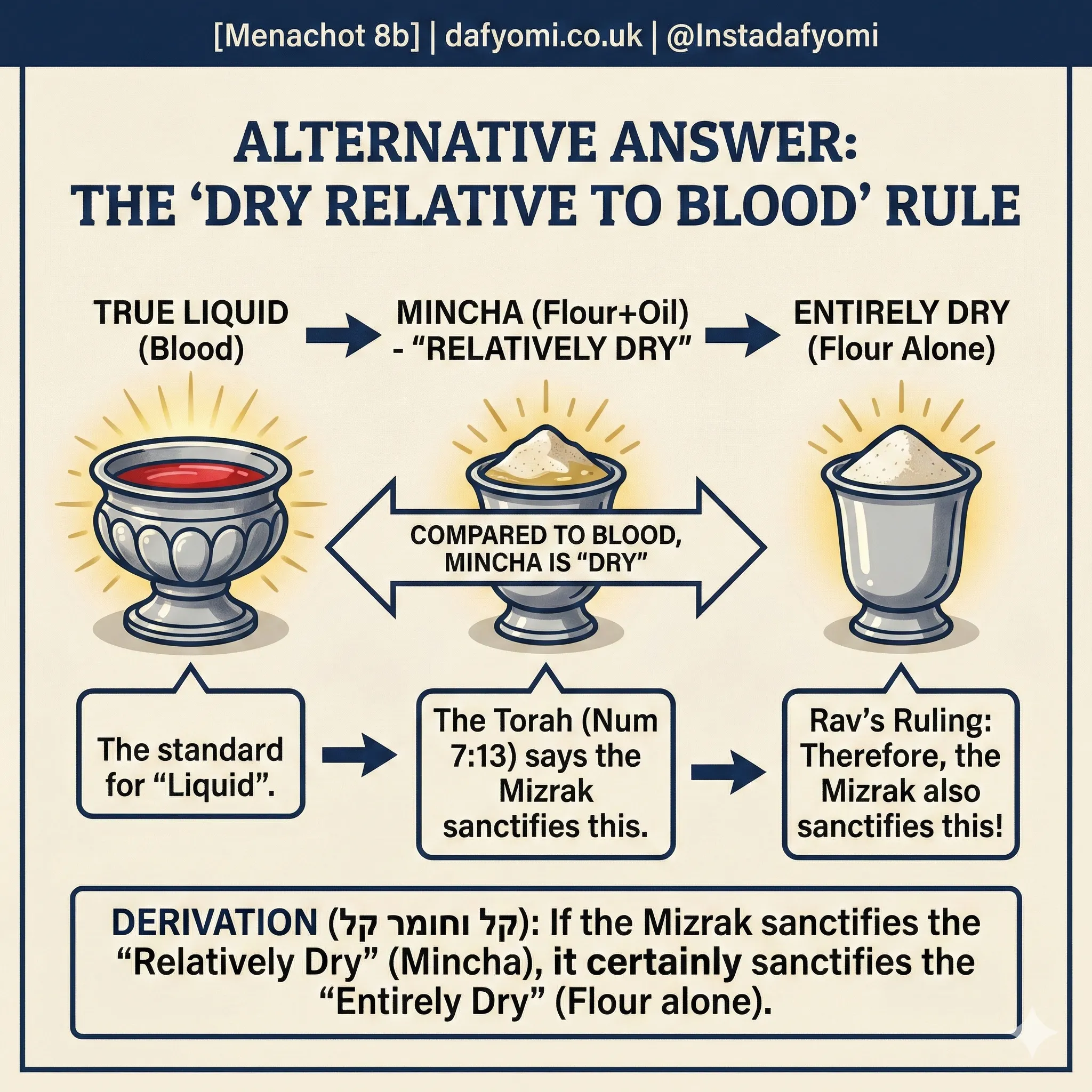
וְאִיבָּעֵית אֵימָא: מִנְחָה, לְגַבֵּי דָּם – כְּיָבֵשׁ דָּמְיָא.
English Translation:
And if you wish, say instead in answer to Rav Aḥa of Difti’s question: A meal offering, even when it is mixed with oil, is, relative to blood, considered as a dry item. Accordingly, one may derive from the verse that the bowls sanctify dry items, and just as a bowl sanctifies a meal offering that contains oil, as it is considered dry in comparison to blood, so too, it sanctifies a meal offering that is entirely dry, i.e., that contains no oil, as claimed by Rav.
קלאוד על הדף:
Alternative answer to Rav Acha’s challenge: “dry” and “wet” are relative terms. Compared to blood, even an oil-mixed meal offering is relatively dry. So the verse’s proof holds: bowls can sanctify things that are “dry” relative to blood, including flour without oil.
Segment 9
TYPE: גופא
Rabbi Elazar: kemitza in the Sanctuary is valid
Hebrew/Aramaic:
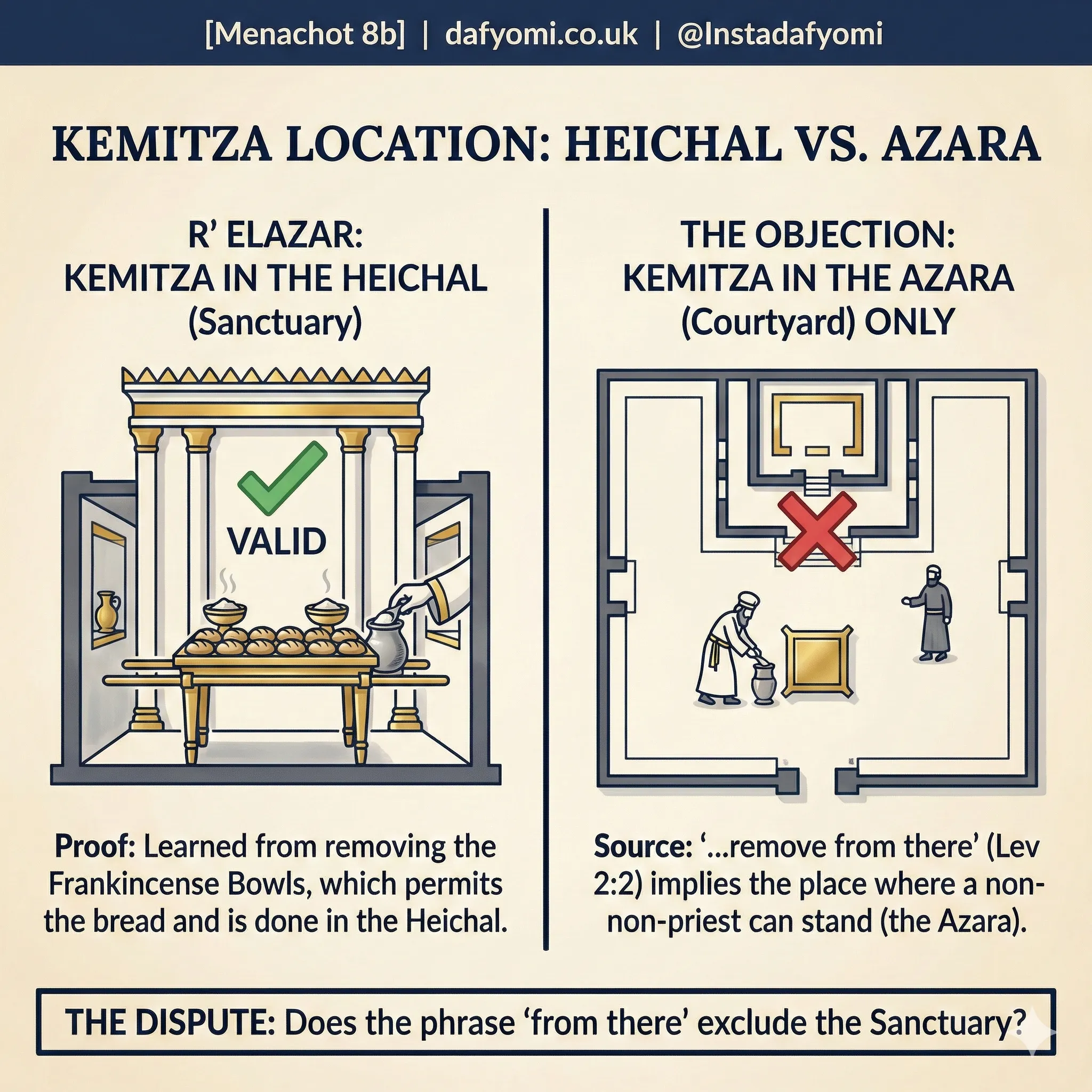
גּוּפָא, אָמַר רַבִּי אֶלְעָזָר: מִנְחָה שֶׁקְּמָצָהּ בַּהֵיכָל – כְּשֵׁרָה, שֶׁכֵּן מָצִינוּ בְּסִילּוּק בָּזִיכִין.
English Translation:
§ The Gemara discusses the matter itself. Rabbi Elazar says: A meal offering from which the priest removed a handful while inside the Sanctuary is valid, despite the fact that the handful should be removed in the Temple courtyard; the reason is that we find a similar case in the Sanctuary, with regard to the removal of the bowls of frankincense from the Table of the shewbread. Just as the bowls permit the shewbread for consumption, so too, the handful permits the remainder of the meal offering for consumption.
קלאוד על הדף:
New topic: can kemitza be performed inside the Sanctuary (Heichal) rather than only in the courtyard? Rabbi Elazar says yes, deriving from the frankincense bowls that are removed from the Table inside the Sanctuary.
Key Terms:
- הֵיכָל (Heichal) = The Sanctuary (inner Temple building)
Segment 10
TYPE: קושיא
Rabbi Yirmiya’s objection from “from there”
Hebrew/Aramaic:
מֵתִיב רַבִּי יִרְמְיָה: ״וְקָמַץ מִשָּׁם״ – מִמָּקוֹם שֶׁרַגְלֵי הַזָּר עוֹמְדוֹת.
English Translation:
Rabbi Yirmeya raises an objection to this opinion from a baraita discussing the verse: “And he shall bring it to Aaron’s sons the priests; and he shall remove from there his handful” (Leviticus 2:2). The verse indicates that the removal of a handful from a meal offering may be performed from the place where the feet of the non-priest may stand, i.e., anywhere within the Temple courtyard.
קלאוד על הדף:
Rabbi Yirmiya challenges: the verse says “from there”—meaning where a non-priest (zar) can stand, i.e., the courtyard only! The Sanctuary is off-limits to non-priests, so kemitza shouldn’t be valid there.
Key Terms:
- מִמָּקוֹם שֶׁרַגְלֵי הַזָּר עוֹמְדוֹת = From where a non-priest’s feet may stand
Segment 11
TYPE: מימרא
Ben Beteira’s interpretation: returning after left-hand kemitza
Hebrew/Aramaic:
בֶּן בְּתִירָא אוֹמֵר: מִנַּיִן שֶׁאִם קָמַץ בִּשְׂמֹאל, שֶׁיַּחֲזִיר וְיִקְמוֹץ בְּיָמִין? תַּלְמוּד לוֹמַר: ״וְקָמַץ מִשָּׁם״ – מִמָּקוֹם שֶׁקָּמַץ כְּבָר.
English Translation:
The baraita continues: Ben Beteira, who holds that a handful is not disqualified when removed with the left hand, says that the verse should be interpreted as follows: From where is it derived that if one removed a handful with his left hand, that he must return the handful to the vessel that contains the meal offering and again remove the handful with his right hand? The verse states: “And he shall remove from there.” This indicates that the handful is removed from the place where he already removed it, i.e., the handful is returned to the meal offering and thereupon removed from the same meal offering, this time with his right hand. It is clear from the statement of the first tanna that the handful of a meal offering may be removed only in the place where the feet of a non-priest may stand, but not in the Sanctuary.
קלאוד על הדף:
Ben Beteira offers an alternative interpretation: “from there” teaches about correcting mistakes. If the priest took the handful with his left hand (which Ben Beteira considers fixable), he should return the flour and take again with his right. “From there” means return it to the same place.
Segment 12
TYPE: תירוץ
Resolution: some say Rabbi Yirmiya answers himself
Hebrew/Aramaic:
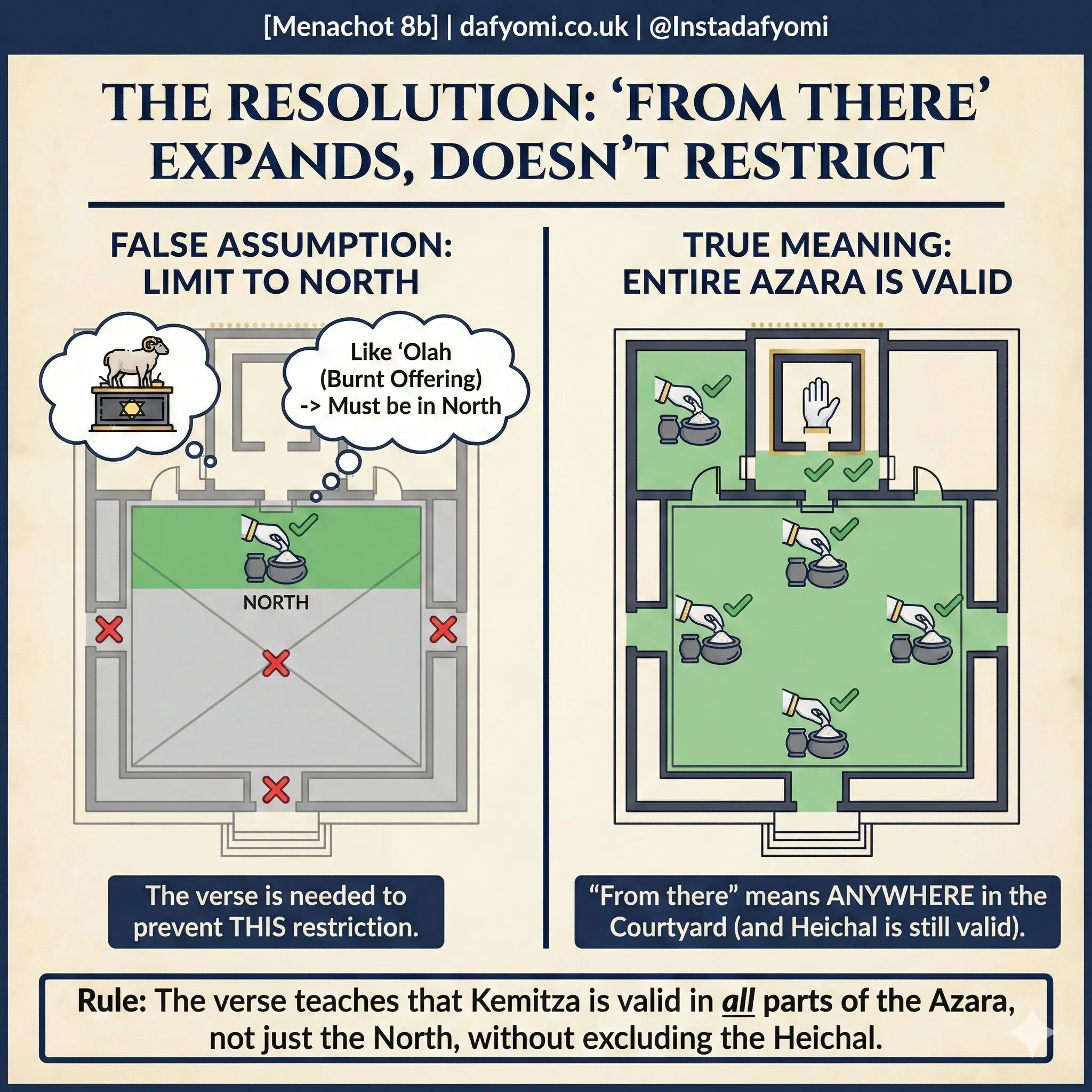
אִיכָּא דְּאָמְרִי: הוּא מוֹתֵיב לַהּ וְהוּא מְפָרֵק לַהּ. אִיכָּא דְאָמְרִי: אֲמַר לֵיהּ רַבִּי יַעֲקֹב לְרַבִּי יִרְמְיָה בַּר תַּחְלִיפָא, אַסְבְּרַהּ לָךְ – לֹא נִצְרְכָא אֶלָּא לְהַכְשִׁיר אֶת כׇּל עֲזָרָה כּוּלָּהּ, שֶׁלֹּא תֹּאמַר: הוֹאִיל וְעוֹלָה קׇדְשֵׁי קָדָשִׁים, וּמִנְחָה קׇדְשֵׁי קָדָשִׁים, מָה עוֹלָה טְעוּנָה צָפוֹן – אַף מִנְחָה טְעוּנָה צָפוֹן.
English Translation:
Some say that Rabbi Yirmeya raises the objection and he resolves it as well. And some say that Rabbi Ya’akov said to Rabbi Yirmeya bar Taḥlifa: I will explain to you the resolution of this objection: The verse is necessary only to permit the entire Temple courtyard for removing the handful there, not to prohibit the removal of a handful inside the Sanctuary. The reason is that you should not say: Since a burnt offering is an offering of the most sacred order, and a meal offering is likewise an offering of the most sacred order, then just as a burnt offering requires that its slaughter be performed in the northern part of the Temple courtyard, so too, a meal offering requires that the removal of its handful be in the northern part.
קלאוד על הדף:
There are two versions of who answered. Either Rabbi Yirmiya answered his own question, or Rabbi Yaakov explained: the verse “from there” doesn’t exclude the Sanctuary—it permits the entire courtyard. Without it, we might think kemitza must be specifically in the north (like slaughtering kodshei kodashim).
Segment 13
TYPE: פירכא
Rejecting the comparison to olah
Hebrew/Aramaic:
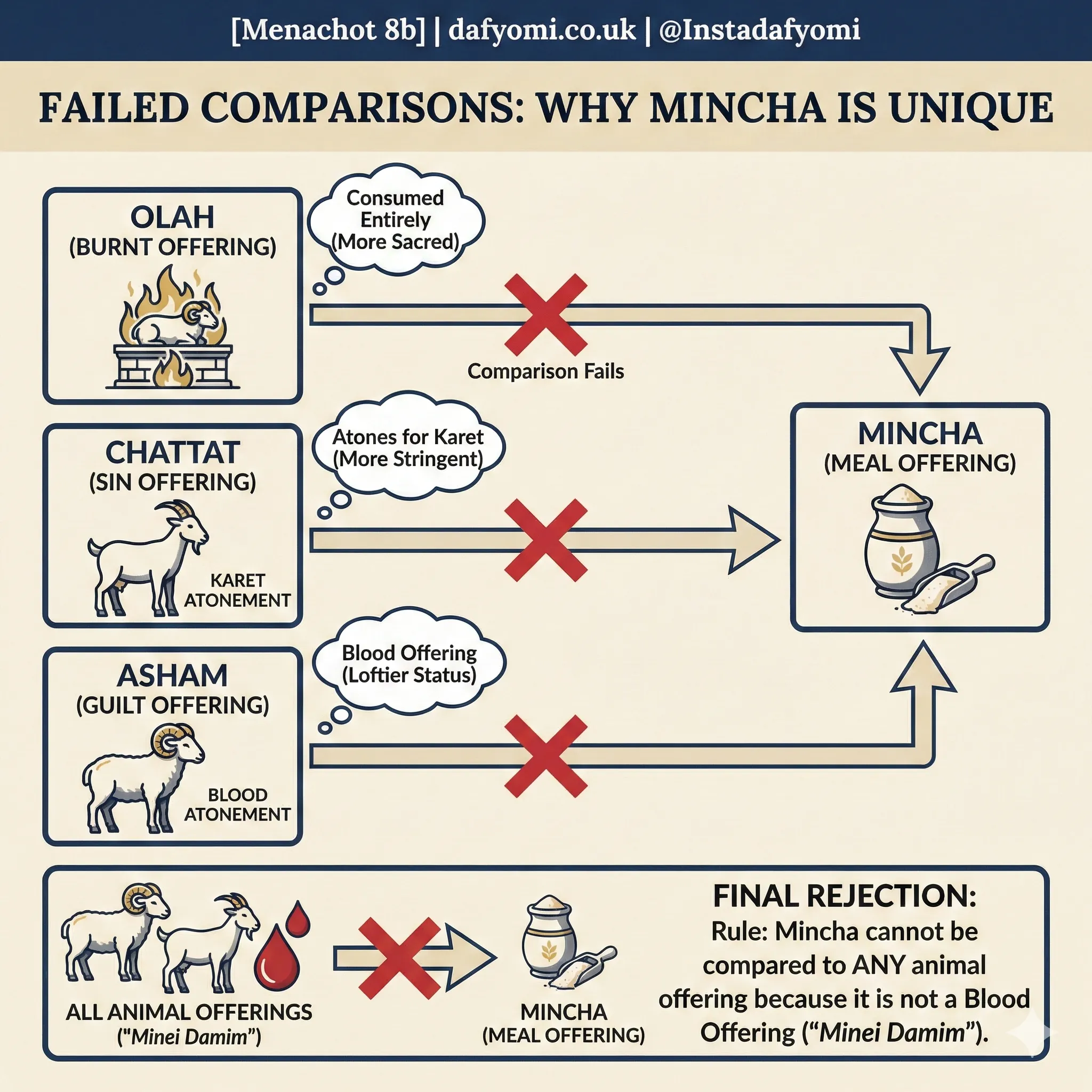
מָה לְעוֹלָה, שֶׁכֵּן כָּלִיל, מֵחַטָּאת.
English Translation:
The Gemara raises a difficulty with regard to this comparison: What is notable about a burnt offering? It is notable in that it is more sacred, as it is consumed in its entirety upon the altar. The Gemara responds: The same comparison may be drawn from a sin offering, which is also an offering of the most sacred order and is not sacrificed in its entirety upon the altar, and yet it must be slaughtered in the northern part of the Temple courtyard.
קלאוד על הדף:
The Gemara challenges: maybe the comparison only works with burnt offerings, which are entirely consumed (kalil)? So try sin offerings instead—they’re also kodshei kodashim but not entirely burned.
Segment 14
TYPE: פירכא
Rejecting the comparison to chatat
Hebrew/Aramaic:
מָה לְחַטָּאת, שֶׁכֵּן מְכַפֶּרֶת עַל חַיָּיבֵי כָרֵיתוֹת, מֵאָשָׁם.
English Translation:
The Gemara raises a difficulty with regard to this comparison as well: What is notable about a sin offering? It is notable in that the halakhot of a sin offering are more stringent, as its sacrifice atones for those sins whose transgression causes one to be liable to receive karet. The Gemara responds: The comparison may be drawn from a guilt offering, as it too is an offering of the most sacred order, it is not sacrificed in its entirety upon the altar, it does not atone for such sins, and yet it must be slaughtered in the northern part of the Temple courtyard.
קלאוד על הדף:
What’s special about sin offerings? They atone for sins punishable by karet. So try guilt offerings instead—they’re kodshei kodashim, not entirely burned, and don’t atone for karet-level sins.
Segment 15
TYPE: מסקנה
All animal offerings share the quality of blood atonement
Hebrew/Aramaic:
מָה לְאָשָׁם, שֶׁכֵּן מִינֵי דָמִים! מִכּוּלְּהוּ נָמֵי, שֶׁכֵּן מִינֵי דָמִים!
English Translation:
The Gemara rejects this suggestion as well: What is notable about a guilt offering? It is notable in that a guilt offering has a loftier status, as it is one of the types of offerings whose atonement is achieved through their blood, i.e., it is an animal offering. The Gemara adds: Once this claim has been accepted, from all of them as well, i.e., from a burnt offering and sin offering, one cannot draw a comparison to a meal offering either, as they are all of the types of offerings whose atonement is achieved through their blood.
קלאוד על הדף:
What’s special about guilt offerings? They’re animal offerings whose atonement comes through blood! And actually, the same is true of ALL animal offerings—they’re all “types of blood.” Meal offerings have no blood, so you can’t compare them to animal offerings that require the north.
Segment 16
TYPE: מסקנה
The verse permits the entire courtyard
Hebrew/Aramaic:
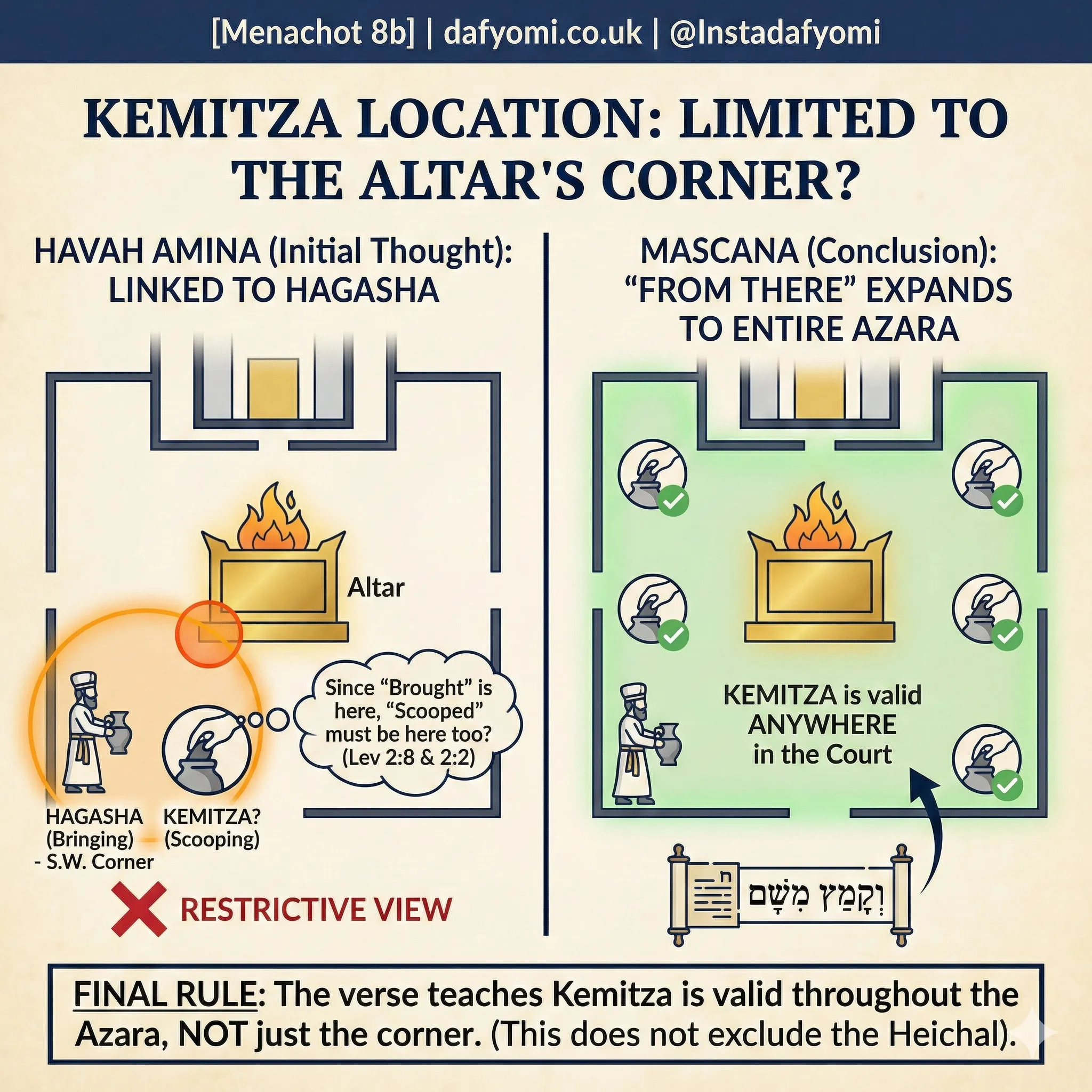
אֶלָּא אִיצְטְרִיךְ, סָלְקָא דַּעְתָּךְ אָמֵינָא, הוֹאִיל וּכְתִיב: ״וְהִקְרִיבָהּ אֶל הַכֹּהֵן וְהִגִּישָׁהּ אֶל הַמִּזְבֵּחַ וְקָמַץ״, מָה הַגָּשָׁה בְּקֶרֶן דְּרוֹמִית מַעֲרָבִית, אַף קְמִיצָה נָמֵי בְּקֶרֶן דְּרוֹמִית מַעֲרָבִית, קָא מַשְׁמַע לַן.
English Translation:
Rather, the verse was necessary in order to permit the removal of a handful anywhere in the Temple courtyard because it might enter your mind to say that since it is written: “And it shall be presented to the priest, and he shall bring it to the altar” (Leviticus 2:8), and it states: “And he shall remove from there his handful” (Leviticus 2:2), one could claim: Just as the bringing of the meal offering is in the southwestern corner of the altar, so too, the removal of the handful must also be performed in the southwestern corner. Therefore, the verse teaches us that the removal of the handful may be performed anywhere in the Temple courtyard, but this does not serve to exclude the Sanctuary.
קלאוד על הדף:
The verse “from there” actually expands, not limits! Without it, we might think kemitza must be specifically at the southwest corner (where hagasha/approach is done). “From there” teaches that the entire courtyard is valid for kemitza—and doesn’t exclude the Sanctuary.
Segment 17
TYPE: גופא
Rabbi Yochanan: peace offerings in the Sanctuary are valid
Hebrew/Aramaic:
גּוּפָא, אָמַר רַבִּי יוֹחָנָן: שְׁלָמִים שֶׁשְּׁחָטָן בַּהֵיכָל – כְּשֵׁרִין, שֶׁנֶּאֱמַר: ״וּשְׁחָטוֹ פֶּתַח אֹהֶל מוֹעֵד״, וְלֹא יְהֵא טָפֵל חָמוּר מִן הָעִיקָּר.
English Translation:
§ The Gemara discusses the matter itself. Rabbi Yoḥanan says: Peace offerings that were slaughtered in the Sanctuary are valid, as it is stated: “And slaughter it at the entrance of the Tent of Meeting” (Leviticus 3:2), i.e., in the courtyard. And it is logical that the halakha with regard to the minor area, i.e., the courtyard, should not be more stringent than the halakha with regard to the major one, the Tent of Meeting or the Sanctuary.
קלאוד על הדף:
Rabbi Yochanan establishes a powerful principle: “the secondary should not be stricter than the primary.” The courtyard (entrance) is secondary to the Sanctuary. If slaughtering is valid in the courtyard, it’s certainly valid in the more sacred Sanctuary.
Key Terms:
- שְׁלָמִים = Peace offerings
- לֹא יְהֵא טָפֵל חָמוּר מִן הָעִיקָּר = The secondary should not be stricter than the primary
Segment 18
TYPE: קושיא
Objection from eating during a siege
Hebrew/Aramaic:
מֵיתִיבִי: רַבִּי יְהוּדָה בֶּן בְּתִירָא אוֹמֵר, מִנַּיִן שֶׁאִם הִקִּיפוּ גּוֹיִם אֶת הָעֲזָרָה, שֶׁהַכֹּהֲנִים נִכְנָסִין לַהֵיכָל וְאוֹכְלִין בְּקׇדְשֵׁי קָדָשִׁים וּשְׁיָרֵי מְנָחוֹת? תַּלְמוּד לוֹמַר:
English Translation:
The Gemara raises an objection to the opinion of Rabbi Yoḥanan from a baraita. Rabbi Yehuda ben Beteira says: From where is it derived that if gentiles surrounded the Temple courtyard and were firing projectiles inside to the point that it became impossible to remain in the courtyard on account of the threat, that the priests enter the Sanctuary and partake of the offerings of the most sacred order and the remainders of the meal offerings while inside the Sanctuary? The verse states:
קלאוד על הדף:
The Gemara challenges Rabbi Yochanan from a baraita: Rabbi Yehuda ben Beteira asks where we learn that priests can eat holy food inside the Sanctuary when enemies surround the courtyard. The fact that he needs a verse implies this is not normally permitted—challenging Rabbi Yochanan’s leniency! (The verse and resolution continue on the next daf.)