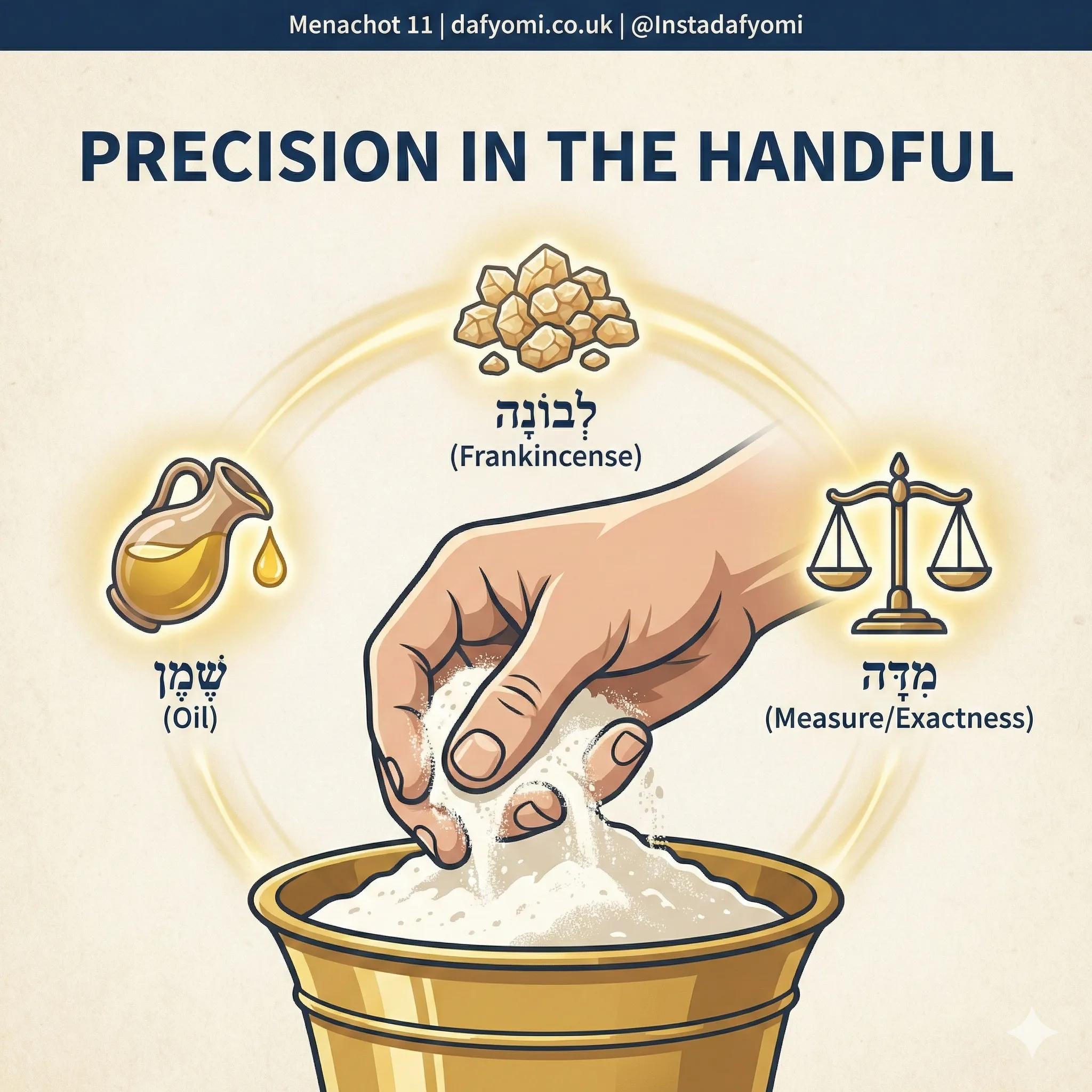
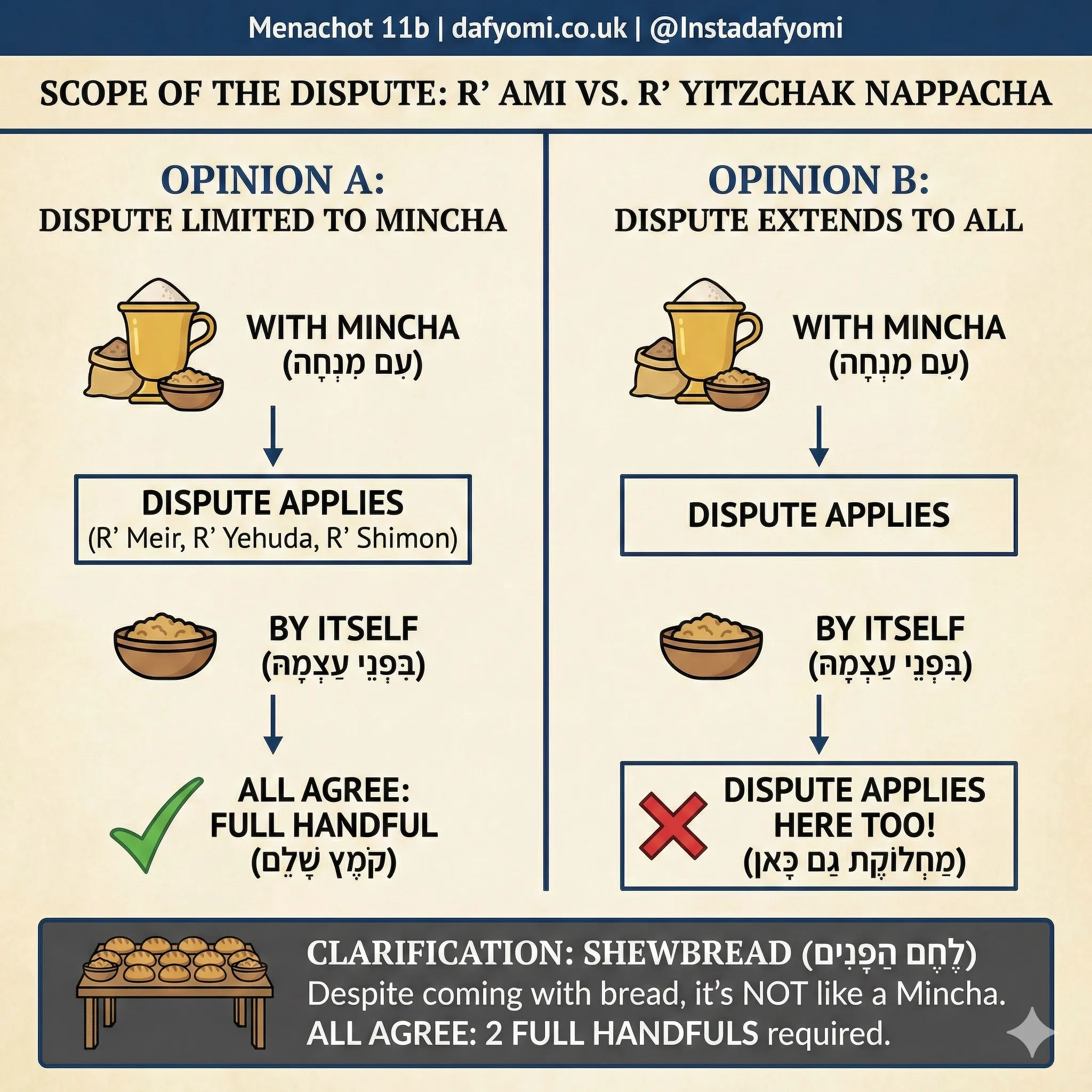
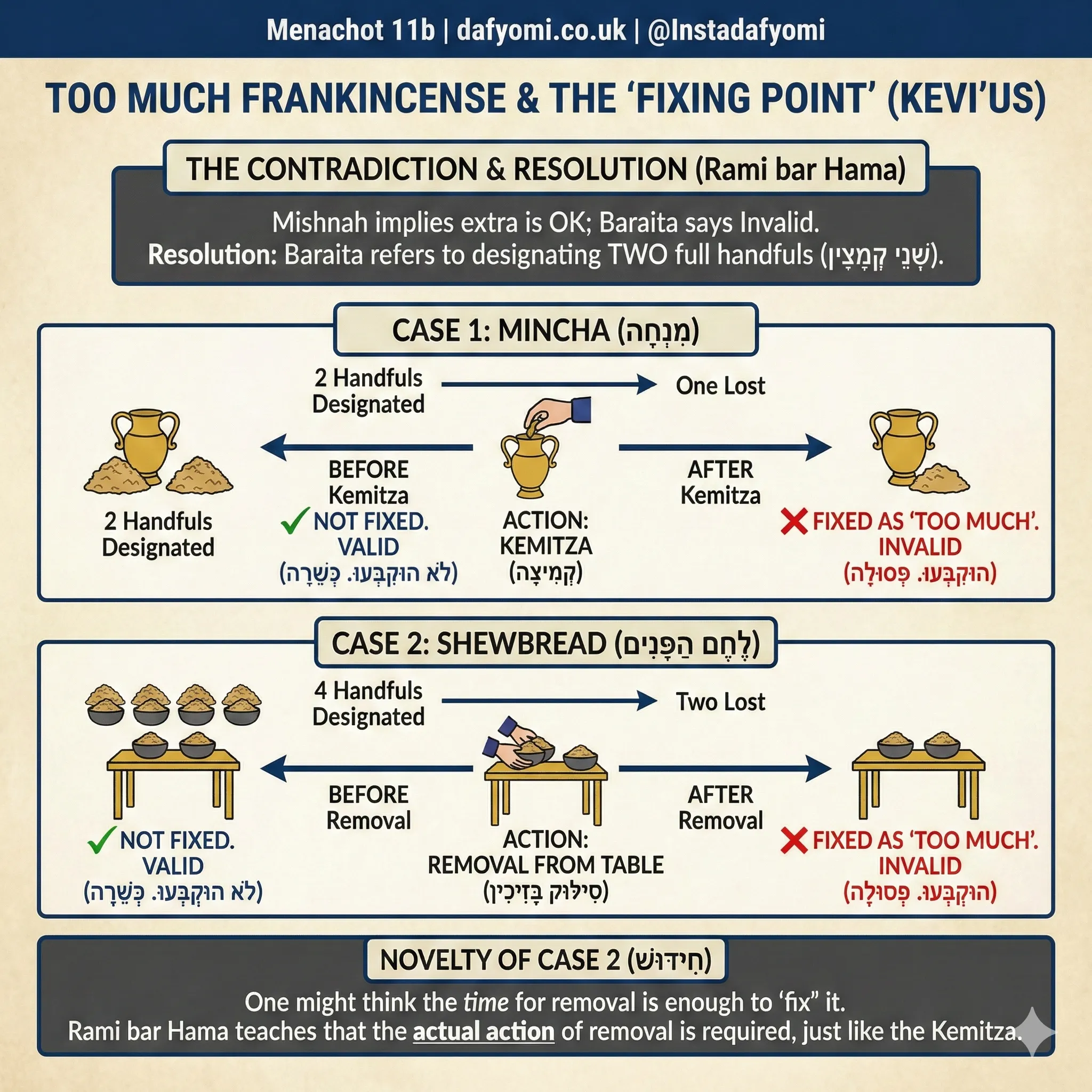
Menachot Daf 11 (מנחות דף י״א)
Daf: 11 | Amudim: 11a – 11b | Date: January 23, 2026
📖 Breakdown
Amud Aleph (11a)
Segment 1
TYPE: גמרא
Why all the examples in the Mishna are necessary
Hebrew/Aramaic:
אוֹ קוֹרֶט לְבוֹנָה – פָּסוּל. כֹּל הָנֵי לְמָה לִי?
English Translation:
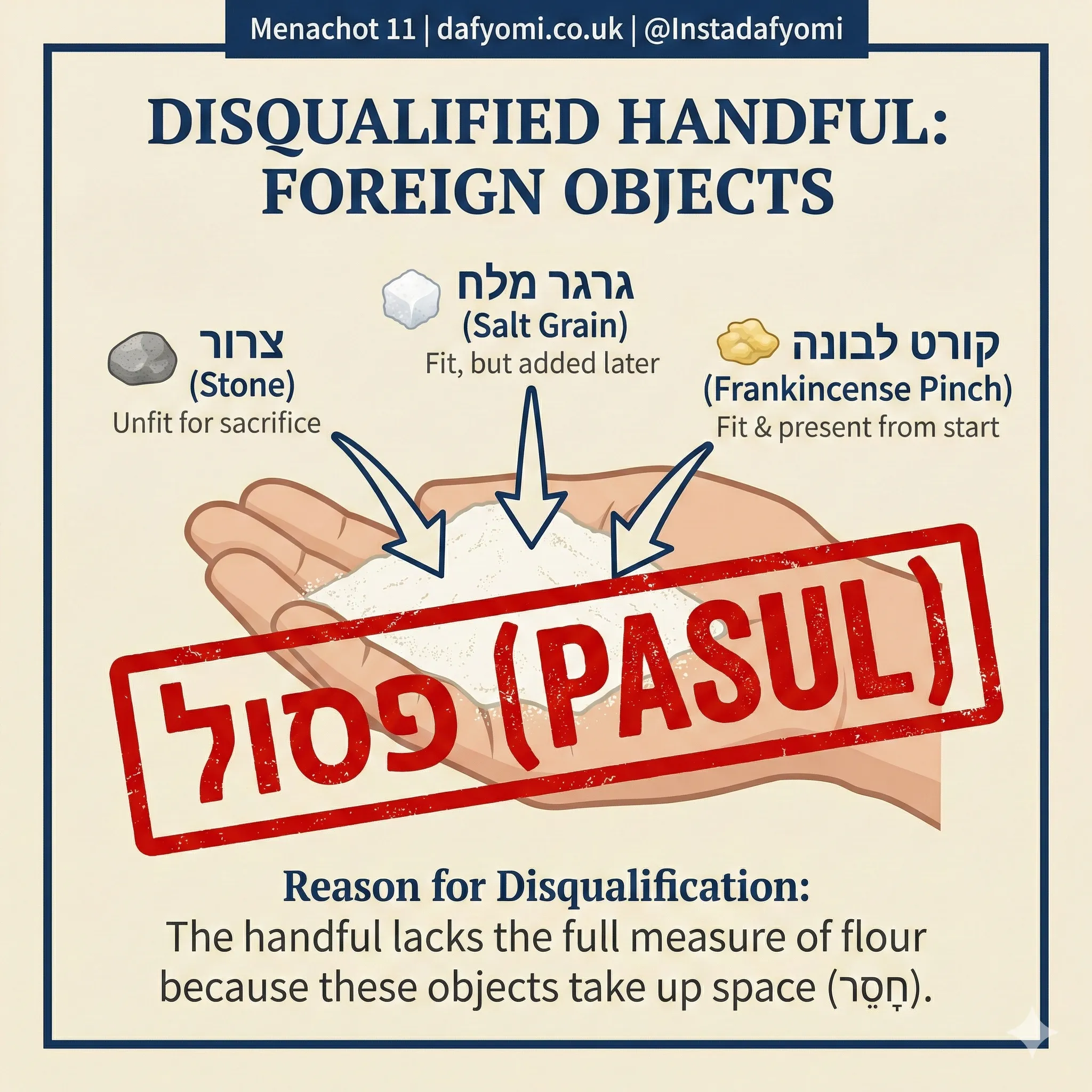
Or a pinch of frankincense emerged in his hand, the meal offering is unfit, as the handful lacks a full measure on account of these items. The Gemara asks: Why do I need all these examples? Any one of them would convey the fact that the handful must contain a full measure.
קלאוד על הדף:
The Gemara continues from the previous daf, questioning why the Mishna needed to list multiple items (stone, salt, frankincense) that disqualify the handful. If any foreign substance in the handful reduces its measure and invalidates it, why enumerate specific examples? This classic Talmudic inquiry leads to an important teaching about the distinct nature of each case.
Key Terms:
- קוֹרֶט לְבוֹנָה (Koret Levonah) = A pinch of frankincense
Segment 2
TYPE: גמרא
Explanation: Stone is not fit for sacrifice
Hebrew/Aramaic:
צְרִיכָא, דְּאִי תְּנָא צְרוֹר – מִשּׁוּם דְּלָאו בַּת הַקְרָבָה הִיא, אֲבָל מֶלַח דְּבַת הַקְרָבָה הִיא – אֵימָא תִּתַּכְשַׁר.
English Translation:
The Gemara explains: All of the cases are necessary. Because if the mishna had taught only the example of a stone, it might have been thought that only a stone diminishes the measure of the handful, because it is not fit for sacrifice. But with regard to salt, which is fit for sacrifice, as the priest places salt on the handful before burning it upon the altar, one might say that the handful should be fit, as the salt should not subtract from the handful’s measure.
קלאוד על הדף:
The first part of the “tzrikha” (necessity) answer. A stone is completely foreign to the altar — it has no sacrificial purpose. One might think only such totally unfit items disqualify. Salt, however, IS used on the altar (all sacrifices require salting), so we need to be taught that it too disqualifies when mixed into the handful.
Key Terms:
- צְרִיכָא (Tzrikha) = It is necessary — indicating all examples are needed
- בַּת הַקְרָבָה (Bat Hakravah) = Fit for the altar
Segment 3
TYPE: גמרא
Explanation: Salt is not fixed with the meal offering
Hebrew/Aramaic:
וְאִי תְּנָא מֶלַח, דְּלָא אִיקְּבַע בַּהֲדֵי מִנְחָה מֵעִיקָּרָא (שֶׁאֵינוֹ מוֹלֵחַ אֶלָּא הַקּוֹמֶץ בִּלְבַד), אֲבָל לְבוֹנָה דְּאִיקְּבַע בַּהֲדֵי מִנְחָה מֵעִיקָּרָא – אֵימָא תִּתַּכְשַׁר, קָא מַשְׁמַע לַן.
English Translation:
And if the mishna had taught only the example of salt, it might have been thought that the salt diminishes the handful’s measure as it was not initially fixed together with the entire meal offering. The reason is that the priest salts the handful alone. But with regard to the frankincense, which was initially fixed together with the entire meal offering, i.e., it is placed upon the meal offering before the priest removes a handful from it, one might say that the handful should be fit and the frankincense should not diminish from the handful’s measure. Therefore, the mishna teaches us that in any of these instances the meal offering is unfit.
קלאוד על הדף:
The second part of the answer completes the logical chain. Salt is added later (only to the kometz itself), so it’s somewhat “external.” But frankincense is part of the meal offering from the beginning — placed on top before kemitza. One might think that since it belongs there, finding it in the handful shouldn’t matter. The Mishna teaches otherwise: even frankincense, despite being part of the offering, disqualifies the handful if mixed in.
Key Terms:
- אִיקְּבַע (Ikba) = Was fixed/established together with
- מֵעִיקָּרָא (Me’ikara) = From the beginning/initially
Segment 4
TYPE: גמרא
Rabbi Yirmeya: The items disqualify when on the side
Hebrew/Aramaic:
מִפְּנֵי שֶׁאָמְרוּ: הַקּוֹמֶץ הֶחָסֵר אוֹ הַיָּתֵר פָּסוּל. מַאי אִירְיָא מִשּׁוּם חָסֵר וְיָתֵר? וְתִיפּוֹק לֵיהּ מִשּׁוּם חֲצִיצָה! אָמַר רַבִּי יִרְמְיָה: מִן הַצַּד.
English Translation:
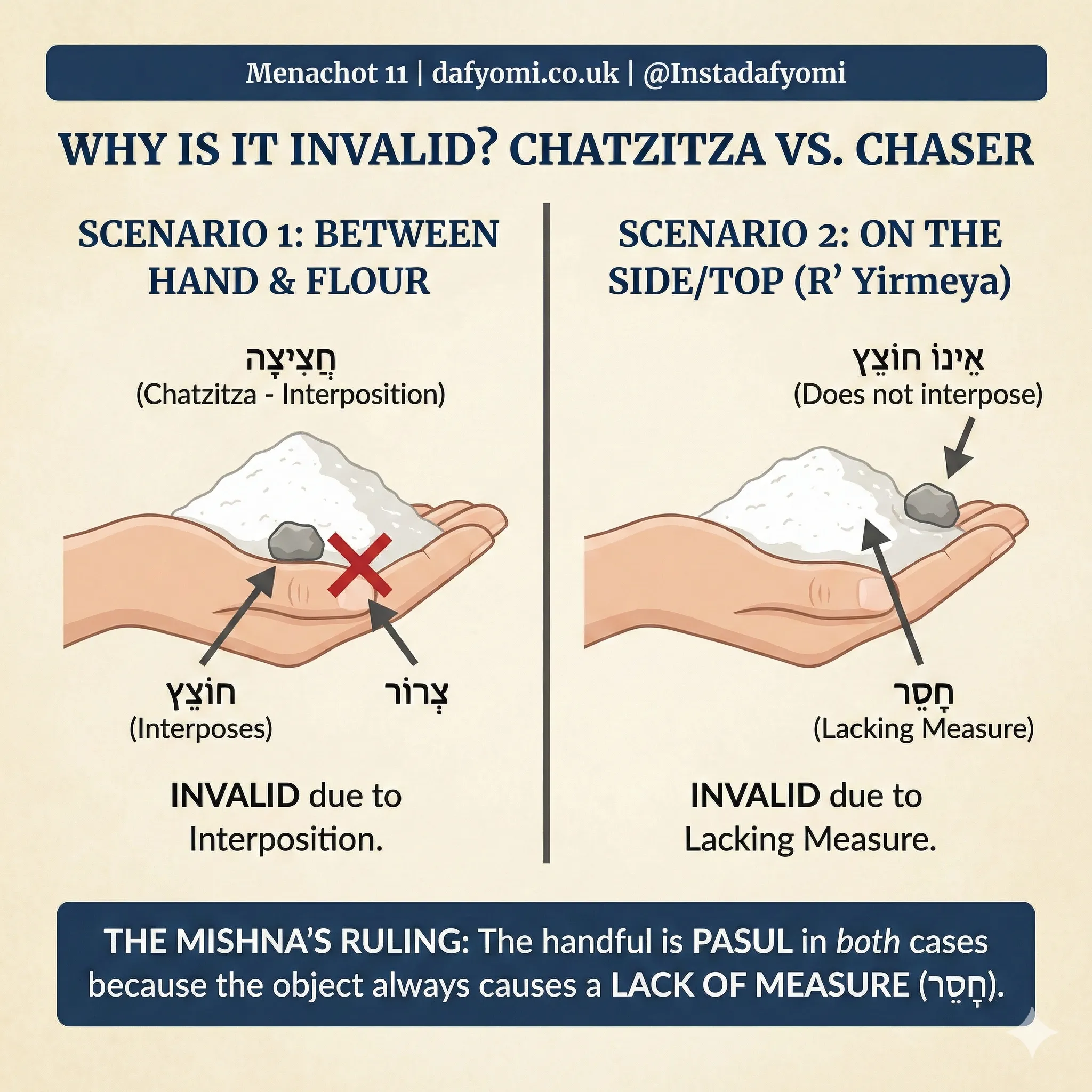
The mishna teaches that if a stone, or a grain of salt, or a pinch of frankincense emerged in the priest’s hand together with the handful, the meal offering is unfit due to the fact that the Sages said: The handful that is lacking or that is outsized is unfit. The Gemara asks: Why does the tanna explain that the offering is not valid specifically because it is lacking or outsized? But let the tanna derive that such a handful is not valid due to the fact that there is an interposition between the priest’s hand and the handful. Rabbi Yirmeya says: Since there are certain instances where these items do not interpose between one’s hand and the handful, e.g., when they are located on the side of the handful, the mishna teaches that they disqualify the handful due to the fact that they reduce its measure.
קלאוד על הדף:
The Gemara raises an alternative reason for disqualification: these items could constitute a chatzitza (interposition) between the priest’s hand and the flour! Rabbi Yirmeya explains that the Mishna specifically mentions “lacking or outsized” because the disqualification applies even when the foreign item is on the side of the handful — where it doesn’t technically interpose but still reduces the measure.
Key Terms:
- חֲצִיצָה (Chatzitza) = Interposition — something blocking direct contact
- מִן הַצַּד (Min HaTzad) = From/on the side
Segment 5
TYPE: גמרא
Abaye asks Rava: How is kemitza performed?
Hebrew/Aramaic:
אֲמַר לֵיהּ אַבָּיֵי לְרָבָא: כֵּיצַד קוֹמְצִין? אֲמַר לֵיהּ: כִּדְקָמְצִי אִינָשֵׁי. אֵיתִיבֵיהּ: זוֹ זֶרֶת, זוֹ קְמִיצָה.
English Translation:
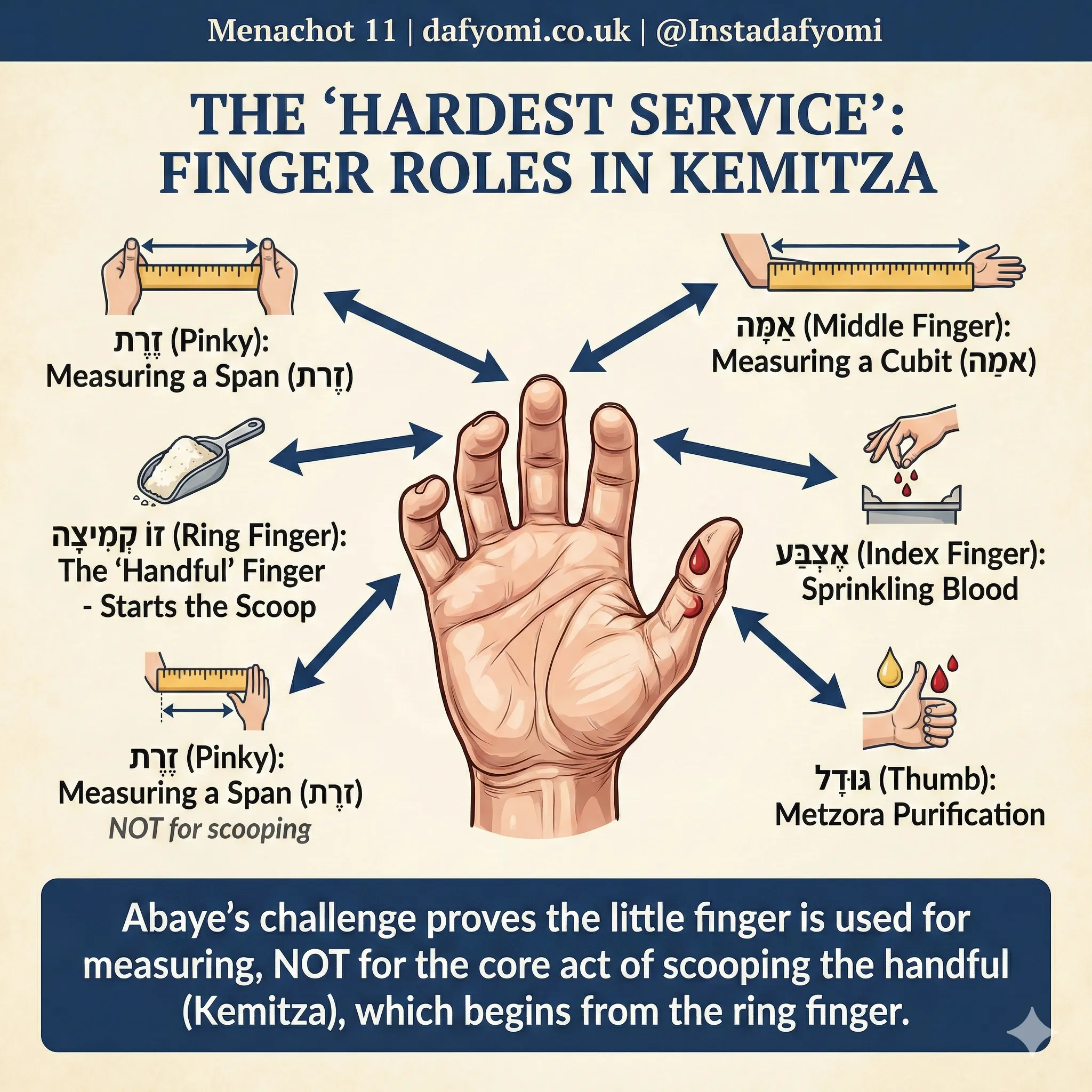
Abaye said to Rava: How do the priests properly remove the handful from a meal offering? Rava said to him: They remove it as people normally remove handfuls, by folding all of their fingers over the palm of the hand. Abaye raised an objection to Rava from a baraita discussing the mitzva function of each of the fingers: This small finger is for measuring a span (see Exodus 28:16), i.e., the distance between the thumb and the little finger. This fourth finger is used for removal of a handful from the meal offering, i.e., the measurement of a handful begins from this finger, as the priest removes a handful by folding the middle three fingers over his palm.
קלאוד על הדף:
A classic Abaye-Rava exchange. Rava initially gives a simple answer: kemitza is done “the normal way people scoop.” Abaye challenges this from a baraita that assigns specific functions to each finger. The fourth finger (ring finger) is specifically designated for kemitza — implying a technical procedure, not just casual scooping.
Key Terms:
- זֶרֶת (Zeret) = A span — the distance from thumb to pinky when spread
- קְמִיצָה (Kemitza) = The removal of the handful
Segment 6
TYPE: גמרא
Continuation of the baraita about finger functions
Hebrew/Aramaic:
זוֹ אַמָּה, זוֹ אֶצְבַּע, זוֹ גּוּדָל.
English Translation:
Furthermore, this middle finger is used for measuring a cubit, the distance from the elbow to the tip of the middle finger. This forefinger, next to the thumb, is the finger used to sprinkle the blood of offerings on the altar. And finally, this thumb is the one on which the blood and oil is placed during the purification ritual of a leper (see Leviticus 14:17). Evidently, the little finger is not used in the removal of a handful.
קלאוד על הדף:
The baraita continues cataloguing each finger’s Temple function: the middle finger measures the cubit; the index finger sprinkles blood; the thumb receives blood and oil for the metzora (leper) purification. Notably, the pinky is mentioned only for measuring the span — seemingly not for kemitza itself.
Key Terms:
- אַמָּה (Amah) = Cubit — measured to the middle finger
- גּוּדָל (Gudal) = Thumb
Segment 7
TYPE: גמרא
Resolution: The pinky is for leveling the handful
Hebrew/Aramaic:
אֶלָּא לְהַשְׁווֹת, (כְּלוֹמַר, קוֹמֵץ מְלֹא הַיָּד כְּדֵי שֶׁלֹּא יְהֵא חָסֵר, וְאַחַר כָּךְ מוֹחֵק בְּאֶצְבַּע קְטַנָּה מִלְּמַטָּה).
English Translation:
The Gemara responds: The little finger is used only for the purposes of leveling the handful, that is to say, the priest first removes a handful with a full hand, i.e., all of his fingers, so that it should not be lacking in measure, and then he wipes away the protruding flour with his little finger from the bottom, and with his thumb from the top.
קלאוד על הדף:
The resolution clarifies the pinky’s role: it doesn’t participate in the actual scooping but serves to level/wipe the handful afterward. The priest uses all fingers to scoop (ensuring a full measure), then uses the thumb and pinky to scrape off excess from top and bottom respectively, achieving the precise measure required.
Key Terms:
- לְהַשְׁווֹת (LeHashvot) = To level/equalize
- מוֹחֵק (Mochek) = Wipes away/scrapes off
Segment 8
TYPE: גמרא
Rav Zutra bar Toviyya: The three-finger technique
Hebrew/Aramaic:
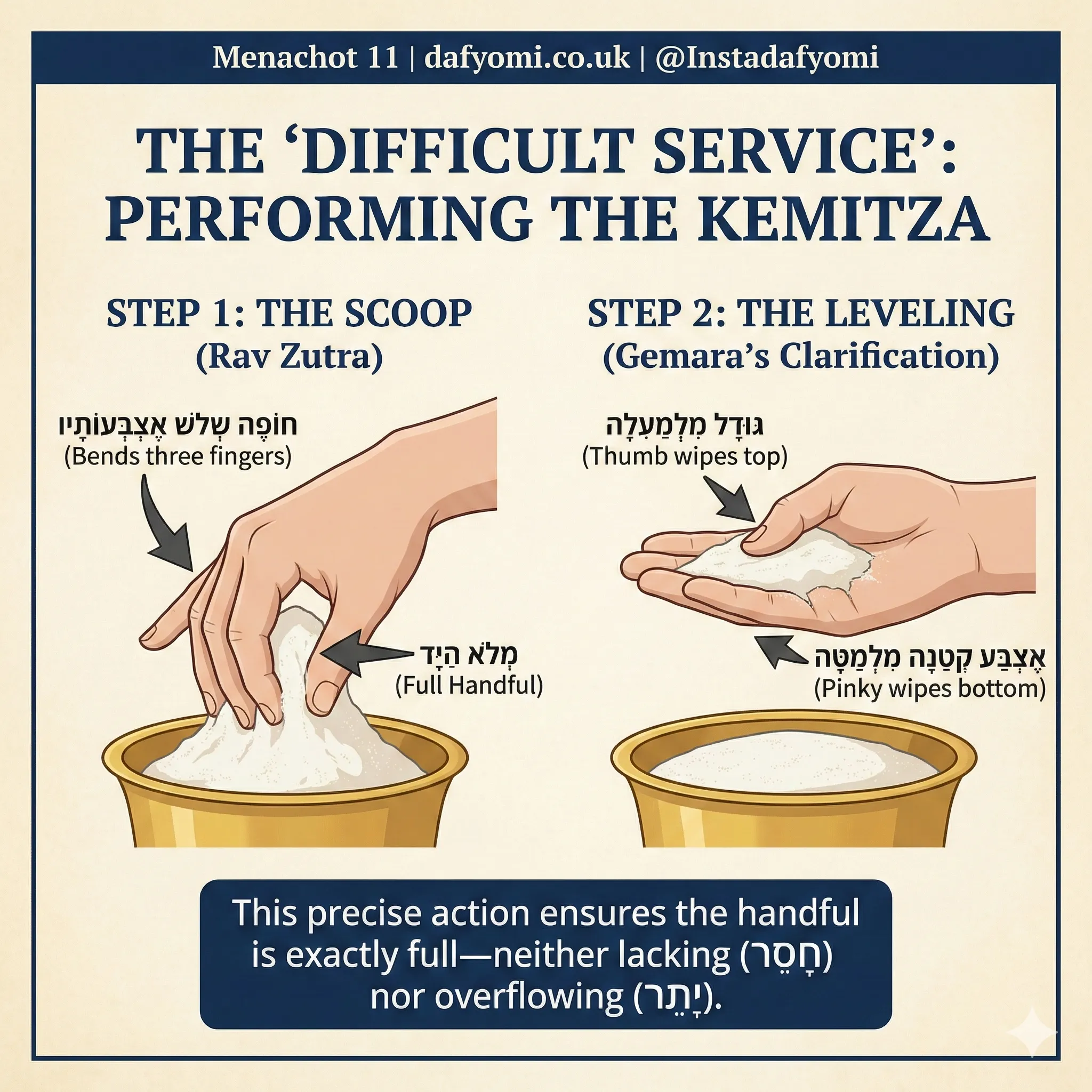
הֵיכִי עָבֵיד? אָמַר רַב זוּטְרָא בַּר טוֹבִיָּה, אָמַר רַב: חוֹפֶה שְׁלֹשׁ אֶצְבְּעוֹתָיו, עַד שֶׁמַּגִּיעַ עַל פַּס יָדוֹ, וְקוֹמֵץ.
English Translation:
The Gemara asks: How is the removal of the handful performed? Rav Zutra bar Toviyya says that Rav says: When the priest places his hand in the meal offering, he bends his middle three fingers until the tips of his fingers reach over the palm of his hand, and he then removes the handful.
קלאוד על הדף:
Rav provides the technical description: the priest bends his three middle fingers (index, middle, ring) toward his palm, creating a natural scoop. This precise motion captures flour within the curved fingers against the palm — the definition of a “kometz.”
Key Terms:
- חוֹפֶה (Chofeh) = Bends/covers
- פַּס יָדוֹ (Pas Yado) = The palm of his hand
Segment 9
TYPE: ברייתא
Baraita: Deriving the proper measure from verses
Hebrew/Aramaic:
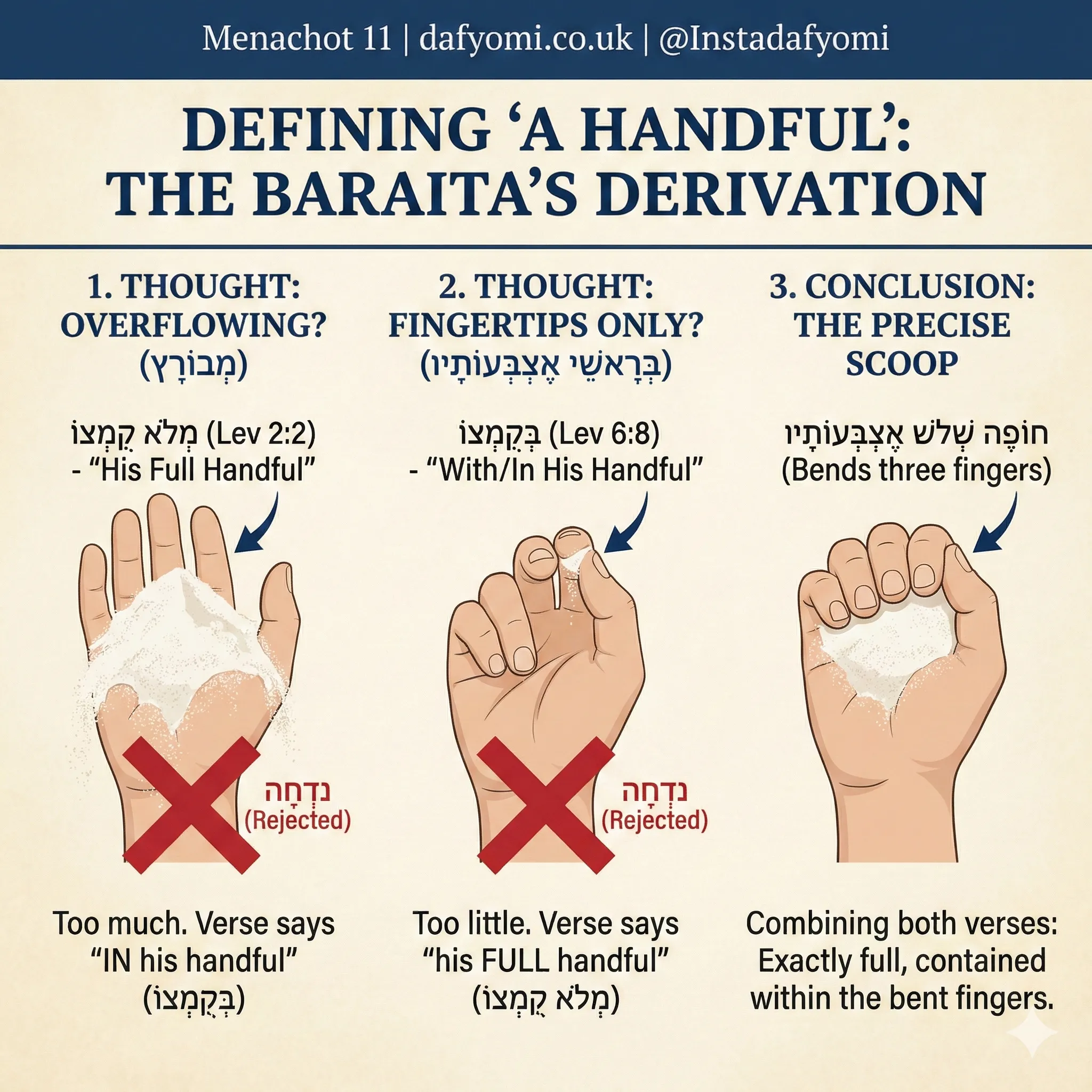
תַּנְיָא נָמֵי הָכִי: ״מְלֹא קֻמְצוֹ״ – יָכוֹל מְבוֹרָץ? תַּלְמוּד לוֹמַר ״בְּקֻמְצוֹ״.
English Translation:
The Gemara notes that this is also taught in a baraita. From the verse that states: “And he shall remove from there his handful” (Leviticus 2:2), one might have thought that the handful should be overflowing. Therefore, another verse states: “And he shall take up from it with his handful [bekumtzo]” (Leviticus 6:8). The prefix that means “with” can also mean: In, indicating that the proper measure of a handful is that which is contained within one’s fingers alone.
קלאוד על הדף:
The baraita derives the proper kemitza measure from two verses. “His handful” (melo kumtzo) suggests fullness — perhaps overflowing? But “with his handful” (bekumtzo) implies containment within the hand. The combination teaches: full but not overflowing.
Key Terms:
- מְלֹא קֻמְצוֹ (Melo Kumtzo) = His full handful
- מְבוֹרָץ (Mevoraz) = Overflowing/heaped
Segment 10
TYPE: ברייתא
Continuation: Not just fingertips
Hebrew/Aramaic:
אִי בְּקֻמְצוֹ, יָכוֹל בְּרָאשֵׁי אֶצְבְּעוֹתָיו? תַּלְמוּד לוֹמַר: ״מְלֹא קֻמְצוֹ״, הָא כֵּיצַד? חוֹפֶה שְׁלֹשׁ אֶצְבְּעוֹתָיו עַל פַּס יָדוֹ וְקוֹמֵץ.
English Translation:
The baraita continues: If the measurement of a handful is determined by the term “with his handful,” one might have thought that the priest removes a handful with his fingertips, i.e., that a handful consists of that which the priest removes by folding his fingers onto themselves. Therefore, the verse states: “His handful,” indicating that the handful must be full and not merely that which is contained within his fingers. How so? He scoops by closing his three fingers over the palm of his hand, and in this way takes a handful from the flour of the meal offering.
קלאוד על הדף:
The baraita completes the derivation. If “bekumtzo” meant merely within the fingers, one might take just a tiny pinch with fingertips. But “melo kumtzo” (full handful) requires more. The resolution: bend three fingers to the palm — capturing flour both within the curved fingers AND against the palm.
Segment 11
TYPE: ברייתא
The difficult service of leveling the handful
Hebrew/Aramaic:
בְּמַחֲבַת וּבְמַרְחֶשֶׁת, מוֹחֵק בְּגוּדָלוֹ מִלְּמַעְלָה וּבְאֶצְבָּעוֹ קְטַנָּה מִלְּמַטָּה, וְזוֹ הִיא עֲבוֹדָה קָשָׁה שֶׁבַּמִּקְדָּשׁ.
English Translation:
The baraita continues: In the case of a pan meal offering and that of a deep-pan meal offering, when the flour was fried before being scooped and was therefore hard, the priest wipes away with his thumb any flour that was overflowing above his handful, and with his little finger he wipes away the flour that was pushing out below. And this precise taking of the handful of a meal offering is the most difficult sacrificial rite in the Temple, as the priest must wipe away any protruding elements without removing any flour from the handful itself.
קלאוד על הדף:
For fried meal offerings (machavat and marcheshet), the hardened flour makes leveling especially difficult. The priest must scrape off excess with thumb above and pinky below — all while maintaining the exact measure. The baraita calls this “the most difficult service in the Temple.”
Key Terms:
- מַחֲבַת (Machavat) = Flat pan (for fried meal offerings)
- מַרְחֶשֶׁת (Marcheshet) = Deep pan
- עֲבוֹדָה קָשָׁה (Avodah Kashah) = Difficult service
Segment 12
TYPE: גמרא
Objection: Other services are also difficult
Hebrew/Aramaic:
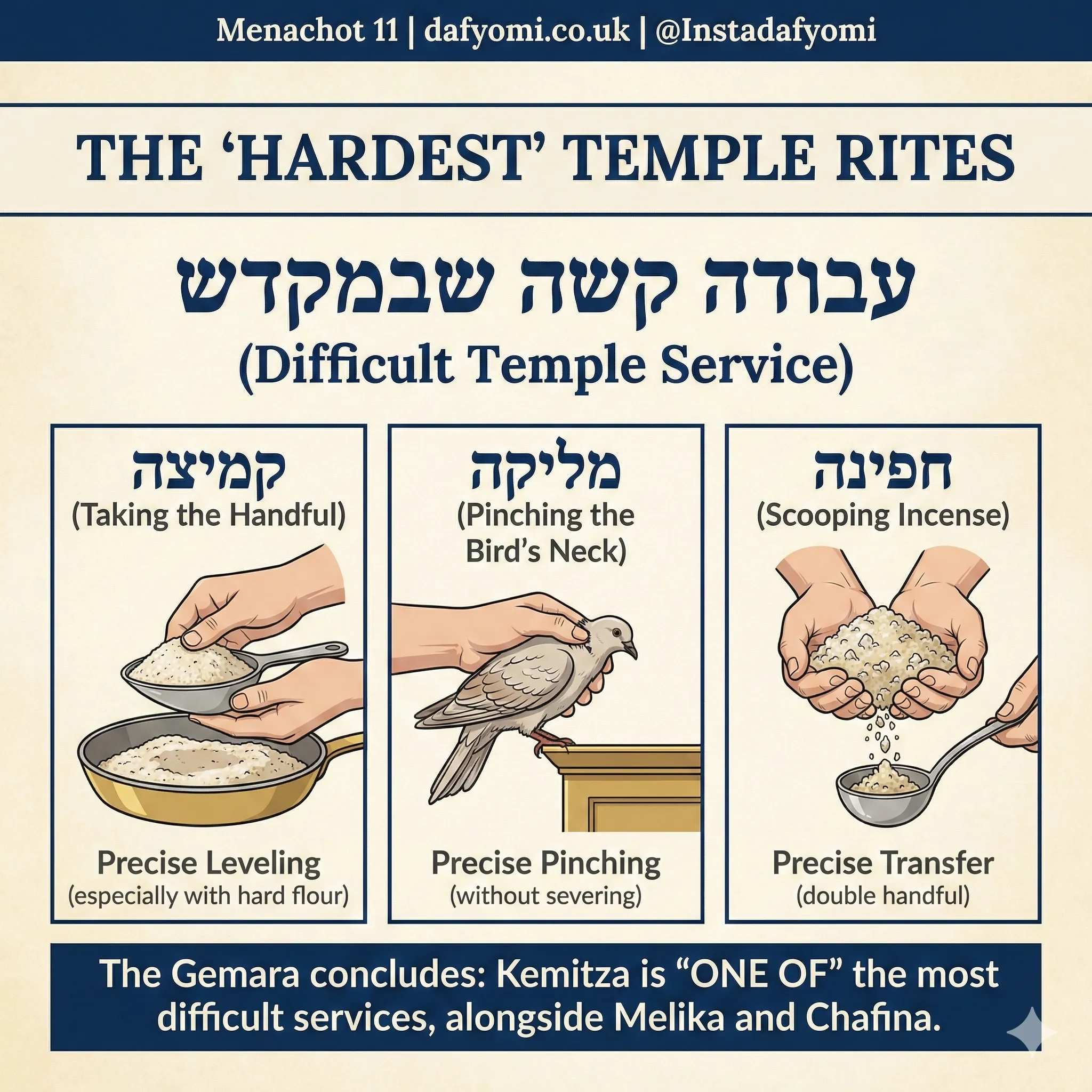
זֶהוּ וְתוּ לָא? וְהָאִיכָּא מְלִיקָה, וְהָאִיכָּא חֲפִינָה! אֶלָּא זוֹ הִיא אַחַת מֵעֲבוֹדוֹת קָשׁוֹת שֶׁבַּמִּקְדָּשׁ.
English Translation:
The Gemara asks: This one is the hardest sacrificial rite, and no other? But isn’t there pinching the nape of the neck of a bird offering, which is also considered extremely difficult to perform, and isn’t there the scooping of the handful of incense by the High Priest on Yom Kippur, another rite that is extremely difficult to perform? Rather, the baraita means that this taking of the handful of a meal offering is one of the most difficult sacrificial rites in the Temple.
קלאוד על הדף:
The Gemara challenges the superlative: melika (pinching a bird’s neck with the fingernail) and chafina (the High Priest’s Yom Kippur incense scooping) are also notoriously difficult! The resolution: kemitza is ONE OF the most difficult services, not THE most difficult.
Key Terms:
- מְלִיקָה (Melika) = Pinching — killing a bird offering by severing with the fingernail
- חֲפִינָה (Chafina) = Scooping — the High Priest’s incense handful on Yom Kippur
Segment 13
TYPE: גמרא
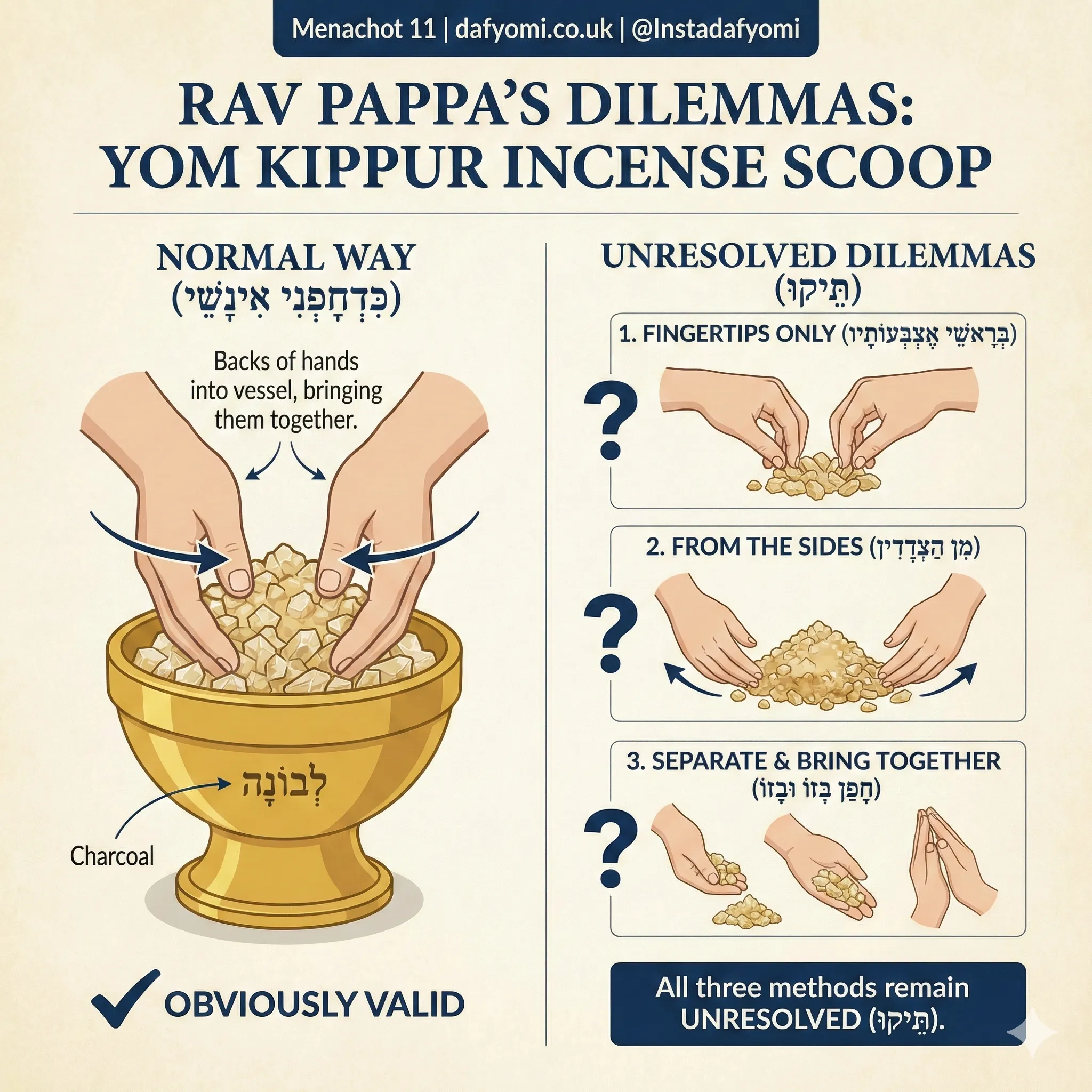
Rav Pappa: Dilemmas about abnormal kemitza
Hebrew/Aramaic:
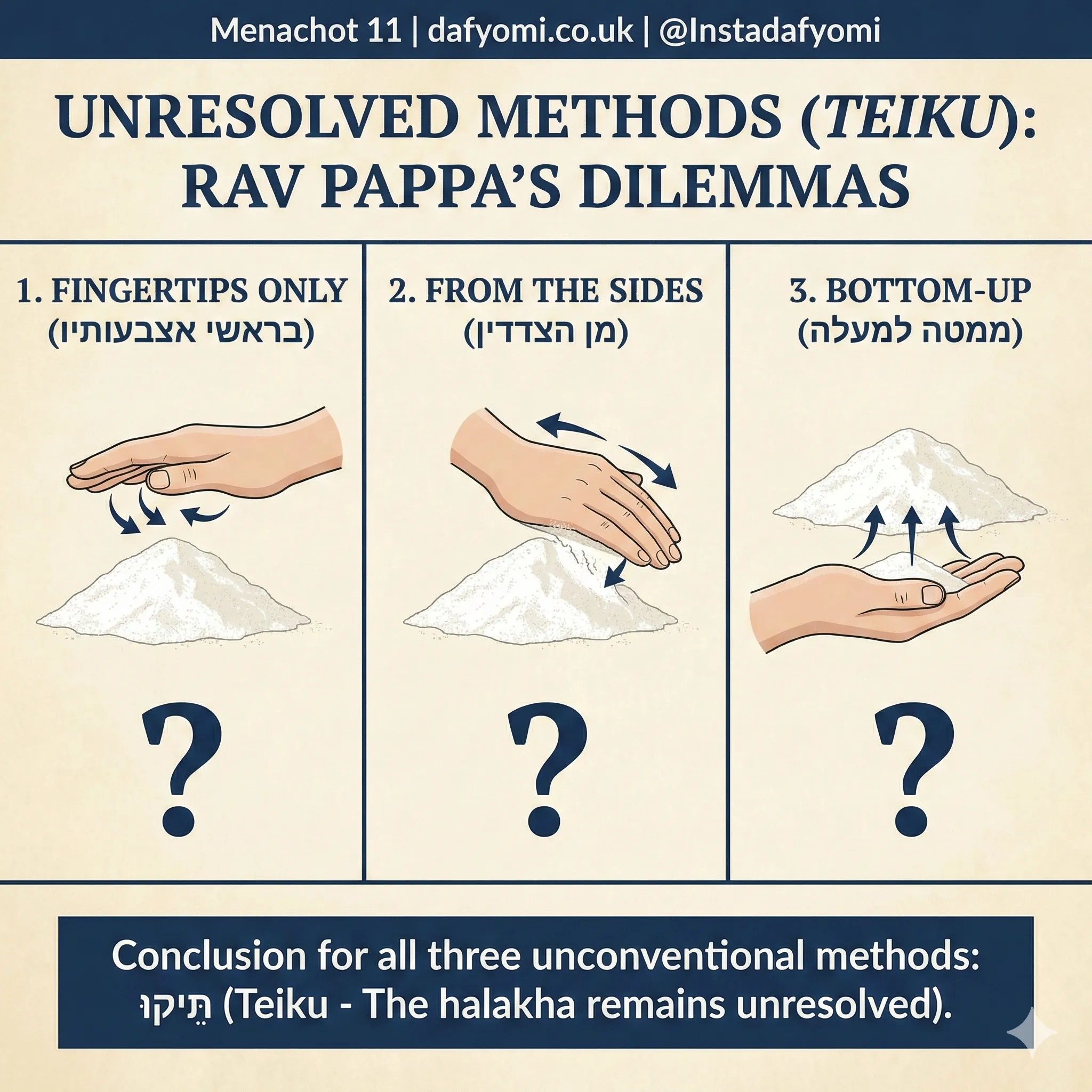
אָמַר רַב פָּפָּא: פְּשִׁיטָא לִי, ״מְלֹא קֻמְצוֹ״ כִּדְקָמְצִי אִינָשֵׁי. בָּעֵי רַב פָּפָּא: קָמַץ בְּרָאשֵׁי אֶצְבְּעוֹתָיו, מַאי?
English Translation:
Rav Pappa said: It is obvious to me that the term “his handful” means that the removal of the handful from a meal offering should be performed ab initio in the manner that people usually remove a handful, with their fingertips angled to the side. Rav Pappa raises a dilemma: What is the halakha if the priest removed a handful with his fingertips, i.e., if he placed his hand horizontally over the meal offering and filled his palm with flour by closing his fingers to his palm? Does this disqualify the taking of the handful or not?
קלאוד על הדף:
Rav Pappa begins a series of dilemmas about non-standard kemitza methods. The ideal is clear: scoop normally. But what if performed differently — using only fingertips (without the palm)?
Segment 14
TYPE: גמרא
More dilemmas: From the sides, from below
Hebrew/Aramaic:
מִן הַצְּדָדִין, מַאי? מִמַּטָּה לְמַעְלָה, מַאי? תֵּיקוּ.
English Translation:
Similarly, if the priest took a handful from the sides, by passing the back of his hand back and forth over the flour in the vessel so that the flour collected in his palm by way of the side of his palm, what is the halakha? Furthermore, if he took the handful with the back of his hand placed downward in the vessel, and with his fingers he collected the flour upward into his palm, what is the halakha? Are the handfuls removed in this manner fit for sacrifice? The Gemara states: These dilemmas shall stand unresolved.
קלאוד על הדף:
The dilemmas continue: What about scooping from the side? Or with the hand inverted, collecting upward? These remain teiku — unresolved. The practical implication: such methods should be avoided ab initio, though their post-facto status is uncertain.
Key Terms:
- תֵּיקוּ (Teiku) = Stands unresolved — a classic Talmudic impasse
Segment 15
TYPE: גמרא
Rav Pappa: Dilemmas about the High Priest’s chafina
Hebrew/Aramaic:
אָמַר רַב פָּפָּא: פְּשִׁיטָא לִי, ״מְלֹא חׇפְנָיו״ כִּדְחָפְנִי אִינָשֵׁי. בָּעֵי רַב פָּפָּא: חָפַן בְּרָאשֵׁי אֶצְבְּעוֹתָיו מַהוּ? מִן הַצְּדָדִין מַהוּ? חָפַן בְּזוֹ וּבָזוֹ וְקֵרְבָן זוֹ אֵצֶל זוֹ מַהוּ? תֵּיקוּ.
English Translation:
Rav Pappa said: It is obvious to me that when the Torah states: “His handful” (Leviticus 16:12), in the context of the scooping of handfuls of incense by the High Priest on Yom Kippur, it means in the manner that people usually scoop a handful, by placing the backs of their hands into the vessel and bringing their hands together. Rav Pappa raises a dilemma: What is the halakha if the High Priest scooped a handful with his fingertips? What is the halakha if he took a handful from the sides? What is the halakha if he scooped a handful with this hand and with that hand separately and then brought them together? The Gemara states: These dilemmas shall stand unresolved.
קלאוד על הדף:
Rav Pappa raises parallel dilemmas about the High Priest’s Yom Kippur chafina (two-handed incense scooping). The standard method uses both hands together; what if done separately and then combined? Also teiku.
Key Terms:
- מְלֹא חׇפְנָיו (Melo Chofnav) = His two-handed handful (for Yom Kippur incense)
Segment 16
TYPE: גמרא
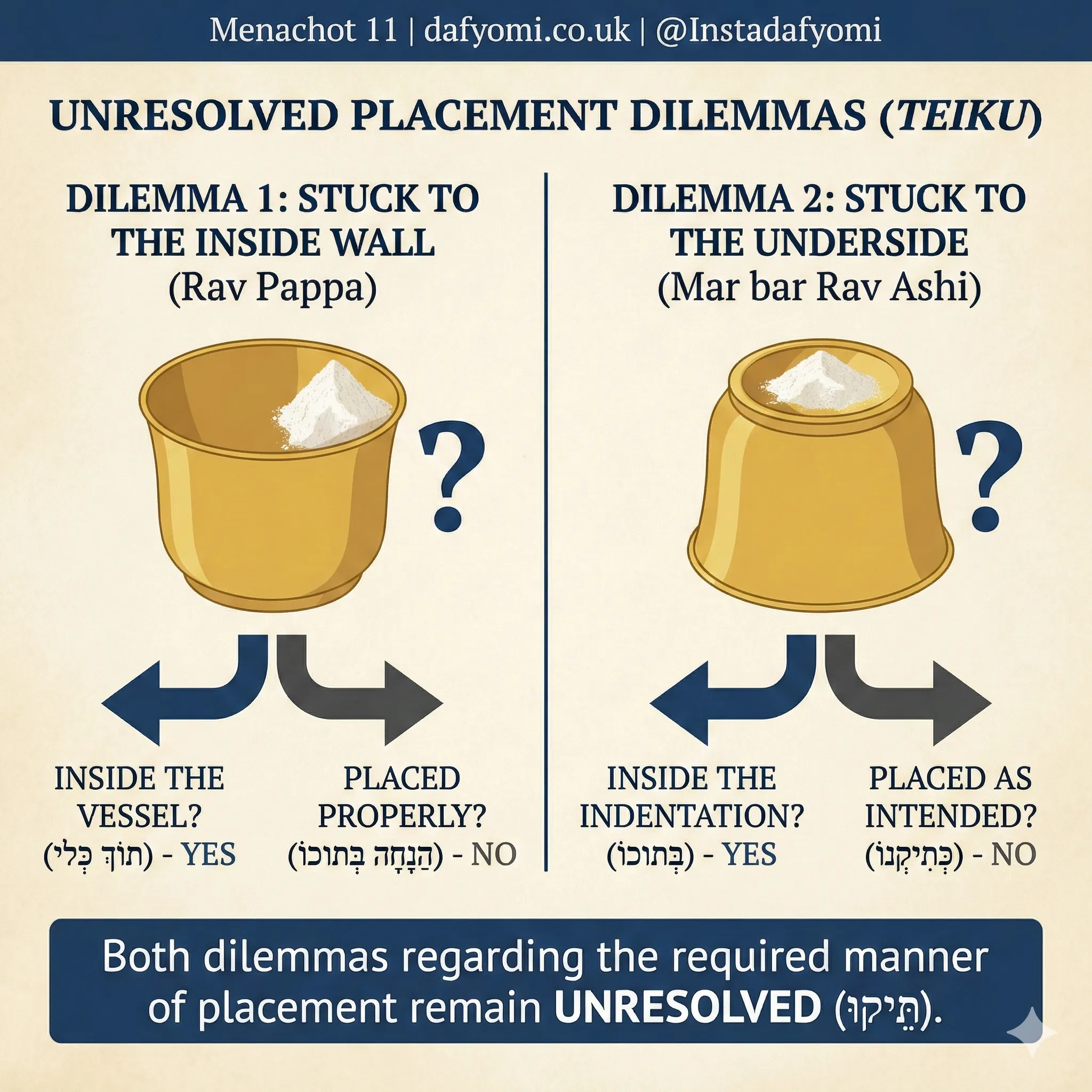
Dilemma: Handful stuck to the side of the vessel
Hebrew/Aramaic:
בָּעֵי רַב פָּפָּא: דַּבְּקֵיהּ לְקוֹמֶץ בְּדַפְנֵיהּ דְּמָנָא, מַאי? תּוֹךְ כְּלִי בָּעֵינַן, וְהָאִיכָּא, אוֹ דִלְמָא הַנָּחָה בְּתוֹכוֹ בָּעֵינַן, וְלֵיכָּא? תֵּיקוּ.
English Translation:
Rav Pappa raises yet another dilemma: If the priest took the handful from the vessel containing the meal offering and stuck the handful onto the side of the second vessel in order to sanctify it, i.e., the handful was not placed directly into the vessel, what is the halakha? Do we require that the handful be inside the vessel, and that is the case here? Or perhaps we require that the handful be placed properly inside the vessel, and that is not the case in this instance. No answer is found, and the Gemara concludes: The dilemma shall stand unresolved.
קלאוד על הדף:
A new dilemma: after kemitza, the kometz must be placed in a service vessel. If stuck to the vessel’s inner wall (rather than resting on the bottom), is it “inside”? The question hinges on whether mere containment suffices or proper placement is required. Teiku.
Segment 17
TYPE: גמרא
Mar bar Rav Ashi: Dilemma about inverted vessel
Hebrew/Aramaic:
בָּעֵי מָר בַּר רַב אָשֵׁי: הַפְכֵיהּ לְמָנָא, וְדַבְּקֵיהּ לְקוֹמֶץ בְּאַרְעִיתָא דְּמָנָא, מַאי? הַנָּחָה בְּתוֹכוֹ בָּעֵינַן, וְהָאִיכָּא, אוֹ דִלְמָא כְּתִיקְנוֹ בָּעִינַן, וְלֵיכָּא? תֵּיקוּ.
English Translation:
Mar bar Rav Ashi raises a similar dilemma: If the priest overturned the vessel and stuck the handful to the underside of the vessel, in a case where there was an indentation on the underside, what is the halakha? Do we require that the handful be placed inside the vessel, and that requirement is fulfilled here, as the handful is within the indentation? Or perhaps we require that it be placed properly in the vessel, and that is not the case here. The Gemara states: The dilemma shall stand unresolved.
קלאוד על הדף:
Mar bar Rav Ashi extends the dilemma: what if the vessel is inverted and the kometz placed in an indentation on the underside? Technically “inside” something, but certainly not proper placement. Another teiku.
Segment 18
TYPE: משנה
New Mishna: Procedure for kemitza
Hebrew/Aramaic:
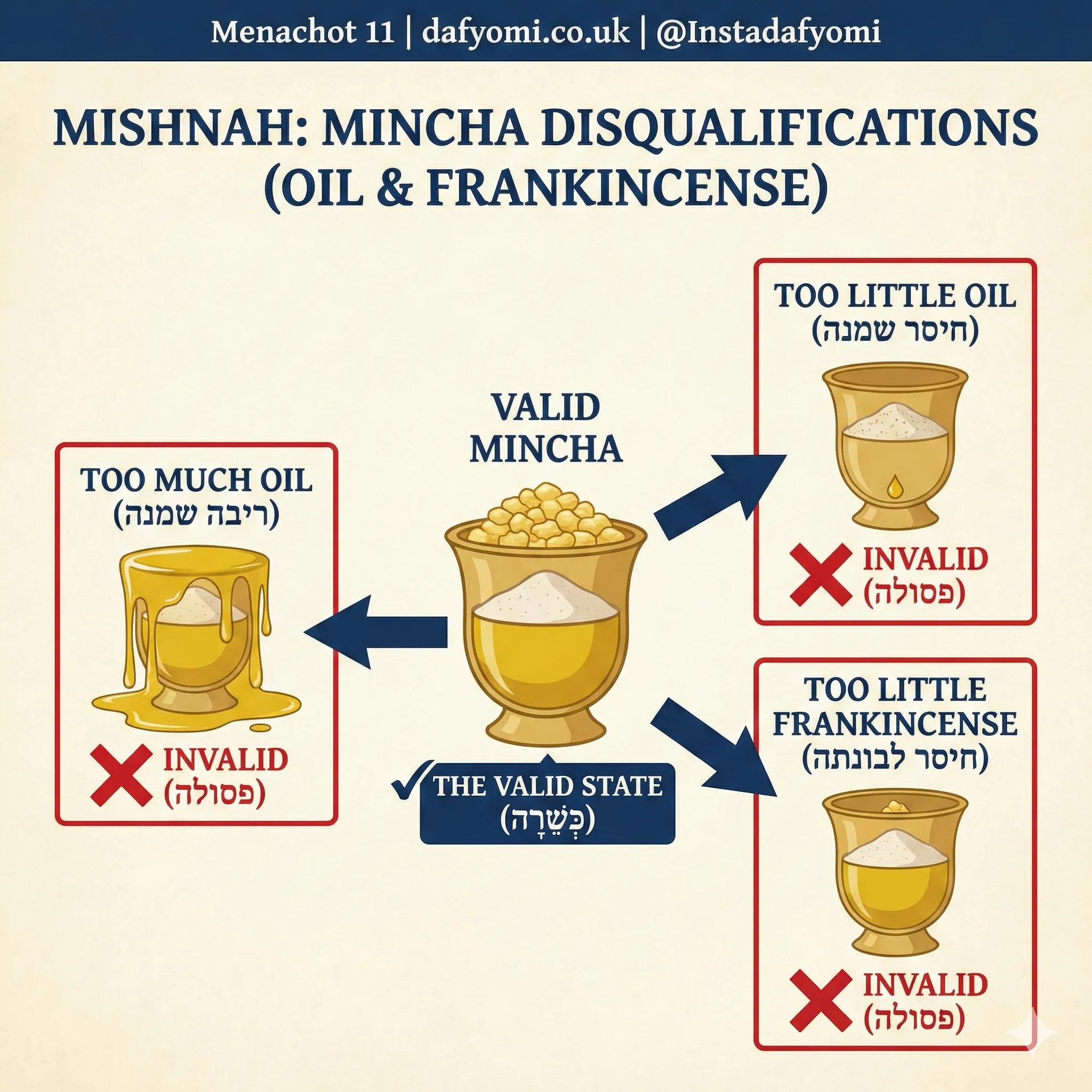
מַתְנִי׳ כֵּיצַד הוּא עוֹשֶׂה? פּוֹשֵׁט אֶת אֶצְבְּעוֹתָיו עַל פַּס יָדוֹ. רִיבָּה שַׁמְנָהּ, חִסֵּר שַׁמְנָהּ, חִיסֵּר לְבוֹנָתָהּ – פְּסוּלָה.
English Translation:
MISHNA: How does the priest perform the removal of a handful? He extends his fingers onto the palm of his hand. If one increased its oil, decreased its oil, or decreased its frankincense, beyond the appropriate measures, the meal offering is unfit.
קלאוד על הדף:
A new Mishna begins with a concise description of kemitza: extending fingers to the palm. It then addresses oil and frankincense quantities. Both excess and deficient oil disqualify; deficient frankincense also disqualifies. The Mishna does not mention excess frankincense here — a point the Gemara will explore.
Key Terms:
- רִיבָּה שַׁמְנָהּ (Ribbah Shamnah) = Increased its oil
- חִסֵּר שַׁמְנָהּ (Chiser Shamnah) = Decreased its oil
Segment 19
TYPE: גמרא
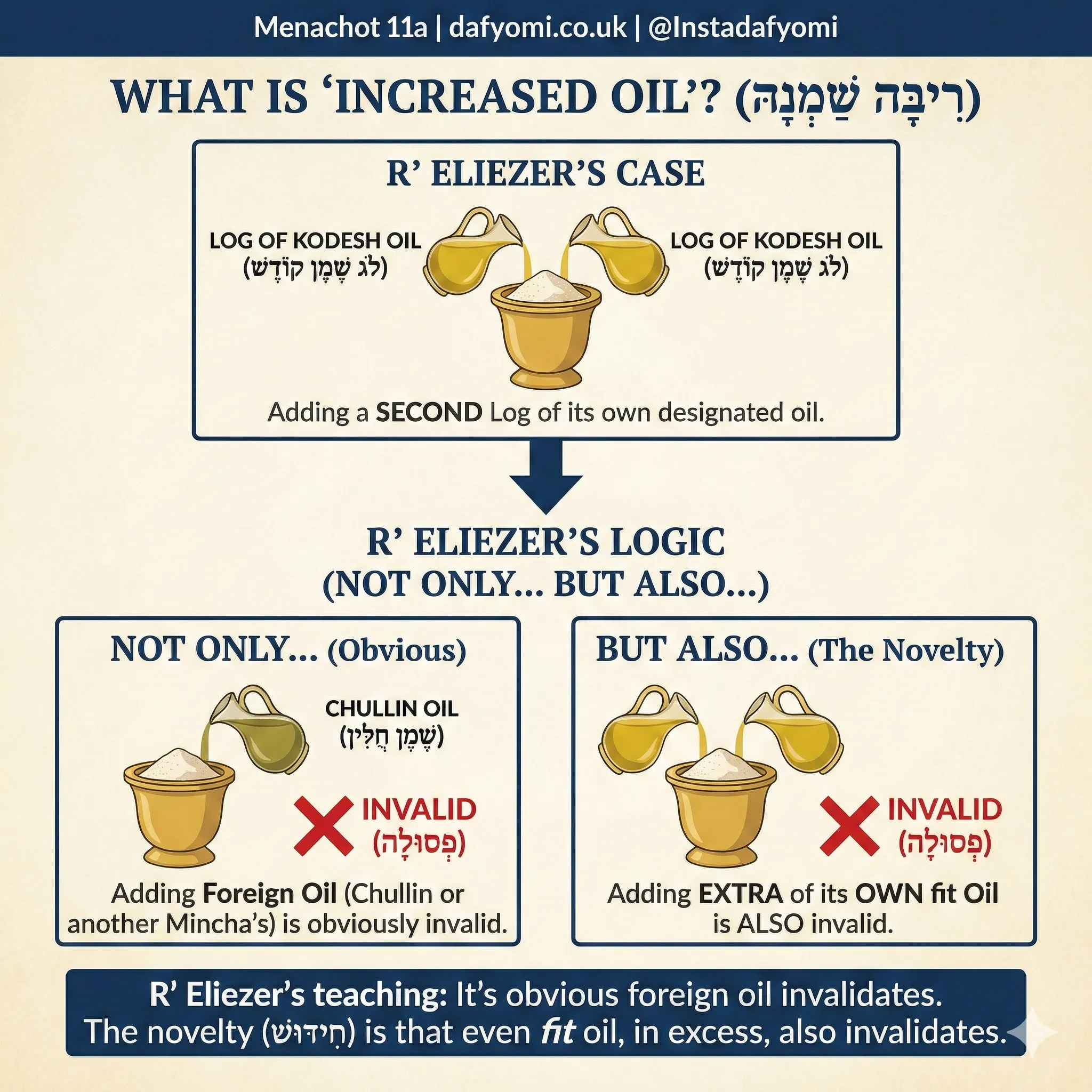
Rabbi Eliezer: What constitutes “increased oil”?
Hebrew/Aramaic:
גְּמָ׳ הֵיכִי דָמֵי רִיבָּה שַׁמְנָהּ? אָמַר רַבִּי אֱלִיעֶזֶר: כְּגוֹן שֶׁהִפְרִישׁ לָהּ שְׁנֵי לוּגִּין. וְלוֹקְמַהּ כְּגוֹן דְּעָרֵיב בָּהּ שֶׁמֶן דְּחוּלִּין וָשֶׁמֶן דַּחֲבֶירְתַּהּ!
English Translation:
GEMARA: What are the circumstances of a case where the meal offering is disqualified due to the fact that one increased its oil? Rabbi Eliezer says: The circumstances are a case where he separated two log of oil for the meal offering instead of one log, and mixed them into a tenth of an ephah of flour. The Gemara raises a difficulty: And let Rabbi Eliezer interpret the mishna as referring to a case where he mixed non-sacred oil or the oil of another meal offering into the meal offering.
קלאוד על הדף:
The Gemara asks: what exactly is “increased oil”? Rabbi Eliezer specifies: separating two log (instead of one) for a single meal offering. The Gemara questions this narrow interpretation — why not also include non-sacred oil or oil from another offering?
Key Terms:
- לוֹג (Log) = A liquid measure (approximately 300ml)
- חוּלִּין (Chullin) = Non-sacred/ordinary
Segment 20
TYPE: גמרא
Challenge from the sinner’s meal offering
Hebrew/Aramaic:
וְכִי תֵּימָא, שֶׁמֶן דְּחוּלִּין וָשֶׁמֶן דַּחֲבֶירְתַּהּ לָא פָּסֵל, מַתְקֵיף לַהּ רַב זוּטְרָא בַּר טוֹבִיָּה: אֶלָּא מֵעַתָּה, מִנְחַת חוֹטֵא דְּפָסֵל בָּהּ שֶׁמֶן, הֵיכִי מַשְׁכַּחַתְּ לַהּ?
English Translation:
And if you would say that non-sacred oil and the oil of another meal offering do not disqualify a meal offering, Rav Zutra bar Toviyya objects to this claim: If that is so, then with regard to the meal offering of a sinner, of which it is stated (59b) that oil disqualifies it, how can you find the circumstances where it is in fact disqualified?
קלאוד על הדף:
Rav Zutra bar Toviyya raises a powerful objection: the mincha of a sinner (which has no oil) is disqualified if oil is added. If non-sacred oil doesn’t disqualify, how would this ever apply?
Key Terms:
- מִנְחַת חוֹטֵא (Minchat Chotei) = Sinner’s meal offering — brought without oil or frankincense
Segment 21
TYPE: גמרא
Elaboration of the challenge
Hebrew/Aramaic:
אִי דִּידַהּ – הָא לֵית לַהּ, אִי דְּחוּלִּין וְדַחֲבֶירְתַּהּ – הָא אָמְרַתְּ לָא פָּסֵל, (וְאִי אָמְרַתְּ דְּאַפְרֵישׁ לֵהּ שֶׁמֶן – כֵּיוָן דְּלֵית לֵהּ שֶׁמֶן כְּלָל, חוּלִּין נִינְהוּ).
English Translation:
Rav Zutra bar Toviyya elaborates: If you suggest that he mixed its own oil into the flour, such a case does not exist, as the meal offering of a sinner does not have any oil. If he mixed non-sacred oil or that of another meal offering into the flour, the meal offering should not be disqualified, as you said that such oil does not disqualify a meal offering. And if you would say that he designated oil for his meal offering and mixed it into the flour despite the Torah prohibition against mixing oil into it, I say that since the meal offering of a sinner does not have oil at all, any oil that he separates and mixes into it is considered non-sacred, and you have already said that non-sacred oil does not disqualify a meal offering.
קלאוד על הדף:
The challenge is complete: (1) The sinner’s offering has no oil of its own; (2) If non-sacred oil doesn’t disqualify, there’s no scenario where oil invalidates it; (3) Even if someone designates oil for it, since this offering has no oil requirement, that oil is merely chullin. The conclusion: non-sacred oil must also disqualify!
Segment 22
TYPE: גמרא
Resolution: Rabbi Eliezer used “it is not necessary” style
Hebrew/Aramaic:
וְרַבִּי אֱלִיעֶזֶר לָא מִיבַּעְיָא קָאָמַר: לָא מִיבַּעְיָא דְּחוּלִּין וְדַחֲבֶירְתַּהּ דְּפָסֵיל, אֲבָל הִפְרִישׁ לָהּ שְׁנֵי לוּגִּין, הוֹאִיל וְהַאי חֲזֵי לֵיהּ וְהַאי חֲזֵי לֵיהּ, אֵימָא לָא לִיפְּסִיל – קָא מַשְׁמַע לַן.
English Translation:
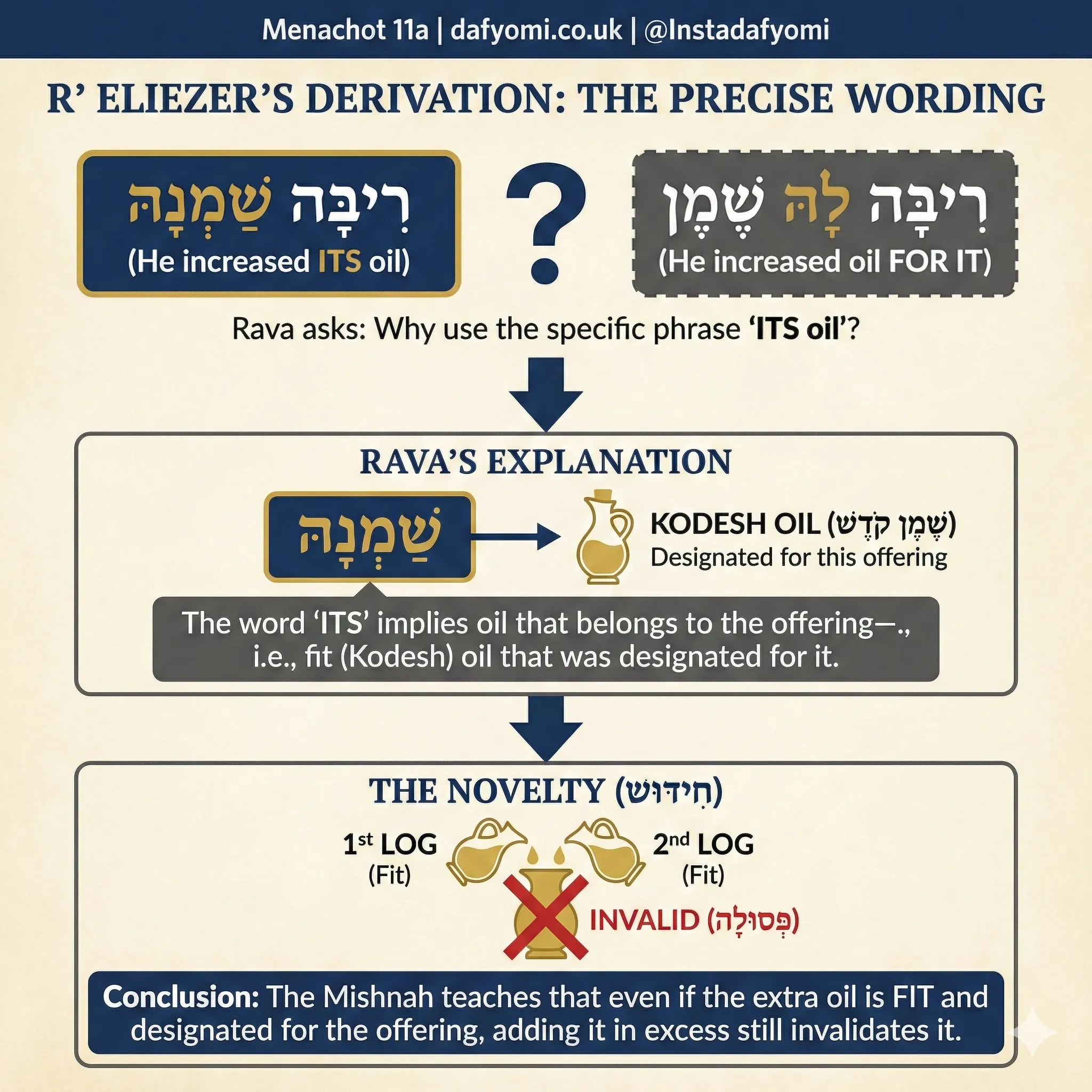
The Gemara responds: In fact, non-sacred oil and the oil of another meal offering do disqualify a meal offering, and Rabbi Eliezer is speaking utilizing the style of: It is not necessary, as follows: It is not necessary to say that non-sacred oil and the oil of another meal offering disqualify a meal offering. But in a case where one separated two log for his meal offering, since this first log is fit for the meal offering, and that second log is also fit for it, one might say that even when he mixes both log into the meal offering, it should not disqualify the meal offering. Therefore, Rabbi Eliezer teaches us that the meal offering is disqualified in this case as well.
קלאוד על הדף:
Resolution using the “lo miba’ya” (it goes without saying) rhetorical style. Non-sacred oil obviously disqualifies. Rabbi Eliezer’s chidush (novelty) is that even two log of the offering’s OWN oil — both individually fit — together disqualify because of the excess.
Key Terms:
- לָא מִיבַּעְיָא (Lo Miba’ya) = It is not necessary [to state] — indicating an a fortiori argument
Segment 23
TYPE: גמרא
Rava: Why the Mishna’s wording supports this
Hebrew/Aramaic:
וּמְנָא לֵיהּ לְרַבִּי אֱלִיעֶזֶר הָא? אָמַר רָבָא: מַתְנִיתִין קְשִׁיתֵיהּ, מַאי אִירְיָא דְּתָנֵי ״רִיבָּה שַׁמְנָהּ״? לִיתְנֵי ״רִיבָּה לָהּ שֶׁמֶן״! אֶלָּא הָא קָא מַשְׁמַע לַן, דְּאַף עַל גַּב דְּהִפְרִישׁ לָהּ שְׁנֵי לוּגִּין.
English Translation:
The Gemara asks: And from where does Rabbi Eliezer derive this conclusion? Rava said: The terminology of the mishna posed a difficulty for him, as one can ask: Why does the tanna specifically teach that the meal offering is disqualified if he increased its oil, which indicates that he increased it with oil belonging to the offering itself? Let the mishna teach simply: He increased the oil. Rather, this is what the mishna teaches us: That even though he initially separated two log of oil for the meal offering, its own oil disqualifies the offering when there is too much.
קלאוד על הדף:
Rava explains Rabbi Eliezer’s textual basis: the Mishna says “ribbah SHAMNAH” (increased ITS oil) — possessive language implying the offering’s own oil. If any oil disqualified, it would say simply “ribbah shemen” (increased oil). The specific wording teaches that even the offering’s own oil, when doubled, disqualifies.
Segment 24
TYPE: גמרא
Baraita: The three-way dispute on minimum frankincense
Hebrew/Aramaic:
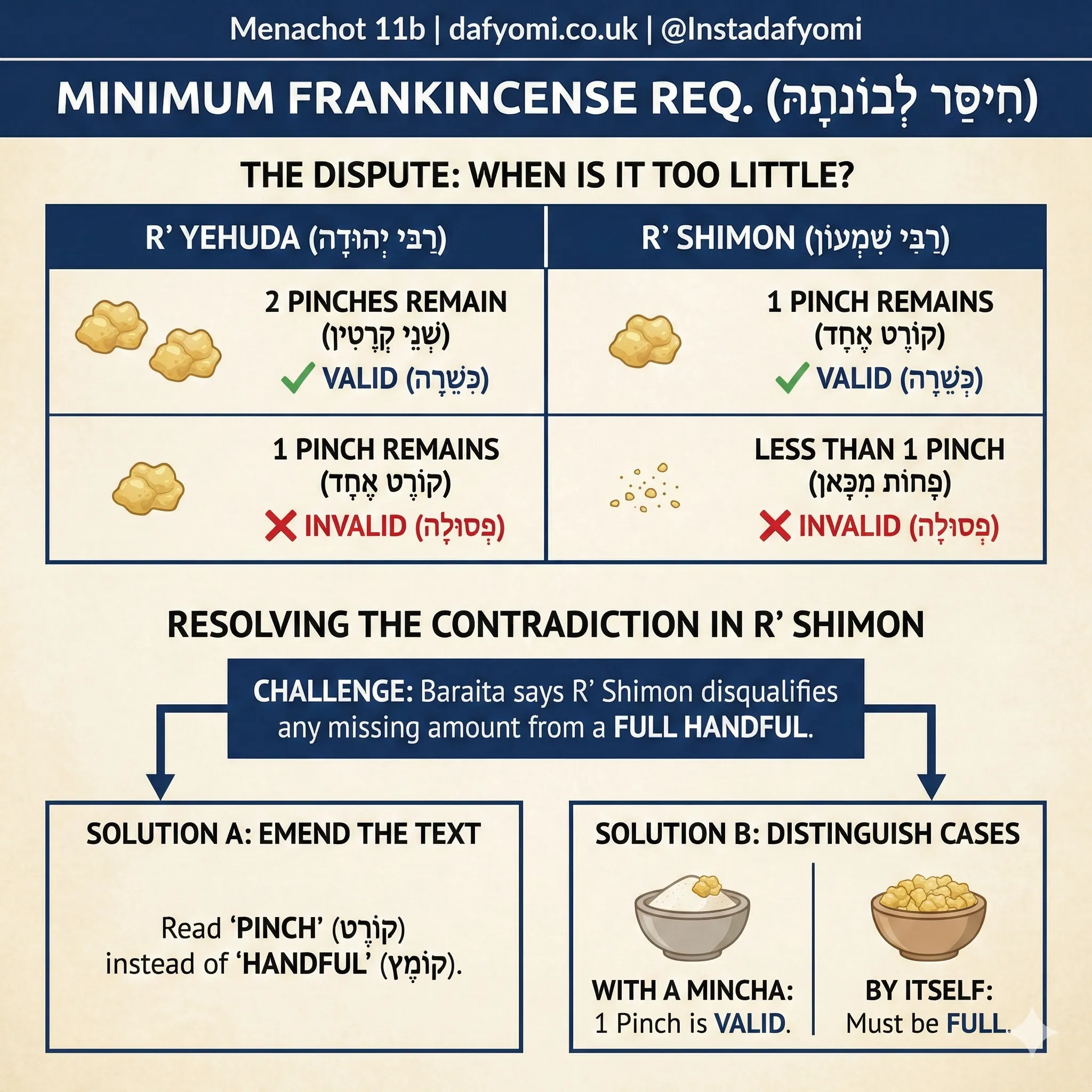
חִיסֵּר לְבוֹנָתָהּ. תָּנוּ רַבָּנַן: חָסְרָה וְעָמְדָה עַל קוֹרֶט אֶחָד – פְּסוּלָה, עַל שְׁנֵי קְרָטִין – כְּשֵׁרָה, דִּבְרֵי רַבִּי יְהוּדָה. רַבִּי שִׁמְעוֹן אוֹמֵר: עַל קוֹרֶט אֶחָד – כְּשֵׁרָה, פָּחוֹת מִכָּאן – פְּסוּלָה.
English Translation:
§ The mishna teaches that if one decreased its frankincense beyond its appropriate measure, the meal offering is unfit. Concerning this, the Sages taught in a baraita: If one decreased its frankincense to the point that the amount stood at only one pinch, it is disqualified, but if the decreased amount stood at two pinches, it is fit; this is the statement of Rabbi Yehuda. Rabbi Shimon says: If the decreased amount stood at one pinch, it is fit; less than that, it is disqualified.
קלאוד על הדף:
The Gemara introduces a tannaitic dispute about minimum frankincense. Rabbi Yehuda: minimum is two pinches (koratim); one pinch is invalid. Rabbi Shimon: one pinch suffices; less than one is invalid. A third opinion (Rabbi Meir, to be mentioned on 11b) requires a full handful.
Key Terms:
- קוֹרֶט (Koret) = A pinch — a small amount of frankincense
- קְרָטִין (Koratin) = Pinches (plural)
Amud Bet (11b)
Segment 1
TYPE: גמרא
Challenge from a baraita about Rabbi Shimon
Hebrew/Aramaic:
וְהָתַנְיָא (רַבִּי שִׁמְעוֹן אוֹמֵר): קוֹמֶץ לְבוֹנָה שֶׁחָסַר כׇּל שֶׁהוּא – פָּסוּל. תְּנִי: קוֹרֶט לְבוֹנָה שֶׁחָסַר כׇּל שֶׁהוּא – פָּסוּל. וְאִיבָּעֵית אֵימָא: כָּאן בִּלְבוֹנָה הַבָּאָה עִם הַמִּנְחָה, כָּאן בִּלְבוֹנָה הַבָּאָה בִּפְנֵי עַצְמָהּ.
English Translation:
The Gemara asks: But isn’t it taught in a baraita that Rabbi Shimon says: A handful of flour or frankincense that was decreased by any amount from its full measure is disqualified? The Gemara answers that one should teach the baraita as follows: A pinch of frankincense that was decreased by any amount is disqualified. And if you wish, say instead that here, the first cited statement of Rabbi Shimon, is referring to the case of frankincense that comes with a meal offering, and this frankincense is disqualified only when there is less than a pinch, whereas there, the second statement of Rabbi Shimon, is referring to the case of frankincense that comes by itself. Such frankincense is disqualified if it comprises any less than its full measure.
קלאוד על הדף:
A contradiction in Rabbi Shimon’s view! One baraita says he requires only one koret; another says ANY reduction from a kometz disqualifies. Two resolutions: (1) Emend “kometz” to “koret” in the second baraita; (2) Distinguish between frankincense with a meal offering (lenient — one koret) vs. frankincense alone (strict — full kometz required).
Segment 2
TYPE: גמרא
Rabbi Yochanan: Three disputes explained
Hebrew/Aramaic:
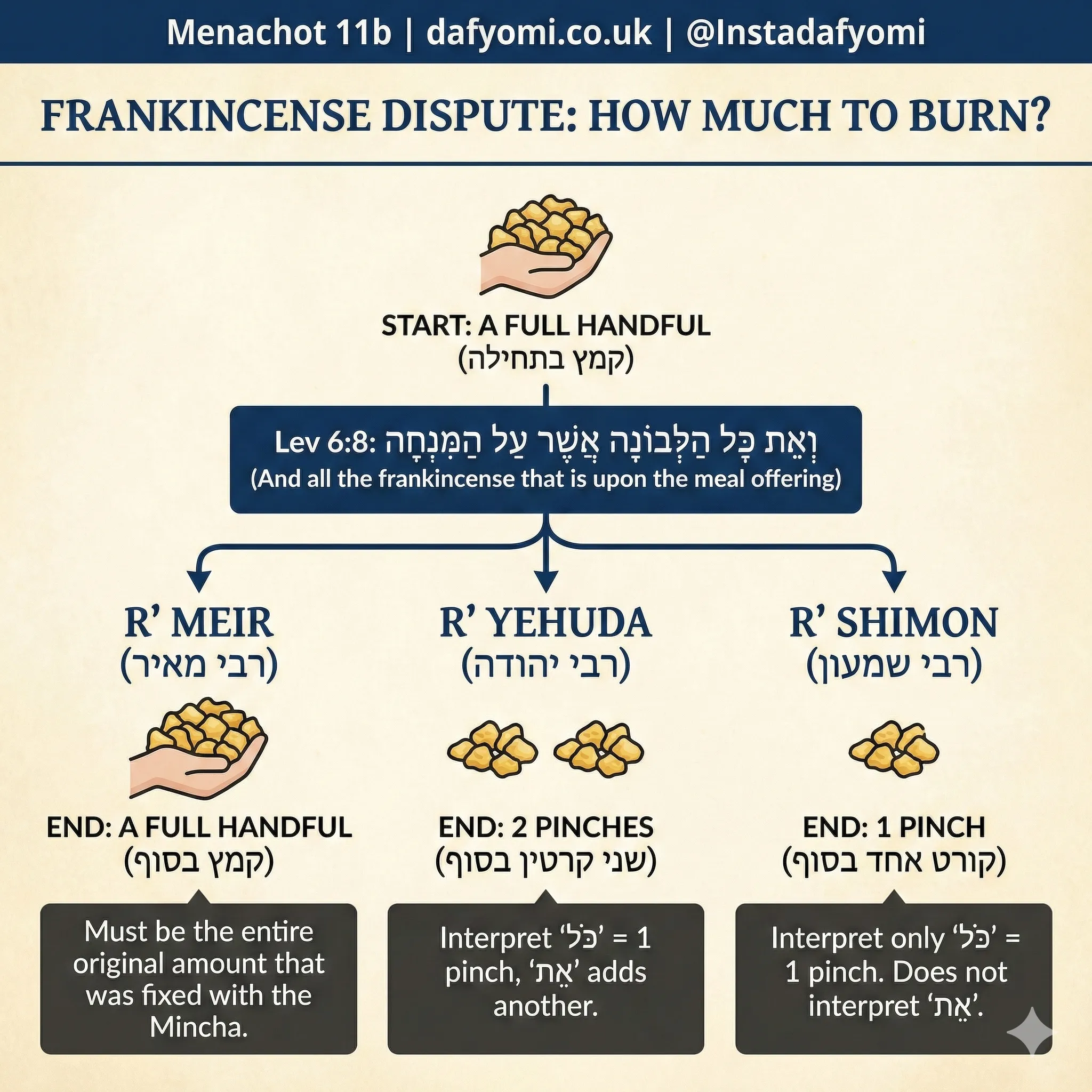
אָמַר רַבִּי יִצְחָק בַּר יוֹסֵף, אָמַר רַבִּי יוֹחָנָן: שָׁלֹשׁ מַחְלוֹקֹות בַּדָּבָר, רַבִּי מֵאִיר סָבַר: קוֹמֵץ בַּתְּחִילָּה וְקוֹמֵץ בַּסּוֹף, וְרַבִּי יְהוּדָה סָבַר: קוֹמֶץ בַּתְּחִילָּה וּשְׁנֵי קְרָטִין בַּסּוֹף, וְרַבִּי שִׁמְעוֹן סָבַר: קוֹמֶץ בַּתְּחִילָּה וְקוֹרֶט אֶחָד בַּסּוֹף.
English Translation:
Rabbi Yitzḥak bar Yosef says that Rabbi Yoḥanan says: There are three disputes of tanna’im with regard to the matter. Rabbi Meir holds that the priest must remove a handful at the beginning, and ultimately the entire handful must be burned upon the altar. And Rabbi Yehuda holds that the priest must remove a handful at the beginning, and ultimately at least two pinches from it must be burned upon the altar. And Rabbi Shimon holds that the priest must remove a handful at the beginning and ultimately at least one pinch from it must be burned upon the altar.
קלאוד על הדף:
Rabbi Yochanan systematizes three tannaitic positions. All agree a full kometz is needed initially. The dispute is about the MINIMUM that must remain for burning: Rabbi Meir — full kometz; Rabbi Yehuda — two koratim; Rabbi Shimon — one koret.
Key Terms:
- בַּתְּחִילָּה (Batchila) = At the beginning
- בַּסּוֹף (BaSof) = At the end/ultimately
Segment 3
TYPE: גמרא
All three derive from the same verse
Hebrew/Aramaic:
וּשְׁלׇשְׁתָּן מִקְרָא אֶחָד דָּרְשׁוּ, ״וְאֵת כׇּל הַלְּבוֹנָה אֲשֶׁר עַל הַמִּנְחָה״. רַבִּי מֵאִיר סָבַר: עַד דְּאִיתָא לִלְבוֹנָה דְּאִיקְּבַעָה בַּהֲדֵי מִנְחָה מֵעִיקָּרָא, וְרַבִּי יְהוּדָה סָבַר: ״כׇּל״ – וַאֲפִילּוּ חַד קוֹרֶט, ״אֶת״ – לְרַבּוֹת קוֹרֶט אַחֵר, וְרַבִּי שִׁמְעוֹן ״אֶת״ לָא דָּרֵישׁ.
English Translation:
And all three of them interpret a single verse differently. The verse states: “And he shall take up from there his handful, of the fine flour of the meal offering, and of the oil of it, and [ve’et] all the frankincense that is upon the meal offering, and shall make it smoke upon the altar” (Leviticus 6:8). Rabbi Meir holds that one may not make the offering smoke upon the altar unless there remains the entire measure of frankincense that was initially fixed together with the meal offering. And Rabbi Yehuda holds that when the verse states: “All [kol],” it is referring to any part of the frankincense, even a single pinch, as kol can mean any amount. And when the verse states: “Et,” this serves to include another pinch. Accordingly, at least two pinches must remain to be burned upon the altar. And Rabbi Shimon interprets the word “all” in the same manner as does Rabbi Yehuda, but he does not interpret and derive a halakha from the term “et,” and he therefore holds that only one pinch must remain to be burned.
קלאוד על הדף:
Remarkably, all three derive their positions from ONE verse (Leviticus 6:8). Rabbi Meir reads “all the frankincense” literally — the full amount. Rabbi Yehuda: “kol” means even one koret; “et” adds a second koret. Rabbi Shimon agrees about “kol” but doesn’t derive from “et” — hence one koret suffices.
Key Terms:
- אֶת (Et) = Direct object marker — often used for additional derivations
- כׇּל (Kol) = All — can mean “any” or “the entirety”
Segment 4
TYPE: גמרא
Rabbi Yochanan: The dispute is only for frankincense with meal offerings
Hebrew/Aramaic:
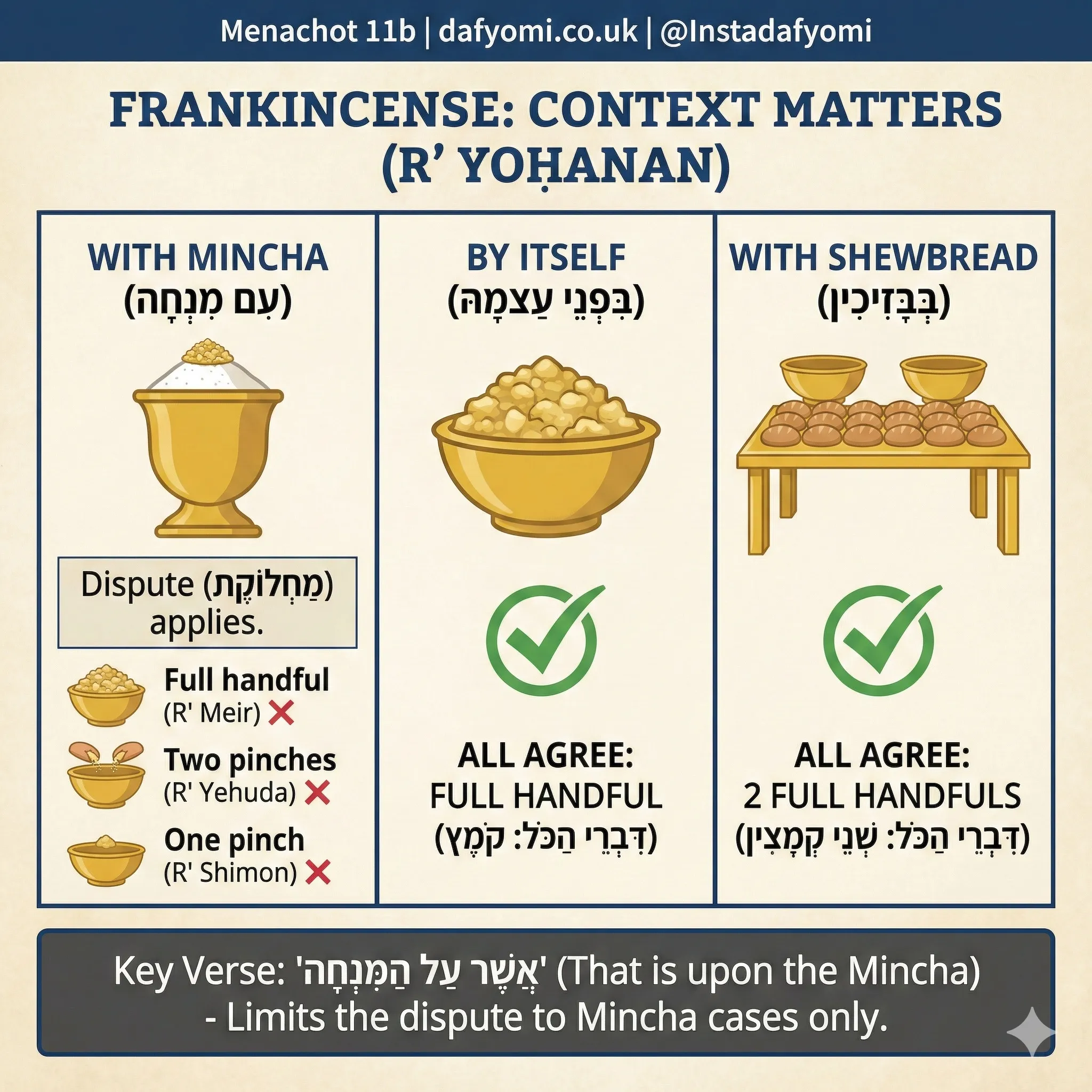
וְאָמַר רַבִּי יִצְחָק בַּר יוֹסֵף, אָמַר רַבִּי יוֹחָנָן: מַחְלוֹקֶת בִּלְבוֹנָה הַבָּאָה עִם הַמִּנְחָה, אֲבָל בִּלְבוֹנָה הַבָּאָה בִּפְנֵי עַצְמָהּ – דִּבְרֵי הַכֹּל קוֹמֶץ בַּתְּחִילָּה וְקוֹמֶץ בַּסּוֹף. לְהָכִי אִיצְטְרִיךְ ״אֲשֶׁר עַל הַמִּנְחָה״, דְּבַהֲדֵי מִנְחָה – אִין, בִּפְנֵי עַצְמָהּ – לָא.
English Translation:
And Rabbi Yitzḥak bar Yosef further says that Rabbi Yoḥanan says: The dispute between these tanna’im is with regard to frankincense that comes with a meal offering. But with regard to frankincense that comes by itself, everyone, even Rabbi Yehuda and Rabbi Shimon, agrees that the priest must bring a handful at the beginning, and ultimately the entire handful must be burned upon the altar. For this reason it was necessary for the verse to state: “That is upon the meal offering,” as this indicates that together with a meal offering, yes, one may burn the frankincense even if there remains only a pinch or two, but with regard to frankincense that comes by itself, one may not burn it if it is in that state.
קלאוד על הדף:
Important limitation: the dispute applies only to frankincense accompanying a meal offering. For frankincense brought independently (a voluntary offering), all agree a full kometz is required throughout. The phrase “that is upon the meal offering” limits the leniency to that context.
Key Terms:
- בִּפְנֵי עַצְמָהּ (Bifnei Atzmah) = By itself — frankincense as a standalone offering
Segment 5
TYPE: גמרא
Regarding the showbread’s frankincense
Hebrew/Aramaic:
וְאָמַר רַבִּי יִצְחָק בַּר יוֹסֵף, אָמַר רַבִּי יוֹחָנָן: מַחְלוֹקֶת בִּלְבוֹנָה הַבָּאָה עִם הַמִּנְחָה, אֲבָל בִּלְבוֹנָה הַבָּאָה בְּבָזִיכִין – דִּבְרֵי הַכֹּל שְׁנֵי קְמָצִין בַּתְּחִילָּה, וּשְׁנֵי קְמָצִין בַּסּוֹף.
English Translation:
And Rabbi Yitzḥak bar Yosef says that Rabbi Yoḥanan says: The dispute between these tanna’im is with regard to frankincense that comes with a meal offering. But with regard to frankincense that comes in bowls together with the shewbread, everyone, even Rabbi Yehuda and Rabbi Shimon, agrees that there must be two handfuls in the beginning, one handful for each bowl, and ultimately there must also be two handfuls.
קלאוד על הדף:
Another clarification: the showbread (lechem hapanim) has two bowls of frankincense. Everyone agrees these require full handfuls — two at the start, two at the end. The dispute’s leniency doesn’t extend to the bazichin.
Key Terms:
- בָּזִיכִין (Bazichin) = Bowls — the two bowls of frankincense accompanying the showbread
- לֶחֶם הַפָּנִים (Lechem HaPanim) = Showbread — twelve loaves displayed weekly in the Temple
Segment 6
TYPE: גמרא
Why this needed to be stated
Hebrew/Aramaic:
פְּשִׁיטָא, מַהוּ דְּתֵימָא: כֵּיוָן דְּבַהֲדֵי לֶחֶם אָתְיָא, כַּ״אֲשֶׁר עַל הַמִּנְחָה״ דָּמְיָא, קָא מַשְׁמַע לַן.
English Translation:
The Gemara asks: Isn’t it obvious that this is the case, as with regard to this halakha the verse does not state the term: All, from which one might derive that it is referring to any part of the frankincense? The Gemara explains: This ruling is necessary, lest you say that since the frankincense in the bowls comes together with bread, i.e., the shewbread, it should be considered as: “Frankincense that is upon the meal offering” (Leviticus 6:8), and therefore Rabbi Yehuda and Rabbi Shimon claim that one may sacrifice it even if less than two handfuls remain. Rabbi Yitzḥak bar Yosef teaches us that this is not the case.
קלאוד על הדף:
Why state the obvious? One might have equated the showbread (also “bread”) with meal offerings, applying the same leniency. Rabbi Yochanan teaches that the showbread’s frankincense has its own stricter requirement.
Segment 7
TYPE: גמרא
Amoraic dispute about the scope of the tannaitic debate
Hebrew/Aramaic:
פְּלִיגִי בַּהּ רַבִּי אַמֵּי וְרַבִּי יִצְחָק נַפָּחָא, חַד אָמַר: מַחְלוֹקֶת בִּלְבוֹנָה הַבָּאָה עִם הַמִּנְחָה, אֲבָל בִּלְבוֹנָה הַבָּאָה בִּפְנֵי עַצְמָהּ – דִּבְרֵי הַכֹּל קוֹמֶץ בַּתְּחִילָּה וְקוֹמֶץ בַּסּוֹף, וְחַד אָמַר: כְּמַחְלוֹקֶת בָּזוֹ כָּךְ מַחְלוֹקֶת בָּזוֹ.
English Translation:
The Gemara notes: Rabbi Ami and Rabbi Yitzḥak Nappaḥa disagree with regard to the case of frankincense that comes by itself. One says that the dispute between the tanna’im with regard to whether or not a handful of frankincense that became lacking may be sacrificed upon the altar applies only with regard to frankincense that comes with a meal offering, but with regard to frankincense that comes by itself, everyone agrees that the priest must remove a handful at the beginning and ultimately the entire handful must be burned upon the altar. And one says: Just as there is a dispute in this case, so too, there is a dispute in that case.
קלאוד על הדף:
An amoraic debate about the tannaitic dispute’s scope. One view (agreeing with Rabbi Yochanan): the dispute is limited to frankincense with meal offerings. The other view: the same three-way dispute applies to standalone frankincense too.
Segment 8
TYPE: גמרא
Question: The Mishna implies excess frankincense is valid
Hebrew/Aramaic:
חִיסֵּר לְבוֹנָתָהּ – הָא יָתֵיר כְּשֵׁרָה, וְהָתַנְיָא: יָתֵיר פְּסוּלָה! אָמַר רָמֵי בַּר חָמָא: כְּגוֹן שֶׁהִפְרִישׁ לָהּ שְׁנֵי קְמָצִין.
English Translation:
§ The mishna teaches that if the priest decreased its frankincense beyond its appropriate measure, the meal offering is unfit. The Gemara infers from this statement that if he increased its frankincense, it is fit. The Gemara asks: But isn’t it taught in a baraita that if he increased its frankincense the meal offering is disqualified? Rami bar Ḥama said: The baraita rules that the meal offering is disqualified in a case where he separated two handfuls of frankincense for the meal offering and placed both of them onto the meal offering.
קלאוד על הדף:
From the Mishna’s silence about excess frankincense, one might infer it’s valid. But a baraita says excess disqualifies! Rami bar Chama reconciles: the baraita refers to someone who separated TWO full handfuls — a significant excess that changes the offering’s character.
Segment 9
TYPE: גמרא
Rami bar Chama: When does extra frankincense become fixed?
Hebrew/Aramaic:
וְאָמַר רָמֵי בַּר חָמָא: הִפְרִישׁ לָהּ שְׁנֵי קְמָצִין, וְאָבַד אֶחָד מֵהֶן קוֹדֶם קְמִיצָה – לֹא הוּקְבְּעוּ, אַחַר קְמִיצָה – הוּקְבְּעוּ.
English Translation:
And Rami bar Ḥama says: In a case where one separated two handfuls of frankincense for the meal offering and subsequently lost one of them, if it was lost before the removal of the handful of the meal offering, the additional frankincense was not fixed with the meal offering, and therefore it does not disqualify the meal offering. But if this occurred after the removal of the handful of the meal offering, since both handfuls were already fixed with the meal offering, it is disqualified, as he increased its frankincense by a large amount.
קלאוד על הדף:
Rami bar Chama addresses timing: if two handfuls were separated but one was lost BEFORE kemitza, only one was ever “fixed” with the offering — valid. If lost AFTER kemitza, both were already fixed — the offering is disqualified (even though only one handful now exists, the excess was already established).
Key Terms:
- הוּקְבְּעוּ (Hukbe’u) = Were fixed/established — became part of the offering
Segment 10
TYPE: גמרא
Application to the showbread’s frankincense
Hebrew/Aramaic:
וְאָמַר רָמֵי בַּר חָמָא: הִפְרִישׁ אַרְבָּעָה קְמָצִין לִשְׁנֵי בָּזִיכִין, וְאָבְדוּ שְׁנַיִם מֵהֶן קוֹדֶם סִילּוּק בָּזִיכִין – לָא הוּקְבְּעוּ, לְאַחַר סִילּוּק בָּזִיכִין – הוּקְבְּעוּ.
English Translation:
And Rami bar Ḥama says: In a case where one separated four handfuls of frankincense for placement in the two bowls that accompany the shewbread, and two of them were subsequently lost, the halakha depends on when they were lost. If they were lost before the removal of the bowls from the Table of the shewbread, then the additional frankincense was not yet fixed with the shewbread, and the frankincense remains fit for sacrifice. But if they were lost after the removal of the bowls, then all four handfuls were already fixed with the shewbread, and therefore the frankincense is disqualified.
קלאוד על הדף:
The same principle applied to the showbread: if four handfuls were separated for the two bowls (double the requirement), losing two before the bowls are removed from the Table means only two were fixed — valid. After removal, all four were fixed — disqualified.
Key Terms:
- סִילּוּק בָּזִיכִין (Siluk Bazichin) = Removal of the bowls — from the Table of showbread
Segment 11
TYPE: גמרא
Question: Why was this additional teaching necessary?
Hebrew/Aramaic:
הָא תּוּ לְמָה לִי? הַיְינוּ הָךְ!
English Translation:
The Gemara asks: Why do I also need this? This statement of Rami bar Ḥama is identical to that previous statement, as the burning of the frankincense permits the shewbread for consumption just as the frankincense permits the meal offering for consumption. Consequently, the removal of the bowls of frankincense is comparable to the removal of the handful from a meal offering.
קלאוד על הדף:
The Gemara questions the redundancy: the showbread case seems identical to the meal offering case. The frankincense permits the bread just as the kometz permits the meal offering remainder.
Segment 12
TYPE: גמרא
Answer: The showbread case has a unique element
Hebrew/Aramaic:
מַהוּ דְּתֵימָא: כֵּיוָן דִּבְרִיר קוֹמֶץ דִּידַהּ, כֵּיוָן שֶׁהִגִּיעַ זְמַנָּהּ לְפוֹרְקָהּ – כְּמַאן דִּפְרִיקָה דָּמְיָא, קָא מַשְׁמַע לַן.
English Translation:
The Gemara explains: The last statement of Rami bar Ḥama is necessary, lest you say that since the handful of frankincense of the shewbread is already considered designated for burning, as it is placed in a separate bowl and burned in its entirety, then once the time arrives for removing the bowls from upon the Table of the shewbread, it is considered as though the bowls were already removed, and the shewbread should therefore be disqualified on account of the additional frankincense. Therefore, Rami bar Ḥama teaches us that the additional handfuls disqualify the shewbread only if they were inside the bowls at the time of their actual removal from the Table.
קלאוד על הדף:
The necessity: one might think that since the showbread’s frankincense is in distinct bowls (always separate from the bread), it’s “designated” and thus fixed once the time for removal arrives — even before actual removal. Rami bar Chama teaches: actual removal is required for fixation.
Segment 13
TYPE: משנה
New Mishna: Improper intent during kemitza
Hebrew/Aramaic:
מַתְנִי׳ הַקּוֹמֵץ אֶת הַמִּנְחָה לֶאֱכוֹל שְׁיָרֶיהָ בַּחוּץ, אוֹ כְּזַיִת מִשְּׁיָרֶיהָ בַּחוּץ, לְהַקְטִיר קוּמְצָהּ בַּחוּץ, אוֹ כְּזַיִת קוּמְצָהּ בַּחוּץ, אוֹ לְהַקְטִיר לְבוֹנָתָהּ בַּחוּץ – פָּסוּל, וְאֵין בּוֹ כָּרֵת. לֶאֱכוֹל שְׁיָרֶיהָ לְמָחָר, אוֹ כְּזַיִת מִשְּׁיָרֶיהָ לְמָחָר, לְהַקְטִיר קוּמְצָהּ לְמָחָר, אוֹ כְּזַיִת מִקּוּמְצָהּ לְמָחָר, אוֹ לְהַקְטִיר לְבוֹנָה לְמָחָר –
English Translation:
MISHNA: With regard to one who removes a handful from the meal offering with the intent to partake of its remainder outside the Temple courtyard or to partake of an olive-bulk of its remainder outside the Temple courtyard, to burn its handful outside the Temple courtyard or to burn an olive-bulk of its handful outside the Temple courtyard, or to burn its frankincense outside the Temple courtyard, in all these cases the offering is unfit, but there is no liability for karet for one who partakes of it. If one had the intent to partake of its remainder on the next day or to partake of an olive-bulk of its remainder on the next day, to burn its handful on the next day or to burn an olive-bulk of its handful on the next day, or to burn its frankincense on the next day,
קלאוד על הדף:
A new Mishna introduces piggul and related disqualifications. Improper intent during kemitza affects the offering’s status. Intent to eat or burn OUTSIDE the proper place invalidates without karet. Intent to eat or burn TOMORROW (beyond the proper time) — the Mishna will continue on the next daf with the karet penalty for piggul.
Key Terms:
- שְׁיָרֶיהָ (Sheyareha) = Its remainder — the portion eaten by priests
- כָּרֵת (Karet) = Divine excision — the penalty for eating piggul
- פִּגּוּל (Piggul) = Abhorrent offering — one disqualified through improper time intent