Menachot Daf 10 (מנחות דף י׳)
Daf: 10 | Amudim: 10a – 10b | Date: January 14, 2025
📖 Breakdown
Amud Aleph (10a)
Segment 1
TYPE: גמרא (Continuation)
Answering the question about why additional verses are needed
Hebrew/Aramaic:
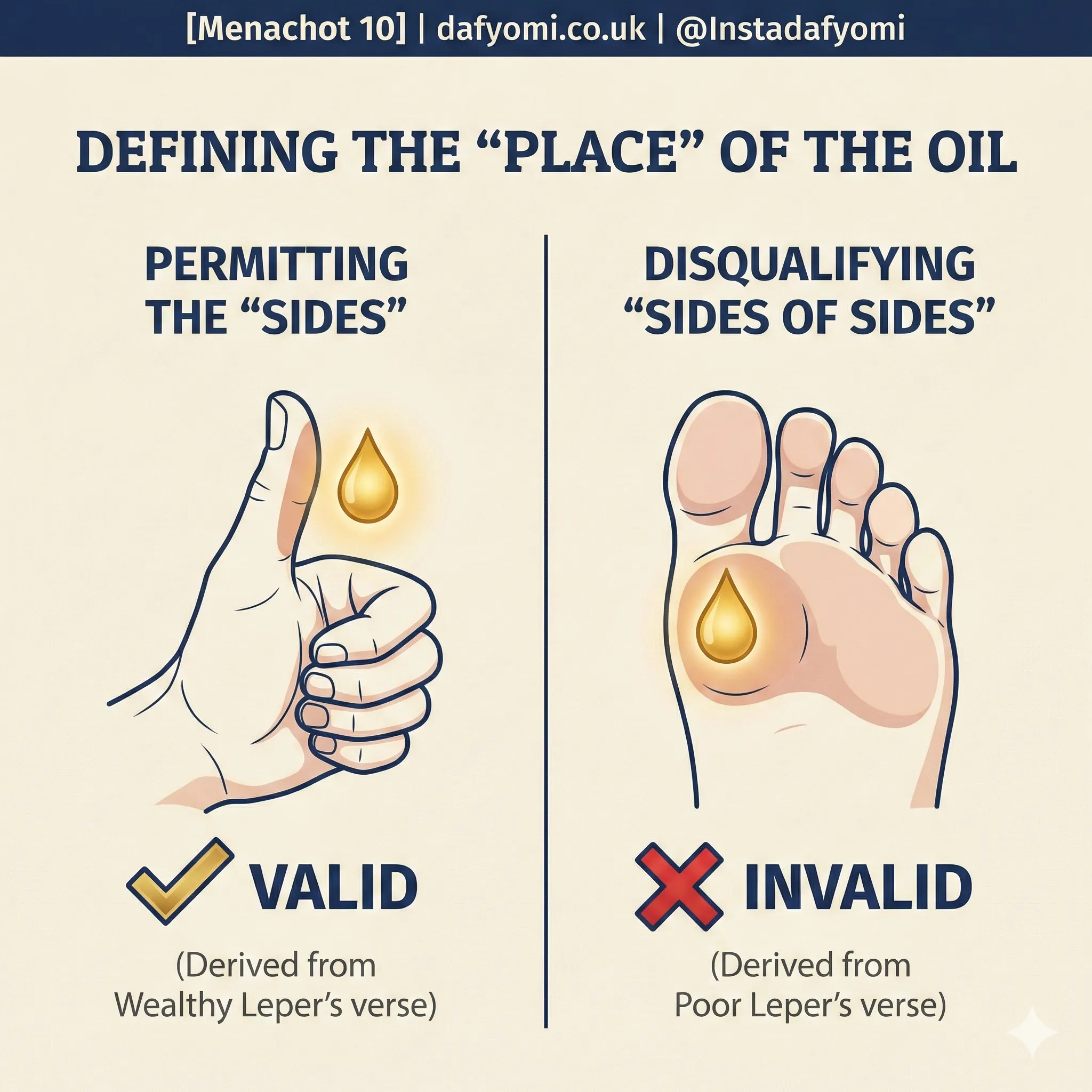
(דְּהָא כְּתִב ״עַל דַּם הָאָשָׁם״!), חַד לְהַכְשִׁיר צְדָדִין, וְחַד לִפְסוֹל צִידֵּי צְדָדִין.
English Translation:
After all, a verse already indicates that the oil must be placed on the right thumb and big toe, as it is written: “Upon the blood of the guilt offering” (Leviticus 14:17). Since the Torah has already specified that the blood is placed upon the right thumb and big toe (Leviticus 14:14), it is clear that the oil is placed there as well. Similarly, why must the verse specify with regard to a poor leper that the oil is placed on the right thumb and big toe? Isn’t already clear from the verse where the oil must be placed, as it states: “Upon the place of the blood of the guilt offering” (Leviticus 14:28)? The Gemara responds: One specification, stated with regard to a wealthy leper, serves to permit the placement of the oil on the sides of the thumb and sides of the big toe in addition to the nail side of the thumb and big toe, and one, stated with regard to a poor leper, serves to disqualify the sides of sides, i.e., their undersides.
קלאוד על הדף:
The Gemara continues from the previous daf, addressing why the Torah needs to specify the placement of oil for both wealthy and poor lepers when this seems redundant. The resolution teaches that each verse has a unique purpose: one permits placing oil on the sides of the thumb (in addition to the top), while the other disqualifies placing it on the undersides. This demonstrates the Talmudic principle that apparent redundancies always teach distinct halachot.
Key Terms:
- צְדָדִין = Sides (of the thumb)
- צִידֵּי צְדָדִין = Sides of the sides (undersides)
Segment 2
TYPE: קושיא (Question)
Inquiring about the purpose of two similar phrases
Hebrew/Aramaic:
״עַל דַּם הָאָשָׁם״, (על) [וְ״עַל] מְקוֹם דַּם הָאָשָׁם״ – לְמַאי אָתוּ?
English Translation:
The Gemara inquires with regard to the verse: “Upon the blood of the guilt offering” (Leviticus 14:17), stated with regard to the purification of a wealthy leper, and the verse: “Upon the place of the blood of the guilt offering” (Leviticus 14:28), stated with regard to the purification of a poor leper. For what purpose do they come, i.e., why are both verses necessary?
קלאוד על הדף:
The Gemara now examines two nearly identical phrases in the Torah. “Upon the blood” and “upon the place of the blood” seem to say the same thing. The subtle distinction between these phrases must have halachic significance, as the Torah does not use superfluous language.
Key Terms:
- לְמַאי אָתוּ = For what purpose do they come?
Segment 3
TYPE: תירוץ (Answer)
Explaining why “upon the blood” is necessary
Hebrew/Aramaic:
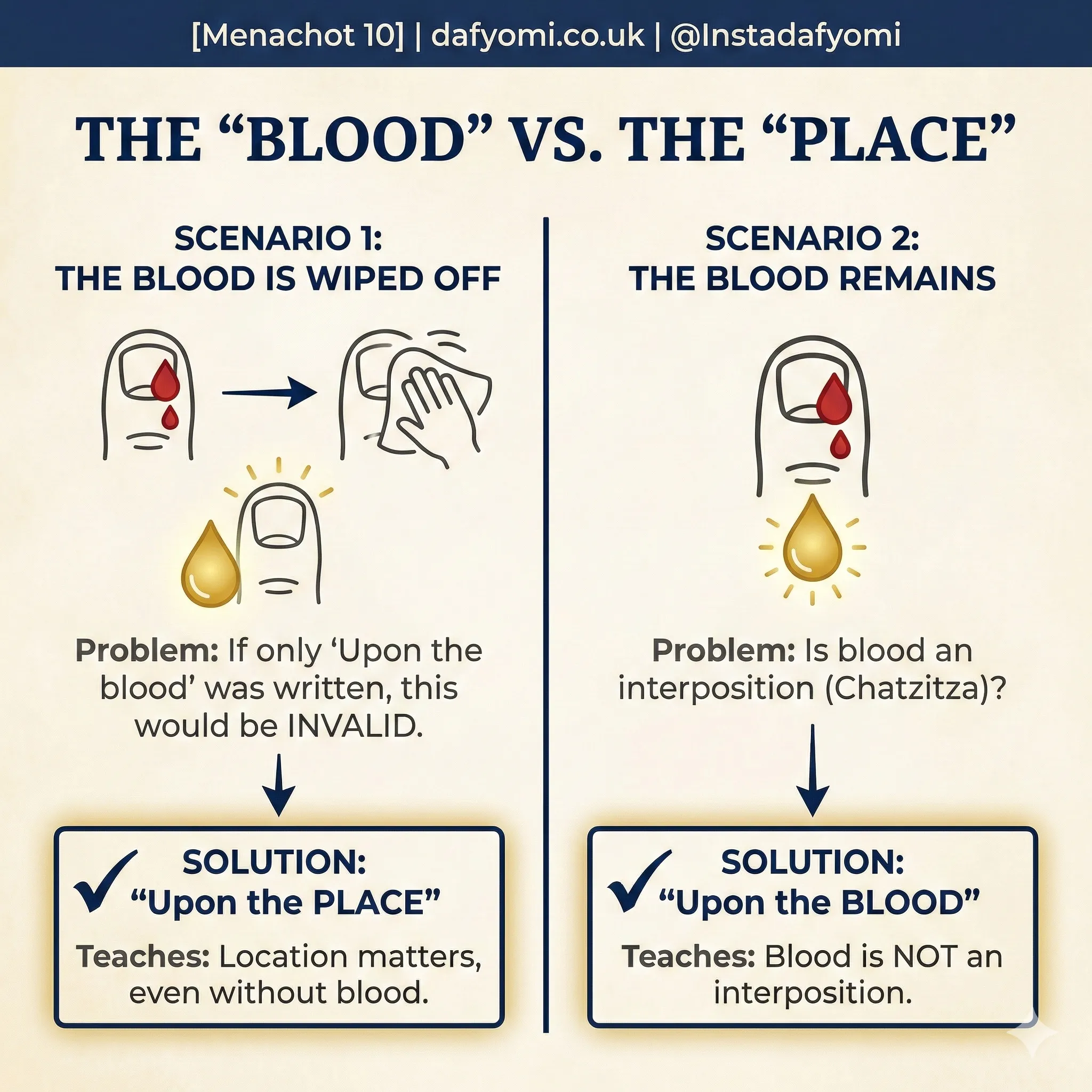
הָנֵי צְרִיכִי, אִי כְּתַב רַחֲמָנָא ״עַל דַּם הָאָשָׁם״, הֲוָה אָמֵינָא: אִיתֵיהּ – אִין, נִתְקַנֵּחַ – לָא, כְּתַב רַחֲמָנָא ״עַל מְקוֹם״.
English Translation:
The Gemara responds: These verses are necessary, because if the Merciful One had written only: “Upon the blood of the guilt offering,” I would say: If the blood is still on the right thumb and big toe of the leper, yes, the priest places the oil upon the blood. But if it was wiped from there, he does not place the oil. Therefore, the Merciful One writes: “Upon the place of the blood of the guilt offering,” indicating that the oil is placed upon the location of the blood, not necessarily upon the blood itself.
קלאוד על הדף:
The Gemara explains the first half of why both phrases are needed. If the Torah only said “upon the blood,” we would think the oil can only be placed when the blood is still visible. The phrase “upon the place of the blood” teaches that even if the blood dried or was wiped away, the oil can still be validly placed on that location.
Key Terms:
- אִיתֵיהּ = If it is there (the blood is present)
- נִתְקַנֵּחַ = Was wiped off
Segment 4
TYPE: תירוץ (Answer continued)
Explaining why “upon the place of the blood” is necessary
Hebrew/Aramaic:
וְאִי כְּתַב רַחֲמָנָא ״עַל מְקוֹם״, הֲוָה אָמֵינָא: דַּוְקָא נִתְקַנֵּחַ, אֲבָל אִיתֵיהּ – אֵימָא הָוֵי חֲצִיצָה, קָא מַשְׁמַע לַן ״עַל דַּם הָאָשָׁם״.
English Translation:
And conversely, if the Merciful One had written only: “Upon the place of the blood of the guilt offering,” I would say: The oil is placed on his right thumb and big toe specifically when the blood was wiped from there. But if the blood is still there, I will say that the blood is an interposition between the oil and the thumb or toe. Therefore, the verse teaches us that the oil is placed “upon the blood of the guilt offering,” and the blood is not considered an interposition.
קלאוד על הדף:
The Gemara completes the explanation. If the Torah only said “upon the place of the blood,” we might think oil can only be placed after the blood is gone — because if blood is present, it would be an interposition (chatzitzah) between the oil and the skin. The phrase “upon the blood” teaches that placing oil directly on the blood is valid and not considered an interposition.
Key Terms:
- חֲצִיצָה = Interposition (a barrier that invalidates)
Segment 5
TYPE: אמר (Statement)
Rava questions the purpose of additional verses
Hebrew/Aramaic:
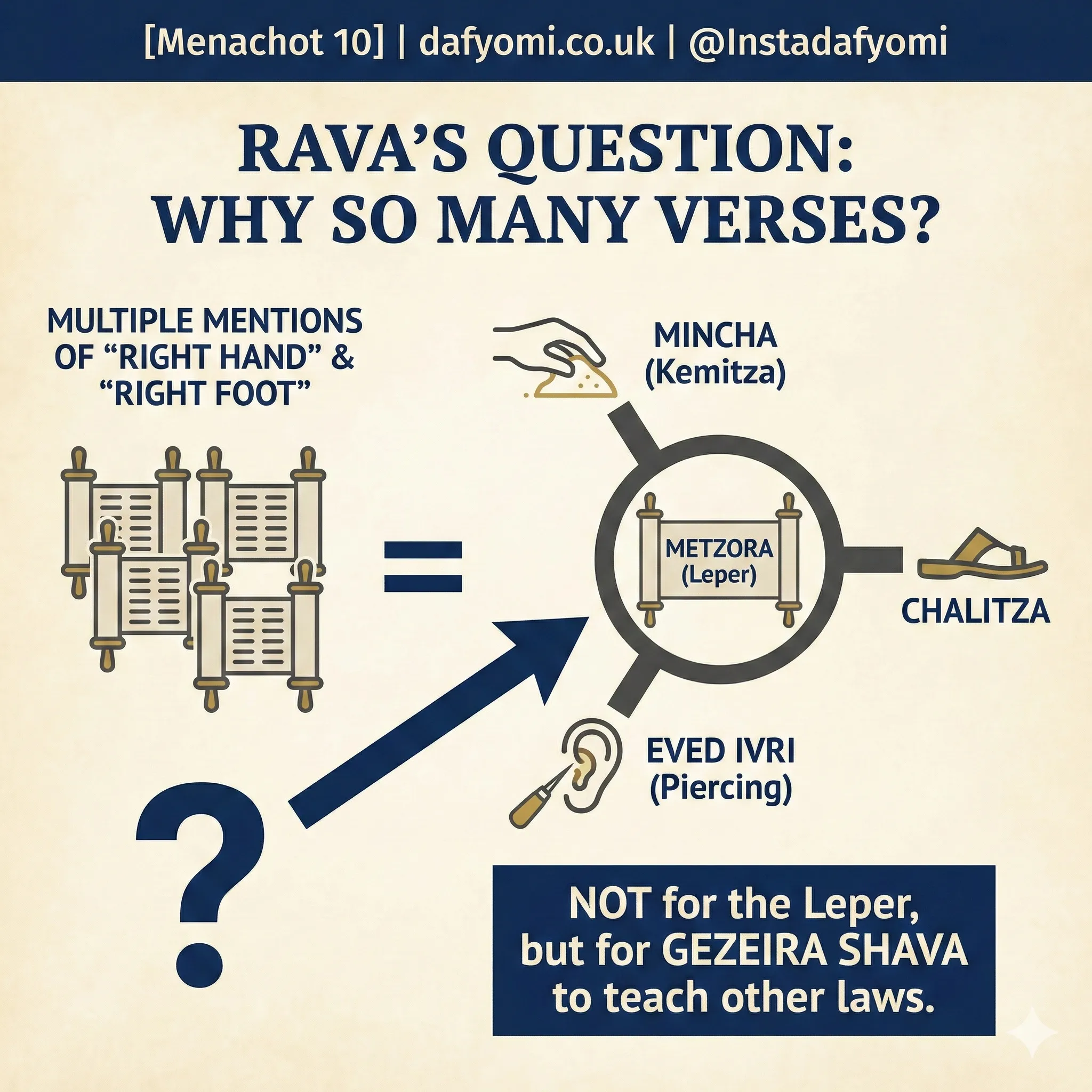
אָמַר רָבָא: מֵאַחַר דִּכְתִיב ״עַל דַּם הָאָשָׁם״ וְ״עַל מְקוֹם [דַּם] הָאָשָׁם״, וּכְתִיבָא יְמָנִית בְּדָם ״עַל בֹּהֶן יָדוֹ הַיְמָנִית וְעַל בֹּהֶן רַגְלוֹ הַיְמָנִית״, וּכְתִיבִי בְּשֶׁמֶן דִּמְצוֹרָע עָשִׁיר וְעָנִי, לְמָה לִי?
English Translation:
Rava said: Since it is written that the priest places the oil “upon the blood of the guilt offering,” and: “Upon the place of the blood of the guilt offering,” and it is also written with regard to a wealthy leper (see Leviticus 14:14) and a poor one (see Leviticus 14:25) that the right hand and foot are required for the placement of the blood, as the verses state: “Upon the thumb of his right hand, and upon the big toe of his right foot,” and this is also written with regard to the oil of a wealthy leper (see Leviticus 14:17) and a poor one (see Leviticus 14:28), one can ask: Why do I need all of these verses?
קלאוד על הדף:
Rava observes that the Torah repeatedly specifies “right” hand and foot for the leper’s purification — in the blood application and oil application, for both wealthy and poor lepers. Since the oil goes on the same place as the blood, why does the Torah need to repeat “right” for the oil? This question sets up Rava’s teaching about verbal analogies (gezeirot shavot).
Key Terms:
- יְמָנִית = Right (side)
- מְצוֹרָע עָשִׁיר וְעָנִי = Wealthy leper and poor leper
Segment 6
TYPE: תירוץ (Resolution)
Rava’s verbal analogy for kemitza
Hebrew/Aramaic:
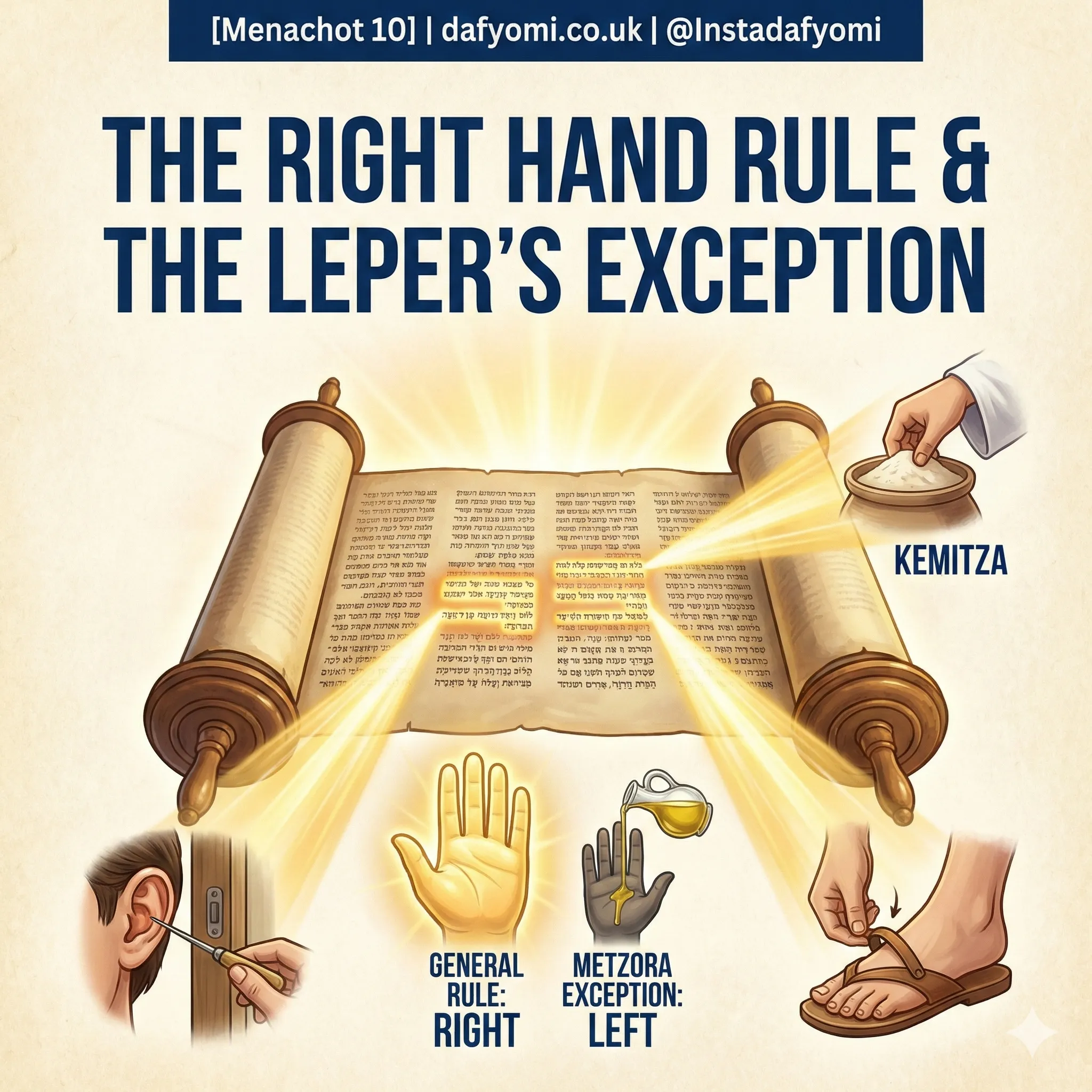
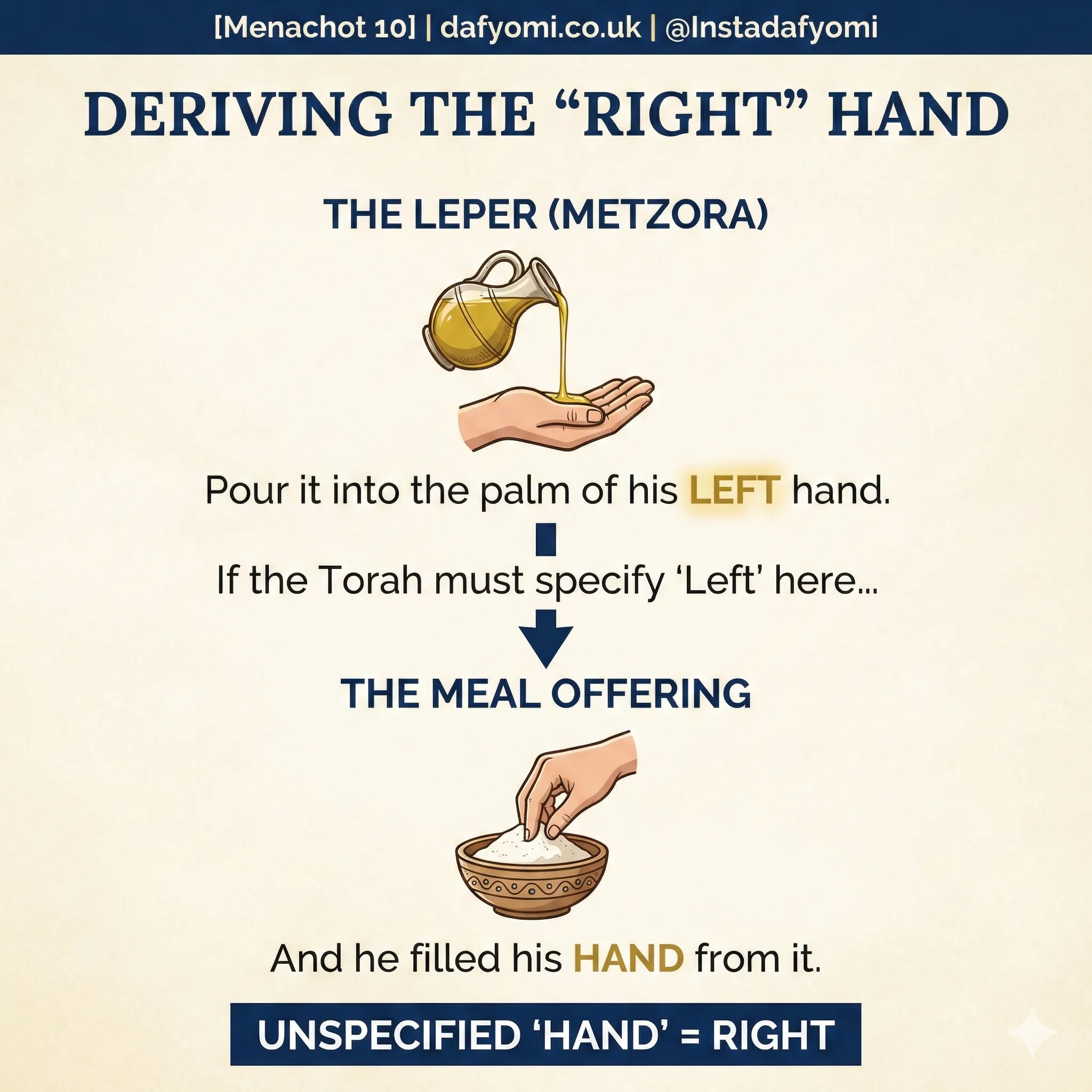
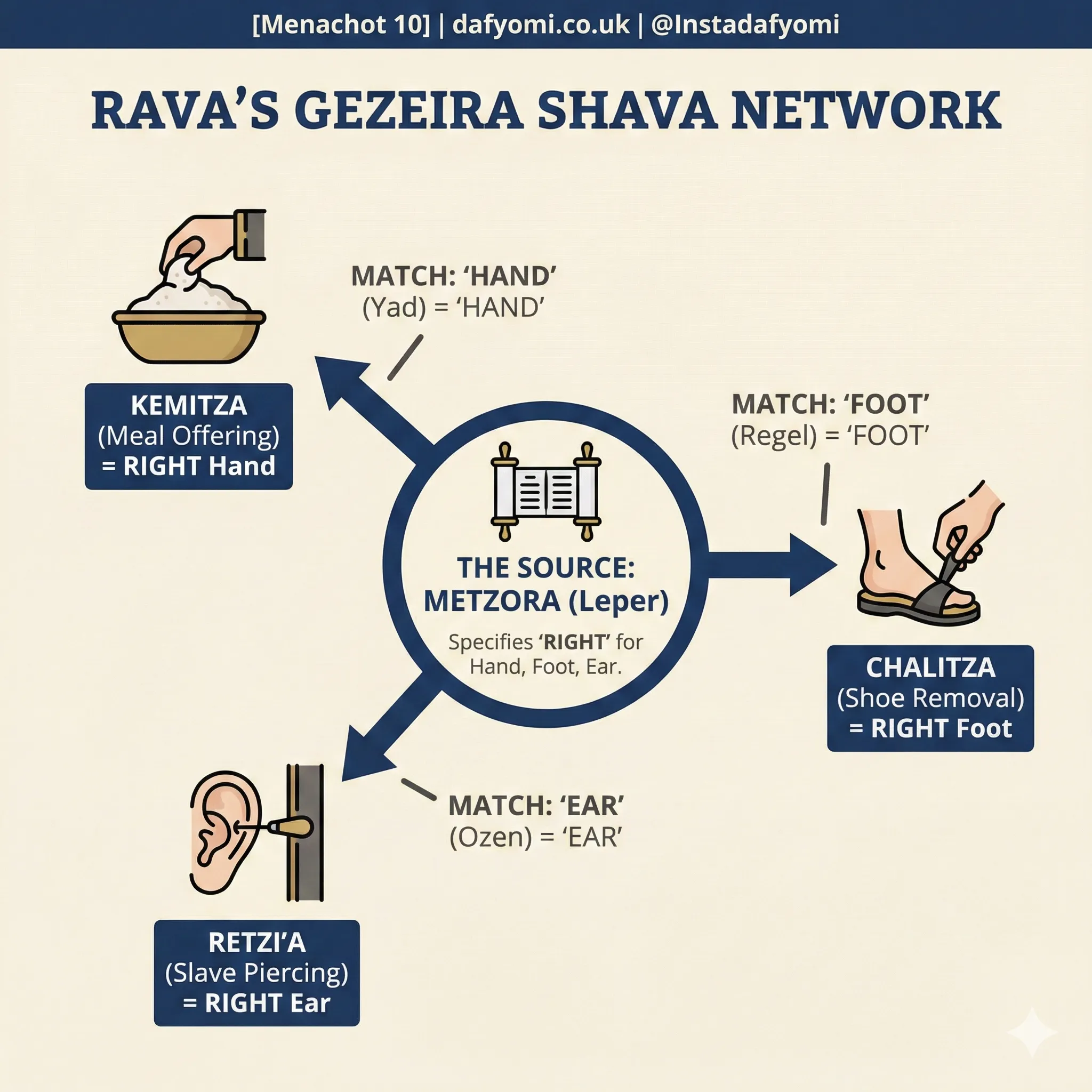
אֶלָּא אָמַר רָבָא: ״יָד״ ״יָד״ לִקְמִיצָה.
English Translation:
Rather, Rava said: The verses that specify that the oil must be placed on the right thumb and big toe do not teach a halakha with regard to a leper, as it is clear that the oil must be placed on the right thumb and big toe, as it states: “Upon the place of the blood of the guilt offering.” Rather, these verses are the source of verbal analogies for other halakhot. When the verse states with regard to a wealthy leper: “Of his right hand” (Leviticus 14:17), this teaches a verbal analogy between the term “hand” written here and “hand” written with regard to the removal of a handful, as the verse states about the removal of a handful: “And he filled his hand from it” (Leviticus 9:17). The verbal analogy teaches that the removal of the handful must also be performed with the right hand.
קלאוד על הדף:
Rava reveals that the “extra” mentions of “right hand” in the leper passages serve as sources for gezeirot shavot — verbal analogies that teach halachot elsewhere. The word “hand” (yad) in the leper verses connects to “hand” written about kemitza (taking a handful from meal offerings), teaching that kemitza requires the right hand.
Key Terms:
- גְּזֵרָה שָׁוָה = Verbal analogy (implied)
- קְמִיצָה = Taking the handful (from a meal offering)
Segment 7
TYPE: דרש (Derivation)
The verbal analogy for chalitzah
Hebrew/Aramaic:
״רֶגֶל״ ״רֶגֶל״ לַחֲלִיצָה.
English Translation:
Similarly, when the verse states: “Of his right foot” (Leviticus 14:17), with regard to a wealthy leper, this teaches a verbal analogy between the term “foot” written here and “foot” written with regard to the ritual through which the yavam, a man whose married brother died childless, frees his brother’s widow, the yevama, of her levirate bonds [chalitza], as the verse states with regard to chalitza: “And remove his shoe from upon his foot” (Deuteronomy 25:9). The verbal analogy teaches that the shoe is removed from his right foot.
קלאוד על הדף:
The second verbal analogy: “foot” in the leper verses connects to “foot” in the chalitza ceremony. When a widow removes her brother-in-law’s shoe to free herself from levirate bonds, she must remove it from his right foot. This derives from the leper’s “right foot” specification.
Key Terms:
- חֲלִיצָה = The ceremony releasing a widow from levirate marriage obligation
Segment 8
TYPE: דרש (Derivation)
The verbal analogy for piercing a slave’s ear
Hebrew/Aramaic:
״אוֹזֶן״ ״אוֹזֶן״ לִרְצִיעָה.
English Translation:
Additionally, when the verse states: “Upon the tip of the right ear of him that is to be cleansed” (Leviticus 14:17), with regard to a wealthy leper, this teaches a verbal analogy between the term “ear” written here and “ear” written with regard to the piercing of a Hebrew slave’s ear with an awl, as the verse states: “And his master shall bore his ear through with an awl” (Exodus 21:6). The verbal analogy teaches that the slave’s right ear is pierced.
קלאוד על הדף:
The third verbal analogy: “ear” in the leper verses connects to “ear” in the law of a Hebrew slave who chooses to remain with his master. When the master pierces the slave’s ear, it must be the right ear. This too derives from the leper’s purification procedure.
Key Terms:
- רְצִיעָה = Piercing (of a slave’s ear)
Segment 9
TYPE: קושיא (Question)
Questioning the purpose of additional “left hand” mention
Hebrew/Aramaic:
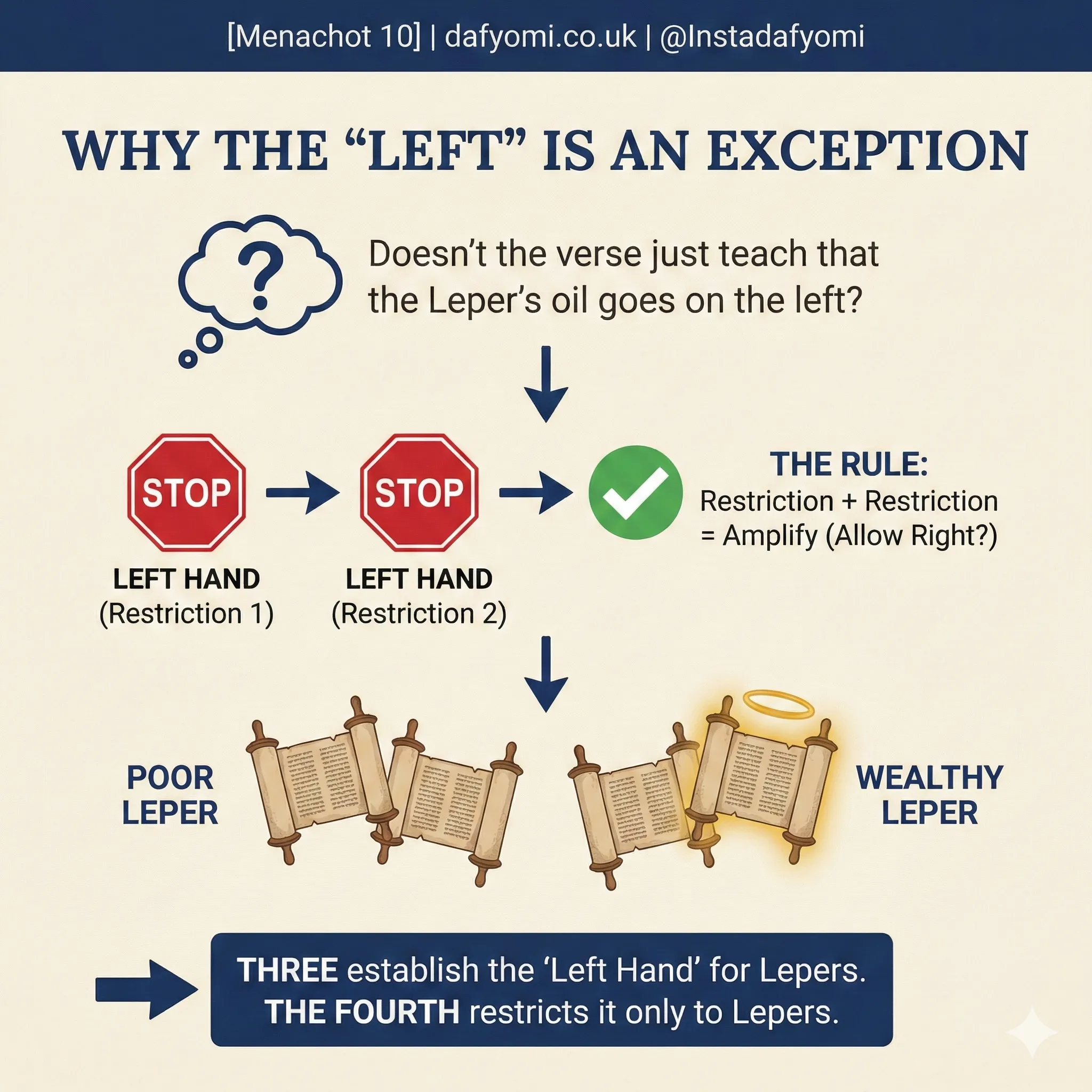
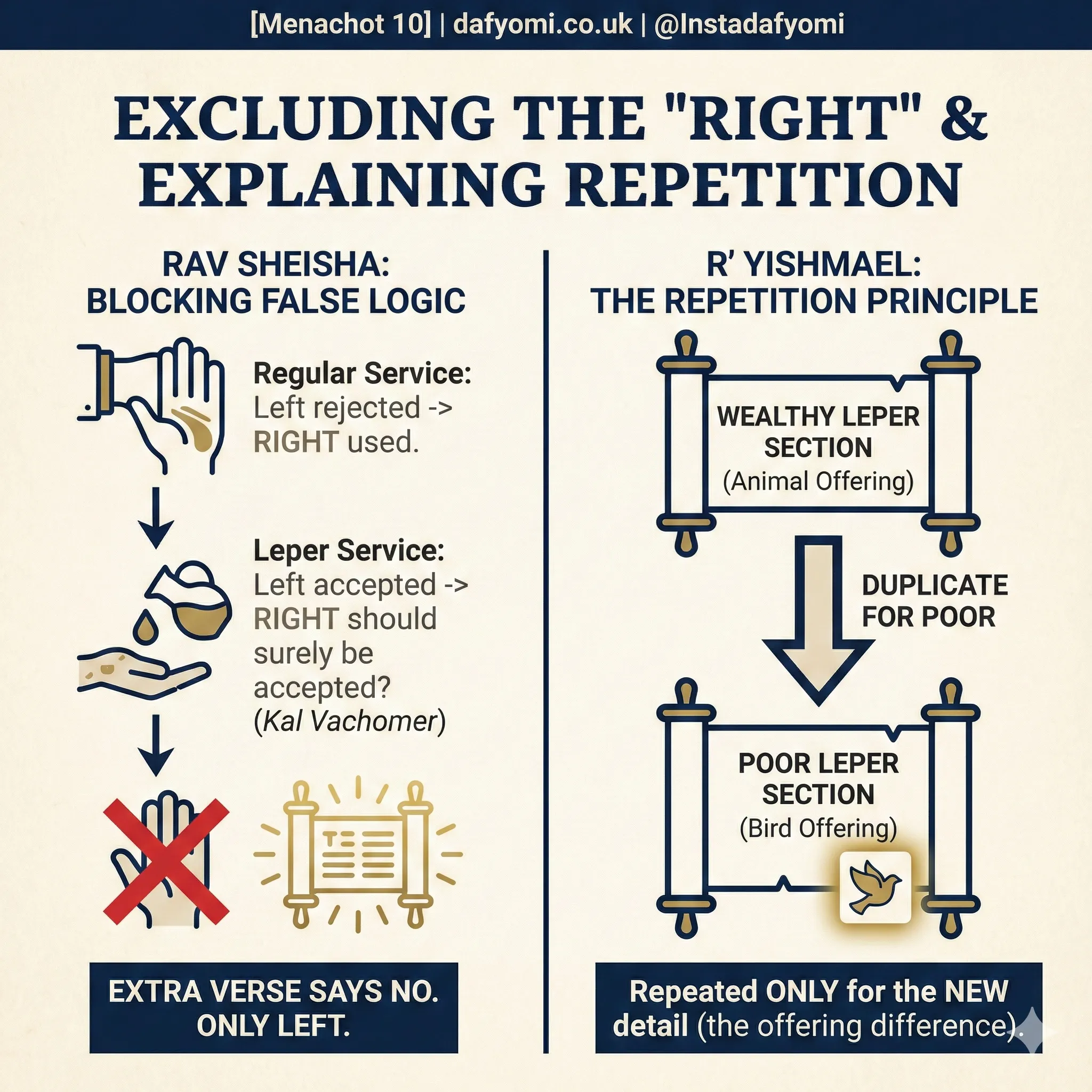
״שְׂמָאלִית״ (הֶעָנִי) לְמַאי אֲתָא? אָמַר רַב שִׁישָׁא בְּרֵיהּ דְּרַב אִידִי: לִיפְסוֹל יָמִין דְּכֹהֵן בִּמְצוֹרָע, שֶׁלֹּא תֹּאמַר: וּמָה בִּמְקוֹם שֶׁלֹּא נִתְרַבְּתָה שְׂמֹאל נִתְרַבְּתָה יָמִין, בְּמָקוֹם שֶׁנִּתְרַבְּתָה שְׂמֹאל אֵינוֹ דִּין שֶׁנִּתְרַבְּתָה יָמִין?
English Translation:
The Gemara asks: With regard to the additional mention of the left hand in the verse dealing with the poor leper, for what purpose does it come? Rav Sheisha, son of Rav Idi, said: It comes to disqualify the right hand of a priest for the purification of a leper. This teaches that you should not say: And if in a place where the left side is not included, as sacrificial rites in general are disqualified when performed with the left hand, the right hand is included, i.e., those rites must be performed with the right hand, then in a place where the left hand is included, in the case of a leper, isn’t it logical that the right hand should also be included? Therefore, the verse repeats that the oil is poured into the priest’s left hand, in order to disqualify the right hand.
קלאוד על הדף:
The Gemara asks about another “extra” mention — the Torah specifies the priest’s “left” hand for holding the oil. Rav Sheisha explains this prevents a mistaken kal vachomer (a fortiori argument): One might reason that if the right hand is always required where left is invalid, surely where left IS valid (holding the oil), right should also be valid. The verse teaches otherwise — only the left hand may hold the oil.
Key Terms:
- שְׂמָאלִית = Left (hand)
- לִיפְסוֹל יָמִין = To disqualify the right hand
Segment 10
TYPE: קושיא (Question)
Purpose of the repeated passage about a poor leper
Hebrew/Aramaic:
וְאִידָּךְ ״שְׂמָאלִית״ (וְיָד וָרֶגֶל יְמָנִית דְּעָנִי), לְמַאי אֲתָא? לְכִדְתָנָא דְּבֵי רַבִּי יִשְׁמָעֵאל: כׇּל פָּרָשָׁה שֶׁנֶּאֶמְרָה וְנִשְׁנֵית, לֹא נִשְׁנֵית אֶלָּא בִּשְׁבִיל דָּבָר שֶׁנִּתְחַדֵּשׁ בָּהּ.
English Translation:
The Gemara asks: And concerning the other verses that specify the left hand of a poor leper (Leviticus 14:26–27) as well as the right hand and foot of a poor leper (Leviticus 14:25–28), for what purpose do they come? The Gemara responds: These verses come for that which the school of Rabbi Yishmael taught: Any passage that was stated in the Torah and was then repeated, was repeated only for the sake of a matter that was introduced for the first time in the repeated passage. That is, sometimes the Torah repeats an entire passage just to teach a single new detail. In this case, the verses that discuss the purification of a poor leper were repeated only for the sake of the differences in the offerings between a wealthy leper and a poor one. No additional halakha should be derived from them.
קלאוד על הדף:
The Gemara applies a principle from Rabbi Yishmael’s school: when the Torah repeats an entire passage, it’s only for the new details introduced. The poor leper’s passage repeats the purification procedure to teach about the different offerings he brings, not to derive additional halachot from the repeated language about hands and feet.
Key Terms:
- נֶאֶמְרָה וְנִשְׁנֵית = Was stated and repeated
- דָּבָר שֶׁנִּתְחַדֵּשׁ = A matter that was introduced (as new)
Segment 11
TYPE: אמר (Statement)
Reish Lakish’s principle about finger and priesthood
Hebrew/Aramaic:
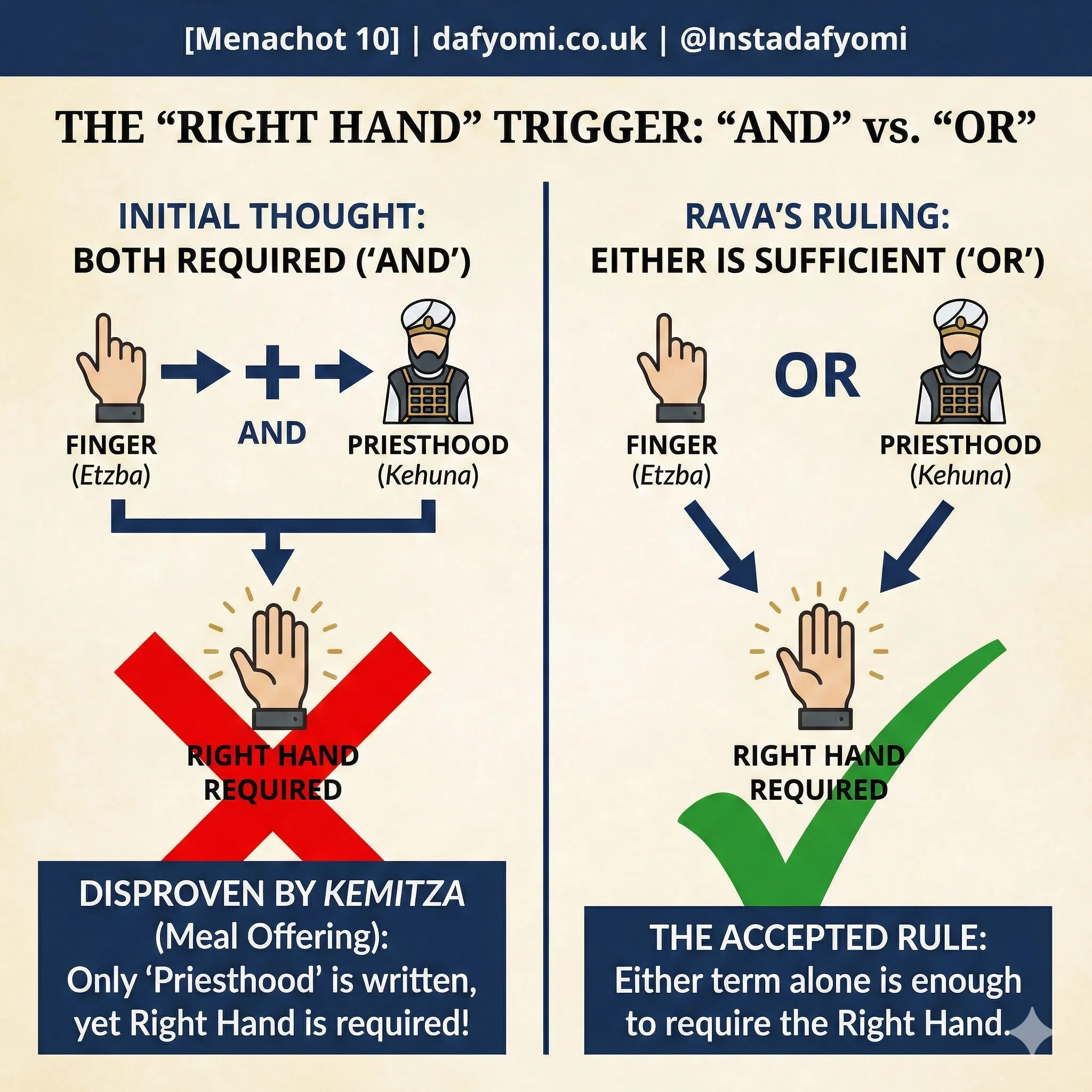
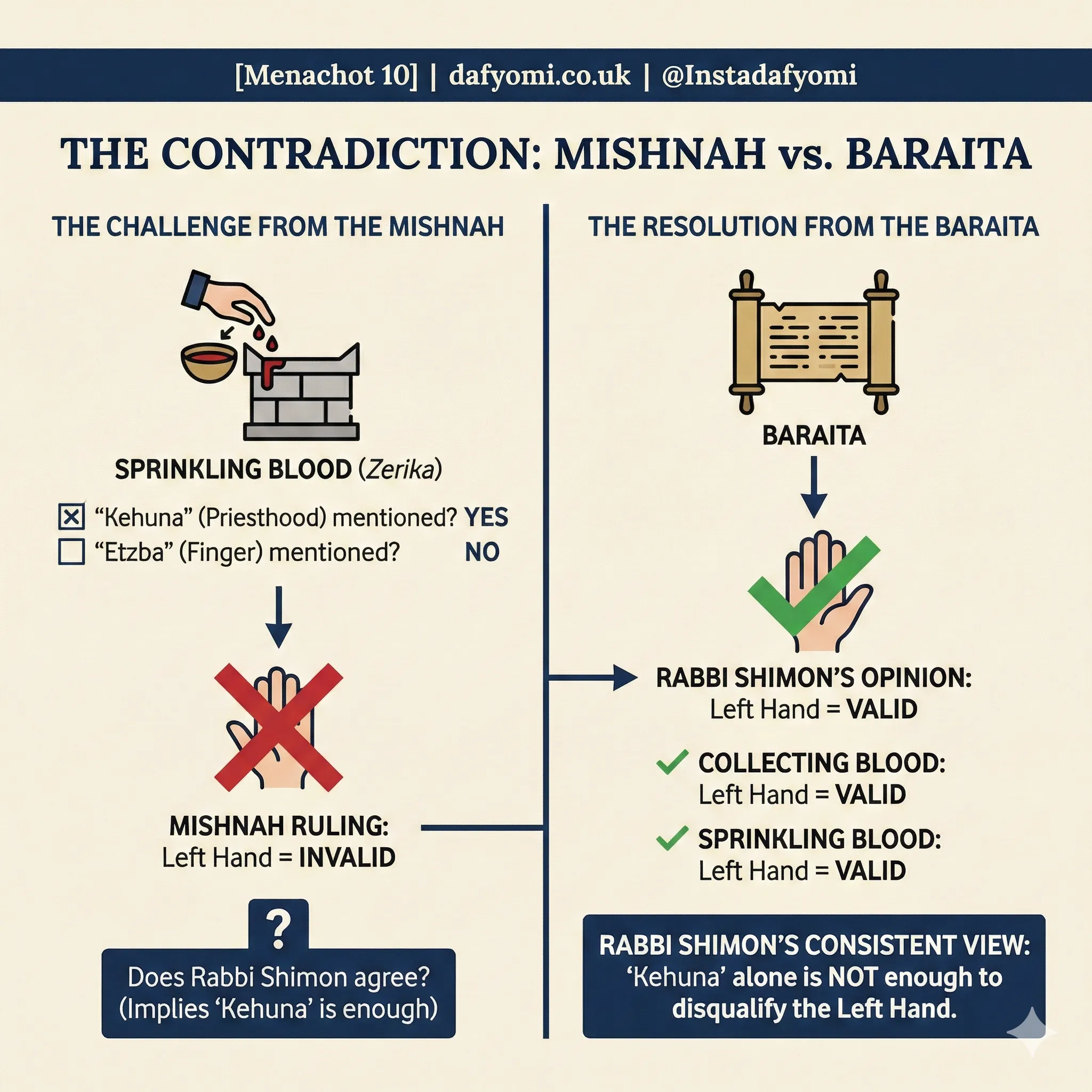
אָמַר רַבָּה בַּר בַּר חָנָה, אָמַר רַבִּי שִׁמְעוֹן בֶּן לָקִישׁ: כׇּל מָקוֹם שֶׁנֶּאֶמְרָה אֶצְבַּע וּכְהוּנָּה, אֵינָהּ אֶלָּא יָמִין.
English Translation:
Rabba bar bar Chana says that Rabbi Shimon ben Lakish says: Any place in the Torah in which it is stated that an action is performed with a finger or by the priesthood, i.e., that one uses his finger to perform the action or that a priest performs it, this teaches that it is performed only with the right hand.
קלאוד על הדף:
Reish Lakish introduces an important principle: whenever the Torah mentions either “finger” (etzba) or “priesthood” (kehunah), the service must be performed with the right hand. This principle will be examined and refined in the following segments.
Key Terms:
- אֶצְבַּע = Finger
- כְּהוּנָּה = Priesthood
Segment 12
TYPE: קושיא (Challenge)
Testing the principle against kemitza
Hebrew/Aramaic:
קָא סָלְקָא דַּעְתִּין, אֶצְבַּע וּכְהוּנָּה בָּעֵינַן, כְּדִכְתִיב: ״וְלָקַח הַכֹּהֵן מִדַּם הַחַטָּאת בְּאֶצְבָּעוֹ״, וְגָמַר מִמְּצוֹרָע, דִּכְתִיב: ״וְטָבַל הַכֹּהֵן אֶת אֶצְבָּעוֹ הַיְמָנִית״. הֲרֵי קְמִיצָה דְּלָא כְּתִיבָא בָּהּ אֶלָּא כְּהוּנָּה, וּתְנַן: קָמַץ בִּשְׂמֹאל פָּסוּל!
English Translation:
The Gemara comments: It might enter our mind to say that this means that we require both a finger and the priesthood to be stated together in the verse in order to mandate use of the right hand, e.g., as it is written: “And the priest shall take of the blood of the sin offering with his finger” (Leviticus 4:25). And the fact that this verse is referring to a finger from his right hand is derived from a leper, as it is written: “And the priest shall dip his right finger” (Leviticus 14:16). This cannot be correct, as there is the verse that addresses the removal of a handful from a meal offering, in which only the priesthood is written, and yet we learned in a mishna (6a): If the priest removed the handful with his left hand the meal offering is unfit.
קלאוד על הדף:
The Gemara tests whether Reish Lakish means BOTH finger AND priesthood are needed, or either one suffices. The challenge comes from kemitza: the Torah only mentions “priesthood” for taking the handful (not “finger”), yet left-handed kemitza invalidates the offering. This proves that “priesthood” alone — without “finger” — already requires the right hand.
Key Terms:
- בָּעֵינַן = We require
- קָמַץ בִּשְׂמֹאל פָּסוּל = If he removed the handful with the left hand, it is disqualified
Segment 13
TYPE: תירוץ (Answer)
Rava clarifies: either finger OR priesthood
Hebrew/Aramaic:
אָמַר רָבָא: אוֹ ״אֶצְבַּע״ אוֹ ״כְּהוּנָּה״.
English Translation:
Therefore, Rava said: This statement means that if the verse mentions either a finger or the priesthood, only the right hand may be used.
קלאוד על הדף:
Rava clarifies Reish Lakish’s principle: it’s not “finger AND priesthood” but “finger OR priesthood.” Either term alone is sufficient to require the right hand. This explains why kemitza — which mentions only priesthood — still requires the right hand.
Segment 14
TYPE: קושיא (Challenge)
Abaye challenges from conveyance of limbs
Hebrew/Aramaic:
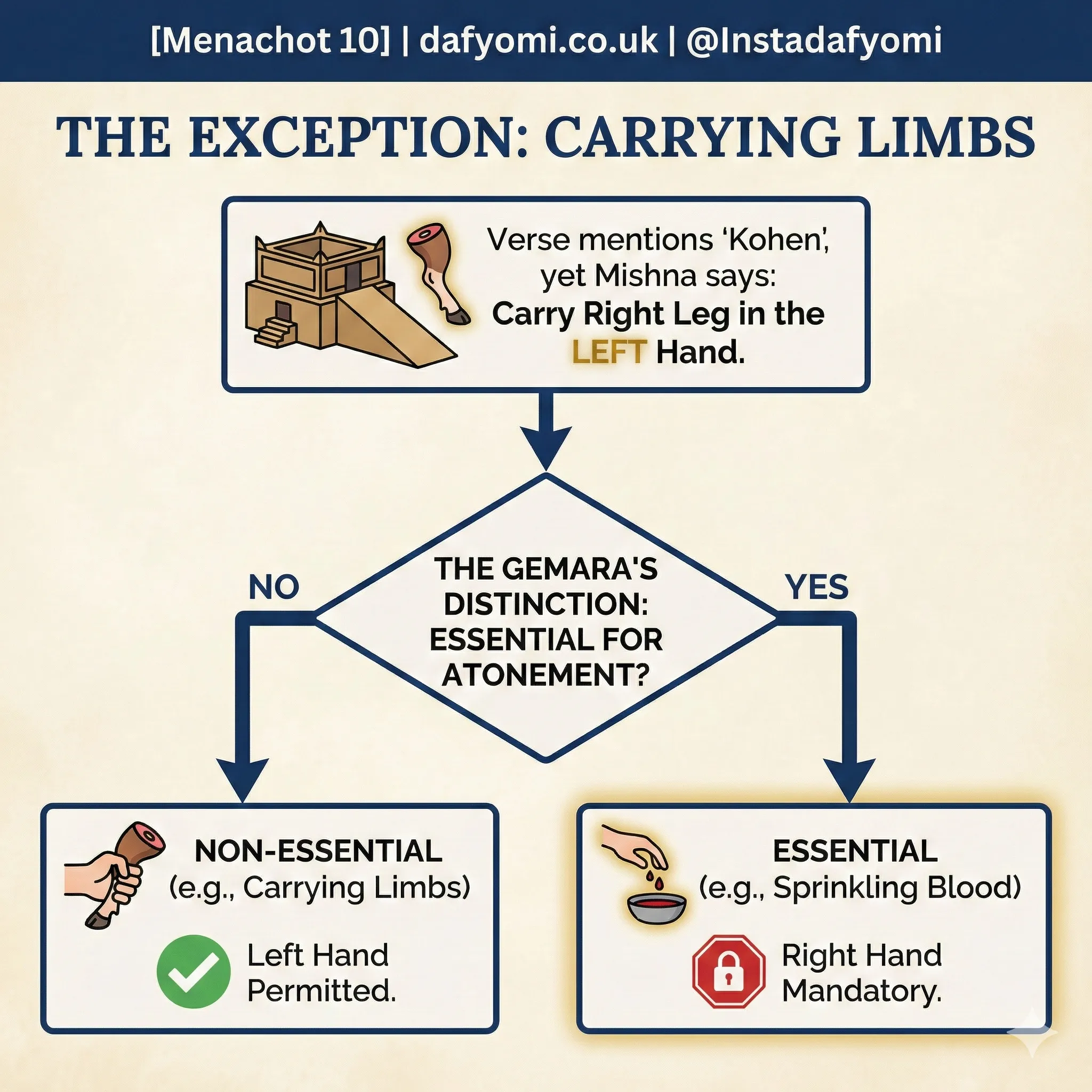
אֲמַר לֵיהּ אַבָּיֵי: הֲרֵי הוֹלָכַת אֵבָרִים לַכֶּבֶשׁ, דִּכְתִיב בְּהוּ כְּהוּנָּה, דִּכְתִיב: ״וְהִקְרִיב הַכֹּהֵן אֶת הַכֹּל הַמִּזְבֵּחָה״, וְאָמַר מָר: זוֹ הוֹלָכַת אֵבָרִים לַכֶּבֶשׁ, וּתְנַן: הָרֶגֶל שֶׁל יָמִין בִּשְׂמֹאל וּבֵית עוֹרָהּ לַחוּץ.
English Translation:
Abaye said to Rava: But this is contradicted by the verse discussing the conveyance of the limbs of the daily burnt offering to the ramp of the altar, as priesthood is written with regard to it, as it is written: “And the priest shall sacrifice the whole and make it smoke upon the altar” (Leviticus 1:13), and the Master said that this verse is referring to the conveyance of the limbs to the ramp. And yet we learned in a mishna (Tamid 31b): When the priest conveys the limbs to the ramp, the foot of the right side of the offering is carried in the left hand of the priest, and the place of its skin, i.e., the side of the limb covered in skin, is held facing outward. Clearly, use of the left hand does not disqualify the conveyance of the limbs.
קלאוד על הדף:
Abaye challenges Rava’s interpretation. Carrying the limbs to the altar ramp involves “priesthood” (the verse says “the priest shall sacrifice”), yet the Mishna describes carrying one limb specifically in the left hand. If “priesthood” alone requires the right hand, why is left-handed conveyance valid here?
Key Terms:
- הוֹלָכַת אֵבָרִים לַכֶּבֶשׁ = Conveyance of limbs to the ramp
Segment 15
TYPE: תירוץ (Resolution)
The principle applies only to rites indispensable for atonement
Hebrew/Aramaic:
כִּי אָמְרִינַן ״אוֹ אֶצְבַּע אוֹ כְּהוּנָּה״ – בְּדָבָר הַמְעַכֵּב כַּפָּרָה.
English Translation:
The Gemara responds: When we say that if the verse states either finger or priesthood then the left hand is disqualified, this is only with regard to a matter that precludes atonement, i.e., a rite whose performance is indispensable to the atonement, similar to the sprinkling of the oil on the leper (see Leviticus 14:16). The conveyance of the limbs, by contrast, is not indispensable to atonement.
קלאוד על הדף:
The Gemara refines the principle significantly: “finger or priesthood requires right hand” applies only to services that are indispensable for atonement (me’akev kapparah). Carrying limbs to the ramp is preparatory, not essential to achieving atonement, so left-hand usage doesn’t invalidate it. Kemitza, by contrast, is essential.
Key Terms:
- מְעַכֵּב כַּפָּרָה = Indispensable to atonement
Segment 16
TYPE: קושיא (Challenge)
Challenging from kabbalah (blood collection)
Hebrew/Aramaic:
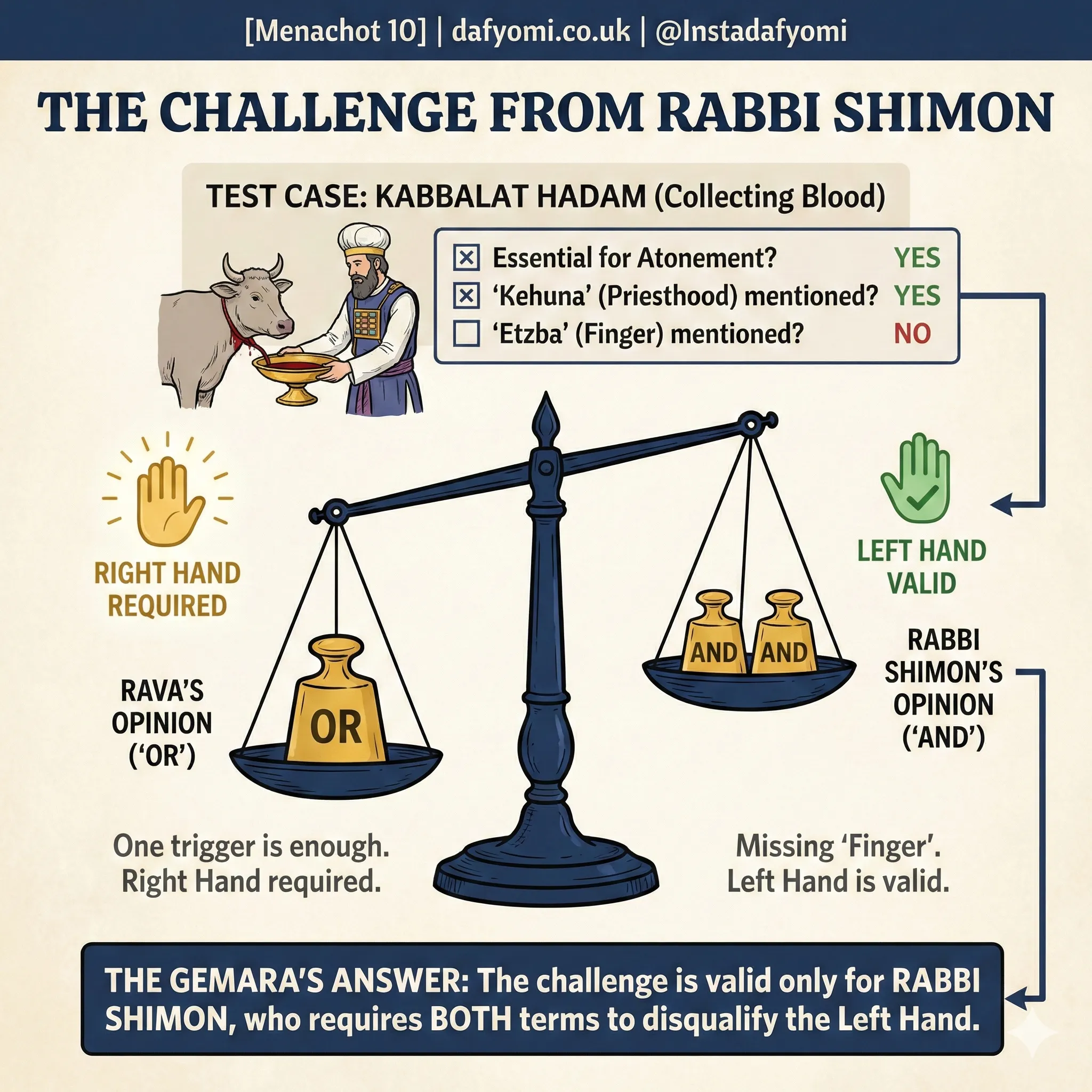
וַהֲרֵי קַבָּלָה (דבר) [דְּדָבָר] הַמְעַכֵּב כַּפָּרָה הוּא, וּכְתִיב בָּהּ כְּהוּנָּה, דִּכְתִיב: ״וְהִקְרִיבוּ בְּנֵי אַהֲרֹן הַכֹּהֲנִים אֶת הַדָּם״ – זוֹ קַבָּלַת הַדָּם, וּתְנַן: קִבֵּל בִּשְׂמֹאל פָּסַל, וְרַבִּי שִׁמְעוֹן מַכְשִׁיר.
English Translation:
The Gemara asks: But isn’t there the collection of the blood in a service vessel, which is a matter indispensable to atonement, and about which priesthood is written? As it is written: “And Aaron’s sons, the priests, shall present the blood” (Leviticus 1:5), and this is referring to the collection of the blood. And yet we learned in a mishna (Zevachim 15b): If one collected the blood with his left hand, the blood is disqualified for offering, and Rabbi Shimon deems it fit, despite the fact that priesthood is mentioned in the verse.
קלאוד על הדף:
A new challenge: blood collection (kabbalah) IS indispensable to atonement, and the verse DOES mention priesthood. Yet Rabbi Shimon validates left-handed collection! This seems to contradict the principle that “priesthood” for essential services requires the right hand.
Key Terms:
- קַבָּלָה = Collection (of blood in a vessel)
- רַבִּי שִׁמְעוֹן מַכְשִׁיר = Rabbi Shimon validates it
Segment 17
TYPE: תירוץ (Answer)
Rabbi Shimon has a different requirement
Hebrew/Aramaic:
לְרַבִּי שִׁמְעוֹן קָאָמְרַתְּ? רַבִּי שִׁמְעוֹן תַּרְתֵּי בָּעֵי.
English Translation:
The Gemara responds: You are saying that there is a difficulty according to the opinion of Rabbi Shimon? Rabbi Shimon requires that both matters appear in the verse, i.e., both finger and priesthood.
קלאוד על הדף:
The Gemara explains that Rabbi Shimon holds a stricter view: he requires BOTH “finger” AND “priesthood” to mandate right-hand usage. Since blood collection only mentions “priesthood” (not “finger”), Rabbi Shimon allows left-handed collection. This resolves the contradiction — Rabbi Shimon has a different threshold than the Sages.
Key Terms:
- תַּרְתֵּי בָּעֵי = Requires two (both conditions)
Segment 18
TYPE: קושיא (Challenge)
Does Rabbi Shimon really require both?
Hebrew/Aramaic:
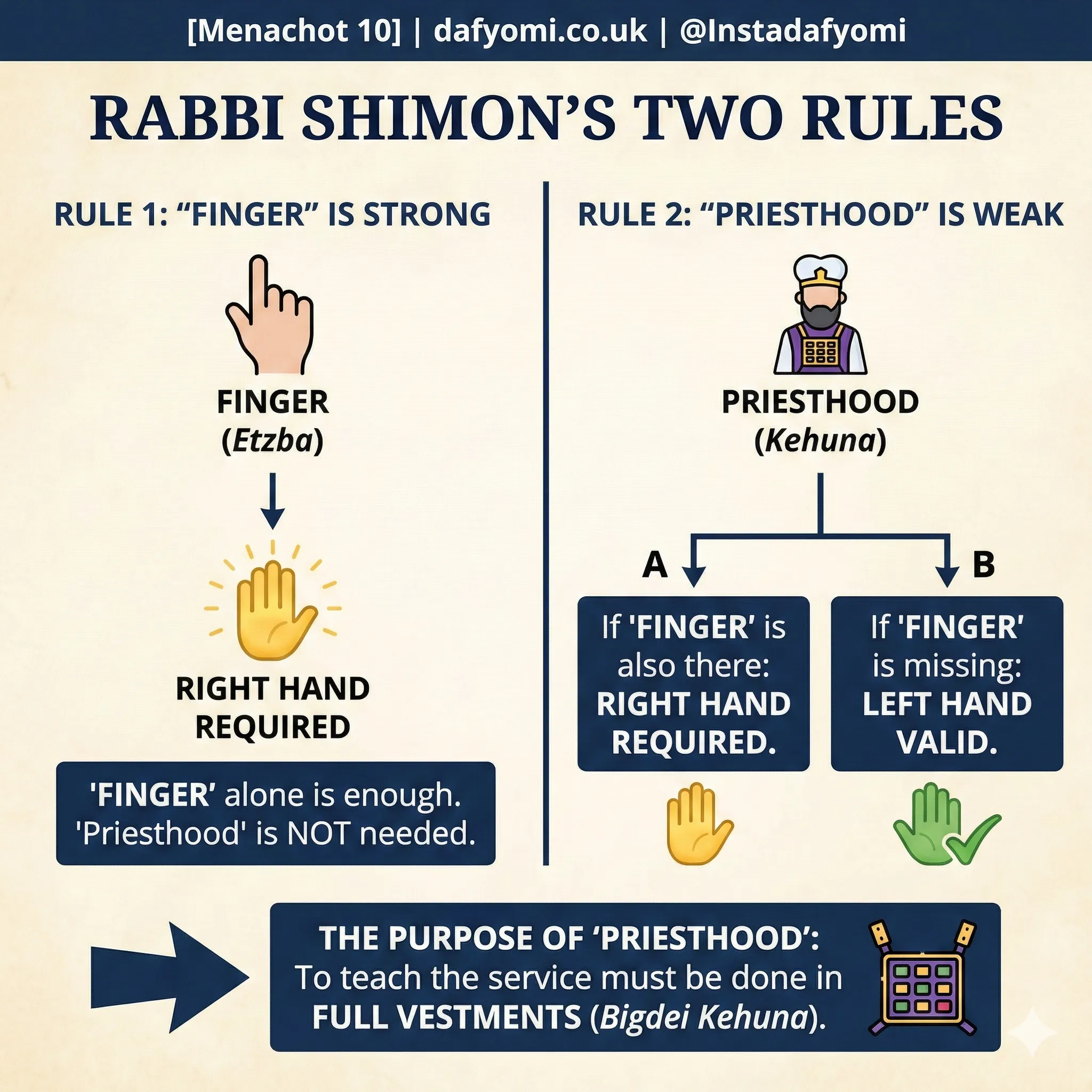
וּמִי בָּעֵי רַבִּי שִׁמְעוֹן תַּרְתֵּי? וְהָתַנְיָא: רַבִּי שִׁמְעוֹן אוֹמֵר: כׇּל מָקוֹם שֶׁנֶּאֶמְרָה ״יָד״ – אֵינָהּ אֶלָּא יָמִין, ״אֶצְבַּע״ – אֵינָהּ אֶלָּא יָמִין! אֶצְבַּע לָא בָּעֲיָא כְּהוּנָּה, כְּהוּנָּה בָּעֲיָא אֶצְבַּע.
English Translation:
The Gemara asks: And does Rabbi Shimon really require both? But isn’t it taught in a baraita: Rabbi Shimon says: In any place in the Torah in which the word hand is stated, the verse is referring only to the right hand, and whenever a verse mentions the word finger, it is referring only to a finger of the right hand? The Gemara responds: According to Rabbi Shimon, if the verse mentions only the word finger, it does not require a mention of the priesthood as well for the limitation to apply. But if the verse mentions only the priesthood, it requires mention of the term finger for the limitation to apply.
קלאוד על הדף:
The Gemara challenges: Rabbi Shimon’s baraita says “hand” or “finger” alone indicates right hand — so he doesn’t always require both! The resolution: Rabbi Shimon distinguishes between the terms. “Finger” alone suffices to require right hand. But “priesthood” alone does NOT suffice — it needs “finger” as well. This asymmetry explains his validation of left-handed blood collection.
Key Terms:
- אֶצְבַּע לָא בָּעֲיָא כְּהוּנָּה = Finger does not require priesthood
- כְּהוּנָּה בָּעֲיָא אֶצְבַּע = Priesthood requires finger
Segment 19
TYPE: קושיא ותירוץ (Question and Answer)
Why mention “priest” for blood collection?
Hebrew/Aramaic:
אֶלָּא כֹּהֵן לְמָה לִּי? בְּכִהוּנוֹ.
English Translation:
The Gemara asks: But according to Rabbi Shimon, if the mention of the priesthood alone does not suffice to disqualify the right hand, then why do I need the superfluous reference to a priest with regard to the collection of the blood? After all, the verse already states that the collection must be performed by the sons of Aaron. The Gemara responds: The additional mention of the priesthood indicates that a priest must perform the collection of the blood in his priestly state, i.e., while wearing the priestly vestments.
קלאוד על הדף:
If “priesthood” alone doesn’t teach about which hand to use (according to Rabbi Shimon), why does the verse mention “priest” at all for blood collection? The answer: it teaches that the priest must be “in his priesthood” — wearing the priestly garments. Without proper vestments, even a valid priest cannot perform the service.
Key Terms:
- בְּכִהוּנוֹ = In his priestly state (wearing vestments)
Amud Bet (10b)
Segment 20
TYPE: קושיא (Challenge)
Blood sprinkling and Rabbi Shimon
Hebrew/Aramaic:
וַהֲרֵי זְרִיקָה דְּלָא כְּתִיב בַּיהּ אֶלָּא כְּהוּנָּה, וּתְנַן: זָרַק בִּשְׂמֹאל פָּסוּל, וְלָא פְּלִיג רַבִּי שִׁמְעוֹן? אָמַר אַבָּיֵי: פְּלִיג בְּבָרַיְיתָא, דְּתַנְיָא: קִבֵּל בִּשְׂמֹאל פָּסוּל, וְרַבִּי שִׁמְעוֹן מַכְשִׁיר; זָרַק בִּשְׂמֹאל פָּסוּל, וְרַבִּי שִׁמְעוֹן מַכְשִׁיר.
English Translation:
The Gemara asks: But isn’t there the sprinkling of the blood, concerning which only the priesthood is written in the verse, and we learned: If one sprinkled the blood with his left hand it is disqualified; and Rabbi Shimon does not disagree with this ruling, indicating that Rabbi Shimon holds that a mention of the priesthood does not require a mention of the word finger? Abaye says: He disagrees with this ruling in a baraita, as it is taught in a baraita: If one collected the blood with his left hand it is disqualified, and Rabbi Shimon deems it fit. Additionally, if one sprinkled the blood with his left hand it is disqualified, and Rabbi Shimon deems it fit.
קלאוד על הדף:
The Gemara raises another challenge: blood sprinkling (zerikah) only mentions “priesthood,” yet the Mishna disqualifies left-handed sprinkling — and Rabbi Shimon doesn’t seem to disagree in the Mishna! Abaye resolves this: Rabbi Shimon DOES disagree, but his view is recorded in a baraita, not in the Mishna. The baraita explicitly states Rabbi Shimon validates both left-handed collection AND left-handed sprinkling.
Key Terms:
- זְרִיקָה = Sprinkling (of blood)
- פְּלִיג בְּבָרַיְיתָא = He disagrees in a baraita
Segment 21
TYPE: קושיא (Question)
Why is Rava’s derivation needed?
Hebrew/Aramaic:
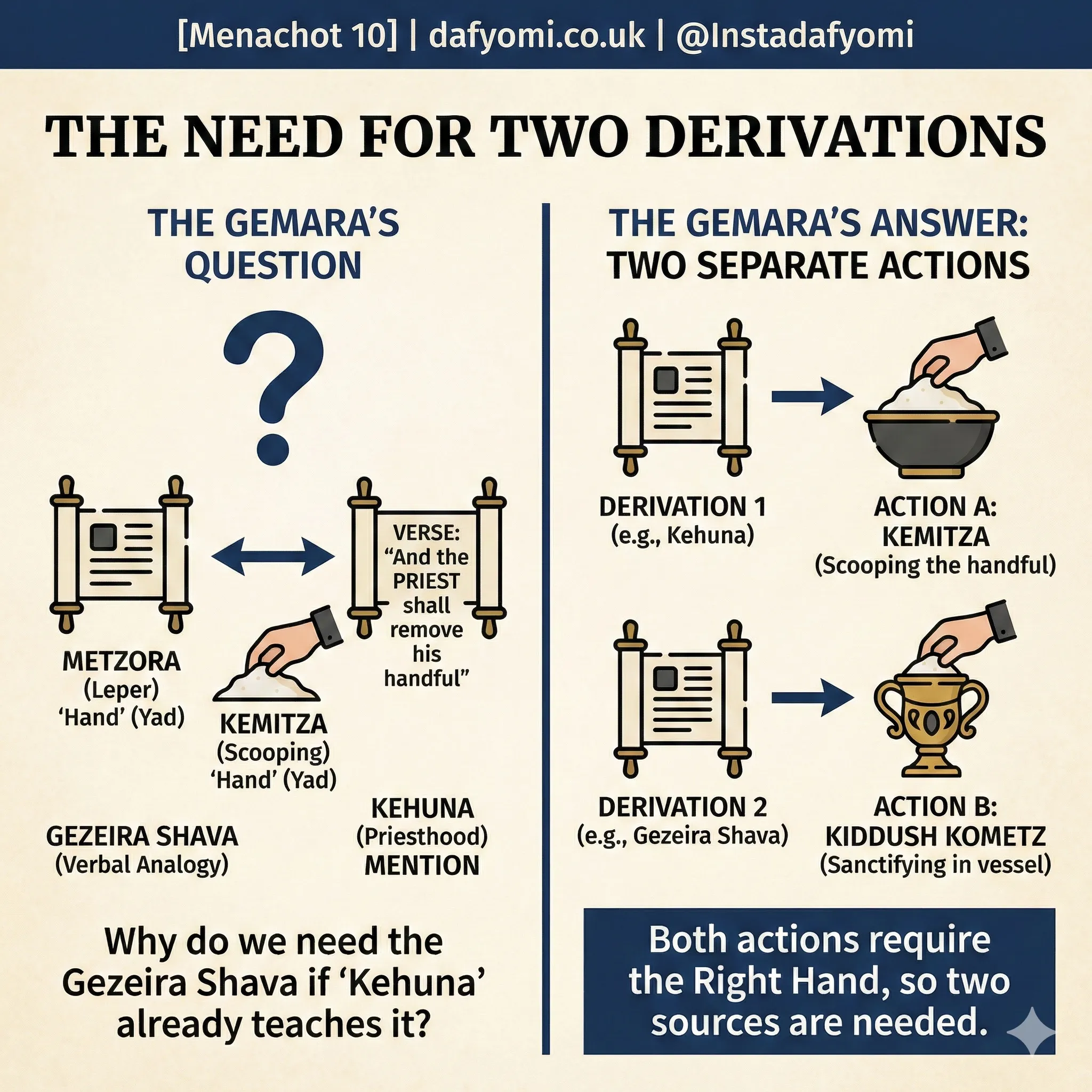
וְאֶלָּא, הָא דְּאָמַר רָבָא: ״יָד״ ״יָד״ לִקְמִיצָה, לְמָה לִי? מִכְּהוּנָּה נָפְקָא!
English Translation:
The Gemara asks: But that which Rava says with regard to the superfluous terms in the passage discussing a leper: One derives a verbal analogy between the word “hand” written in that passage and the word “hand” written with regard to the removal of a handful from a meal offering, to indicate that the latter must also be performed with the right hand, why do I need this verbal analogy? One can derive that the handful must be removed with the right hand from the verse’s mention of the priesthood, as it is stated: “And the priest shall remove his handful” (Leviticus 5:12).
קלאוד על הדף:
Now the Gemara circles back to challenge Rava’s original derivation. If “priesthood” alone (according to the Sages) or even according to some views is sufficient to require the right hand for kemitza, why does Rava need his verbal analogy of “hand-hand”? The derivation seems redundant.
Key Terms:
- מִכְּהוּנָּה נָפְקָא = It is derived from priesthood
Segment 22
TYPE: תירוץ (Answer)
Both derivations are needed — for kemitza and kidush kometz
Hebrew/Aramaic:
חַד לְקוֹמֶץ, וְחַד לְקִידּוּשׁ קוֹמֶץ.
English Translation:
The Gemara responds: Both derivations are necessary, one for the removal of the handful from a meal offering, and one for the sanctification of the handful, i.e., placing it into a second service vessel. Both must be performed with the right hand.
קלאוד על הדף:
The Gemara resolves that Rava’s derivation serves a dual purpose: one teaches about the kemitza itself (taking the handful), and one teaches about kidush kometz (sanctifying the handful by placing it in a sacred vessel). Both procedures require the right hand, so both derivations are necessary.
Key Terms:
- קוֹמֶץ = The handful
- קִידּוּשׁ קוֹמֶץ = Sanctification of the handful (placing in a vessel)
Segment 23
TYPE: קושיא (Challenge)
According to Rabbi Shimon who doesn’t require kidush kometz
Hebrew/Aramaic:
לְרַבִּי שִׁמְעוֹן דְּלָא בָּעֵי קִידּוּשׁ קוֹמֶץ, וּלְמַאן דְּאָמַר נָמֵי דְּבָעֵי קִידּוּשׁ קוֹמֶץ לְרַבִּי שִׁמְעוֹן, וּבִשְׂמֹאל אַכְשׁוֹרֵי מַכְשַׁר – ״יָד״ ״יָד״ דְּרָבָא לְמָה לִי?
English Translation:
The Gemara asks: And according to Rabbi Shimon, who does not require sanctification of the handful, or according to the one who says that Rabbi Shimon also requires the sanctification of the handful but that he deems the sanctification fit when performed with the left hand (see 26a), why do I need the verbal analogy of Rava between “hand” and “hand”?
קלאוד על הדף:
The Gemara challenges the resolution based on Rabbi Shimon’s view. Rabbi Shimon either doesn’t require kidush kometz at all, or validates it even with the left hand. If so, the second half of Rava’s derivation (for kidush kometz) doesn’t apply according to Rabbi Shimon. What does his “hand-hand” teach then?
Key Terms:
- לָא בָּעֵי קִידּוּשׁ קוֹמֶץ = Does not require sanctification of the handful
- בִשְׂמֹאל אַכְשׁוֹרֵי מַכְשַׁר = He validates it with the left hand
Segment 24
TYPE: קושיא (Challenge continued)
Rabbi Yehuda son of Rabbi Chiyya’s teaching
Hebrew/Aramaic:
אִי לִקְמִיצָה גּוּפַהּ, אַלִּיבָּא דְּרַבִּי שִׁמְעוֹן, מִדְּרַבִּי יְהוּדָה בְּרֵיהּ דְּרַבִּי חִיָּיא נָפְקָא, דְּאָמַר רַבִּי יְהוּדָה בְּרֵיהּ דְּרַבִּי חִיָּיא: מַאי טַעְמָא דְּרַבִּי שִׁמְעוֹן? דְּאָמַר קְרָא: ״קֹדֶשׁ קָדָשִׁים הִיא כַּחַטָּאת וְכָאָשָׁם״.
English Translation:
If one suggests that it is necessary to indicate that the removal of the handful itself must be performed with the right hand, this cannot be, since this is derived from the verse cited by Rabbi Yehuda, son of Rabbi Chiyya. As Rabbi Yehuda, son of Rabbi Chiyya, says: What is the reason that Rabbi Shimon does not require that the handful be sanctified in a service vessel? As the verse states with regard to the meal offering: “It is most holy, as the sin offering, and as the guilt offering” (Leviticus 6:10).
קלאוד על הדף:
The challenge continues: perhaps Rava’s derivation teaches about kemitza itself (for Rabbi Shimon)? But Rabbi Yehuda son of Rabbi Chiyya already provides Rabbi Shimon’s source! He explains that Rabbi Shimon derives from “as the sin offering and as the guilt offering” — the meal offering can be treated like either, depending on the method used.
Key Terms:
- קֹדֶשׁ קָדָשִׁים = Most holy
- כַּחַטָּאת וְכָאָשָׁם = As the sin offering and as the guilt offering
Segment 25
TYPE: ביאור (Explanation)
The sin offering/guilt offering comparison
Hebrew/Aramaic:
בָּא לְעוֹבְדָהּ בַּיָּד – עוֹבְדָהּ בְּיָמִין, כְּחַטָּאת; בָּא לְעוֹבְדָהּ בִּכְלִי – עוֹבְדָהּ בִּשְׂמֹאל, כְּאָשָׁם.
English Translation:
Rabbi Yehuda, son of Rabbi Chiyya, elaborates: The verse compares the meal offering to a sin offering and a guilt offering. Therefore, if the priest comes to perform the burning of the handful with his hand, he performs it with his right hand, like in the case of a sin offering, whose blood is sprinkled with the hand. And if he comes to perform it with a vessel, i.e., if he first sanctifies the handful in a service vessel, then he may perform it with his left hand, like in the case of a guilt offering, whose blood is sprinkled from a vessel.
קלאוד על הדף:
Rabbi Yehuda son of Rabbi Chiyya explains Rabbi Shimon’s reasoning: the verse compares the meal offering to both sin and guilt offerings. If performed by hand (directly), it follows sin-offering rules — requiring the right hand. If performed via a vessel, it follows guilt-offering rules — allowing the left hand. Since kemitza is done by hand, it requires the right hand according to this derivation.
Key Terms:
- בַּיָּד = By hand
- בִּכְלִי = With a vessel
- כְּחַטָּאת = Like a sin offering
- כְּאָשָׁם = Like a guilt offering
Segment 26
TYPE: תירוץ (Resolution)
The derivation is needed for the sinner’s meal offering
Hebrew/Aramaic:
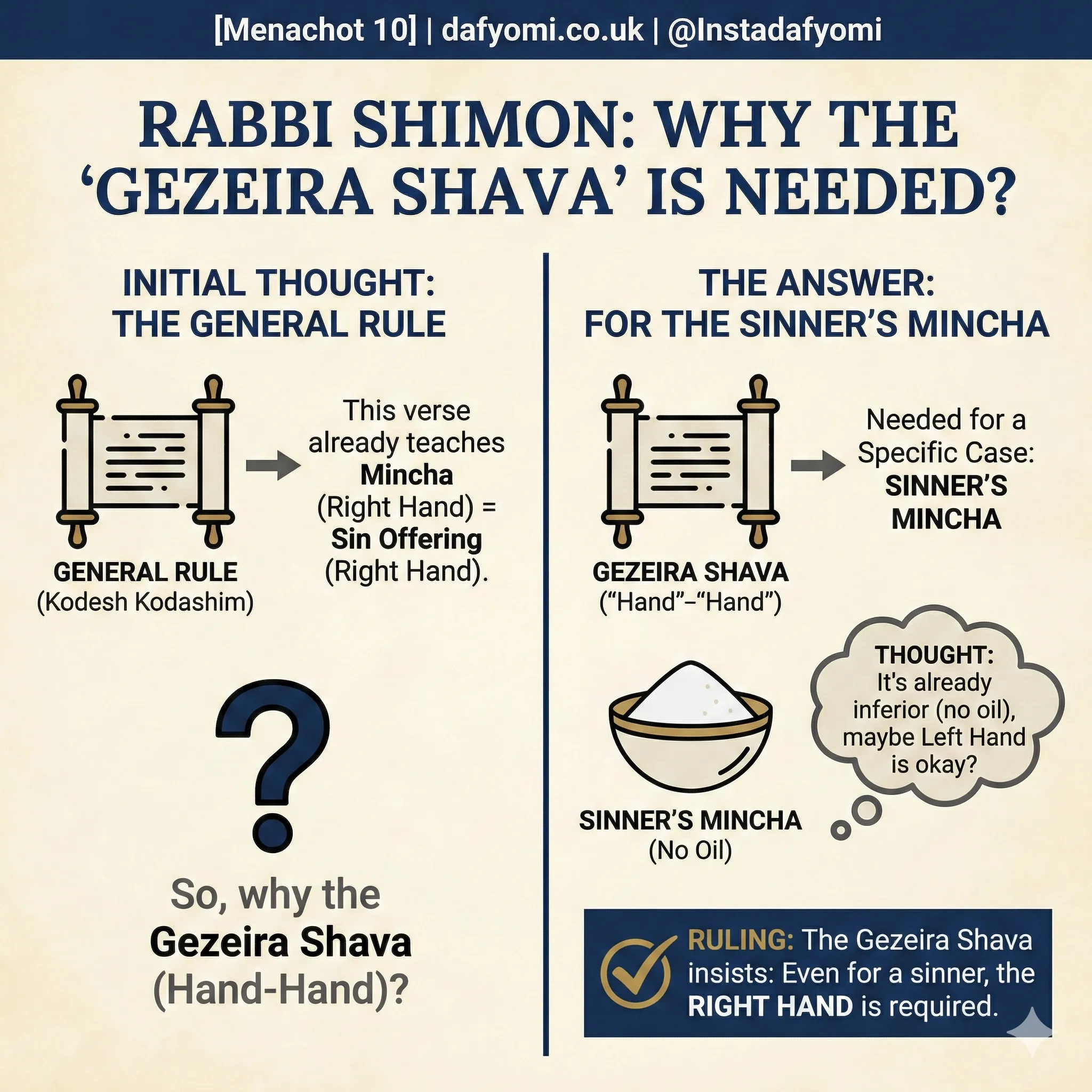
לֹא נִצְרְכָא אֶלָּא לְקוֹמֶץ דְּמִנְחַת חוֹטֵא, סָלְקָא דַּעְתָּךְ אָמֵינָא: הוֹאִיל וְאָמַר רַבִּי שִׁמְעוֹן שֶׁלֹּא יְהֵא קׇרְבָּנוֹ מְהוּדָּר, כִּי קָמֵיץ לַהּ נָמֵי בִּשְׂמֹאל תִּתַּכְשַׁר, קָמַשְׁמַע לַן.
English Translation:
The Gemara responds: The verbal analogy is necessary only for the handful of the meal offering of a sinner, to teach that it must be removed with the right hand. It might enter your mind to say: Since Rabbi Shimon says that this offering does not require oil and frankincense so that a sinner’s offering will not be of superior quality, perhaps when the priest removed the handful with his left hand, which is a manner of inferior quality, it should be fit as well. The verbal analogy therefore teaches us that the handful must always be removed with the right hand, even in the case of the meal offering of a sinner.
קלאוד על הדף:
The Gemara finally resolves why Rava’s derivation is needed according to Rabbi Shimon: it’s for the minchat chotet (sinner’s meal offering). Rabbi Shimon rules this offering shouldn’t have oil and frankincense — so the sinner’s offering isn’t “beautified.” One might think left-handed kemitza would also be acceptable as a “lesser” method. Rava’s derivation teaches: even for this offering, right-hand kemitza is required.
Key Terms:
- מִנְחַת חוֹטֵא = Sinner’s meal offering
- שֶׁלֹּא יְהֵא קׇרְבָּנוֹ מְהוּדָּר = So that his offering will not be of superior quality
Segment 27
TYPE: משנה (Mishna Citation)
Returning to the mishna about foreign objects
Hebrew/Aramaic:
קָמַץ וְעָלָה בְּיָדוֹ צְרוֹר, אוֹ גַרְגֵּר מֶלַח,
English Translation:
The mishna teaches: If a priest removed the handful of flour, and a stone or a grain of salt emerged in his hand,
קלאוד על הדף:
The Gemara transitions to a new topic, citing the mishna about foreign objects in the kometz. This mishna (which was discussed on earlier dapim) rules that if the priest’s handful contains a pebble, salt grain, or frankincense particle, the offering is disqualified. The Gemara on the following daf will analyze why these particular items invalidate the handful.
Key Terms:
- צְרוֹר = Stone/pebble
- גַרְגֵּר מֶלַח = Grain of salt