Menachot Daf 5 (מנחות דף ה׳)
Daf: 5 | Amudim: 5a – 5b | Date: January 17, 2026
📖 Breakdown
Amud Aleph (5a)
Segment 1
TYPE: גמרא
Continuation of nazirite discussion
Hebrew/Aramaic:
דְּאָמַר מָר: גִּילַּח עַל אַחַת מִשְּׁלׇשְׁתָּן יָצָא.
English Translation:
As the Master said about the nazirite (Nazir 45a): And if he shaved after the sacrifice of any one of the three of them, i.e., after sacrificing his sin offering, burnt offering, or peace offering, he has fulfilled his obligation after the fact, i.e., he has successfully completed his term of naziriteship.
קלאוד על הדף:
The Gemara continues from the previous daf, discussing whether certain offerings “render fit” their owners. The nazirite’s case proves that there’s no single offering that “renders fit” — shaving after any of the three offerings validates the naziriteship. This suggests the nazirite’s offerings don’t fit the category of “offerings that come to permit.”
Key Terms:
- נזיר (Nazir) = Nazirite; one who takes a vow of abstinence
- גילוח (Giluach) = Shaving; the final act completing naziriteship
Segment 2
TYPE: גמרא
Challenge from the leper’s guilt offering
Hebrew/Aramaic:
מֵיתִיבִי: אָשָׁם מְצוֹרָע שֶׁנִּשְׁחַט שֶׁלֹּא לִשְׁמוֹ, אוֹ שֶׁלֹּא נִיתַּן מִדָּמוֹ עַל גַּבֵּי בְּהוֹנוֹת – הֲרֵי זֶה עוֹלֶה לְגַבֵּי מִזְבֵּחַ, וְטָעוּן נְסָכִים, וְצָרִיךְ אָשָׁם אַחֵר לְהַכְשִׁירוֹ. תְּיוּבְתָּא דְרַב.
English Translation:
The Gemara raises an objection from a baraita: With regard to the guilt offering of a leper that was slaughtered not for its own sake, or if none of its blood was placed on the leper’s right thumb and big toe, this guilt offering is offered up upon the altar and it requires libations, in accordance with the halakha of the guilt offering of a leper. But the leper must nevertheless bring another guilt offering to render him fit to partake of offerings. This baraita is a conclusive refutation of the statement of Rav.
קלאוד על הדף:
A baraita challenges Rav’s position from the previous daf. If a leper’s guilt offering was slaughtered improperly, it can still be offered on the altar — but the leper needs another guilt offering to complete his purification. This contradicts Rav’s view that such an offering would be entirely disqualified.
Key Terms:
- אשם מצורע (Asham Metzora) = The leper’s guilt offering
- בהונות (Behonot) = Thumbs and big toes; where blood and oil are applied
Segment 3
TYPE: גמרא
Reish Lakish’s position on the omer
Hebrew/Aramaic:
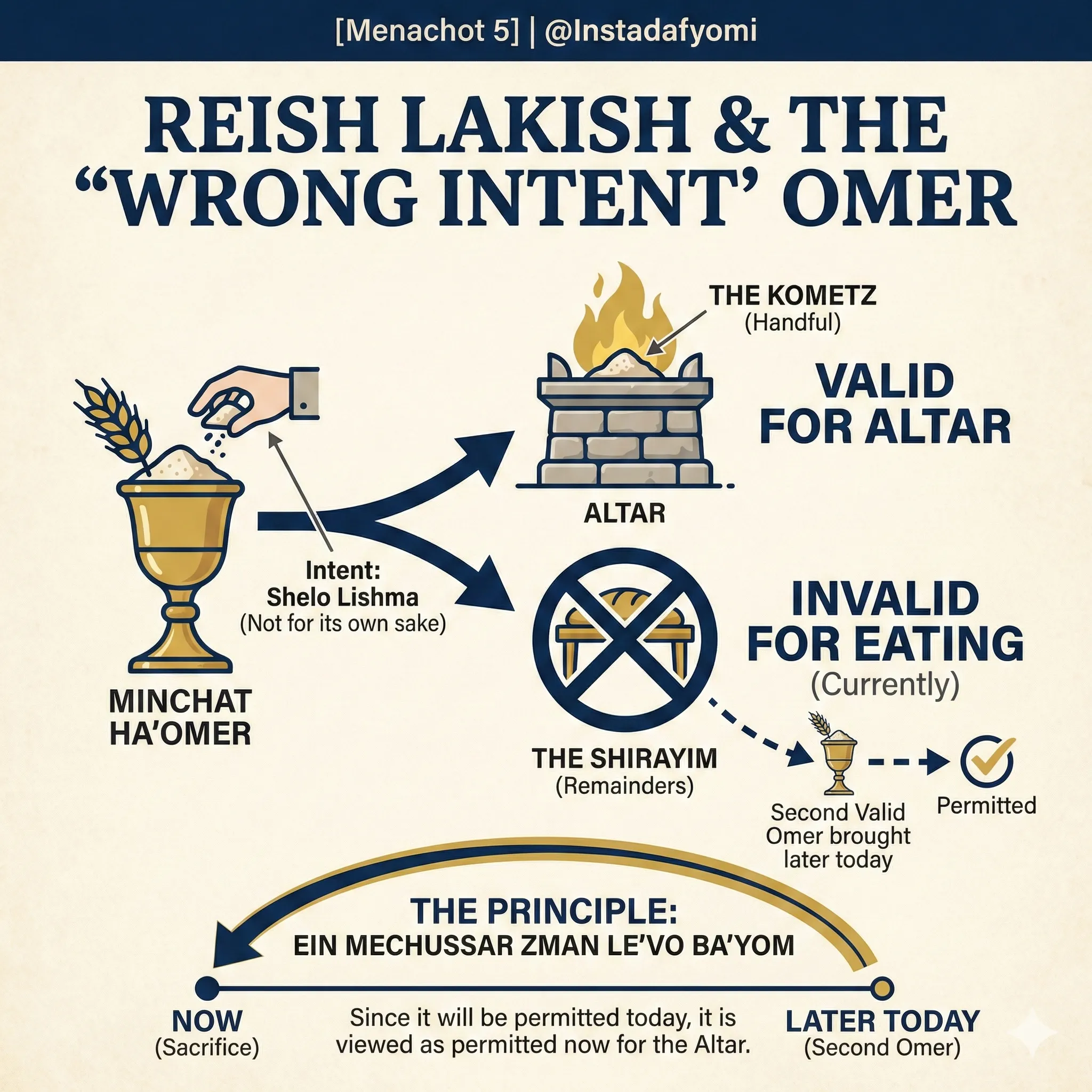
וְרַבִּי שִׁמְעוֹן בֶּן לָקִישׁ אָמַר: מִנְחַת הָעוֹמֶר שֶׁקְּמָצָהּ שֶׁלֹּא לִשְׁמָהּ – כְּשֵׁירָה, וּשְׁיָרֶיהָ אֵין נֶאֱכָלִין עַד שֶׁתָּבִיא מִנְחַת הָעוֹמֶר אַחֶרֶת וְתַתִּירֶנָּה.
English Translation:
And Rabbi Shimon ben Lakish says, with regard to an omer meal offering from which a priest removed a handful not for its own sake, that it is valid and the handful is burned on the altar. But its remainder may not be consumed by the priests until a priest brings another omer meal offering on the same day and thereby permits the first offering for consumption, as the prohibition against consuming the new crop remains in effect.
קלאוד על הדף:
Reish Lakish presents a middle position: the omer meal offering with improper intent is valid for the altar, but its remainder cannot be eaten until another proper omer is brought. This is because the new crop (chadash) is still prohibited until the omer properly permits it.
Key Terms:
- מנחת העומר (Minchat Ha’omer) = The omer meal offering; permits the new crop
- קמיצה (Kemitza) = Removing a handful; a key stage in meal offering service
- שיריים (Shirayim) = Remainder; the portion eaten by priests
Segment 4
TYPE: גמרא
Challenge: How can it be sacrificed?
Hebrew/Aramaic:
שֶׁשְּׁיָרֶיהָ אֵין נֶאֱכָלִין עַד שֶׁתָּבִיא מִנְחַת הָעוֹמֶר אַחֶרֶת, מִקְרָב הֵיכִי קָרְבָה? ״מִמַּשְׁקֵה יִשְׂרָאֵל״ – מִן הַמּוּתָּר לְיִשְׂרָאֵל.
English Translation:
But if its remainder may not be consumed by the priests until they bring another omer meal offering, how can the handful removed from this omer meal offering be sacrificed upon the altar? Before the omer meal offering is sacrificed, the new crop is forbidden for consumption, and the verse states: “From the well-watered pastures of Israel” (Ezekiel 45:15), from which it is derived that one may sacrifice only from that which is permitted to the Jewish people.
קלאוד על הדף:
The Gemara raises a fundamental problem: if the new crop is still forbidden, how can anything from it be offered on the altar? The principle of “mimashkeh Yisrael” requires that offerings come from items permitted to Jews. If the first omer didn’t work, the grain is still forbidden!
Key Terms:
- ממשקה ישראל (Mimashkeh Yisrael) = “From the well-watered pastures of Israel”; offerings must come from permitted items
- חדש (Chadash) = New crop; forbidden until the omer is brought
Segment 5
TYPE: גמרא
Resolution: “Not lacking time on that day”
Hebrew/Aramaic:
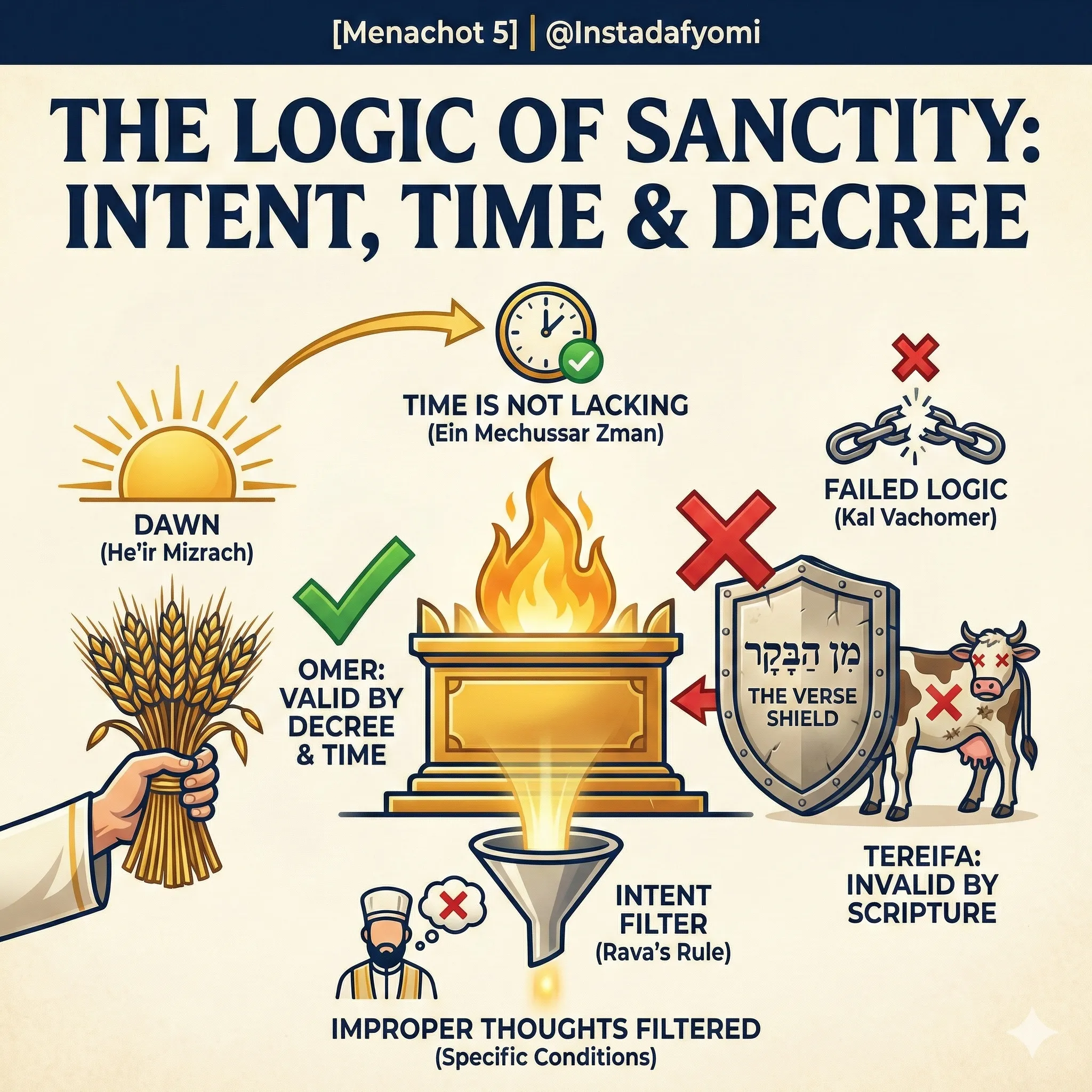
אָמַר רַב אַדָּא בַּר אַהֲבָה: קָסָבַר רֵישׁ לָקִישׁ, אֵין מְחוּסָּר זְמַן לְבוֹ בַּיּוֹם.
English Translation:
Rav Adda bar Ahava said in response: Reish Lakish holds that an offering is not considered one whose time has not yet arrived if it is to be brought on that day.
קלאוד על הדף:
This is a key principle: “ein mechusar zman l’vo bayom” — something isn’t considered “premature” if it will become permitted that same day. Since another proper omer can be brought the same day, the first handful is already considered as if it were permitted.
Key Terms:
- מחוסר זמן (Mechusar Zman) = Lacking time; something not yet permitted
- לבו ביום (L’vo Bayom) = On that day; same-day permission retroactively validates
Segment 6
TYPE: גמרא
Challenge from a baraita about birds vs. meal offerings
Hebrew/Aramaic:
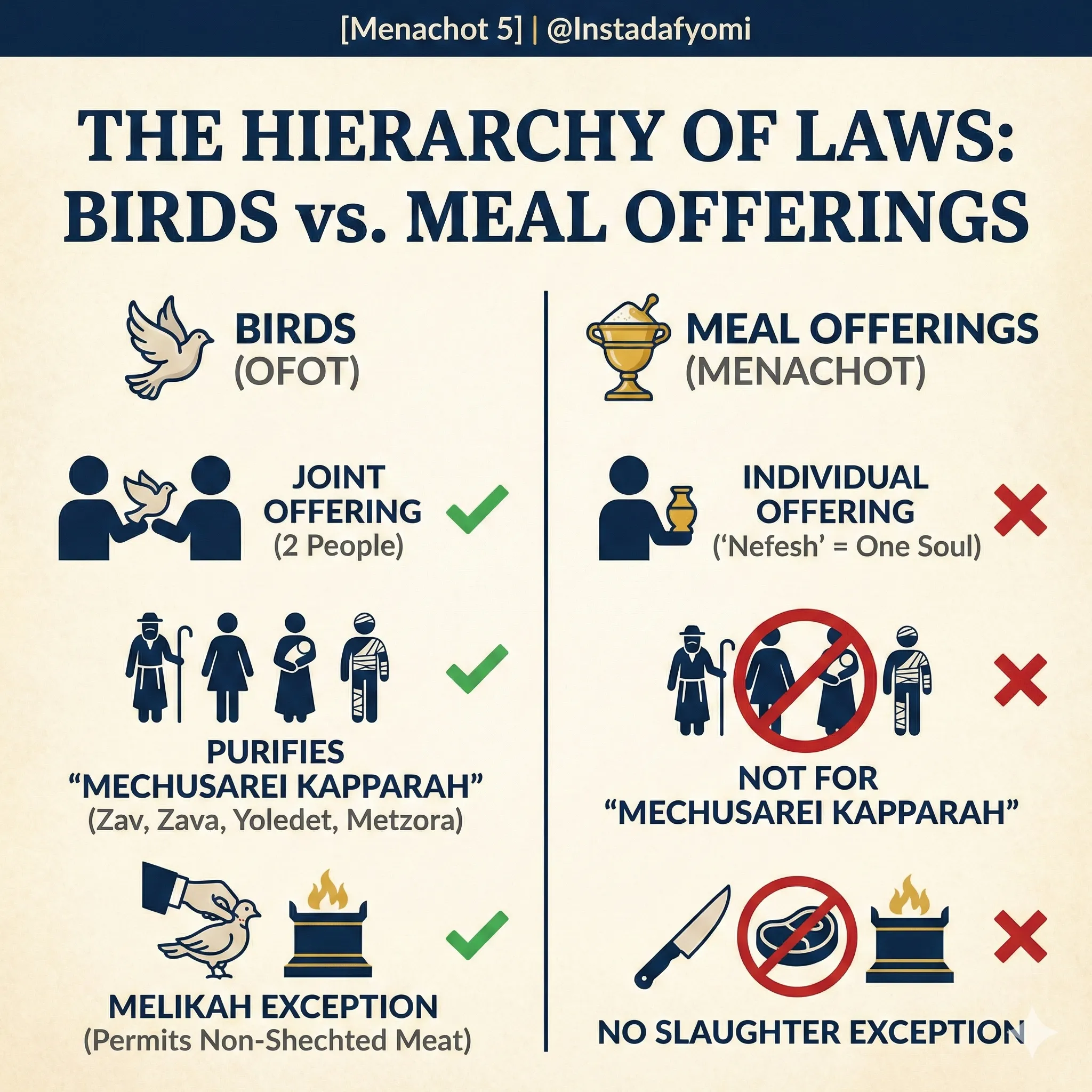
מֵתִיב רַב אַדָּא בְּרֵיהּ דְּרַב יִצְחָק: יֵשׁ בָּעוֹפוֹת שֶׁאֵין בַּמְּנָחוֹת, יֵשׁ בַּמְּנָחוֹת שֶׁאֵין בָּעוֹפוֹת. יֵשׁ בָּעוֹפוֹת – שֶׁהָעוֹפוֹת בָּאִין בְּנִדְבַת שְׁנַיִם, אֲבָל מְנָחוֹת ״נֶפֶשׁ״ כְּתִיבָא.
English Translation:
Rav Adda, son of Rav Yitzchak, raises an objection from a baraita: There is a halakha that applies to birds that does not apply to meal offerings, and there is a halakha that applies to meal offerings that does not apply to birds. There is a halakha that applies to birds that does not apply to meal offerings, as birds may be brought as a gift offering on behalf of two people. But with regard to meal offerings it is written: “And when one brings a meal offering” (Leviticus 2:1), indicating that only individuals may vow to bring a meal offering.
קלאוד על הדף:
The Gemara introduces a baraita comparing bird offerings and meal offerings. Birds can be brought jointly by two people; meal offerings cannot (the word “nefesh” — soul — implies individuality). This sets up a detailed comparison of the two offering types.
Key Terms:
- עופות (Ofot) = Bird offerings
- נפש (Nefesh) = Soul; implies individuality in the context of vows
Segment 7
TYPE: גמרא
Those lacking atonement
Hebrew/Aramaic:
וּמְחוּסְּרֵי כַפָּרָה: זָב, וְזָבָה, יוֹלֶדֶת, וּמְצוֹרָע.
English Translation:
And another halakha that applies to birds but not meal offerings involves one who has not yet brought his atonement offering, i.e., a zav, or zavah, or a woman after childbirth, or a leper, all of whom must bring an offering to complete their atonement process. They bring a bird offering, not a meal offering.
קלאוד על הדף:
The baraita lists those who need atonement offerings (mechusrei kapparah): zav, zavah, yoledet, and metzora. These individuals bring bird offerings to complete their purification — another distinction between birds and meal offerings.
Segment 8
TYPE: גמרא
Birds: prohibition permitted through consecration
Hebrew/Aramaic:
וְהוּתְּרוּ מִכְּלַל אִיסּוּרָן בַּקּוֹדֶשׁ, מַה שֶּׁאֵין כֵּן בַּמְּנָחוֹת.
English Translation:
And furthermore, with regard to birds, their general prohibition was permitted when they are consecrated, i.e., killing a non-sacred bird by pinching the nape of its neck renders it a carcass, whose consumption is prohibited, and yet pinching the nape of a bird offering enables it to be sacrificed upon the altar and permits it for consumption, which is not so with regard to meal offerings.
קלאוד על הדף:
A remarkable feature of bird offerings: melikah (pinching the nape) would normally make a bird a neveilah (carcass), forbidden for consumption. But when consecrated, the same act renders the bird fit for the altar! This “prohibition permitted through sanctity” doesn’t apply to meal offerings.
Key Terms:
- מליקה (Melikah) = Pinching the bird’s nape; the method of killing bird offerings
- נבילה (Neveilah) = Carcass; normally forbidden for consumption
Segment 9
TYPE: גמרא
Unique features of meal offerings
Hebrew/Aramaic:
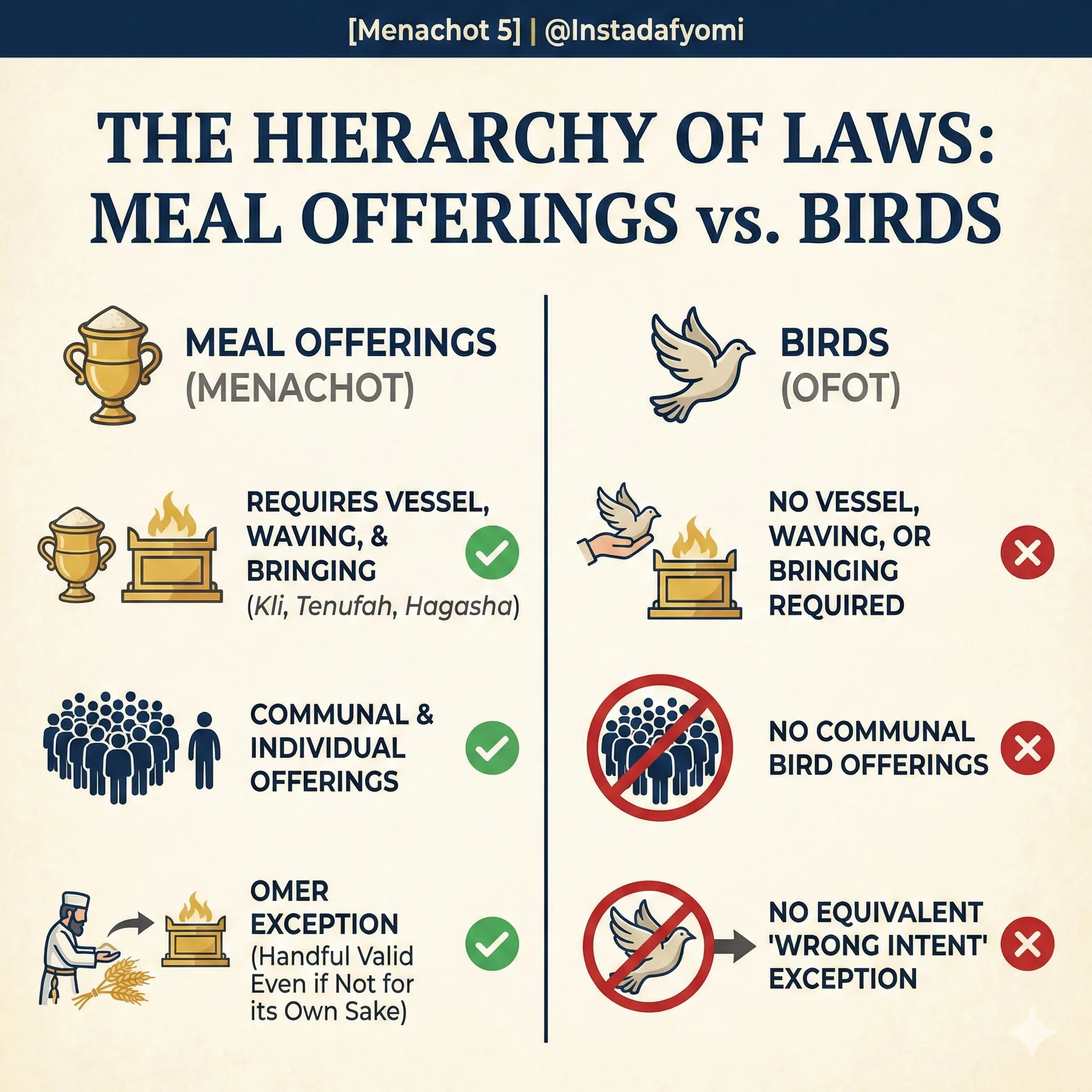
וְיֵשׁ בַּמְּנָחוֹת – שֶׁהַמְּנָחוֹת טְעוּנוֹת כְּלִי, וּתְנוּפָה וְהַגָּשָׁה, וְיֶשְׁנָן בַּצִּיבּוּר כְּבַיָּחִיד, מַה שֶּׁאֵין כֵּן בָּעוֹפוֹת.
English Translation:
And there is a halakha that applies to meal offerings that does not apply to birds. As meal offerings require placement in a service vessel, and they require waving and bringing, i.e., they must be brought to the corner of the altar prior to removal of the handful. And lastly, there are meal offerings of the community just as there are meal offerings of individuals, e.g., the omer meal offering is a communal meal offering, which is not so with regard to birds.
קלאוד על הדף:
Meal offerings have unique requirements: they need a service vessel, require waving (tenufah) and bringing near (hagashah). Also, there are communal meal offerings (like the omer), whereas all bird offerings are individual.
Key Terms:
- תנופה (Tenufah) = Waving; movement of the offering
- הגשה (Hagashah) = Bringing near; bringing to the altar corner
- ציבור (Tzibbur) = Community; communal offerings
Segment 10
TYPE: גמרא
The challenge applied
Hebrew/Aramaic:
וְאִם אִיתָא, בִּמְנָחוֹת נָמֵי מַשְׁכַּחַתְּ לַהּ, דְּהוּתְּרוּ מִכְּלַל אִיסּוּרָן בַּקּוֹדֶשׁ, וּמַאי נִיהוּ? מִנְחַת הָעוֹמֶר.
English Translation:
Rav Adda, son of Rav Yitzchak, explains his objection: And if it is so that a handful that was removed from an omer meal offering not for its own sake is fit for burning upon the altar, then with regard to meal offerings as well, you find that their general prohibition was permitted when they are consecrated. And what is this meal offering that was permitted? It is the omer meal offering.
קלאוד על הדף:
Here’s the challenge: if Reish Lakish is correct that an improperly-kemitzah’d omer can still be offered, then meal offerings DO have the feature of “prohibition permitted through sanctity” — the omer permits forbidden new-crop grain to be offered!
Segment 11
TYPE: גמרא
Resolution
Hebrew/Aramaic:
כֵּיוָן דְּאֵין מְחוּסַּר זְמַן לְבוֹ בַּיּוֹם, לָאו אִיסּוּרָא הוּא.
English Translation:
Since an offering is not considered one whose time has not yet arrived if it is to be brought on that day, the sacrificing of that handful is not a prohibition that was permitted. Instead, it was initially fit for sacrifice upon the altar, as though another omer meal offering had already been brought to permit it.
קלאוד על הדף:
The resolution returns to the key principle: since another omer can be brought the same day, the new crop is already considered permitted. Therefore, the omer doesn’t demonstrate “prohibition permitted through sanctity” — it was never truly prohibited at that moment.
Segment 12
TYPE: גמרא
Challenge from the leper’s purification
Hebrew/Aramaic:
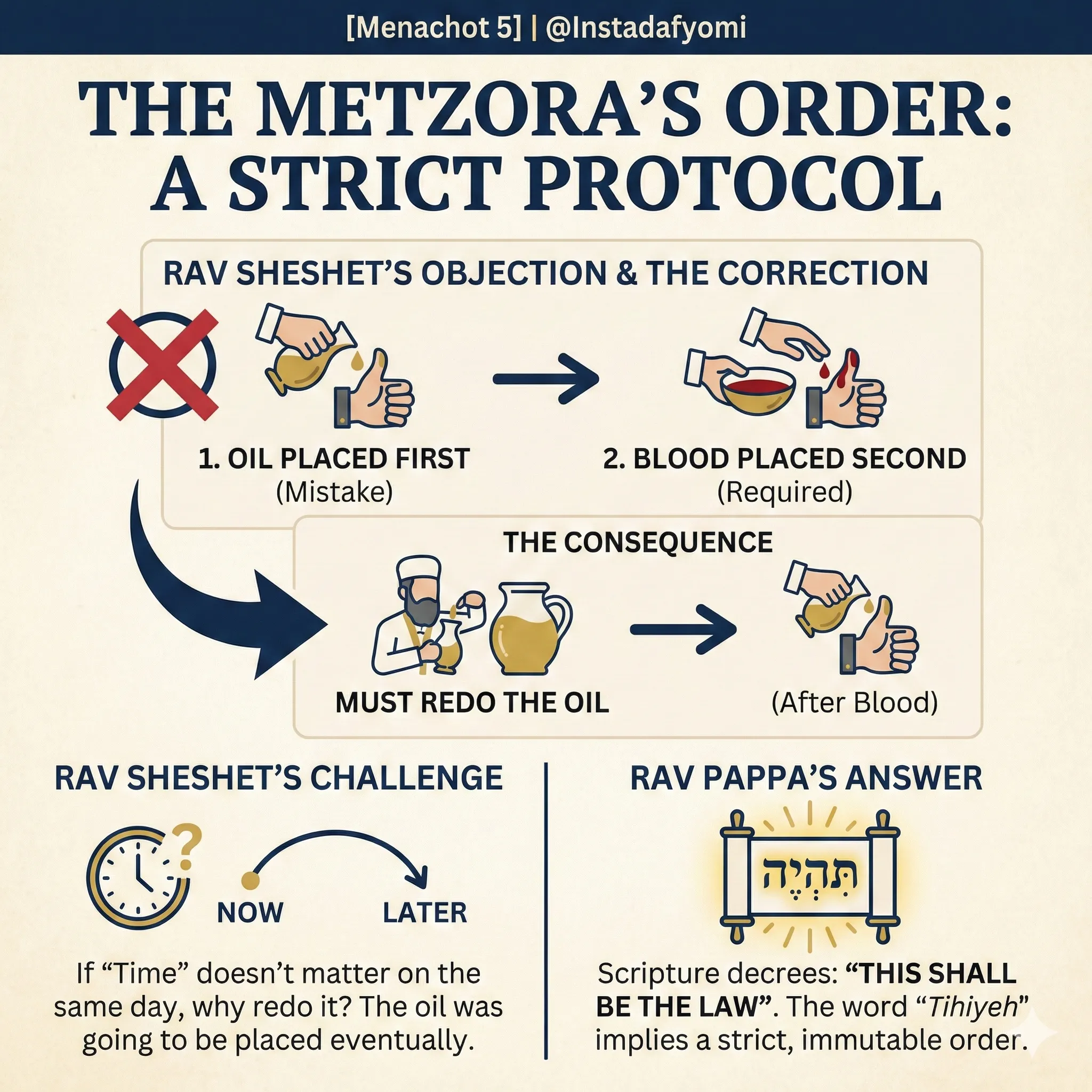
מֵתִיב רַב שֵׁשֶׁת: הִקְדִּים מַתַּן שֶׁמֶן לְמַתַּן דָּם – יְמַלְּאֶנּוּ שֶׁמֶן וְיַחֲזוֹר וְיִתֵּן שֶׁמֶן אַחַר מַתַּן דָּם, מַתַּן בְּהוֹנוֹת לְמַתַּן שֶׁבַע – יְמַלְּאֶנּוּ שֶׁמֶן וְיַחֲזוֹר וְיִתֵּן מַתַּן בְּהוֹנוֹת אַחַר מַתַּן שֶׁבַע.
English Translation:
Rav Sheshet raises an objection from a baraita that discusses the ritual purification of a leper: If the priest performed the placement of oil on the leper’s right thumb and big toe before the placement of blood from the leper’s guilt offering on the leper’s right thumb and big toe, he fills the vessel that holds a log of oil and he then puts oil on the leper’s right thumb and big toe again after the placement of blood. If the priest performed the placement of oil on the leper’s right thumb and big toe before the placement of seven sprinklings of oil before the Lord, he fills the vessel with oil and he again puts oil on the leper’s right thumb and big toe after the placement of seven sprinklings.
קלאוד על הדף:
Rav Sheshet brings a powerful challenge from the leper’s purification process. If oil was applied before blood (wrong order), the oil application must be repeated. If the “same day” principle worked, the wrong-order application should be valid!
Key Terms:
- מתן שמן (Matan Shemen) = Application of oil
- מתן דם (Matan Dam) = Application of blood
- שבע הזאות (Sheva Hazaot) = Seven sprinklings
Segment 13
TYPE: גמרא
The challenge articulated
Hebrew/Aramaic:
וְאִי אָמְרַתְּ אֵין מְחוּסַּר זְמַן לְבוֹ בַּיּוֹם, אַמַּאי יַחְזוֹר וְיִתֵּן? מַאי דַּעֲבַד עֲבַד!
English Translation:
And if you say that an offering is not considered as one whose time has not yet arrived if it is to be brought on that day, then why should the priest place the oil on the leper’s right thumb and big toe again? What he performed, he already performed.
קלאוד על הדף:
The challenge is clear: if “same day” makes premature acts retroactively valid, why repeat the oil application? The first application should be valid since the blood would be applied that same day!
Segment 14
TYPE: גמרא
Rav Pappa’s resolution: leper is different
Hebrew/Aramaic:
אָמַר רַב פָּפָּא: שָׁאנֵי הִלְכוֹת מְצוֹרָע, דִּכְתִיבָא בְּהוּ הֲוָיָיה, דְּאָמַר הַכָּתוּב: ״זֹאת תִּהְיֶה תּוֹרַת הַמְּצוֹרָע״, ״תִּהְיֶה״ – בַּהֲוָיָיתָהּ תְּהֵא.
English Translation:
Rav Pappa said in response: The halakhot of a leper are different, as it is written concerning them an expression of being, as the verse states: “This shall be the law of the leper” (Leviticus 14:2). The term “shall be” indicates that it shall be as it is, i.e., the purification process of a leper must be performed in accordance with the precise order prescribed in the Torah.
קלאוד על הדף:
Rav Pappa resolves the challenge by distinguishing the leper’s case. The Torah uses “tihyeh” (shall be), implying the leper’s process must follow exact prescribed order. This is a special stringency for leper purification, not a general principle.
Key Terms:
- הויה (Havayah) = Being/existence; implying strict adherence to prescribed order
- תורת המצורע (Torat HaMetzora) = The law of the leper
Segment 15
TYPE: גמרא
Rav Pappa’s own challenge
Hebrew/Aramaic:
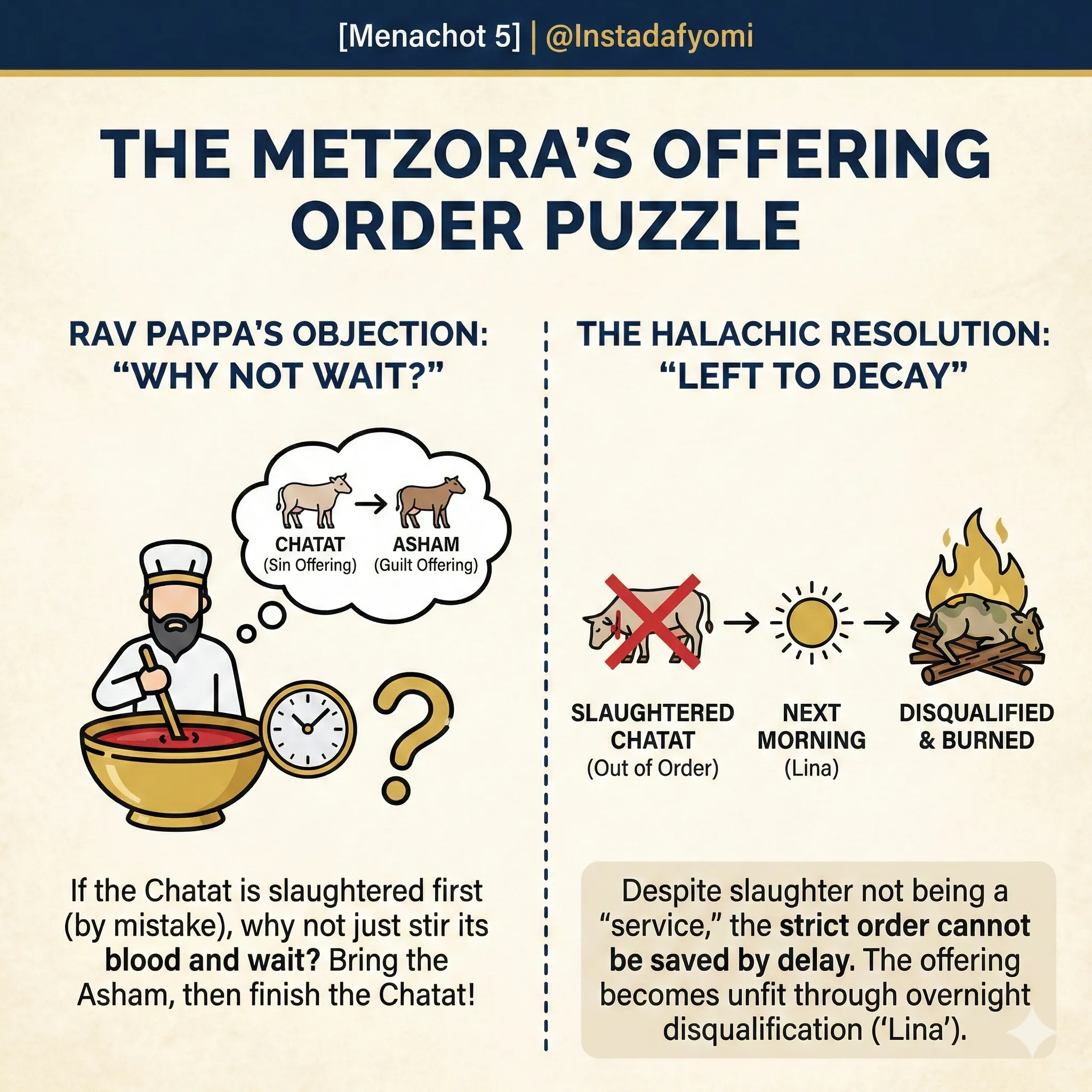
מֵתִיב רַב פָּפָּא: הִקְדִּים חַטָּאתוֹ לַאֲשָׁמוֹ – לֹא יִהְיֶה אַחֵר מְמָרֵס בְּדָמָהּ, אֶלָּא תְּעוּבַּר צוּרָתָהּ וְתֵצֵא לְבֵית הַשְּׂרֵיפָה.
English Translation:
Rav Pappa raises an objection from a baraita: If the priest performed the slaughter of a leper’s sin offering before the slaughter of his guilt offering, there should not be another priest stirring the blood of the leper’s sin offering to prevent it from congealing. Rather, the sin offering is left until its form decays, i.e., until the next morning, at which point it is definitively disqualified due to remaining overnight and can be taken out to the place designated for burning.
קלאוד על הדף:
Now Rav Pappa himself raises a challenge! If a leper’s sin-offering was slaughtered before the guilt-offering (wrong order), the sin-offering must be left to decay. Why can’t the guilt-offering be quickly slaughtered to fix the order?
Key Terms:
- ממרס (Memares) = Stirring; to prevent blood from congealing
- תעובר צורתה (Te’ubar Tzuratah) = Its form decays; left overnight
Segment 16
TYPE: גמרא
Resolution: slaughter vs. service
Hebrew/Aramaic:
אַמַּאי קָא מוֹתֵיב רַב פָּפָּא? וְהָא רַב פָּפָּא הוּא דְּאָמַר: שָׁאנֵי הִלְכוֹת מְצוֹרָע, דִּכְתִיבָא בְּהוּ הֲוָיָיה! אֶלָּא רַב פָּפָּא הָכִי קָא קַשְׁיָא לֵיהּ: אֵימָא הָנֵי מִילֵּי עֲבוֹדָה, שְׁחִיטָה לָאו עֲבוֹדָה הִיא
English Translation:
Why does Rav Pappa raise this objection? But isn’t it Rav Pappa himself who said: The halakhot of a leper are different, as it is written concerning them an expression of being? Rather, this is what is difficult to Rav Pappa: You can say that this statement, the halakha that the order is indispensable, applies only to a sacrificial rite, whereas the act of slaughter is not considered a rite.
קלאוד על הדף:
The Gemara clarifies Rav Pappa’s question: maybe the “tihyeh” requirement for exact order only applies to priestly service (avodah), but shechitah (slaughter) isn’t technically avodah — it can be done by non-priests. So why does wrong-order slaughter invalidate?
Key Terms:
- עבודה (Avodah) = Temple service; specifically priestly duties
- שחיטה (Shechitah) = Slaughter; can be performed by non-priests
Segment 17
TYPE: גמרא
Reish Lakish’s underlying reasoning
Hebrew/Aramaic:
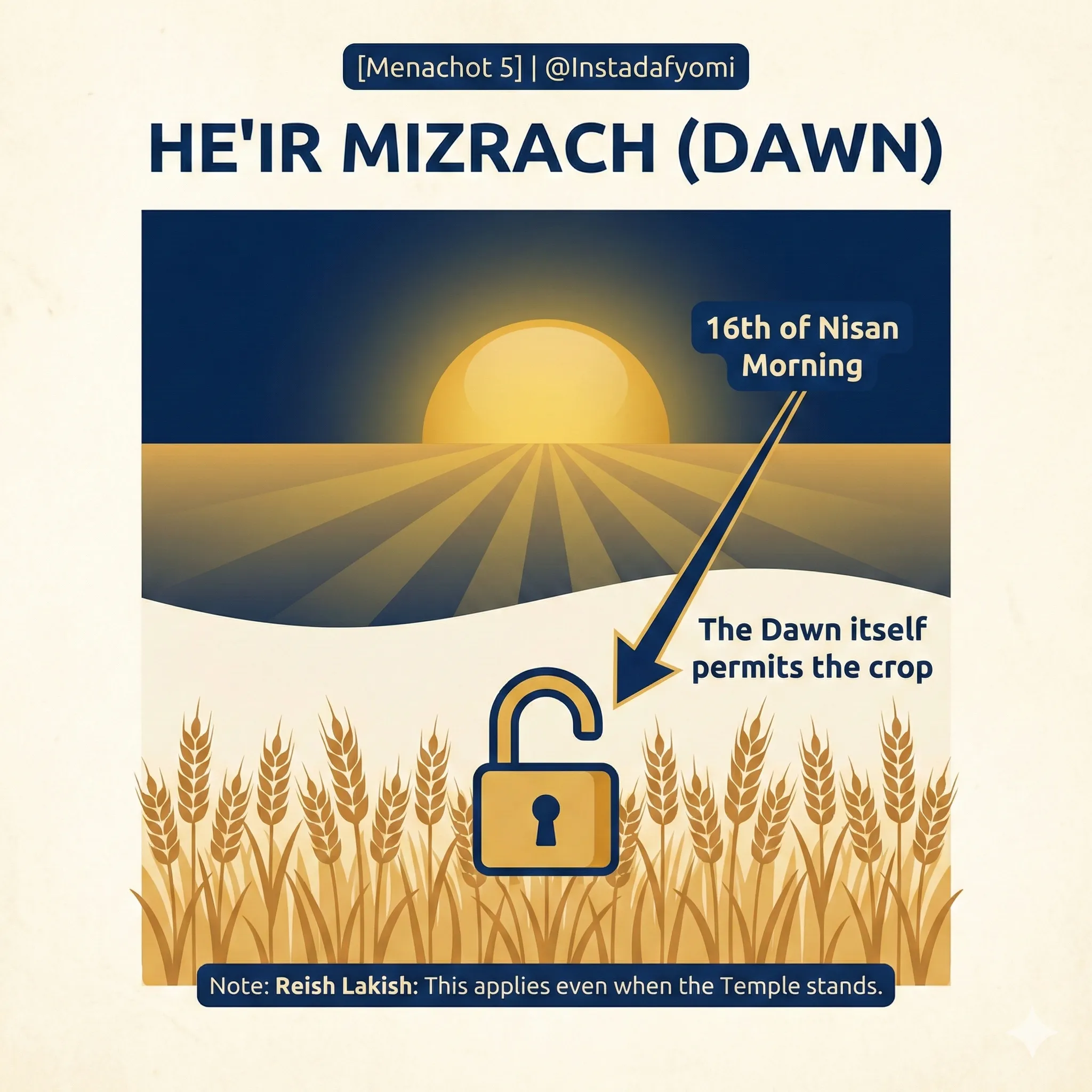
אֶלָּא אָמַר רַב פָּפָּא: הַיְינוּ טַעְמָא דְּרֵישׁ לָקִישׁ, דְּקָסָבַר הֵאִיר מִזְרָח מַתִּיר, דְּרַבִּי יוֹחָנָן וְרֵישׁ לָקִישׁ דְּאָמְרִי תַּרְוַיְיהוּ: אֲפִילּוּ בִּזְמַן שֶׁבֵּית הַמִּקְדָּשׁ קַיָּים
English Translation:
Rather, Rav Pappa said: This is the reason of Reish Lakish, who said that the handful of an omer meal offering that was removed not for its own sake is valid: It is that he holds that the illumination of the eastern horizon on the morning of the sixteenth of Nisan permits the new crop to the Jewish people even before the omer meal offering is sacrificed, as Rabbi Yochanan and Reish Lakish both say: Even when the Temple is standing…
קלאוד על הדף:
Rav Pappa reveals Reish Lakish’s actual reasoning: dawn on the 16th of Nisan automatically permits the new crop, even without the omer being offered! This is a major position — the omer is a mitzvah but isn’t technically required for permission.
Key Terms:
- האיר מזרח (He’ir Mizrach) = The eastern horizon illuminated; dawn
- ט״ז ניסן (16 Nisan) = The date the omer is brought
Amud Bet (5b)
Segment 1
TYPE: גמרא
Continuation: dawn permits
Hebrew/Aramaic:
הֵאִיר מִזְרָח מַתִּיר.
English Translation:
The illumination of the eastern horizon permits the new crop.
קלאוד על הדף:
The Gemara continues from 5a, stating the principle: dawn on the 16th of Nisan permits the new crop even without the omer sacrifice. This is the joint position of Rabbi Yochanan and Reish Lakish.
Segment 2
TYPE: גמרא
Reish Lakish’s position derived by inference
Hebrew/Aramaic:
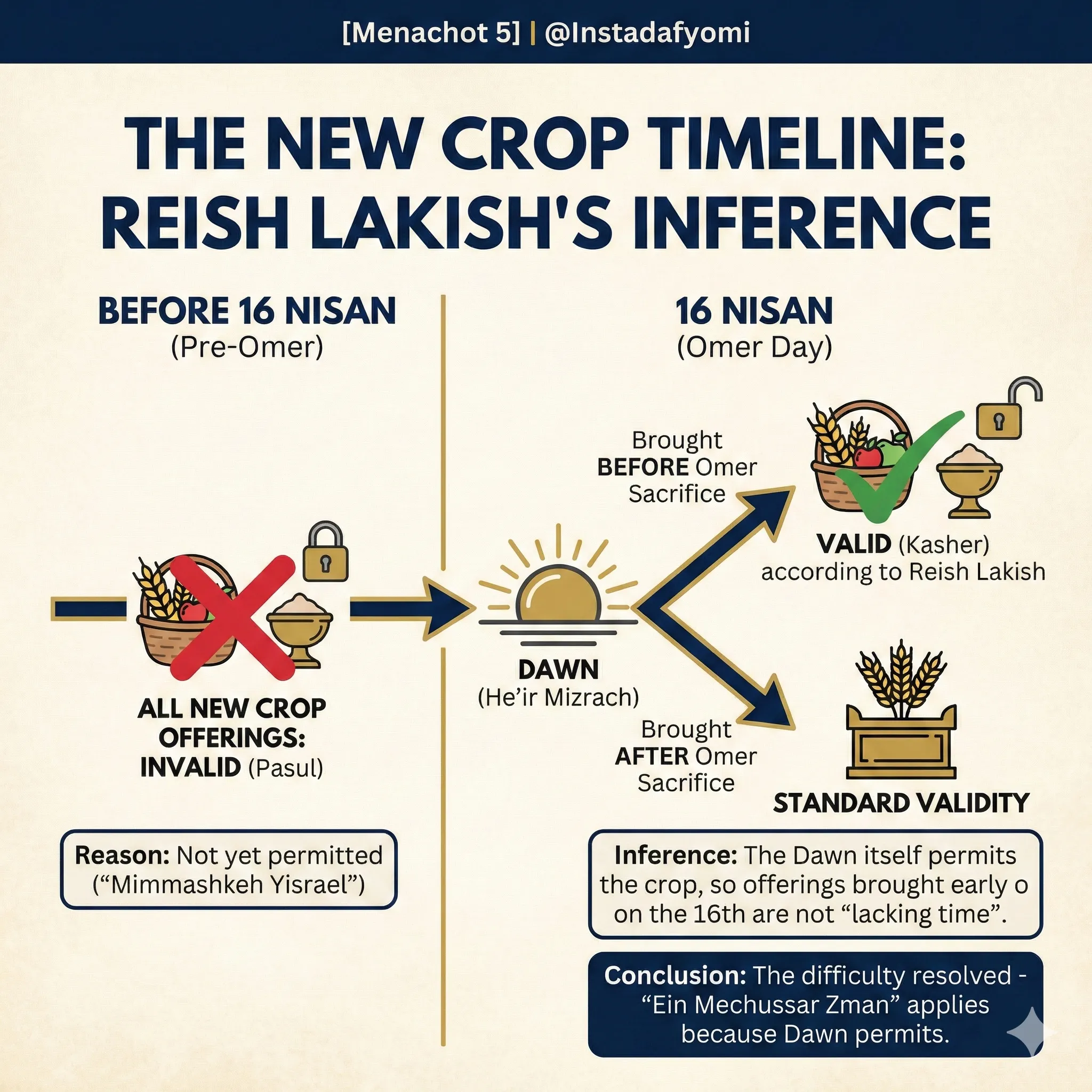
וְהָא דְּרֵישׁ לָקִישׁ לָאו בְּפֵירוּשׁ אִיתְּמַר, אֶלָּא מִכְּלָלָא אִיתְּמַר, דִּתְנַן: אֵין מְבִיאִין מִנְחַת בִּכּוּרִים וּמִנְחַת בְּהֵמָה קוֹדֶם לָעוֹמֶר, דְּבָעֵינַן ״מִמַּשְׁקֵה יִשְׂרָאֵל״, וְאִם הֵבִיא – פָּסוּל.
English Translation:
And this statement of Reish Lakish was not stated explicitly; rather, it was stated by inference. As we learned in a mishna (68b): One may not bring a meal offering, the first fruits, or the meal offering brought with the libations accompanying an animal offering, from the new crop, prior to the sacrifice of the omer. The reason is that we require “from the well-watered pastures of Israel.” And if he brought these offerings from the new crop they are unfit.
קלאוד על הדף:
The Gemara notes that Reish Lakish’s position about dawn permitting was inferred, not stated directly. A mishna teaches that meal offerings from the new crop before the omer are invalid — they must come from what’s permitted to Israel.
Segment 3
TYPE: גמרא
Before the two loaves
Hebrew/Aramaic:
קוֹדֶם לִשְׁתֵּי הַלֶּחֶם לֹא יָבִיא, מִשּׁוּם דְּאִיקְּרוּ ״בִּכּוּרִים״, וְאִם הֵבִיא – כָּשֵׁר.
English Translation:
After the omer but prior to the two loaves one may not bring those offerings from the new crop. This is because the two loaves are called first fruits, and therefore they should precede all other offerings from the new crop. But if he brought those offerings from the new crop, they are fit.
קלאוד על הדף:
Between the omer and Shavuot’s two loaves (shtei halechem), one shouldn’t bring new-crop offerings — but if brought, they’re valid. The two loaves are called “bikkurim” (first fruits), so they should ideally come first.
Key Terms:
- שתי הלחם (Shtei HaLechem) = The two loaves; brought on Shavuot
- ביכורים (Bikkurim) = First fruits
Segment 4
TYPE: גמרא
Reish Lakish’s inference clarified
Hebrew/Aramaic:
וְאָמַר רַבִּי יִצְחָק אָמַר רֵישׁ לָקִישׁ: לֹא שָׁנוּ אֶלָּא בְּאַרְבָּעָה עָשָׂר וּבַחֲמִשָּׁה עָשָׂר, אֲבָל בְּשִׁשָּׁה עָשָׂר אִם הֵבִיא – כָּשֵׁר, וְקַשְׁיָא לִי: לִיהְווֹ כַּמְחוּסַּר זְמַן! אַלְמָא קָסָבַר הֵאִיר הַמִּזְרָח מַתִּיר.
English Translation:
And Rav Yitzchak says that Reish Lakish says: The Sages taught that a meal offering that was brought from the new crop before the omer meal offering is disqualified only if it was brought on the fourteenth or on the fifteenth of Nisan. But if it was on the sixteenth, then even if he brought it prior to the omer meal offering, it is valid. And this poses a difficulty for me: Why? Let them be considered like offerings whose time has not yet arrived. Apparently, Reish Lakish holds that the illumination of the eastern horizon permits the new crop.
קלאוד על הדף:
Here’s the key inference: Reish Lakish ruled that offerings from new crop on the 16th are valid even before the omer — this only makes sense if dawn itself permits! Otherwise they’d be “mechusar zman” (lacking time).
Segment 5
TYPE: גמרא
Rava’s third position
Hebrew/Aramaic:
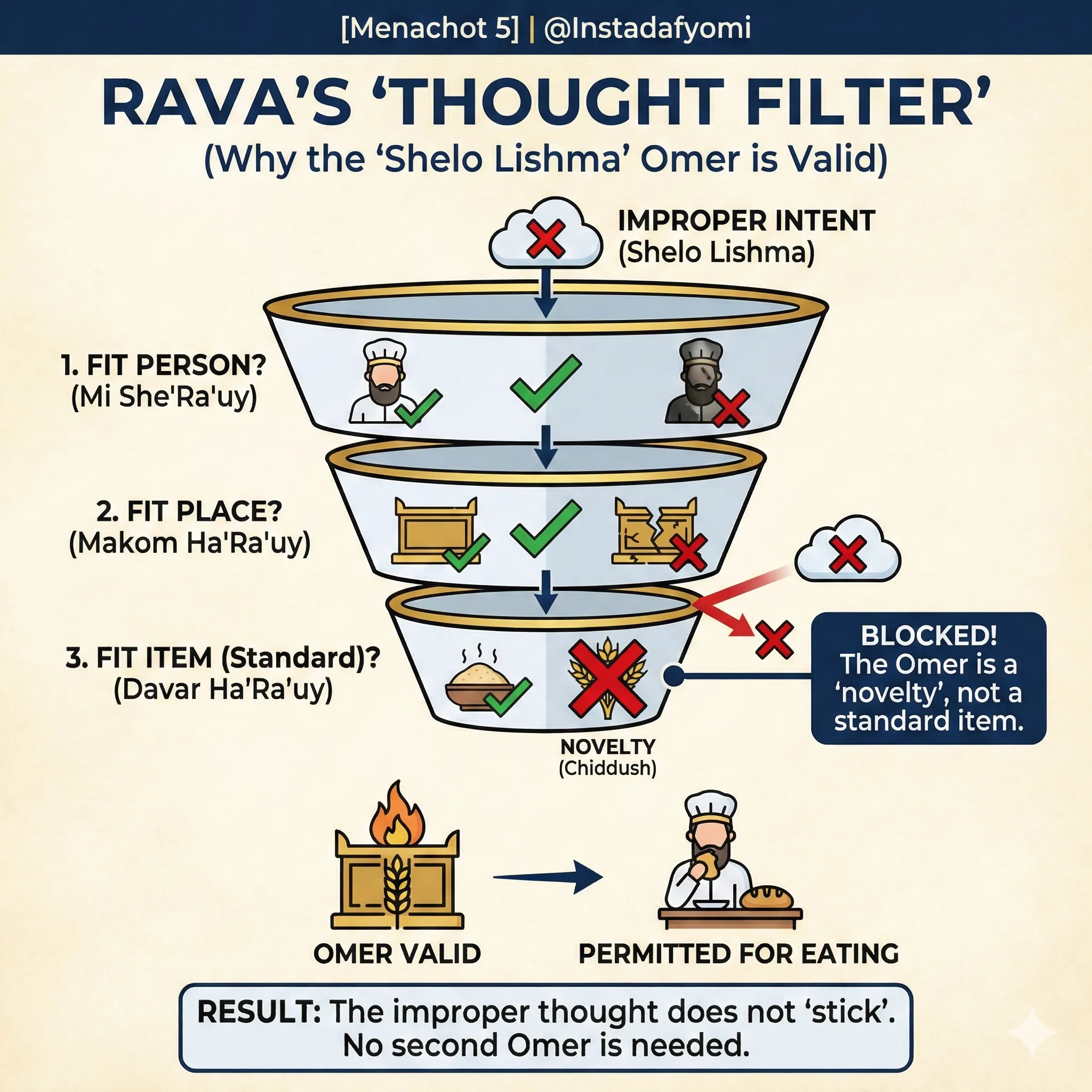
וְרָבָא אָמַר: מִנְחַת הָעוֹמֶר שֶׁקְּמָצָהּ שֶׁלֹּא לִשְׁמָהּ – כְּשֵׁירָה, וּשְׁיָרֶיהָ נֶאֱכָלִין, וְאֵינָהּ צְרִיכָה מִנְחַת הָעוֹמֶר אַחֶרֶת לְהַתִּירָהּ, שֶׁאֵין מַחְשָׁבָה מוֹעֶלֶת אֶלָּא בְּמִי שֶׁרָאוּי לָעֲבוֹדָה, וּבְדָבָר הָרָאוּי לָעֲבוֹדָה, וּבִמְקוֹם הָרָאוּי לָעֲבוֹדָה.
English Translation:
And Rava says: With regard to an omer meal offering from which the priest removed a handful not for its own sake, it is valid and its remainder is consumed, and it does not require another omer meal offering to permit it for consumption. The reason is that improper intent is effective to disqualify an offering only when it is expressed by one who is fit for the Temple service, and with regard to an item that is fit for the Temple service, and in a place that is fit for the Temple service.
קלאוד על הדף:
Rava presents a third position, most lenient: the improperly-kemitzah’d omer is completely valid and doesn’t need another! His reasoning: improper intent (machshava) only disqualifies when three conditions are met — the person, the item, and the place must all be fit for service.
Key Terms:
- מחשבה מועלת (Machshava Mo’elet) = Effective/disqualifying intent
- ראוי לעבודה (Ra’uy La’Avodah) = Fit for Temple service
Segment 6
TYPE: גמרא
Three conditions for disqualifying intent
Hebrew/Aramaic:
בְּמִי שֶׁרָאוּי לָעֲבוֹדָה – לְאַפּוֹקֵי כֹּהֵן בַּעַל מוּם, וּבְדָבָר הָרָאוּי לָעֲבוֹדָה – לְאַפּוֹקֵי מִנְחַת הָעוֹמֶר דְּלָא חַזְיָא, דְּחִדּוּשׁ הוּא, וּבִמְקוֹם הָרָאוּי לָעֲבוֹדָה – לְאַפּוֹקֵי נִפְגַּם הַמִּזְבֵּחַ.
English Translation:
By one who is fit for the Temple service — to exclude a blemished priest. With regard to an item that is fit for the Temple service — to exclude the omer meal offering, which is generally unfit, as it is a novelty, in that it is brought from barley whereas most meal offerings are brought from wheat. And in a place that is fit for the Temple service — to exclude when the altar was damaged.
קלאוד על הדף:
Rava elaborates: (1) A blemished priest’s intent doesn’t disqualify; (2) The omer is a “novelty” (from barley, not wheat like normal minchot) so intent doesn’t disqualify it; (3) Intent while the altar is damaged doesn’t disqualify. The omer is exempt because it’s inherently unusual.
Key Terms:
- חידוש (Chiddush) = Novelty; an exceptional case
- שעורים (Se’orim) = Barley; the omer is unique in being barley-based
- נפגם המזבח (Nifgam HaMizbe’ach) = Damaged altar
Segment 7
TYPE: גמרא
New topic: Excluding tereifah from offerings
Hebrew/Aramaic:
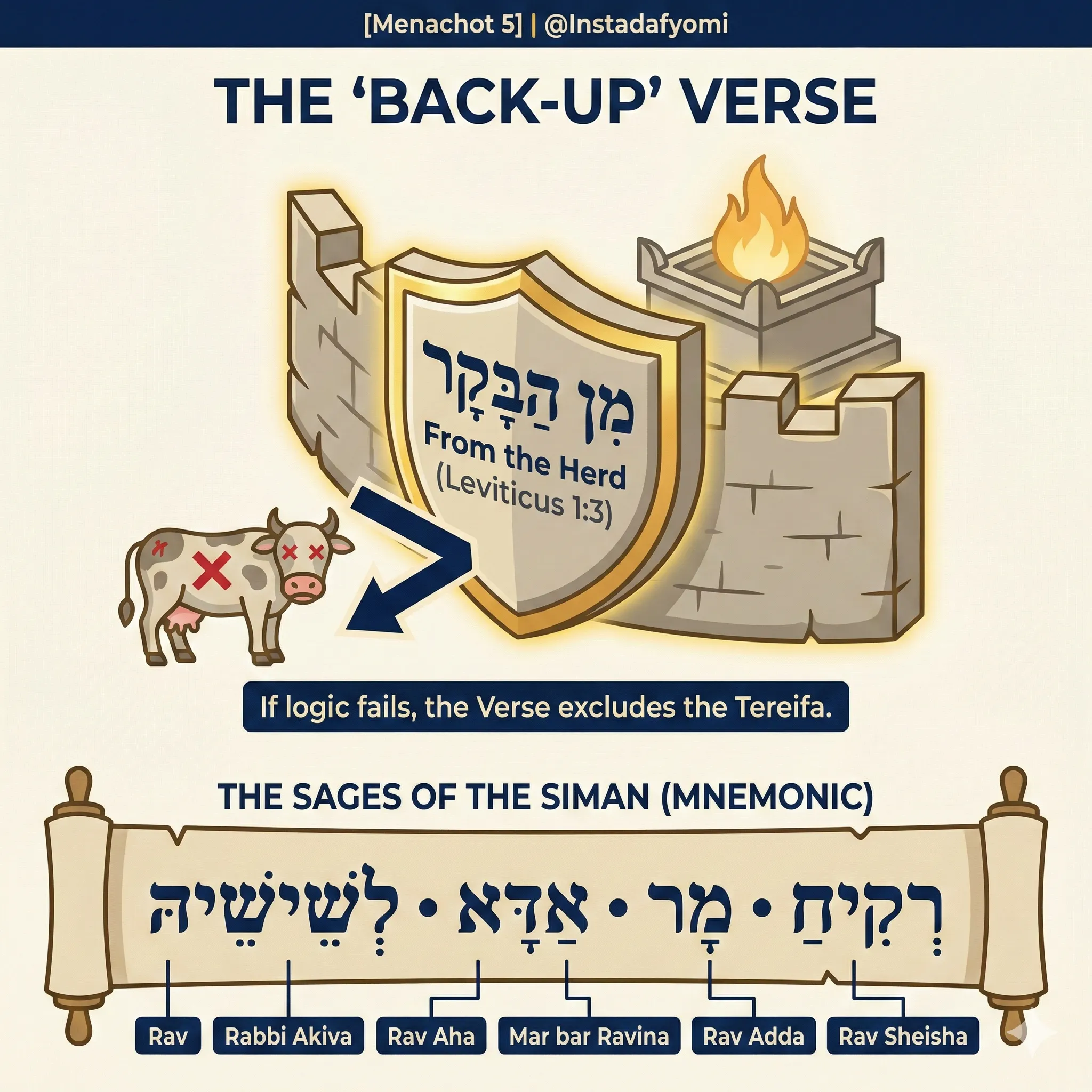
תָּנוּ רַבָּנַן: כְּשֶׁהוּא אוֹמֵר ״מִן הַבָּקָר״ לְמַטָּה, שֶׁאֵין תַּלְמוּד לוֹמַר, אֶלָּא לְהוֹצִיא אֶת הַטְּרֵפָה.
English Translation:
The Sages taught in a baraita: When it states later, “of the herd” (Leviticus 1:3), as there is no need for the verse to state this, this serves to exclude a tereifah (an animal with a fatal wound) from being brought as an offering.
קלאוד על הדף:
The Gemara shifts to a new topic: why can’t a tereifah (mortally wounded animal) be sacrificed? A seemingly superfluous phrase “min habakar” (of the herd) excludes it. This begins an extended logical analysis.
Key Terms:
- טריפה (Tereifah) = An animal with a wound that will cause death within 12 months
Segment 8
TYPE: גמרא
Attempted a fortiori inference
Hebrew/Aramaic:
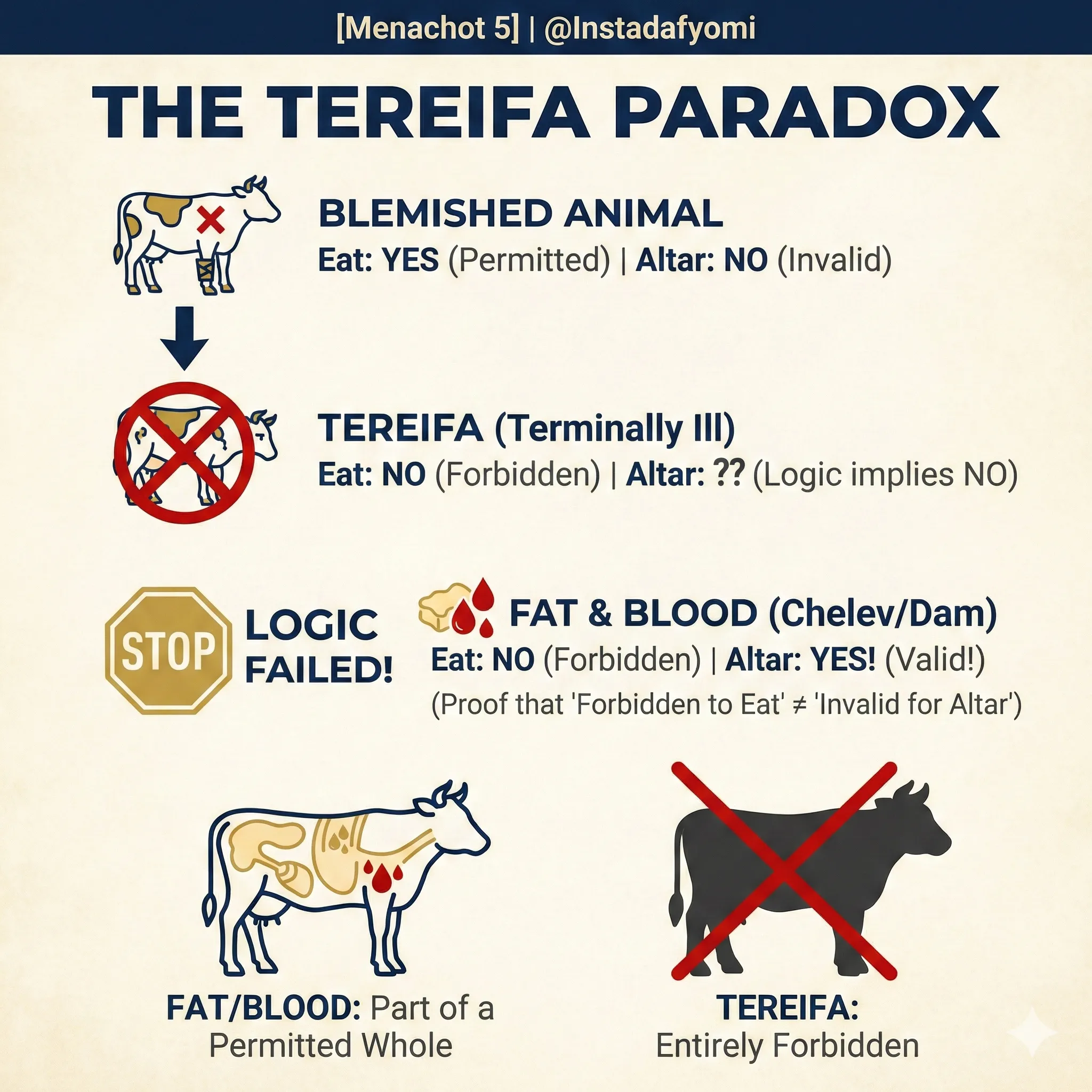
וַהֲלֹא דִּין הוּא: וּמָה בַּעַל מוּם שֶׁמּוּתֶּרֶת לַהֶדְיוֹט – אֲסוּרָה לַגָּבוֹהַּ, טְרֵיפָה שֶׁאֲסוּרָה לַהֶדְיוֹט – אֵין דִּין שֶׁאֲסוּרָה לַגָּבוֹהַּ? חֵלֶב וָדָם יוֹכִיחוּ, שֶׁאֲסוּרִין לַהֶדְיוֹט וּמוּתָּרִין לַגָּבוֹהַּ!
English Translation:
But could this not be derived through an a fortiori inference? If a blemished animal, which is permitted to an ordinary person for consumption, is nevertheless prohibited as an offering for the Most High, then certainly with regard to a tereifah, which is forbidden to an ordinary person for consumption, is it not logical that it is prohibited for the Most High? The baraita responds: Fat and blood prove this is not valid, as they are forbidden to an ordinary person and yet they are permitted for the Most High.
קלאוד על הדף:
The Gemara attempts a kal vachomer: if blemished animals (permitted to people) can’t be offered, surely tereifot (forbidden to people) can’t! But fat and blood disprove this — they’re forbidden to people yet offered to God!
Key Terms:
- קל וחומר (Kal Vachomer) = A fortiori argument; from lenient to stringent
- חלב ודם (Chelev V’Dam) = Fat and blood; forbidden to eat, offered on altar
Segment 9
TYPE: גמרא
Refutation: fat and blood come from permitted animals
Hebrew/Aramaic:
מָה לְחֵלֶב וָדָם, שֶׁכֵּן בָּאִין מִכְּלַל הֶיתֵּר, תֹּאמַר בִּטְרֵיפָה שֶׁכּוּלָּהּ אֲסוּרָה, וְלֹא תְּהֵא מוּתֶּרֶת לַגָּבוֹהַּ!
English Translation:
What is notable about fat and blood? They are notable in that they come from an item that is generally permitted, i.e., the animal from which they come is itself permitted for consumption. Will you say the same with regard to a tereifah, which is entirely forbidden, and therefore should not be permitted for the Most High?
קלאוד על הדף:
The refutation: fat and blood come from animals that are otherwise permitted — only those specific parts are forbidden. A tereifah is entirely forbidden. So the comparison fails.
Segment 10
TYPE: גמרא
Counter-example: melikah
Hebrew/Aramaic:
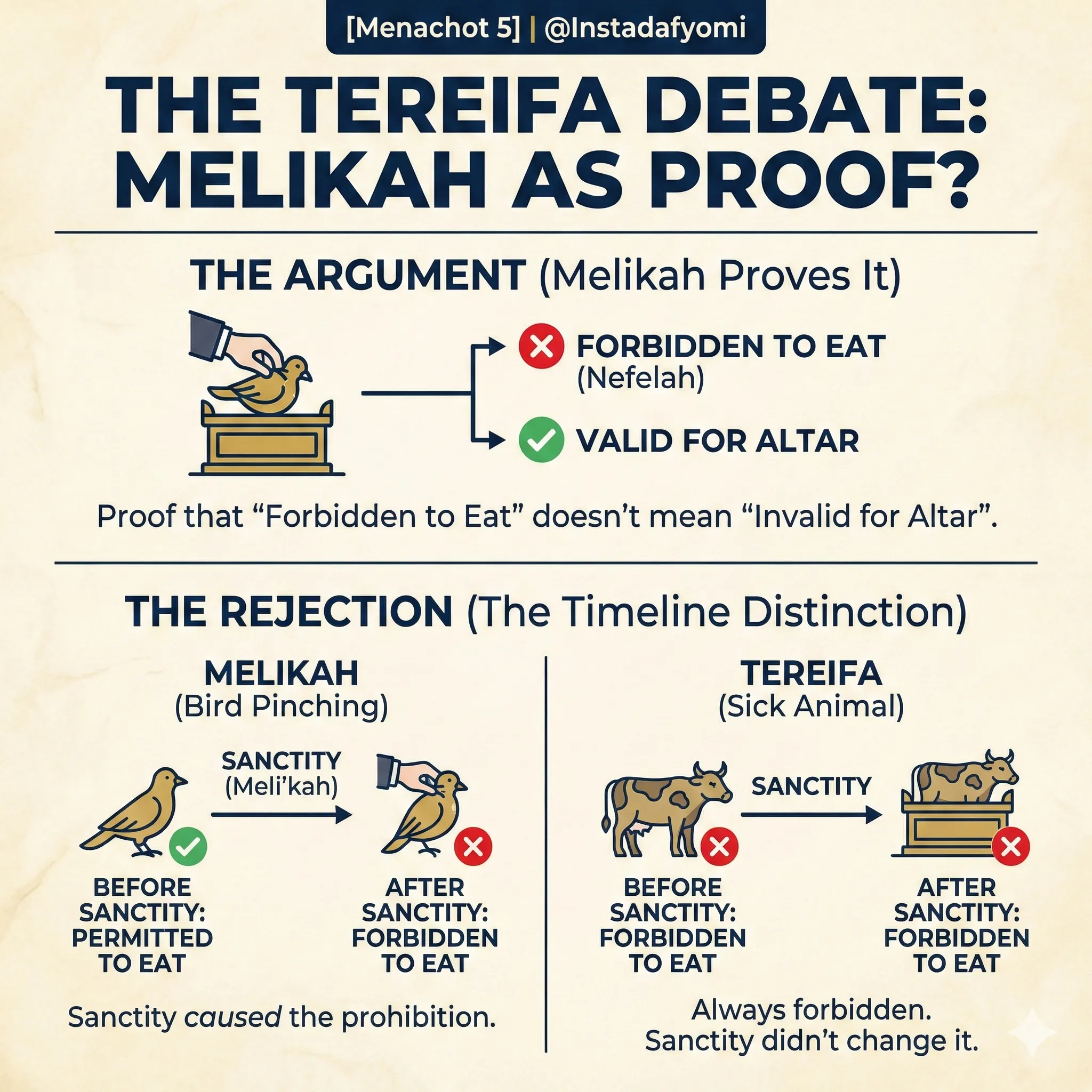
מְלִיקָה תּוֹכִיחַ, שֶׁכּוּלָּהּ אִיסּוּר, וַאֲסוּרָה לַהֶדְיוֹט, וּמוּתֶּרֶת לַגָּבוֹהַּ.
English Translation:
The pinching of bird offerings will prove that one cannot derive by an a fortiori inference that a tereifah is disqualified. As a bird killed by the pinching of its nape is also entirely forbidden, and yet although it is forbidden for consumption to an ordinary person, it is nevertheless permitted for the Most High.
קלאוד על הדף:
Another counter-example: melikah (pinching) makes a bird entirely a neveilah — forbidden to people — yet it’s offered to God! So perhaps tereifah could be too?
Segment 11
TYPE: גמרא
Refutation: melikah’s prohibition comes from sanctity
Hebrew/Aramaic:
מָה לִמְלִיקָה, שֶׁכֵּן קְדוּשָּׁתָהּ אוֹסַרְתָּהּ, בִּשְׁעַת קְדוּשָּׁתָהּ לַמִּזְבֵּחַ הִיא נֶאֶסְרָה לַהֶדְיוֹט, דְּהַיְינוּ מְלִיקָתָהּ, אֲבָל קוֹדֶם לָכֵן לֹא נֶאֶסְרָה לַהֶדְיוֹט, מַה שֶּׁאֵין כֵּן בִּטְרֵיפָה, שֶׁאֵין קְדוּשָּׁתָהּ אוֹסַרְתָּהּ!
English Translation:
What is notable about pinching? It is notable in that its sanctity prohibits it, i.e., only at the time when it becomes sanctified for the altar does it become prohibited for consumption to an ordinary person, which is at the time of its pinching. But before this time it is not yet prohibited. This is not the case with regard to a tereifah, as its sanctity does not prohibit it.
קלאוד על הדף:
The refutation: melikah only creates prohibition at the moment of sanctification for the altar. Before being consecrated, the bird was permitted. A tereifah was always forbidden — its prohibition doesn’t come from sanctity.
Segment 12
TYPE: גמרא
Conclusion: verse is needed
Hebrew/Aramaic:
וְאִם הֵשַׁבְתָּה, כְּשֶׁהוּא אוֹמֵר ״מִן הַבָּקָר״ לְמַטָּה, שֶׁאֵין תַּלְמוּד לוֹמַר, לְהוֹצִיא אֶת הַטְּרֵיפָה.
English Translation:
And if you have responded, i.e., if you succeeded in rejecting the a fortiori inference, then when the verse states later: “Of the herd” (Leviticus 1:3), as there is no need for the verse to state this, it serves to exclude a tereifah.
קלאוד על הדף:
The conclusion: since the logical arguments can be refuted, we need the verse “min habakar” to exclude tereifah from offerings. The Gemara will now explore what the refutation might be.
Segment 13
TYPE: גמרא
What was the refutation?
Hebrew/Aramaic:
מָה ״אִם הֵשַׁבְתָּה״? (סִימָן: רְקִיחַ, מָר, אַדָּא, לְשֵׁישֵׁיהּ).
English Translation:
What response is alluded to by the statement: “If you have responded?” The Gemara cites several suggestions, for which it provides a mnemonic: Rekiach, Mar, Adda, Leshisheih.
קלאוד על הדף:
The Gemara asks: what refutation worked to break the kal vachomer, requiring a verse? A mnemonic lists the Sages who will offer answers: Rav, Mar son of Ravina, Rav Adda, and Rav Sheisha.
Key Terms:
- סימן (Siman) = Mnemonic; memory aid for a list
Segment 14
TYPE: גמרא
Rav’s answer: the omer proves it
Hebrew/Aramaic:
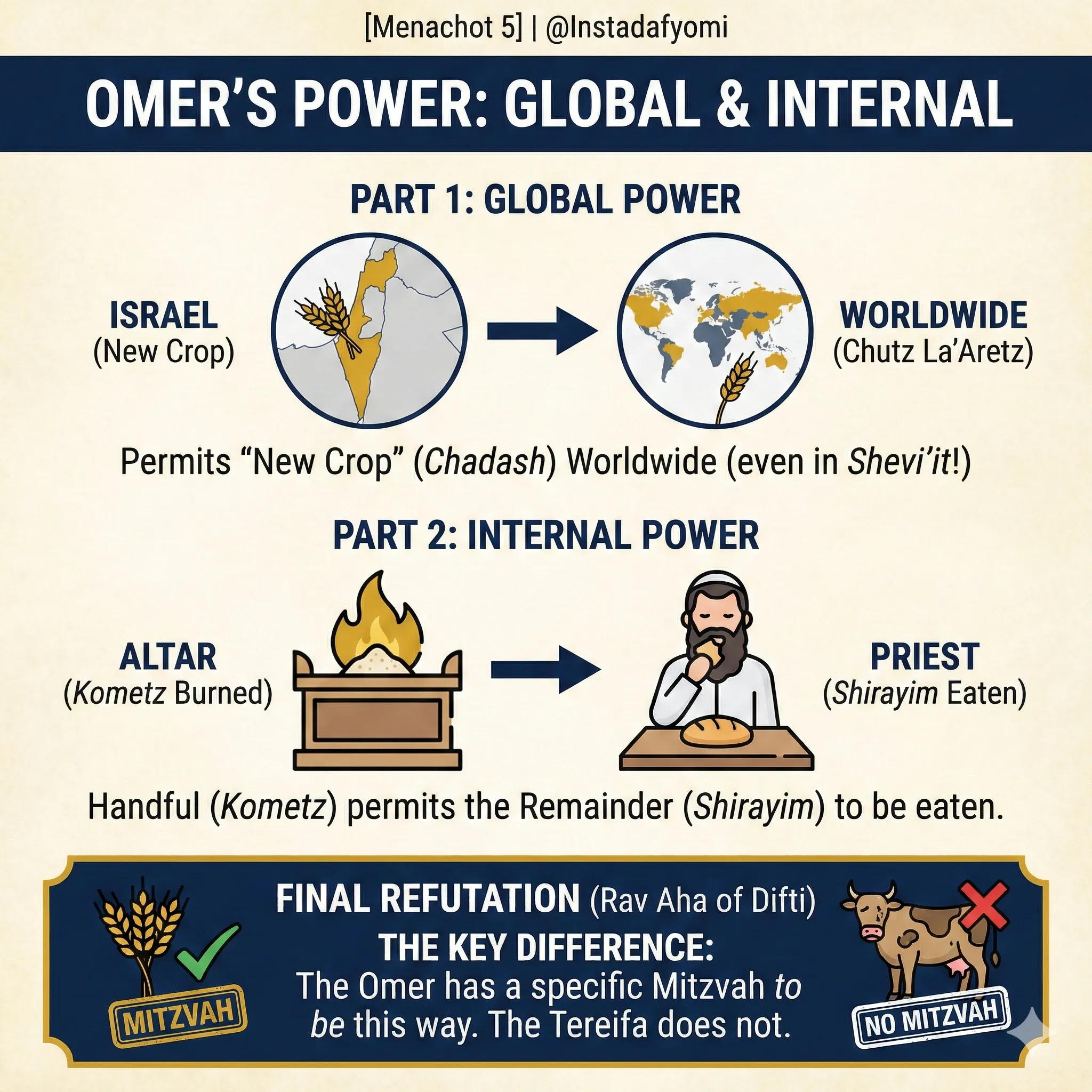
אָמַר רַב, מִשּׁוּם דְּאִיכָּא לְמֵימַר: מִנְחַת הָעוֹמֶר תּוֹכִיחַ, שֶׁאֲסוּרָה לַהֶדְיוֹט וּמוּתֶּרֶת לַגָּבוֹהַּ. מָה לְמִנְחַת הָעוֹמֶר, שֶׁכֵּן מַתֶּרֶת חָדָשׁ!
English Translation:
Rav said: Because it may be said that the omer meal offering proves it, as the omer is prohibited for consumption to an ordinary person, and yet it is permitted as an offering for the Most High. What is notable about the omer meal offering? It is notable in that the omer renders the new crop permitted.
קלאוד על הדף:
Rav’s suggestion: the omer proves the kal vachomer fails! The omer is from forbidden new crop, yet it’s offered to God. Refutation: the omer permits the new crop — it has a special function.
Segment 15
TYPE: גמרא
What about Shemittah year?
Hebrew/Aramaic:
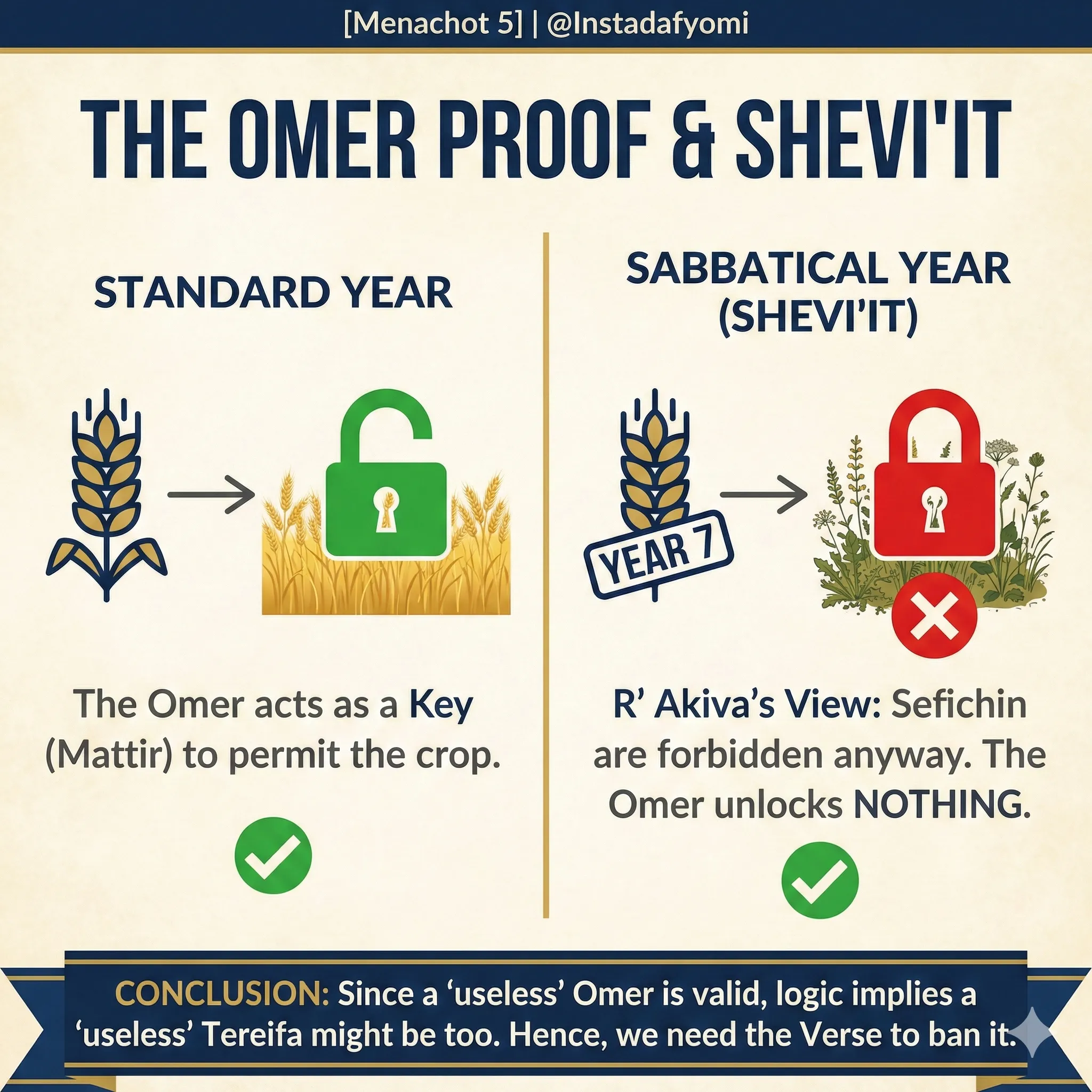
בַּשְּׁבִיעִית – שְׁבִיעִית נָמֵי, שֶׁכֵּן מַתֶּרֶת סְפִיחִין בַּשְּׁבִיעִית, כְּרַבִּי עֲקִיבָא, דְּאָמַר: סְפִיחִין אֲסוּרִים בִּשְׁבִיעִית.
English Translation:
During a Sabbatical Year the omer doesn’t permit any new crop since planting was forbidden. The Gemara counters: The omer in a Sabbatical Year also permits sefihin (volunteer produce) according to Rabbi Akiva, who says sefihin are prohibited during the Sabbatical Year.
קלאוד על הדף:
Challenge: during Shemittah (Sabbatical Year), there’s no new planted crop — so what does the omer permit? Answer: it permits sefihin (volunteer produce), according to Rabbi Akiva who forbids sefihin.
Key Terms:
- שמיטה/שביעית (Shemittah/Shevi’it) = Sabbatical Year
- ספיחין (Sefihin) = Volunteer produce; grew without planting
Segments 16-25
TYPE: גמרא
Extended debate on refuting the kal vachomer
The Gemara continues with multiple Sages offering different answers to what breaks the kal vachomer:
- Rav Acha bar Abba suggests the omer permits new crop outside Eretz Yisrael, or permits the remainder to be eaten.
- Rav Acha of Difti suggests a tereifah could also permit something if sacrificed.
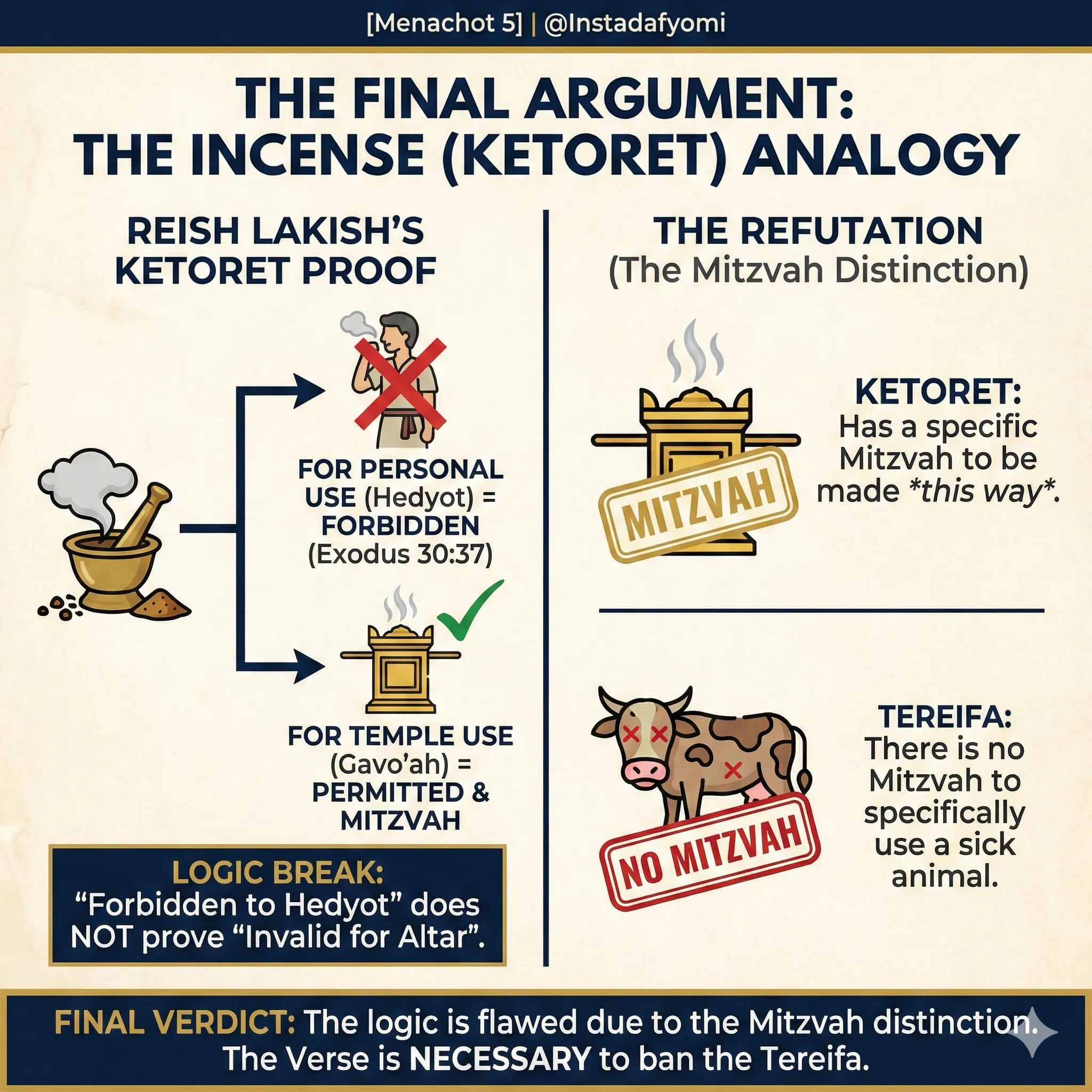
- Reish Lakish suggests the incense mixture (ketoret) proves it — forbidden to make for personal use, but permitted for the Temple.
- Mar son of Ravina suggests Shabbat — forbidden for personal labor, permitted for Temple service.
- Rav Adda bar Abba suggests kilayim (mixed fabrics) — forbidden for ordinary wear, permitted in priestly garments.
Each suggestion is refuted with “its mitzvah is in this manner” — these items have specific mitzvot requiring their use, unlike a tereifah which has no mitzvah to sacrifice it.
קלאוד על הדף:
This extended section demonstrates Talmudic methodology: multiple Sages propose different “proofs” that could break the kal vachomer, each showing something forbidden to people but permitted to God. Each is refuted — the comparison to tereifah fails because those items have specific mitzvot requiring them (omer permits new crop, ketoret is commanded, Shabbat service is commanded, priestly garments require kilayim). A tereifah has no such mitzvah, so we need a verse to exclude it.