Menachot Daf 9 (מנחות דף ט׳)
Daf: 9 | Amudim: 9a – 9b | Date: January 13, 2025
📖 Breakdown
Amud Aleph (9a)
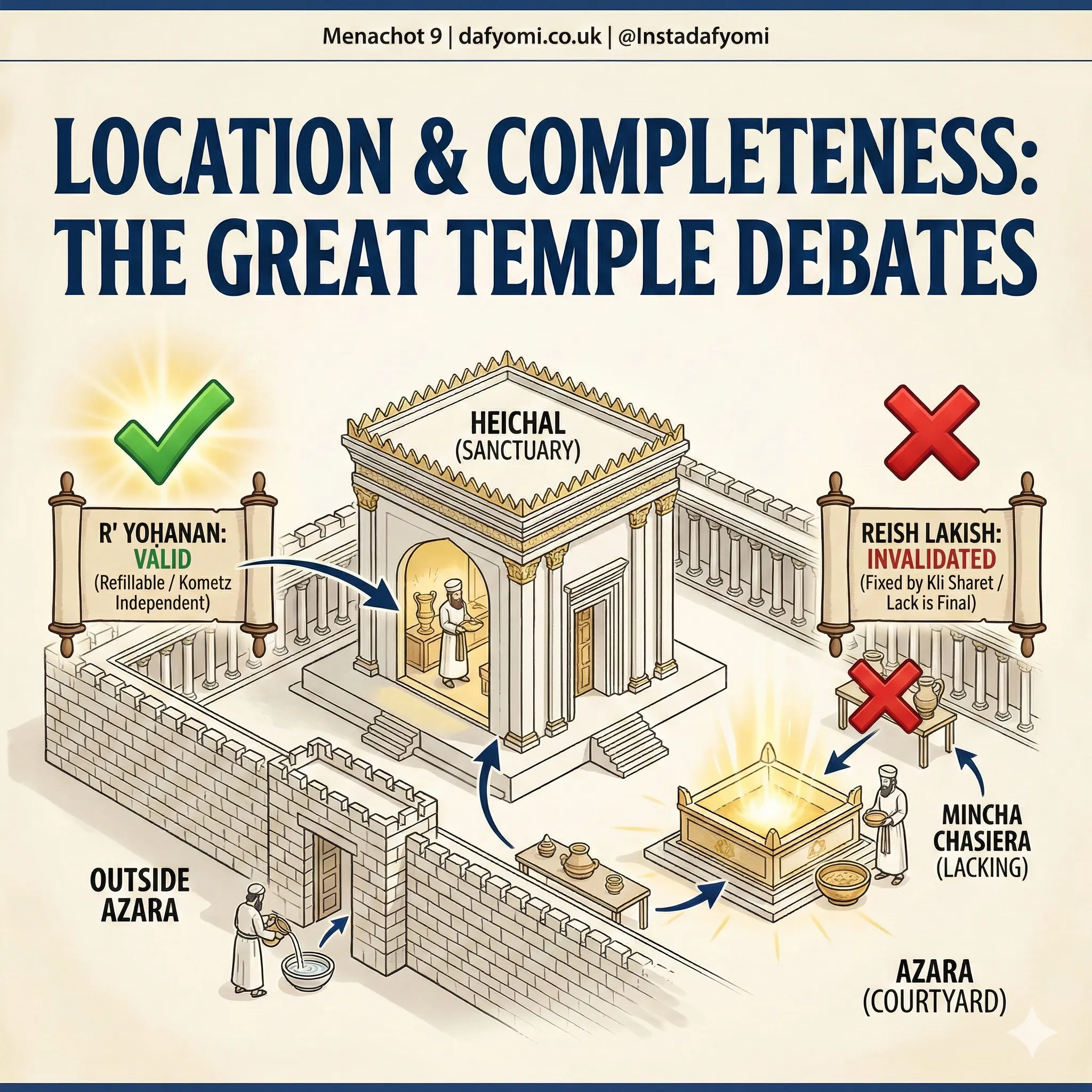
Segment 1
TYPE: גמרא (Continuation)
Citing the verse about consuming offerings in the holy place
Hebrew/Aramaic:
״בְּקֹדֶשׁ הַקֳּדָשִׁים תֹּאכְלֶנּוּ״.
English Translation:
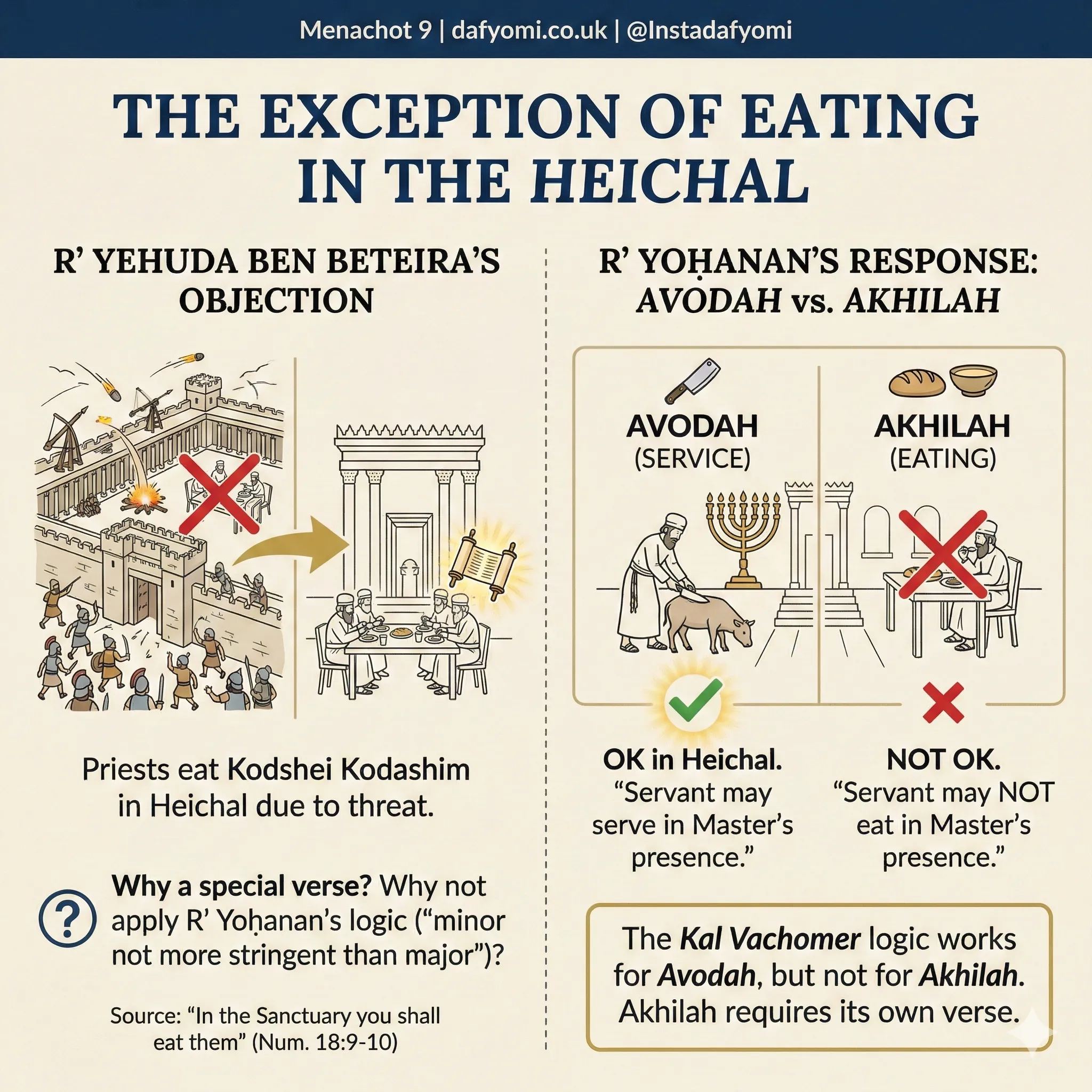
“Every meal offering of theirs, and every sin offering of theirs, and every guilt offering of theirs, which they may render unto Me, shall be most holy for you and for your sons. In the Sanctuary you shall eat them” (Numbers 18:9–10). This indicates that although the mitzva is to consume offerings of the most sacred order in the courtyard, in certain instances the priests may consume these offerings inside the Sanctuary, the most holy place.
קלאוד על הדף:
The Gemara continues its analysis from the previous daf, examining the verse that establishes where kodshei kodashim (most holy offerings) must be consumed. This verse teaches that priests may eat these offerings not only in the Temple courtyard but even inside the Sanctuary itself.
Key Terms:
- קֹדֶשׁ הַקֳּדָשִׁים = Most holy place (the Sanctuary)
- תֹּאכְלֶנּוּ = You shall eat it
Segment 2
TYPE: קושיא (Challenge)
Questioning the necessity of the verse
Hebrew/Aramaic:
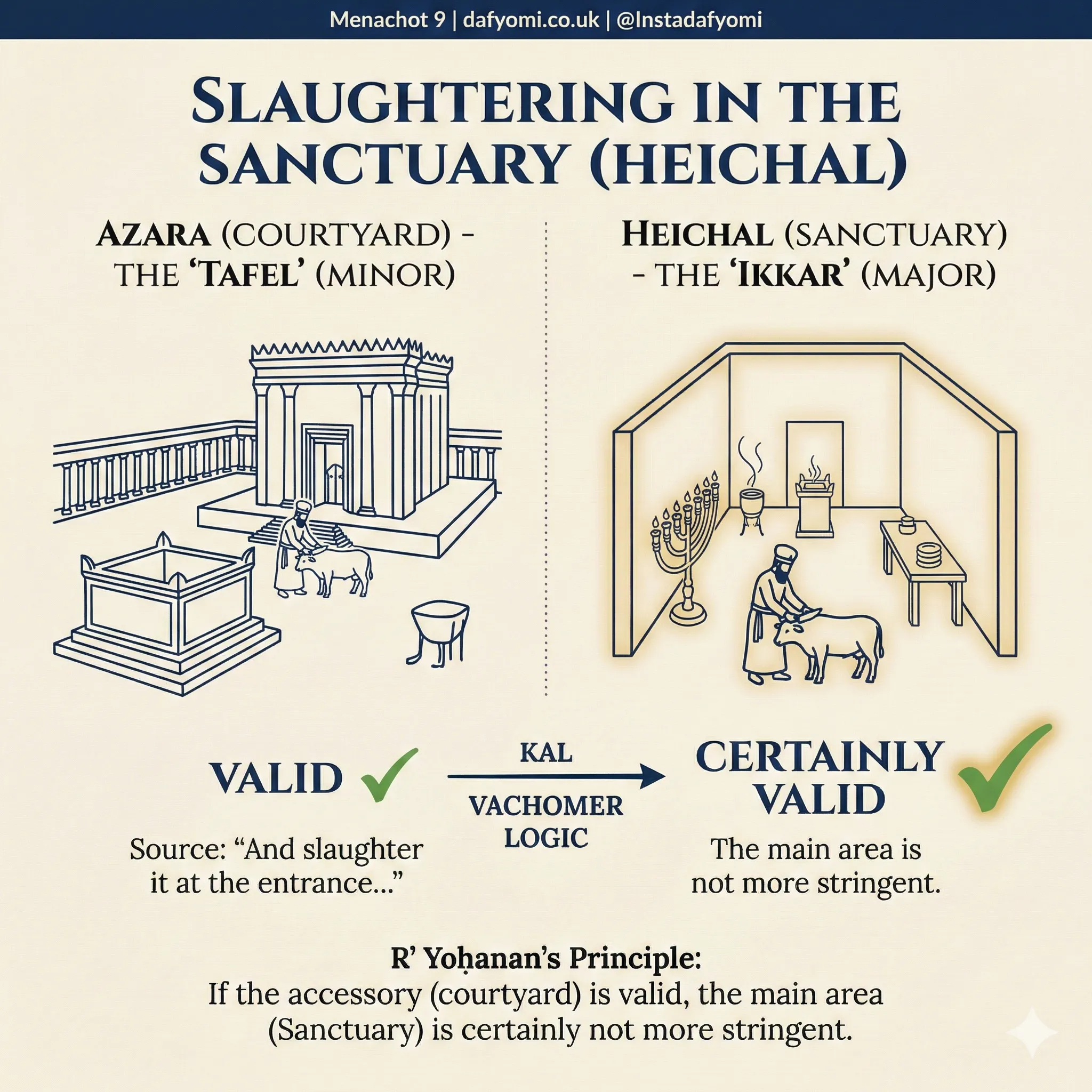
וְהָא לְמָה לִי קְרָא? לֵימָא: ״בַּחֲצַר אֹהֶל מוֹעֵד יֹאכְלוּהָ״, וְלֹא יְהֵא טָפֵל חָמוּר מִן הָעִיקָּר.
English Translation:
The Gemara explains its objection: But according to the opinion of Rabbi Yoḥanan, why do I need this verse? Let him say here as well that as the verse states: “In the court of the Tent of Meeting they shall eat it” (Leviticus 6:9), i.e., in the Temple courtyard, it is logical that the halakha with regard to the minor area should not be more stringent than the halakha with regard to the major one, i.e., if one may consume a peace offering in the Temple courtyard then all the more so may he consume it in the Sanctuary.
קלאוד על הדף:
The Gemara raises a logical objection: if the Temple courtyard is the designated place for eating kodshei kodashim, why would we need a separate verse to permit eating in the Sanctuary? Logically, if the courtyard is permitted, the more sacred Sanctuary should certainly be permitted — the secondary area (Sanctuary) should not be more stringent than the primary (courtyard).
Key Terms:
- טָפֵל = Secondary/subordinate
- עִיקָּר = Primary/main
- חֲצַר אֹהֶל מוֹעֵד = Court of the Tent of Meeting
Segment 3
TYPE: תירוץ (Answer)
Distinguishing between service and consumption
Hebrew/Aramaic:
עֲבוֹדָה, דְּאָדָם עוֹבֵד בִּמְקוֹם רַבּוֹ, אָמְרִינַן שֶׁלֹּא יְהֵא טָפֵל חָמוּר מִן הָעִיקָּר. אֲכִילָה, שֶׁאֵין אָדָם אוֹכֵל בִּמְקוֹם רַבּוֹ, טַעְמָא דִּכְתַב קְרָא, הָא לָא כְּתַב קְרָא – לֹא יְהֵא טָפֵל חָמוּר מִן הָעִיקָּר לָא אָמְרִינַן.
English Translation:
The Gemara explains: Consuming an offering is not the same as slaughtering it. The slaughter of an offering is part of the sacrificial service, and it is not considered disrespectful for a person to serve his master in the place of his master, i.e., within the Sanctuary as well as in the courtyard. Therefore, we say that the halakha with regard to the minor area should not be more stringent than the halakha with regard to the major one. By contrast, with regard to the consumption of an offering, since a person may not eat in the place of his master, the only reason that it is permitted to consume an offering inside the Sanctuary is that it is written in the verse: “In a most holy place you shall eat them.” Had this not been written in the verse, we would not say that the halakha with regard to the minor area should not be more stringent than the halakha with regard to the major one.
קלאוד על הדף:
The Gemara makes a crucial distinction between service and consumption. Serving one’s master in his master’s quarters is respectful, so the kal vachomer (a fortiori) argument works for sacrificial service — if it’s permitted in the courtyard, it’s certainly permitted in the Sanctuary. But eating in one’s master’s presence is considered disrespectful. Therefore, without an explicit verse permitting consumption in the Sanctuary, we would not have extended the permission from the courtyard.
Key Terms:
- עֲבוֹדָה = Sacrificial service
- אֲכִילָה = Consumption/eating
- בִּמְקוֹם רַבּוֹ = In the place of his master
Segment 4
TYPE: מחלוקת (Dispute)
Dispute about mixing oil outside the courtyard
Hebrew/Aramaic:
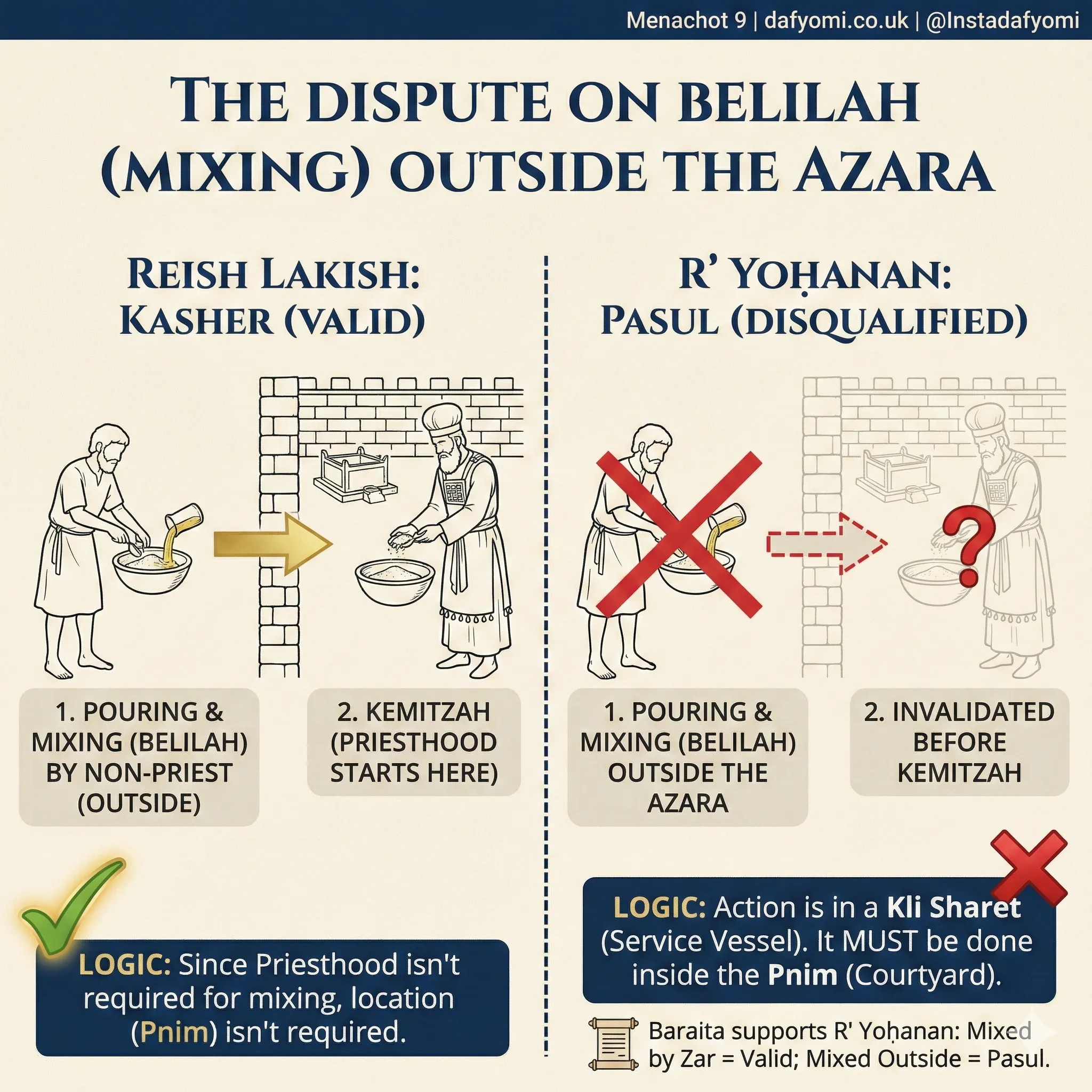
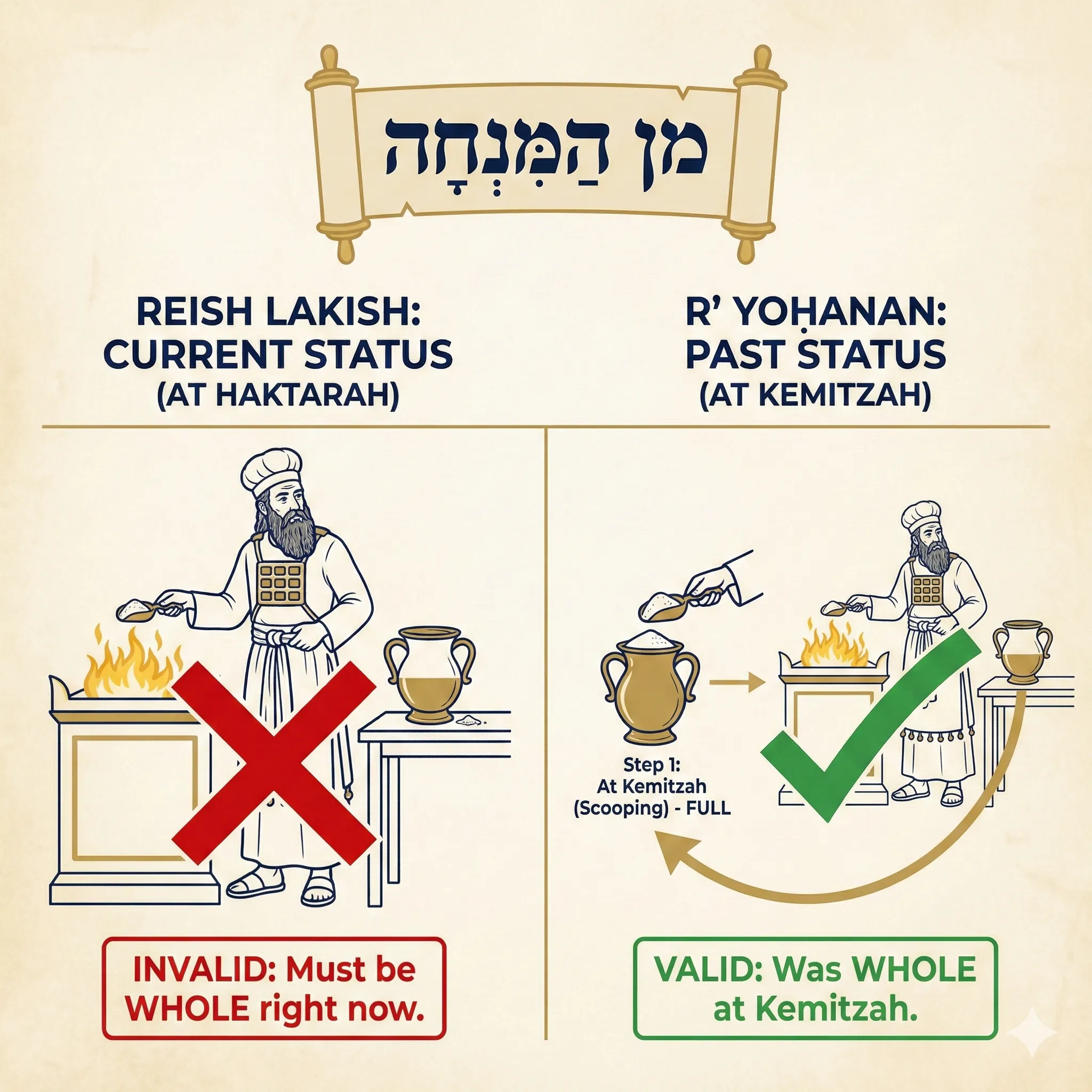
אִיתְּמַר: בְּלָלָהּ חוּץ לְחוֹמַת עֲזָרָה, רַבִּי יוֹחָנָן אָמַר: פְּסוּלָה, רֵישׁ לָקִישׁ אָמַר: כְּשֵׁרָה. רֵישׁ לָקִישׁ אָמַר כְּשֵׁרָה, דִּכְתִיב: ״וְיָצַק עָלֶיהָ שֶׁמֶן וְנָתַן עָלֶיהָ לְבוֹנָה״, וַהֲדַר ״וֶהֱבִיאָהּ אֶל בְּנֵי אַהֲרֹן הַכֹּהֲנִים וְקָמַץ״.
English Translation:
It was stated: If one mixed the oil of a meal offering into it outside the wall of the Temple courtyard, Rabbi Yoḥanan says that it is disqualified, and Reish Lakish says that it is valid. Reish Lakish says: It is valid, as it is written: “And he shall pour oil upon it, and put frankincense upon it” (Leviticus 2:1), and then it is written: “And he shall bring it to Aaron’s sons the priests; and he shall remove” (Leviticus 2:2).
קלאוד על הדף:
This introduces a fundamental dispute between two great Amoraim about the location requirements for mixing oil into a meal offering. Reish Lakish derives his lenient ruling from the order of verses in Leviticus: the pouring and mixing are mentioned before the bringing to the priests and the kemitza, suggesting these preliminary steps can occur outside the Temple courtyard.
Key Terms:
- בְּלָלָהּ = Mixed it (the oil into the flour)
- חוּץ לְחוֹמַת עֲזָרָה = Outside the wall of the Temple courtyard
- כְּשֵׁרָה = Valid
- פְּסוּלָה = Disqualified
Segment 5
TYPE: ביאור (Explanation)
Reish Lakish’s reasoning expanded
Hebrew/Aramaic:
מִקְּמִיצָה וְאֵילָךְ מִצְוַת כְּהוּנָּה, לִימֵּד עַל יְצִיקָה וּבְלִילָה שֶׁכְּשֵׁרִין בְּזָר, וּמִדִּכְהוּנָּה לָא בָּעֲיָא, פְּנִים נָמֵי לָא בָּעֲיָא.
English Translation:
Reish Lakish explains: The Sages derived from here that from the removal of the handful onward the rites performed with the meal offering are solely a mitzva of the priesthood. Accordingly, the verse taught about pouring and mixing that they are valid when performed by a non-priest. And from the fact that the priesthood is not required for the mixing, it may be derived that it is also not required that its performance be inside the walls of the Temple courtyard.
קלאוד על הדף:
Reish Lakish’s reasoning connects two principles: if a procedure doesn’t require a priest (can be done by a zar/non-priest), it also doesn’t require performance inside the sacred precincts. Since the verse sequence shows that pouring and mixing precede priestly involvement, they are valid when done by a non-priest and therefore valid when done outside the courtyard as well.
Key Terms:
- מִקְּמִיצָה וְאֵילָךְ = From the kemitza and onward
- מִצְוַת כְּהוּנָּה = Priestly duty
- יְצִיקָה = Pouring
- בְלִילָה = Mixing
- זָר = Non-priest
Segment 6
TYPE: ביאור (Explanation)
Rabbi Yochanan’s reasoning and supporting baraita
Hebrew/Aramaic:
וְרַבִּי יוֹחָנָן אָמַר: פְּסוּלָה, כֵּיוָן דַּעֲשִׂיָּיתָהּ בִּכְלִי הוּא, נְהִי דִּכְהוּנָּה לָא בָּעֲיָא, פְּנִים מִיהַת בָּעֲיָא. תַּנְיָא כְּוָותֵיהּ דְּרַבִּי יוֹחָנָן: בְּלָלָהּ זָר – כְּשֵׁרָה, חוּץ לְחוֹמַת הָעֲזָרָה – פְּסוּלָה.
English Translation:
And Rabbi Yoḥanan says: This meal offering is disqualified, since a meal offering’s performance is in a service vessel. Therefore, granted that the priesthood is not required, yet in any event its performance inside the Temple courtyard is required. The Gemara notes that it is taught in a baraita in accordance with the opinion of Rabbi Yoḥanan: If a meal offering was mixed by a non-priest it is valid. But if it was mixed outside the wall of the Temple courtyard it is disqualified.
קלאוד על הדף:
Rabbi Yochanan distinguishes between the requirement for a priest and the requirement for location. He concedes that mixing doesn’t require a priest, but argues that since the procedure involves a sacred service vessel (kli sharet), it must be performed inside the Temple courtyard. A baraita explicitly supports his view, confirming that while a non-priest may mix, mixing outside the courtyard disqualifies the offering.
Key Terms:
- עֲשִׂיָּיתָהּ בִּכְלִי = Its performance is in a vessel
- פְּנִים = Inside (the courtyard)
- תַּנְיָא כְּוָותֵיהּ = It is taught in support of him
Segment 7
TYPE: מחלוקת (New Dispute)
Deficient meal offering before kemitza
Hebrew/Aramaic:
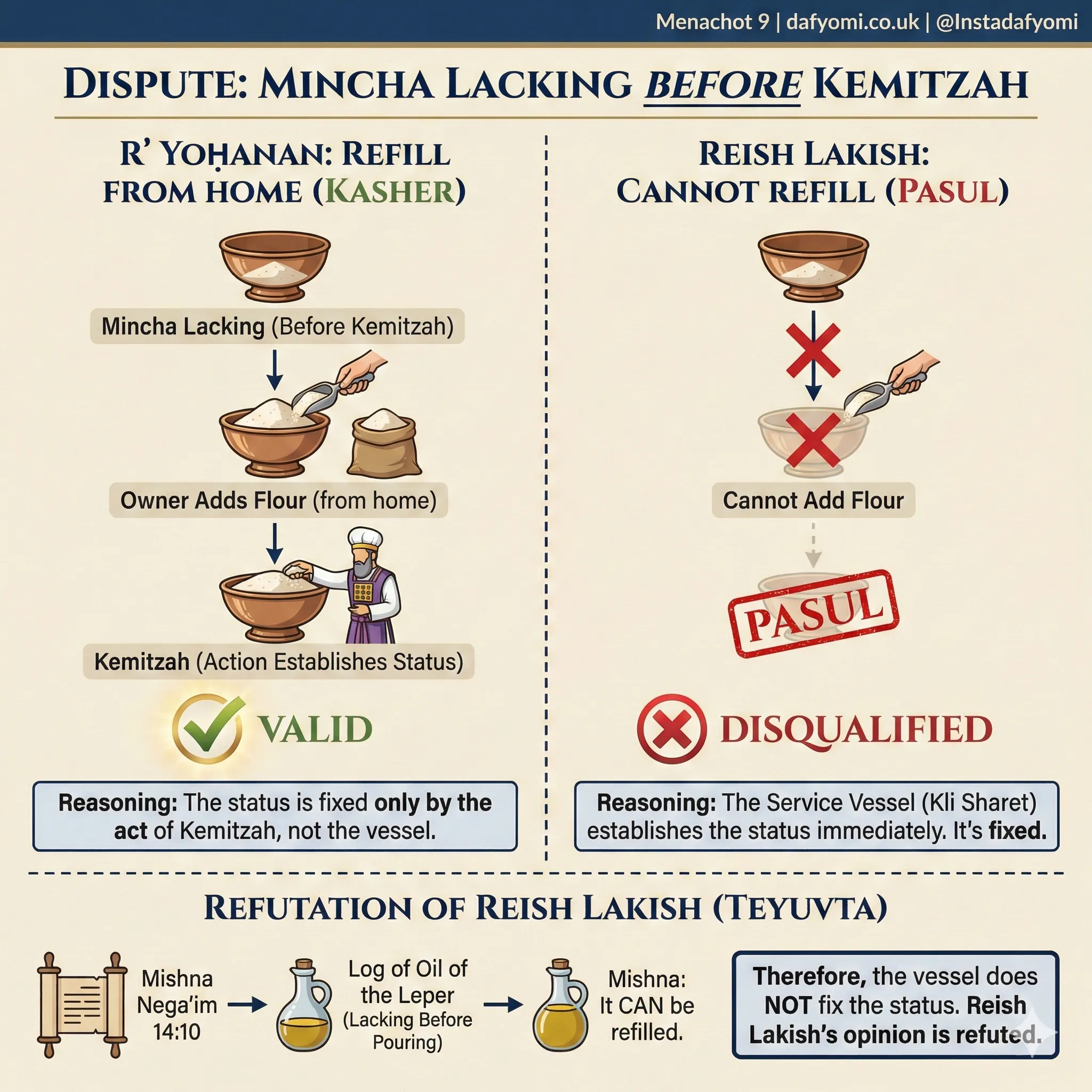
אִיתְּמַר: מִנְחָה שֶׁחָסְרָה קוֹדֶם קְמִיצָה, רַבִּי יוֹחָנָן אָמַר: יָבִיא מִתּוֹךְ בֵּיתוֹ וִימַלְּאֶנָּה, רֵישׁ לָקִישׁ אָמַר: לָא יָבִיא מִתּוֹךְ בֵּיתוֹ וִימַלְּאֶנָּה.
English Translation:
It was stated: With regard to a meal offering that became lacking in its full measure before the removal of the handful, Rabbi Yoḥanan says that the owner shall bring additional flour from within his home and shall fill the missing part of the measure of the meal offering. Reish Lakish says: He shall not bring flour from within his home and fill it. Instead, he must bring a new meal offering.
קלאוד על הדף:
The Gemara introduces a second dispute between Rabbi Yochanan and Reish Lakish. If some of the meal offering is lost before the kemitza, can it be supplemented? Interestingly, here Rabbi Yochanan is the lenient one (allowing supplementation) while Reish Lakish is strict (requiring a new offering).
Key Terms:
- חָסְרָה = Became deficient/lacking
- קוֹדֶם קְמִיצָה = Before the kemitza
- יָבִיא מִתּוֹךְ בֵּיתוֹ = He should bring from his house
- וִימַלְּאֶנָּה = And fill it
Segment 8
TYPE: ביאור (Explanation)
Reasoning for both positions
Hebrew/Aramaic:
רַבִּי יוֹחָנָן אָמַר: מֵבִיא מִתּוֹךְ בֵּיתוֹ וִימַלְּאֶנָּה, קְמִיצָה קָבְעָה לֵיהּ. רֵישׁ לָקִישׁ אָמַר: לָא יָבִיא מִתּוֹךְ בֵּיתוֹ וִימַלְּאֶנָּה, קְדוּשַּׁת כְּלִי קָבְעָה לֵיהּ.
English Translation:
The Gemara explains: Rabbi Yoḥanan says that he brings flour from within his home and he fills it, as the removal of the handful establishes it as a meal offering to the extent that it may become disqualified. Before the removal, one may always add flour to the meal offering. Reish Lakish says: He shall not bring flour from within his home and fill it, as the sanctity of the service vessel establishes it as a meal offering. Therefore, once the meal offering was placed in a service vessel and sanctified, it is disqualified if it becomes lacking.
קלאוד על הדף:
The dispute hinges on what “establishes” the meal offering’s status. Rabbi Yochanan holds that the kemitza is the defining moment — until then, the offering is still in a preparatory phase and can be supplemented. Reish Lakish holds that placement in the sacred vessel already establishes the offering’s sanctified status, making later additions impossible.
Key Terms:
- קְמִיצָה קָבְעָה לֵיהּ = The kemitza establishes it
- קְדוּשַּׁת כְּלִי קָבְעָה לֵיהּ = The sanctity of the vessel establishes it
Segment 9
TYPE: קושיא ותיובתא (Challenge and Refutation)
Refutation of Reish Lakish from the log of oil
Hebrew/Aramaic:
אֵיתִיבֵיהּ רַבִּי יוֹחָנָן לְרַבִּי שִׁמְעוֹן בֶּן לָקִישׁ: חָסֵר הַלּוֹג, אִם עַד שֶׁלֹּא יָצַק – יְמַלְּאֶנּוּ, תְּיוּבְתָּא.
English Translation:
Rabbi Yoḥanan raised an objection to Rabbi Shimon ben Lakish, Reish Lakish, from a mishna (Nega’im 14:10) discussing the log of oil brought by a leper: In a case where the log lacked a full measure, if it became lacking before the priest poured from it into his palm in order to place it on the right thumb and big toe of the leper, he shall fill it. Clearly the service vessel containing the log does not sanctify the oil to the extent that it can become disqualified. The Gemara notes: Indeed, this is a conclusive refutation of the opinion of Reish Lakish.
קלאוד על הדף:
Rabbi Yochanan brings a decisive proof from the laws of the leper’s purification. The log of oil, though placed in a sacred vessel, can be refilled if it becomes deficient before the priest pours from it. This directly contradicts Reish Lakish’s principle that the vessel’s sanctity establishes the offering. The Gemara accepts this as a conclusive refutation (teyuvta).
Key Terms:
- לוֹג = A liquid measure (log of oil for leper’s purification)
- יָצַק = Poured
- תְּיוּבְתָּא = Conclusive refutation
Segment 10
TYPE: מחלוקת (Third Dispute)
Shirayim that became deficient between kemitza and burning
Hebrew/Aramaic:
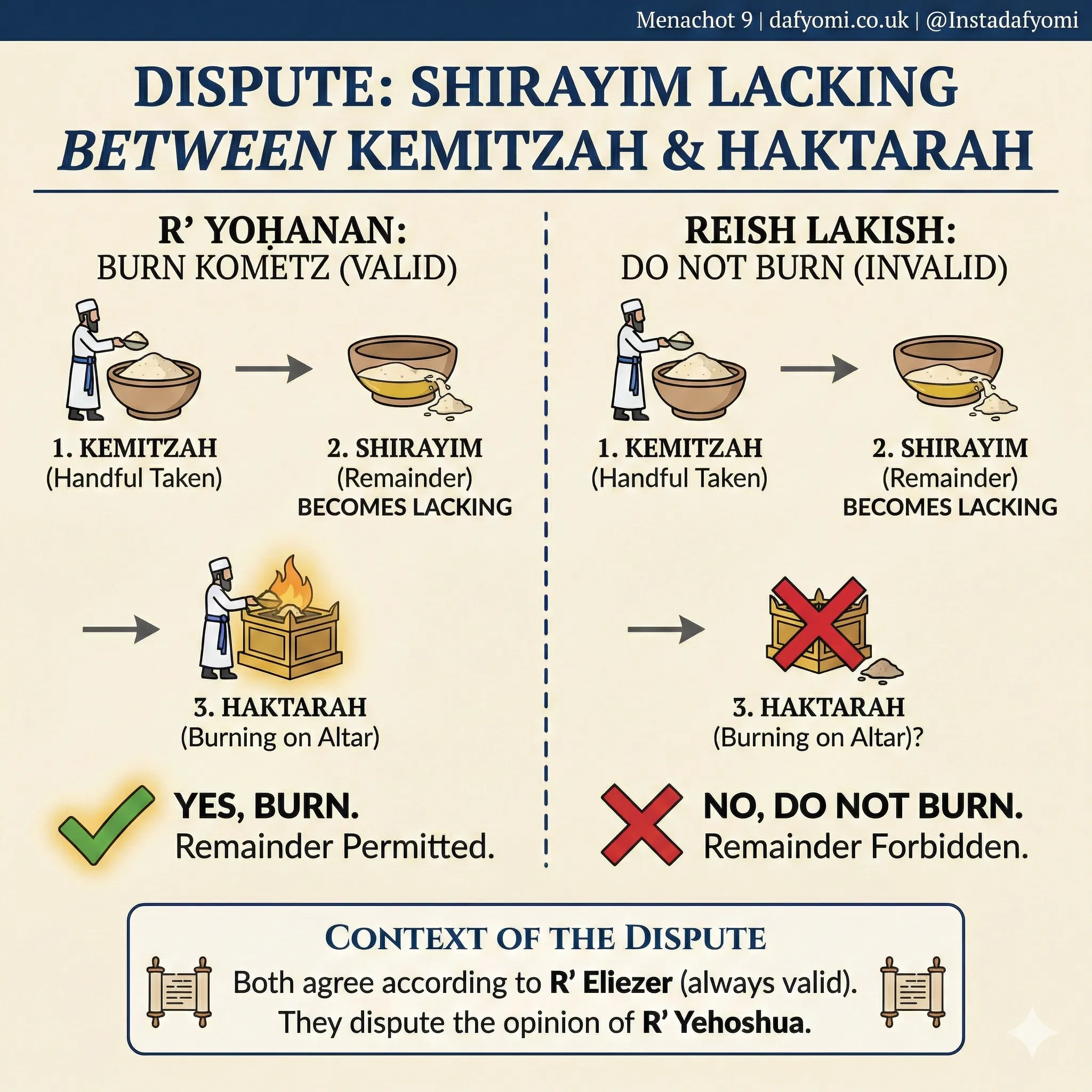
אִיתְּמַר: שִׁירַיִם שֶׁחָסְרוּ בֵּין קְמִיצָה לְהַקְטָרָה, רַבִּי יוֹחָנָן אָמַר: מַקְטִיר קוֹמֶץ עֲלֵיהֶן, וְרֵישׁ לָקִישׁ אָמַר: אֵין מַקְטִיר קוֹמֶץ עֲלֵיהֶן. אַלִּיבָּא דְּרַבִּי אֱלִיעֶזֶר כּוּלֵּי עָלְמָא לָא פְּלִיגִי, כִּי פְּלִיגִי אַלִּיבָּא דְּרַבִּי יְהוֹשֻׁעַ.
English Translation:
It was stated: With regard to the remainder of a meal offering that became lacking between the removal of the handful and its burning upon the altar, Rabbi Yoḥanan says that one burns the handful on account of such a remainder, and that the remainder is then permitted for consumption. And Reish Lakish says that one does not burn the handful on account of the remainder. The Gemara notes: According to the opinion of Rabbi Eliezer, everyone agrees that the handful is burned on account of the remainder. In other words, both amora’im, Rabbi Yoḥanan and Reish Lakish, concur that this is the halakha according to the tanna Rabbi Eliezer. When they disagree, it is concerning the halakha according to the opinion of Rabbi Yehoshua.
קלאוד על הדף:
A third dispute concerns what happens if the shirayim (the remainder eaten by priests) becomes deficient after the kemitza but before the kometz is burned. Rabbi Yochanan permits burning the kometz anyway; Reish Lakish forbids it. Significantly, both agree according to Rabbi Eliezer (who is lenient); they only disagree about Rabbi Yehoshua’s view.
Key Terms:
- שִׁירַיִם = Remainder (the portion eaten by priests)
- בֵּין קְמִיצָה לְהַקְטָרָה = Between kemitza and burning
- מַקְטִיר קוֹמֶץ עֲלֵיהֶן = Burns the handful on their account
Segment 11
TYPE: משנה (Source)
The Tannaitic dispute of Rabbi Eliezer and Rabbi Yehoshua
Hebrew/Aramaic:
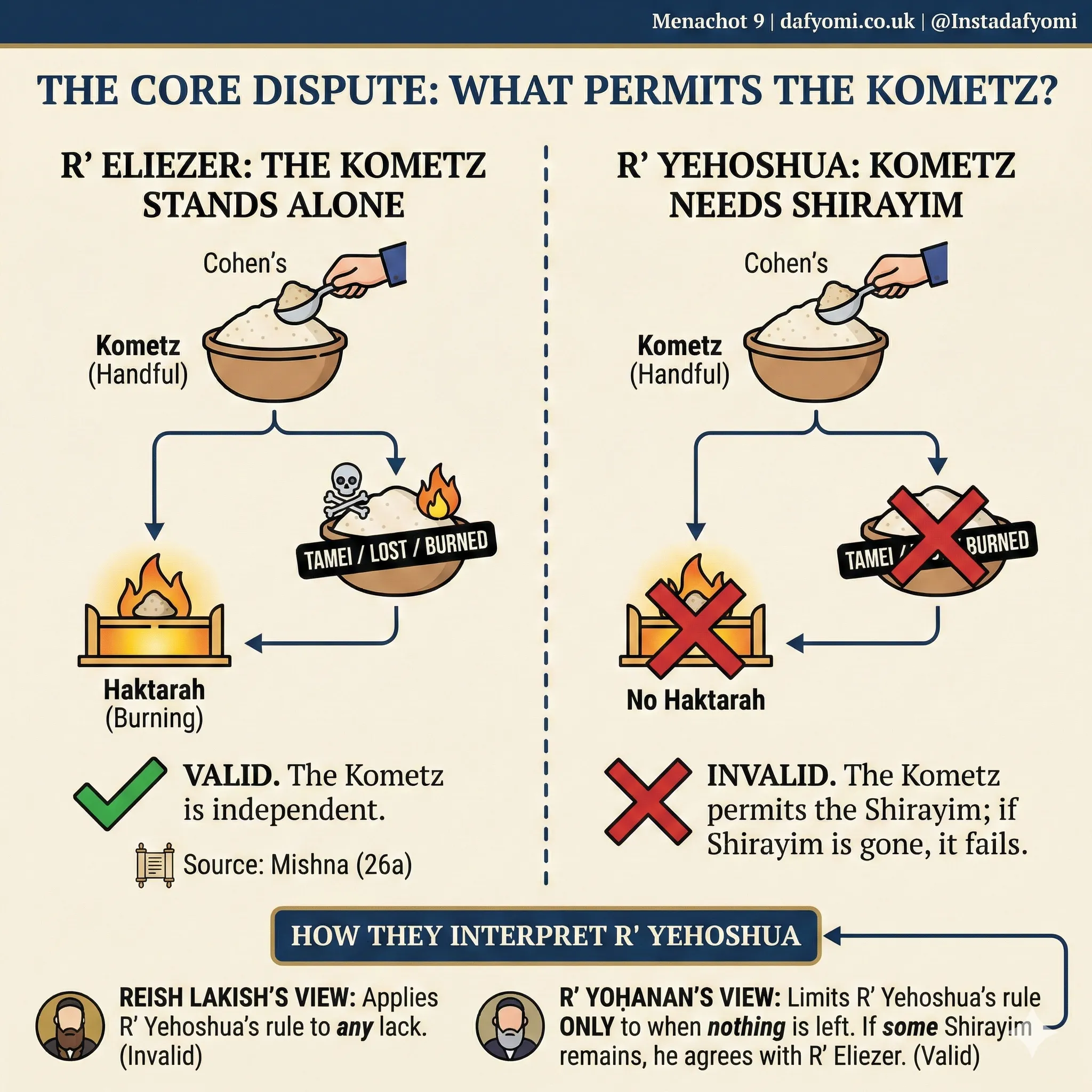
דִּתְנַן: נִטְמְאוּ שְׁיָרֶיהָ, נִשְׂרְפוּ שְׁיָרֶיהָ, אָבְדוּ שְׁיָרֶיהָ – כְּמִדַּת רַבִּי אֱלִיעֶזֶר כְּשֵׁרָה, כְּמִדַּת רַבִּי יְהוֹשֻׁעַ פְּסוּלָה.
English Translation:
The Gemara cites the dispute in question. As we learned in a mishna (26a): If, after the handful was removed, the remainder of the meal offering became ritually impure, or if the remainder of the meal offering was burned, or if the remainder of the meal offering was lost, according to the principle of Rabbi Eliezer, who says that with regard to an animal offering the blood is fit for sprinkling even if there is no meat that can be eaten, the meal offering is fit, and the priest burns the handful. But according to the principle of Rabbi Yehoshua, who says that with regard to an animal offering the blood is fit for sprinkling only if there is meat that can be eaten, it is unfit and the priest does not burn the handful, as the handful serves to render the remainder permitted.
קלאוד על הדף:
The Gemara cites the foundational Tannaitic dispute. Rabbi Eliezer and Rabbi Yehoshua disagree about the relationship between the kometz and the shirayim. Rabbi Eliezer views them as independent — the kometz can be burned even if the shirayim are unavailable. Rabbi Yehoshua sees them as interdependent — the purpose of burning the kometz is to permit the shirayim, so if there are no shirayim, burning the kometz serves no purpose.
Key Terms:
- נִטְמְאוּ = Became impure
- נִשְׂרְפוּ = Were burned
- אָבְדוּ = Were lost
- כְּמִדַּת = According to the principle of
Segment 12
TYPE: ביאור (Explanation)
How the Amoraim interpret the Tannaitic dispute
Hebrew/Aramaic:
מַאן דְּפָסֵל – כְּרַבִּי יְהוֹשֻׁעַ, וּמַאן דְּמַכְשַׁר – עַד כָּאן לֹא אָמַר רַבִּי יְהוֹשֻׁעַ הָתָם אֶלָּא דְּלָא אִישְׁתְּיַיר, אֲבָל הֵיכָא דְּאִישְׁתְּיַיר – אֲפִילּוּ רַבִּי יְהוֹשֻׁעַ מוֹדֶה לֵיהּ.
English Translation:
The one who disqualifies the remainder of a meal offering that became lacking between the removal of the handful and its burning upon the altar, i.e., Reish Lakish, holds in accordance with the plain meaning of the opinion of Rabbi Yehoshua. And the one who deems that remainder fit, i.e., Rabbi Yoḥanan, maintains that when Rabbi Yehoshua says that the remainder is unfit, he says so only there, in a case where nothing remained from the meal offering other than the remainder. Since the handful is intended to render permitted for consumption the remainder of the meal offering, if there is no remainder at all then the handful is not burned. But in a case where there remained a portion of the remainder, Rabbi Yoḥanan maintains that even Rabbi Yehoshua concedes to Rabbi Eliezer that the handful is fit to be burned.
קלאוד על הדף:
The Gemara explains the Amoraic dispute. Reish Lakish follows Rabbi Yehoshua’s view straightforwardly — any deficiency in the shirayim prevents burning the kometz. Rabbi Yochanan distinguishes: Rabbi Yehoshua only invalidates when there’s NOTHING left of the shirayim, but if some portion remains, even a deficient amount, Rabbi Yehoshua would agree the kometz may be burned.
Key Terms:
- מַאן דְּפָסֵל = The one who disqualifies
- מַאן דְּמַכְשַׁר = The one who deems fit
- אִישְׁתְּיַיר = Remained
Segment 13
TYPE: ראיה (Proof)
Baraita supporting Rabbi Yochanan’s interpretation
Hebrew/Aramaic:
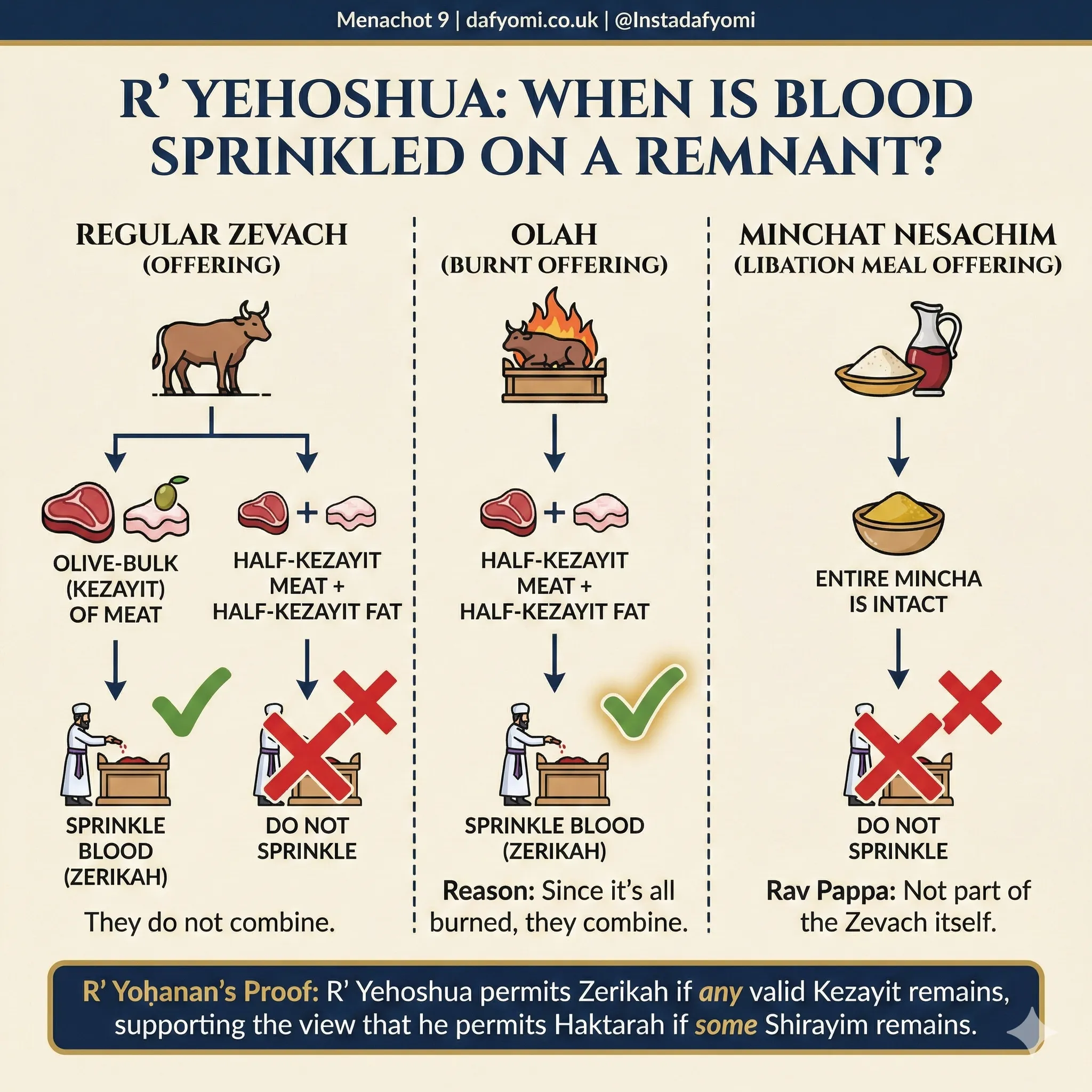
דְּתַנְיָא: רַבִּי יְהוֹשֻׁעַ אוֹמֵר: כׇּל הַזְּבָחִים שֶׁבַּתּוֹרָה שֶׁנִּשְׁתַּיֵּיר מֵהֶם כְּזַיִת בָּשָׂר אוֹ כְּזַיִת חֵלֶב – זוֹרֵק הַדָּם, כַּחֲצִי זַיִת בָּשָׂר כַּחֲצִי זַיִת חֵלֶב – אֵינוֹ זוֹרֵק אֶת הַדָּם.
English Translation:
The Gemara cites a proof for Rabbi Yoḥanan: It is clear that this is Rabbi Yehoshua’s opinion, as it is taught in a baraita that Rabbi Yehoshua says: With regard to any of the offerings that are mentioned in the Torah from which there remains either an olive-bulk of meat or an olive-bulk of fat, the halakha is that the priest sprinkles the blood of that offering and thereby permits either the remaining meat for consumption or the remaining fat for sacrifice upon the altar. But if there remains only half an olive-bulk of meat and half an olive-bulk of fat, he does not sprinkle the blood, as the consumption or burning of anything less than an olive-bulk is not significant enough to warrant the sprinkling of the blood. The volumes of the meat and the fat do not combine to form a whole olive-bulk.
קלאוד על הדף:
This baraita supports Rabbi Yochanan’s interpretation of Rabbi Yehoshua. Rabbi Yehoshua’s ruling shows he permits sprinkling the blood as long as there is a significant amount (olive-bulk) remaining. He only disqualifies when the remainder is too small to matter. This proves Rabbi Yehoshua distinguishes between complete loss and partial deficiency.
Key Terms:
- כְּזַיִת = Olive-bulk (minimum significant measure)
- בָּשָׂר = Meat
- חֵלֶב = Fat
- זוֹרֵק הַדָּם = Sprinkles the blood
Segment 14
TYPE: ביאור (Continuation)
Special rules for burnt offering and meal offering
Hebrew/Aramaic:
וּבָעוֹלָה, אֲפִילּוּ כַּחֲצִי זַיִת בָּשָׂר וְכַחֲצִי זַיִת חֵלֶב – זוֹרֵק אֶת הַדָּם, מִפְּנֵי שֶׁבָּעוֹלָה כּוּלָּהּ כָּלִיל, וּבַמִּנְחָה, אַף עַל פִּי שֶׁכּוּלָּהּ קַיֶּימֶת – לֹא יִזְרוֹק.
English Translation:
The baraita continues: And in the case of a burnt offering, even if there remains only half an olive-bulk of flesh and half an olive-bulk of fat, he sprinkles the blood, because in the case of a burnt offering it is entirely consumed, i.e., as the flesh and fat are both burned upon the altar, there is in fact an olive-bulk of the offering that is designated for burning upon the altar. And with regard to a meal offering, even though it remains entirely intact, he shall not sprinkle.
קלאוד על הדף:
The baraita concludes with two special cases. For a burnt offering (olah), where everything is consumed on the altar, even half-measures combine because it’s all going to the same place. For a meal offering, surprisingly, blood is never sprinkled even if the meal offering is complete — because the meal offering that accompanies libations doesn’t have the same relationship to the animal sacrifice as the animal’s own meat and fat do.
Key Terms:
- עוֹלָה = Burnt offering
- כָּלִיל = Entirely consumed (on the altar)
- מִנְחָה = Meal offering
Amud Bet (9b)
Segment 15
TYPE: קושיא (Question)
Why is meal offering mentioned?
Hebrew/Aramaic:
מִנְחָה מַאי עֲבִידְתֵּהּ? אָמַר רַב פָּפָּא: מִנְחַת נְסָכִים.
English Translation:
Parenthetically, the Gemara asks: What is the mention of a meal offering doing here, in a baraita that discusses slaughtered offerings? There is no sprinkling in the case of a meal offering. Rav Pappa said: The baraita is referring to a meal offering that accompanies the libations brought with a slaughtered offering.
קלאוד על הדף:
The Gemara questions the relevance of the meal offering in a baraita about blood sprinkling — meal offerings don’t involve sprinkling blood. Rav Pappa clarifies that this refers to the minchat nesachim, the meal offering that accompanies animal sacrifices as part of the libation requirements.
Key Terms:
- מִנְחַת נְסָכִים = Meal offering of libations (accompanies animal sacrifices)
Segment 16
TYPE: ביאור (Explanation)
What we might have thought about minchat nesachim
Hebrew/Aramaic:
סָלְקָא דַּעְתָּךְ אָמֵינָא: הוֹאִיל וּבַהֲדֵי זֶבַח אָתְיָא – כִּי גּוּפֵיהּ דְּזֶבַח דָּמְיָא, קָא מַשְׁמַע לַן.
English Translation:
Rav Pappa elaborates: It might enter your mind to say that since such a meal offering comes with a slaughtered offering, it is considered like the offering itself. Accordingly, if the only part remaining from an offering is the meal offering that is brought with it, perhaps it is considered as though part of the offering itself remains, and therefore the priest may sprinkle the offering’s blood on account of it. Therefore, the baraita teaches us that this is not the halakha.
קלאוד על הדף:
The hava amina (initial reasoning) was that since the minchat nesachim accompanies an animal sacrifice, it might be considered as part of that sacrifice for purposes of blood sprinkling. The baraita teaches that this is not so — the accompanying meal offering cannot substitute for the meat/fat of the animal sacrifice.
Key Terms:
- סָלְקָא דַּעְתָּךְ = It might enter your mind
- בַהֲדֵי זֶבַח אָתְיָא = Comes with a slaughtered offering
Segment 17
TYPE: תירוץ (Defense)
Reish Lakish’s response to the baraita
Hebrew/Aramaic:
וּמַאן דְּפָסֵל – שָׁאנֵי הָכָא, דְּאָמַר קְרָא: ״וְהֵרִים הַכֹּהֵן מִן הַמִּנְחָה אֶת אַזְכָּרָתָהּ וְהִקְטִיר הַמִּזְבֵּחָה״, ״הַמִּנְחָה״ – עַד דְּאִיתַהּ לְכוּלַּהּ מִנְחָה לֹא יַקְטִיר.
English Translation:
Rabbi Yoḥanan cited this baraita as proof that even according to Rabbi Yehoshua, if a portion of the remainder of a meal offering remains intact then the handful may be burned on account of it. The Gemara asks: And concerning the one who disqualifies the handful when the remainder is lacking, i.e., Reish Lakish, how does he explain the opinion of Rabbi Yehoshua? The Gemara responds: Reish Lakish would claim that it is different here, in the case of a meal offering, as the verse states: “And the priest shall remove from the meal offering its memorial part, and shall make it smoke upon the altar” (Leviticus 2:9). Since it is clear that the verse is discussing a meal offering, the apparently superfluous mention of “the meal offering” teaches that unless the entire meal offering is intact, the priest shall not burn the handful.
קלאוד על הדף:
Reish Lakish defends his position by citing a different verse. The phrase “from the meal offering” (hamincha) seems redundant — of course we’re discussing a meal offering! He interprets this redundancy to teach that the ENTIRE meal offering must be intact for the kometz to be burned.
Key Terms:
- אַזְכָּרָתָהּ = Its memorial part (the kometz)
- הַמִּנְחָה = The meal offering (seemingly redundant)
Segment 18
TYPE: תירוץ (Counter-interpretation)
Rabbi Yochanan’s reading of the same verse
Hebrew/Aramaic:
וְאִידָּךְ, ״מִן הַמִּנְחָה״ – מִנְחָה שֶׁהָיְתָה כְּבָר שְׁלֵימָה בִּשְׁעַת קְמִיצָה יַקְטִיר, אַף עַל גַּב דְּהַשְׁתָּא אֵינָהּ שְׁלֵימָה.
English Translation:
The Gemara continues: And the other amora, Rabbi Yoḥanan, how does he interpret that verse? Rabbi Yoḥanan claims that the phrase “from the meal offering” is referring to a meal offering that was already whole at the time of the removal of its handful, and the verse teaches that he shall burn its handful even though it is currently not whole.
קלאוד על הדף:
Rabbi Yochanan reads the same verse with opposite implications. “From the meal offering” refers to a meal offering that WAS complete at the time of kemitza. The verse teaches that such a kometz may be burned EVEN IF the meal offering is currently deficient — what matters is its status at the moment of kemitza, not its current state.
Key Terms:
- שֶׁהָיְתָה כְּבָר שְׁלֵימָה = That was already whole
- בִּשְׁעַת קְמִיצָה = At the time of kemitza
- הַשְׁתָּא = Now/currently
Segment 19
TYPE: קושיא (Challenge)
Rabbi Yochanan challenges Reish Lakish from shewbread
Hebrew/Aramaic:
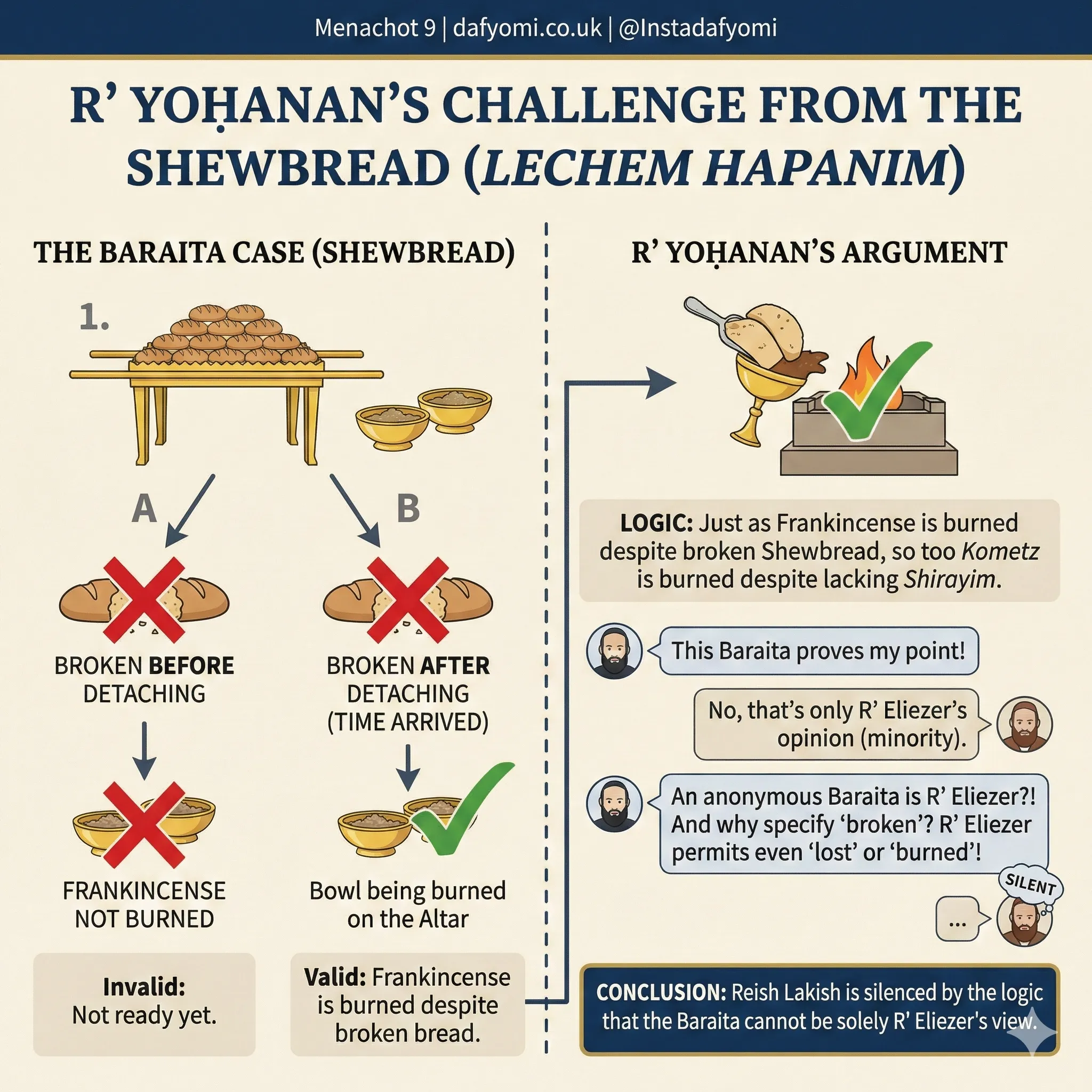
אֵיתִיבֵיהּ רַבִּי יוֹחָנָן לְרֵישׁ לָקִישׁ: עַד שֶׁלֹּא פֵּרְקָהּ נִפְרַס הַלֶּחֶם – פָּסוּל, וְאֵין מַקְטִיר עָלָיו אֶת הַבָּזִיכִין, וְאִם מִשֶּׁפֵּרְקָהּ נִפְרַס לַחְמָהּ – הַלֶּחֶם פָּסוּל, וּמַקְטִיר עָלָיו אֶת הַבָּזִיכִין. וְאָמַר רַבִּי אֶלְעָזָר: לֹא פֵּרְקָהּ מַמָּשׁ, אֶלָּא כֵּיוָן שֶׁהִגִּיעַ זְמַנָּהּ לְפָרֵק, וְאַף עַל פִּי שֶׁלֹּא פִּירְקָהּ.
English Translation:
Rabbi Yoḥanan raised an objection to Reish Lakish from a baraita: If before the priest detached the arrangement of shewbread and the bowls of frankincense from upon the Table, the bread broke into pieces, the bread is unfit for consumption and the priest does not burn the frankincense contained in the bowls on account of it. And if the bread broke after the priest detached it, the bread is unfit but the priest burns the frankincense contained in the bowls on account of it. And Rabbi Elazar says: The baraita does not mean that the priest actually detached the shewbread. Rather, it means that once the time to detach it has arrived the frankincense contained in the bowls may be burned, even though he has not yet detached it.
קלאוד על הדף:
Rabbi Yochanan brings proof from the shewbread (lechem hapanim). The frankincense bowls accompanying the shewbread may be burned even if the bread subsequently breaks — as long as the bread was intact when the time for detachment arrived. This parallels the meal offering: the kometz may be burned even if the shirayim later become deficient, as long as the offering was intact at the critical moment.
Key Terms:
- לֶחֶם הַפָּנִים = Shewbread
- בָּזִיכִין = Bowls (of frankincense)
- פֵּרְקָהּ = Detached it
- נִפְרַס = Broke into pieces
Segment 20
TYPE: תשובה (Response)
Reish Lakish attributes the baraita to Rabbi Eliezer
Hebrew/Aramaic:
אֲמַר לֵיהּ: הָא מַנִּי? רַבִּי אֱלִיעֶזֶר הִיא. אֲמַר לֵיהּ: אֲנָא אָמֵינָא לָךְ מִשְׁנָה שְׁלֵימָה, וְאָמְרַתְּ לִי אַתְּ רַבִּי אֱלִיעֶזֶר?
English Translation:
Reish Lakish said to Rabbi Yoḥanan in response: In accordance with whose opinion is this? It is in accordance with the opinion of Rabbi Eliezer, who permits the burning of a handful even when the remainder has been entirely destroyed. And I hold in accordance with the opinion of Rabbi Yehoshua. Rabbi Yoḥanan said to him: I am stating a complete halakha to you, i.e., a baraita of an unspecified opinion, and you say to me that this baraita is in accordance with the opinion of Rabbi Eliezer alone?
קלאוד על הדף:
Reish Lakish attempts to deflect the proof by attributing the baraita to Rabbi Eliezer’s minority position. Rabbi Yochanan objects: this is a “complete” (unattributed) mishna, which typically represents the accepted halakha, not a minority view. Dismissing it as merely Rabbi Eliezer’s opinion is insufficient.
Key Terms:
- הָא מַנִּי = In accordance with whose opinion is this?
- מִשְׁנָה שְׁלֵימָה = A complete/unattributed mishna
Segment 21
TYPE: קושיא נוספת (Additional Challenge)
Why specifically “broke”?
Hebrew/Aramaic:
אִי רַבִּי אֱלִיעֶזֶר, מַאי אִירְיָא נִפְרַס? אֲפִילּוּ שָׂרוּף וְאָבוּד נָמֵי מַכְשַׁר! אִישְׁתִּיק.
English Translation:
Rabbi Yoḥanan added: And furthermore, if the baraita is in accordance with the opinion of only Rabbi Eliezer, then why does the baraita mention specifically an instance where the bread broke? According to Rabbi Eliezer, even if the bread was burned or lost entirely, he deems the frankincense contained in the bowls fit for burning as well. The Gemara notes: Reish Lakish was silent and did not respond to the objections of Rabbi Yoḥanan.
קלאוד על הדף:
Rabbi Yochanan presses further: if this were Rabbi Eliezer’s view, why does the baraita specify that the bread “broke”? Rabbi Eliezer permits burning the frankincense even if the bread was completely burned or lost! The specific mention of “breaking” suggests this is a more moderate position — the bread is deficient but still exists. Reish Lakish’s silence indicates he has no adequate response.
Key Terms:
- נִפְרַס = Broke
- שָׂרוּף וְאָבוּד = Burned and lost
- אִישְׁתִּיק = Was silent
Segment 22
TYPE: קושיא (Question)
Why didn’t Reish Lakish offer a different defense?
Hebrew/Aramaic:
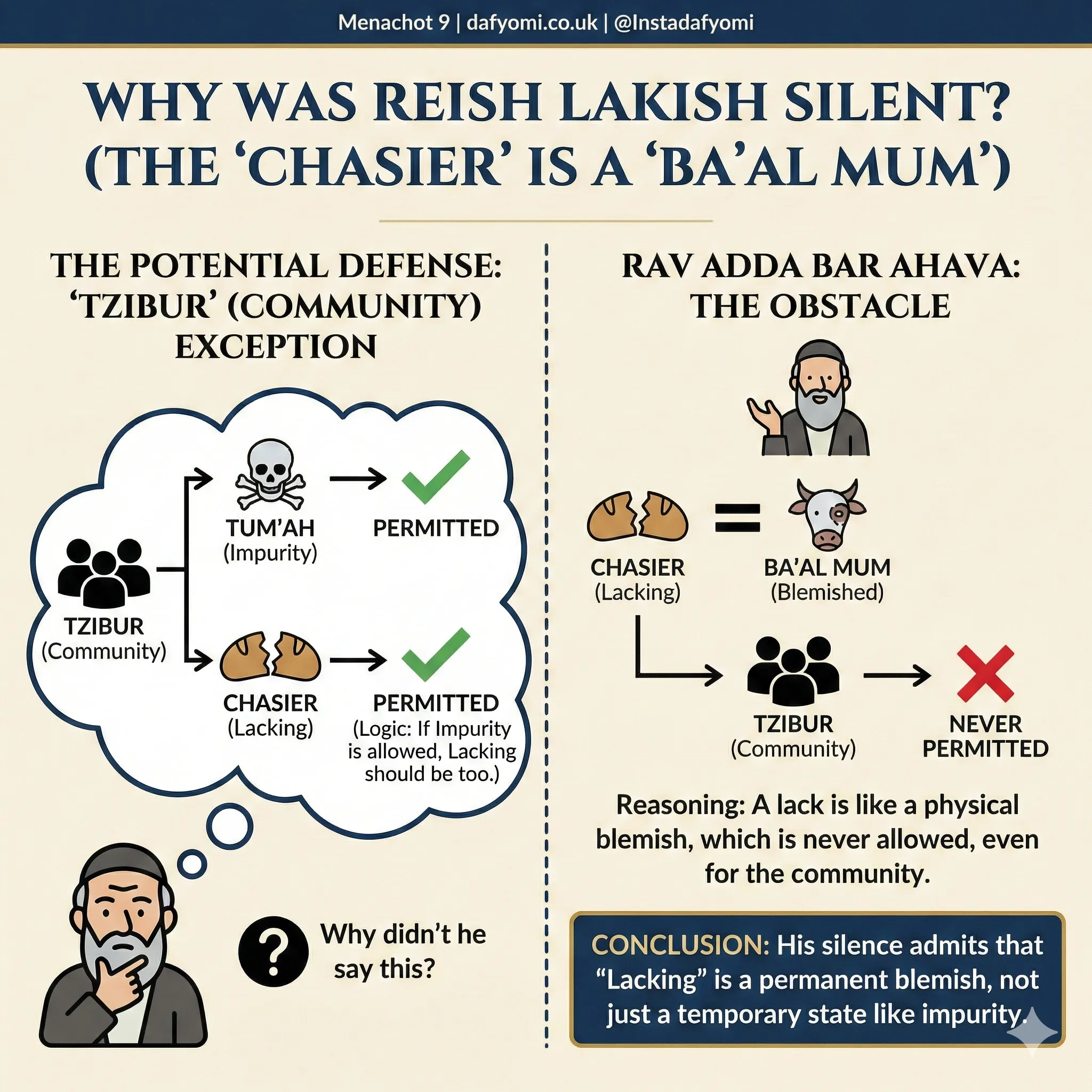
וְאַמַּאי שְׁתֵק? לֵימָא לֵיהּ: צִבּוּר שָׁאנֵי, הוֹאִיל וְאִישְׁתְּרַי טוּמְאָה לְגַבַּיְיהוּ – אִישְׁתְּרַי נָמֵי חֲסֵרוֹת! אָמַר רַב אַדָּא בַּר אַהֲבָה: זֹאת אוֹמֶרֶת, הַחֶסְרוֹן כְּבַעַל מוּם דָּמֵי, וְאֵין בַּעַל מוּם בַּצִּבּוּר.
English Translation:
The Gemara asks: But why was Reish Lakish silent? Let him say to Rabbi Yoḥanan that one cannot cite a proof from a baraita that discusses the shewbread, a communal offering, because offerings of the community are different, since ritual impurity was permitted for them, i.e., communal offerings may be sacrificed even in a state of ritual impurity. Therefore, it was also permitted to sacrifice them when they are lacking. Rav Adda bar Ahava said: The fact that Reish Lakish did not respond in this manner is to say that a meal offering that is lacking in measure is considered like a blemished animal, not merely like an impure offering, and there is no instance of a blemished animal being permitted for use as an offering, even in the case of a communal offering.
קלאוד על הדף:
The Gemara wonders why Reish Lakish didn’t argue that communal offerings are different — since impurity is waived for them, perhaps deficiency is too. Rav Adda bar Ahava derives from Reish Lakish’s silence an important principle: deficiency is analogous to a blemish (mum), not to impurity. While impurity can be waived for communal offerings, blemishes never can. This explains why Reish Lakish couldn’t use that defense.
Key Terms:
- צִבּוּר = Community/communal offering
- טוּמְאָה = Ritual impurity
- חֲסֵרוֹת = Deficiencies
- בַּעַל מוּם = Blemished (animal)
Segment 23
TYPE: קושיא (Challenge to Rav Adda’s derivation)
Rav Yosef bar Shemaya’s objection
Hebrew/Aramaic:
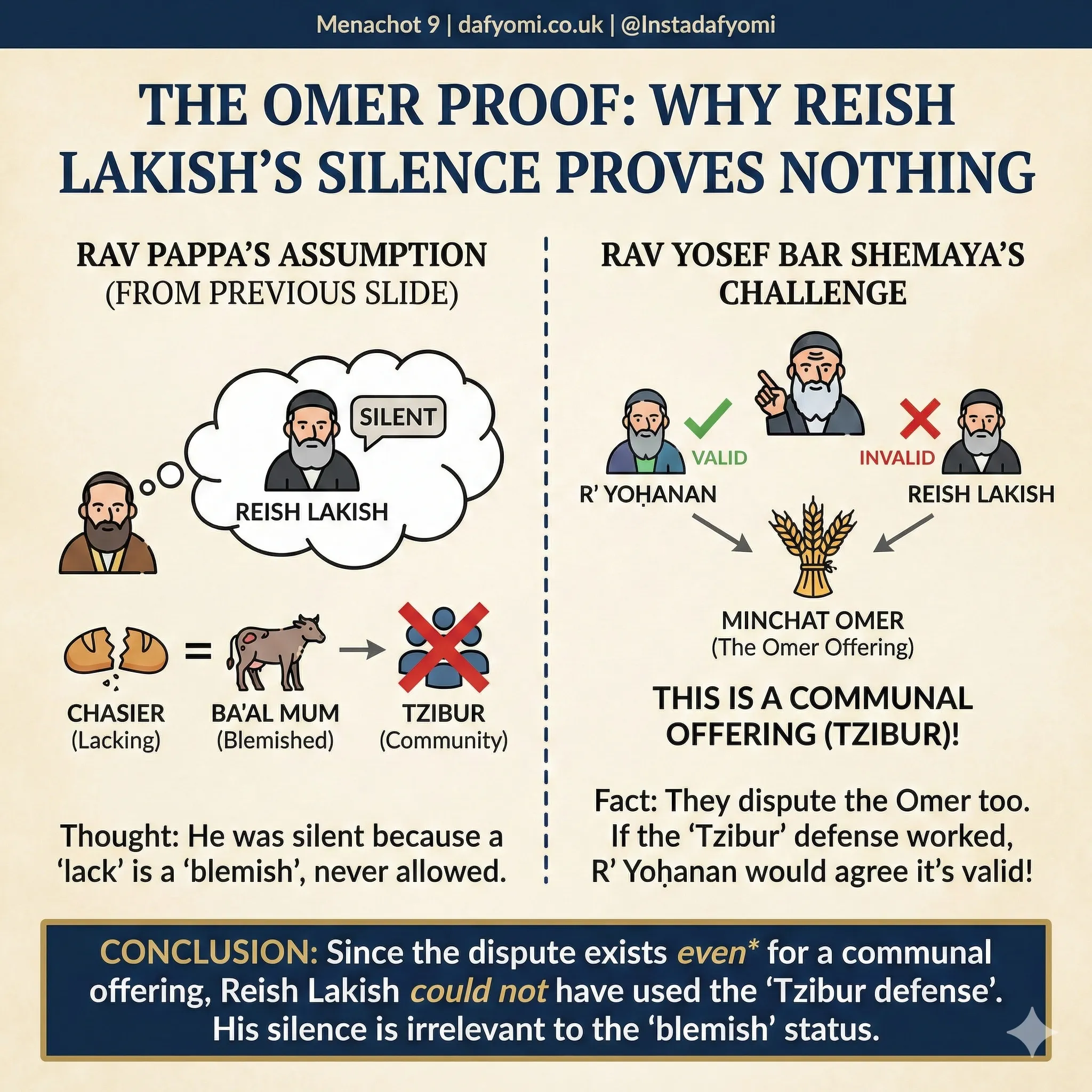
יָתֵיב רַב פָּפָּא וְקָאָמַר לְהָא שְׁמַעְתָּא, אֲמַר לֵיהּ רַב יוֹסֵף בַּר שְׁמַעְיָה לְרַב פָּפָּא: מִי לָא עָסְקִינַן דְּרַבִּי יוֹחָנָן וְרֵישׁ לָקִישׁ בְּמִנְחַת הָעוֹמֶר דְּצִיבּוּר הִיא, וּפְלִיגִי?
English Translation:
The Gemara relates that Rav Pappa was once sitting and saying this halakha, and he noted that Reish Lakish was silent and did not respond to Rabbi Yoḥanan’s objections by differentiating between a communal offering and that of an individual, and that Rav Adda bar Ahava derived from Reish Lakish’s silence that a lack in the measure of a meal offering is tantamount to a blemish. Rav Yosef bar Shemaya said to Rav Pappa: Are we not dealing with a disagreement that exists between Rabbi Yoḥanan and Reish Lakish even in the case of the omer meal offering, which is a communal offering? And even so, they disagree.
קלאוד על הדף:
Rav Yosef bar Shemaya challenges Rav Adda’s derivation. The dispute between Rabbi Yochanan and Reish Lakish applies even to the omer offering, which is communal. If Reish Lakish couldn’t distinguish communal from individual offerings because deficiency equals blemish, why would they dispute about the omer at all? This suggests Reish Lakish’s silence had a different reason.
Key Terms:
- מִנְחַת הָעוֹמֶר = The omer meal offering (communal)
Segment 24
TYPE: ברייתא (Teaching)
Two verses about deficiency
Hebrew/Aramaic:
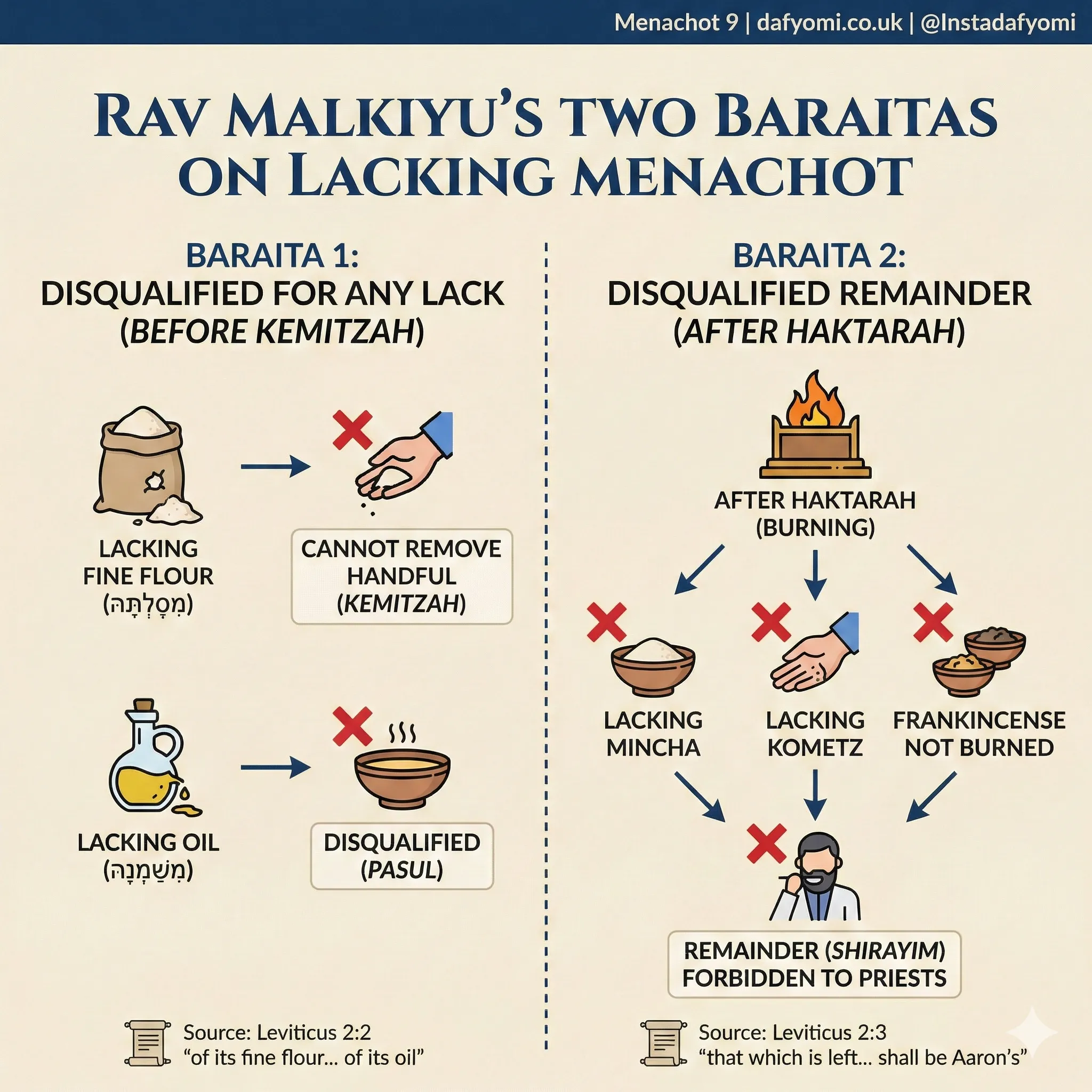
אָמַר רַב מַלְכִּיּוֹ, תָּנָא חֲדָא: ״מִסׇּלְתָּהּ״ – שֶׁאִם חָסְרָה כׇּל שֶׁהוּא פְּסוּלָה, ״מִשַּׁמְנָהּ״ – שֶׁאִם חָסְרָה כׇּל שֶׁהוּא פָּסוּל.
English Translation:
The Gemara further discusses the disagreement between Rabbi Yoḥanan and Reish Lakish. Rav Malkiyu says that one baraita taught: The verse states: “And he shall remove…of its fine flour” (Leviticus 2:2). This indicates that if the meal offering lacks any amount of its flour, it is disqualified and the priest may not remove a handful from it. Similarly, the term: “Of its oil” (Leviticus 2:2), teaches that if the meal offering lacks any amount of its oil, it is disqualified.
קלאוד על הדף:
Rav Malkiyu cites a baraita deriving from the verse “from its flour” and “from its oil” that any deficiency in either component disqualifies the meal offering. The word “from” (mi-) implies the offering must be complete — if any amount is lacking, the kemitza cannot be performed.
Key Terms:
- מִסׇּלְתָּהּ = From its fine flour
- מִשַּׁמְנָהּ = From its oil
- כׇּל שֶׁהוּא = Any amount
Segment 25
TYPE: ברייתא (Second Teaching)
Another verse about deficiency
Hebrew/Aramaic:
וְתַנְיָא אִידַּךְ: ״וְהַנּוֹתֶרֶת מִן הַמִּנְחָה״ – פְּרָט לַמִּנְחָה שֶׁחָסְרָה הִיא, וְשֶׁחָסַר קוּמְצָהּ, וְשֶׁלֹּא הִקְטִיר מִלְּבוֹנָתָהּ כְּלוּם.
English Translation:
And it is taught in another baraita that the verse that states: “But that which is left of the meal offering shall be Aaron’s and his sons’” (Leviticus 2:3), teaches that the remainder of the meal offering is given to the priests only if there was initially a whole meal offering, to the exclusion of a meal offering that was lacking, or whose handful was lacking, or from which the priest did not burn any frankincense. In such cases, the meal offering is disqualified and its remainder may not be consumed by the priests.
קלאוד על הדף:
A second baraita derives from “that which is left of the meal offering” (vehanoteret min hamincha) that several deficiencies disqualify an offering: if the meal offering itself was lacking, if the kometz was lacking, or if no frankincense was burned. Each of these prevents the remainder from being consumed by priests.
Key Terms:
- וְהַנּוֹתֶרֶת = And that which is left
- שֶׁחָסַר קוּמְצָהּ = Whose handful was lacking
- לְבוֹנָתָהּ = Its frankincense
Segment 26
TYPE: קושיא (Question)
Why two verses?
Hebrew/Aramaic:
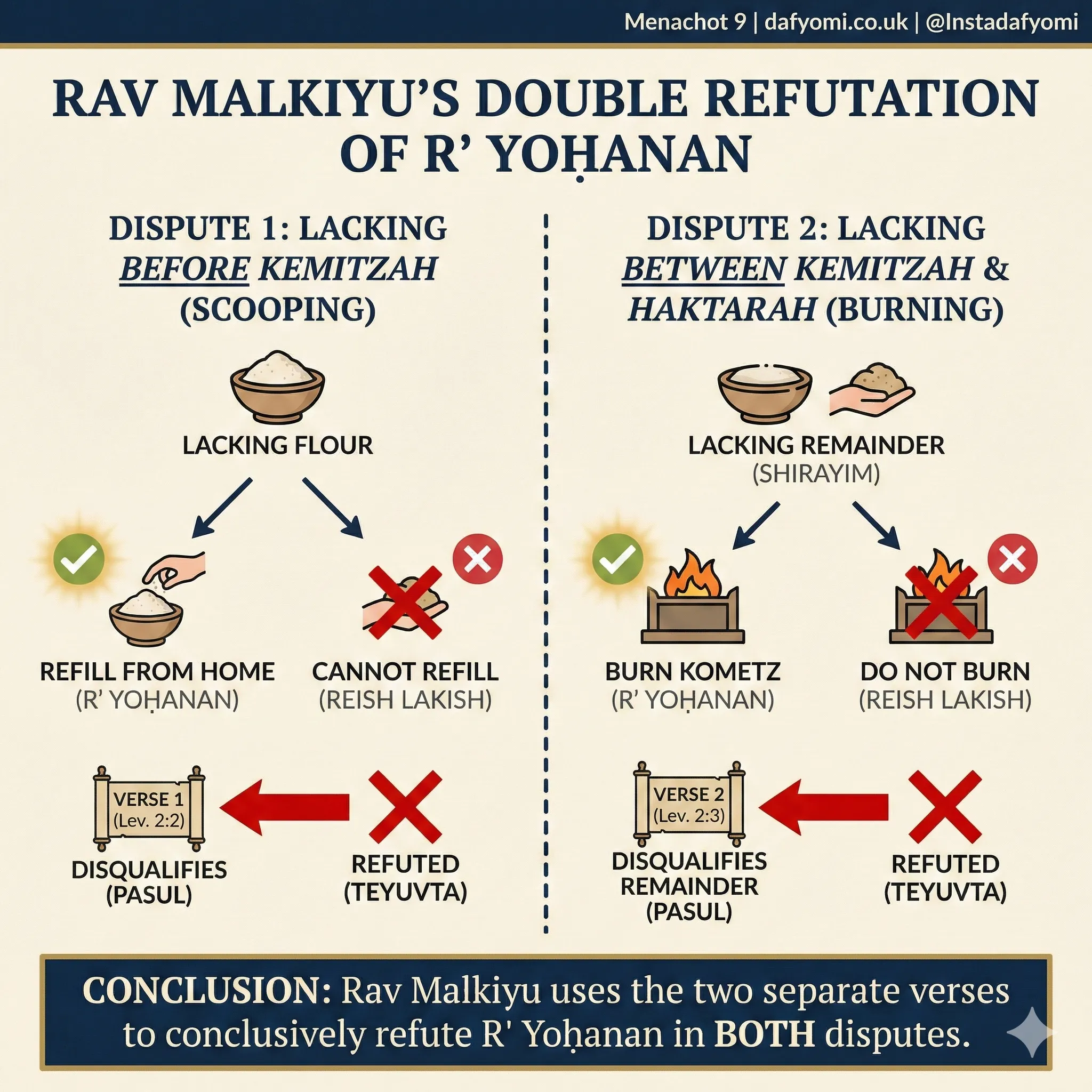
תְּרֵי קְרָאֵי בַּחֲסֵרוֹת לְמָה לִי? לָאו חַד לְמִנְחָה שֶׁחָסְרָה קוֹדֶם קְמִיצָה, וְחַד לְשִׁירַיִם שֶׁחָסְרוּ בֵּין קְמִיצָה לְהַקְטָרָה,
English Translation:
Rav Malkiyu asks: Why do I need two verses to disqualify meal offerings that are lacking? Is it not correct to say that one verse is referring to a meal offering that became lacking before the removal of the handful, i.e., that one may not refill it, and one verse is referring to the remainder of a meal offering that became lacking between the removal of the handful and its burning upon the altar, and it teaches that one may not burn a handful on account of such a remainder?
קלאוד על הדף:
Rav Malkiyu asks why Scripture needs two separate verses about deficiency. He suggests one addresses pre-kemitza deficiency (you cannot simply refill it) and one addresses post-kemitza deficiency (you cannot burn the kometz). This would support Reish Lakish’s strict positions on both issues.
Key Terms:
- תְּרֵי קְרָאֵי = Two verses
- בַּחֲסֵרוֹת = Regarding deficiencies
Segment 27
TYPE: קושיא (Potential Refutation)
Challenge to Rabbi Yochanan
Hebrew/Aramaic:
וּתְיוּבְתָּא דְּרַבִּי יוֹחָנָן בְּתַרְוַיְיהוּ?
English Translation:
Rav Malkiyu concludes: And if so, then this is a conclusive refutation of the opinion of Rabbi Yoḥanan in both instances where he disagrees with Reish Lakish, i.e., in the case of a meal offering that became lacking before the removal of the handful, as Rabbi Yoḥanan holds that one may refill it, and in the case of the remainder that became lacking between the removal of the handful and its burning, as he holds that the handful may be burned.
קלאוד על הדף:
If Rav Malkiyu’s interpretation is correct, Rabbi Yochanan is refuted on both disputed points: he permits supplementing a pre-kemitza deficiency (but the verse forbids it), and he permits burning the kometz for a post-kemitza deficiency (but the other verse forbids it).
Segment 28
TYPE: תירוץ (Resolution)
Reinterpreting the verses to support Rabbi Yochanan
Hebrew/Aramaic:
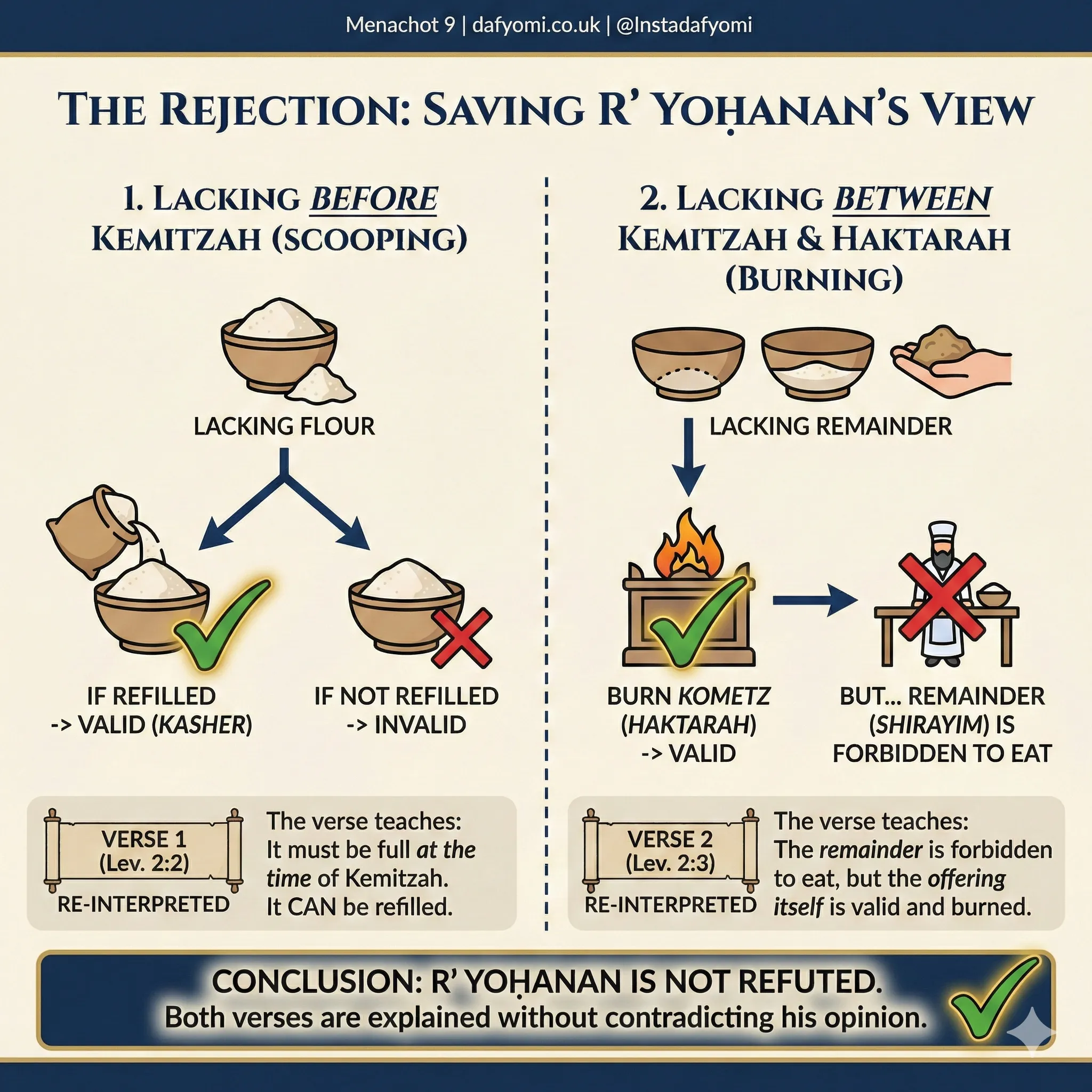
לָא, חַד לְמִנְחָה שֶׁחָסְרָה קוֹדֶם קְמִיצָה, דְּאִי מֵבִיא מִבֵּיתוֹ וִימַלְּאֶנָּה – אִין, וְאִי לָא – לָא, וְחַד לְשִׁירַיִם שֶׁחָסְרוּ בֵּין קְמִיצָה לְהַקְטָרָה, דְּאַף עַל גַּב דְּמַקְטִיר קוֹמֶץ עֲלֵיהֶן – אוֹתָן שִׁירַיִם אֲסוּרִים לַאֲכִילָה.
English Translation:
The Gemara rejects this suggestion: No; one verse is indeed referring to a meal offering that became lacking before the removal of the handful, but it is not teaching that this meal offering is disqualified. Rather, this verse indicates that if he brings flour from his home and fills it so that the meal offering is no longer lacking, then yes, it is fit, but if he does not bring more flour, it is not fit. And one verse is indeed referring to the remainder of a meal offering that became lacking between the removal of the handful and its burning upon the altar; nevertheless, it does not indicate that the handful may not be burned. Rather, it teaches that even though the priest burns the handful on account of such a remainder, that remainder is prohibited for consumption.
קלאוד על הדף:
The Gemara reinterprets both verses in ways consistent with Rabbi Yochanan. The first verse teaches that supplementation IS the solution — if you refill it, it’s valid; if you don’t, it’s invalid. The second verse doesn’t prohibit burning the kometz; rather, it prohibits EATING the deficient shirayim even though the kometz is burned. This preserves both of Rabbi Yochanan’s positions.
Key Terms:
- אוֹתָן שִׁירַיִם אֲסוּרִים לַאֲכִילָה = Those remains are prohibited for consumption
Segment 29
TYPE: בעיא (Dilemma)
Question about eating deficient shirayim
Hebrew/Aramaic:
דְּאִיבַּעְיָא לְהוּ: לְדִבְרֵי הָאוֹמֵר שִׁירַיִם שֶׁחָסְרוּ בֵּין קְמִיצָה לְהַקְטָרָה מַקְטִיר קוֹמֶץ עֲלֵיהֶן, אוֹתָן שִׁירַיִם מָה הֵן בַּאֲכִילָה?
English Translation:
The Gemara continues: This is indeed the appropriate explanation of the verses, as a dilemma was raised before the Sages: According to the statement of the one who says that in a case where the remainder of a meal offering became lacking between the removal of the handful and its burning upon the altar, the priest burns the handful on account of this remainder, concerning the remainder itself, what is its status with regard to consumption, i.e., may the remainder be eaten?
קלאוד על הדף:
The Gemara confirms this interpretation by citing an actual dilemma: according to the view that the kometz may be burned even when the shirayim are deficient, can the deficient shirayim be eaten? This question shows that burning the kometz and eating the shirayim were treated as separate issues — supporting the Gemara’s reinterpretation.
Segment 30
TYPE: תירוץ (Answer)
Ze’eiri and Rabbi Yannai’s sources
Hebrew/Aramaic:
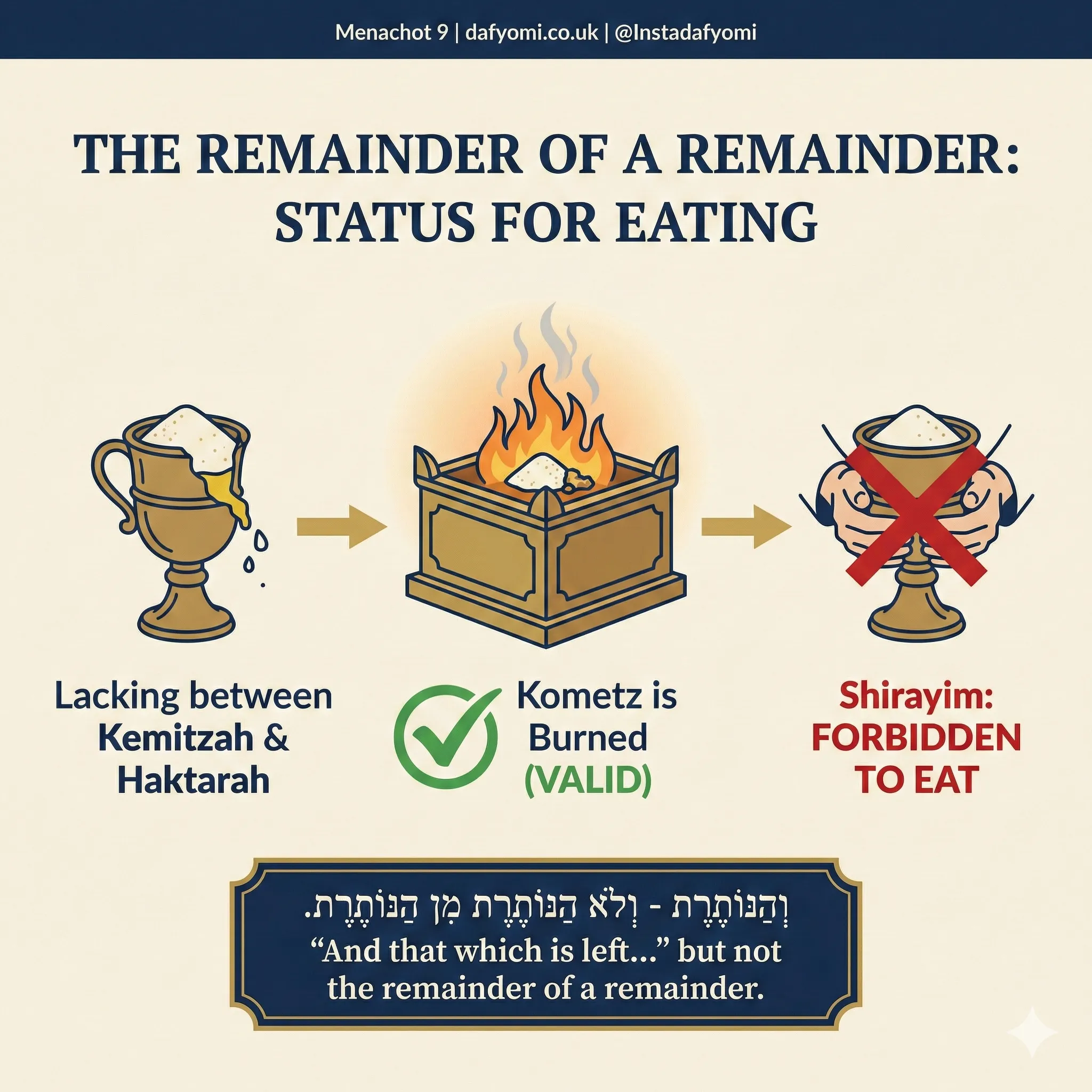
אָמַר זְעֵירִי, אָמַר קְרָא: ״וְהַנּוֹתֶרֶת״, וְלֹא הַנּוֹתֶרֶת מִן הַנּוֹתֶרֶת. וְרַבִּי יַנַּאי אָמַר: ״מֵהַמִּנְחָה״ – מִנְחָה שֶׁהָיְתָה כְּבָר.
English Translation:
Ze’eiri said that the verse states: “But that which is left of the meal offering shall be Aaron’s and his sons’,” which teaches that the priests may consume the remainder of a meal offering, but not the remainder of the remainder, i.e., if the remainder became lacking before the handful was burned, the remaining part of the remainder may not be consumed. Alternatively, Rabbi Yannai says that “of the meal offering shall be Aaron’s and his sons’” indicates that the priests may consume only the remainder of a meal offering that was previously whole when the handful was burned, not the remainder of the remainder.
קלאוד על הדף:
Two Amoraim provide scriptural sources for prohibiting consumption of deficient shirayim. Ze’eiri derives from “that which is left” (vehanoteret) — the remainder of a whole offering, not the remainder of an already-deficient remainder. Rabbi Yannai derives from “of the meal offering” (mehamincha) — from an offering that “was” complete, implying past wholeness is required.
Key Terms:
- הַנּוֹתֶרֶת מִן הַנּוֹתֶרֶת = The remainder of the remainder
- מִנְחָה שֶׁהָיְתָה כְּבָר = A meal offering that was previously (whole)
Segment 31
TYPE: בעיא (New Topic)
Left-handed kemitza
Hebrew/Aramaic:
קָמַץ בִּשְׂמֹאל – מְנָא הָנֵי מִילֵּי? אָמַר רַבִּי זֵירָא, דְּאָמַר קְרָא: ״וַיַּקְרֵב אֶת הַמִּנְחָה וַיְמַלֵּא כַפּוֹ מִמֶּנָּה״ – כַּף זֶה אֵינִי יוֹדֵעַ מַהוּ, כְּשֶׁהוּא אוֹמֵר: ״וְלָקַח הַכֹּהֵן מִלּוֹג הַשָּׁמֶן וְיָצַק עַל כַּף הַכֹּהֵן הַשְּׂמָאלִית״ – כָּאן שְׂמָאלִית, הָא כׇּל מָקוֹם שֶׁנֶּאֱמַר ״כַּף״ אֵינוֹ אֶלָּא יָמִין.
English Translation:
The mishna teaches: If the priest removed the handful with his left hand the meal offering is unfit. The Gemara asks: From where are these matters derived? Rabbi Zeira said that it is derived from that which the verse states: “And the meal offering was presented; and he filled his hand from it” (Leviticus 9:17). Rabbi Zeira explains: This hand, I do not know what it is, i.e., the left hand or the right. When the verse states with regard to the atonement of a leper: “And the priest shall take of the log of oil, and pour it into the palm of his own left hand” (Leviticus 14:15), it mentions the left hand. One can therefore derive that here, where the verse specifies, the priest must use his left hand, whereas in any place where it is stated in a verse “hand” without specification, it is referring only to the right hand.
קלאוד על הדף:
The Gemara shifts to a new topic: the source for requiring right-hand kemitza. Rabbi Zeira’s derivation: when Scripture says “hand” (kaf) without specifying, we don’t know which hand. But the leper’s purification explicitly mentions “left hand” (hasmalit). From this we learn that wherever Scripture specifies “left,” use left; wherever it says simply “hand,” use right.
Key Terms:
- קָמַץ בִּשְׂמֹאל = Removed handful with left hand
- כַּף = Palm/hand
- שְׂמָאלִית = Left
Segment 32
TYPE: קושיא (Challenge)
Isn’t the verse needed for itself?
Hebrew/Aramaic:
וְהָא מִיבְּעֵי לֵיהּ לְגוּפֵיהּ? ״שְׂמָאלִית״ אַחֲרִינָא כְּתִיב.
English Translation:
The Gemara asks: But this verse is necessary for itself, i.e., to teach that the oil must be poured on the priest’s left hand, not his right. The Gemara answers that another mention of the left hand is written in the same passage (see Leviticus 14:16). From this additional mention of the left hand it may be derived that any unspecified reference to a hand is referring to the right hand.
קלאוד על הדף:
The Gemara objects: the verse specifying “left hand” for the leper’s oil is needed to teach that specific law — how can we also derive a general rule from it? The answer: “left” appears multiple times in the leper passage, so one mention teaches the specific law while the others allow the general derivation.
Segment 33
TYPE: קושיא (Challenge)
Perhaps two restrictions amplify?
Hebrew/Aramaic:
וְאֵימָא: אֵין מִיעוּט אַחַר מִיעוּט אֶלָּא לְרַבּוֹת? ״שְׂמָאלִית״ אַחֲרִינָא כְּתִיב. כָּאן שְׂמָאלִית, וְאֵין אַחֵר שְׂמָאלִית.
English Translation:
The Gemara challenges: But say that according to the hermeneutical principle that one restriction after another restriction serves only to amplify, it should be inferred from the additional specification of the left hand that the oil may be poured onto the priest’s right hand. The Gemara responds: Yet another specification of the left hand is written in that passage (see Leviticus 14:26). Accordingly, the hermeneutical principle that one restriction after another serves only to amplify does not apply. Instead, the verse indicates that here the left hand is required, and there is no other instance where the Torah requires the left hand.
קלאוד על הדף:
The Gemara raises the hermeneutical principle “miut achar miut lerabot” — two restrictions in a row actually expand rather than restrict. Perhaps the multiple mentions of “left” mean EITHER hand is valid? The answer: there are even more mentions — enough to establish that “left” is restricted to this case only, while all other cases require “right.”
Key Terms:
- מִיעוּט אַחַר מִיעוּט = Restriction after restriction
- לְרַבּוֹת = To include/amplify
Segment 34
TYPE: קושיא (Challenge)
Perhaps left is the default?
Hebrew/Aramaic:
וְאֵימָא: אַדְּרַבָּה, מָה כָּאן שְׂמָאלִית – אַף בְּעָלְמָא נָמֵי שְׂמָאלִית! אַרְבָּעָה ״שְׂמָאלִית״ כְּתִיבִי: תְּרֵי בְּעָנִי, וּתְרֵי בְּעָשִׁיר.
English Translation:
The Gemara challenges: But one can say that on the contrary, just as here the left hand is required, so too generally, the left hand is required as well. The Gemara responds: Four mentions of the left hand are written in the passage, two with regard to a poor leper (Leviticus 14:26–27), and two with regard to a wealthy one (Leviticus 14:15–16).
קלאוד על הדף:
One might argue the opposite: learn from the leper that LEFT is the default everywhere! The Gemara resolves this by counting: there are FOUR mentions of “left” — two for the poor leper, two for the wealthy. This multiplicity emphasizes that left-hand requirement is exceptional and limited to this case.
Key Terms:
- עָנִי = Poor (leper)
- עָשִׁיר = Wealthy (leper)
Segment 35
TYPE: קושיא (Remaining Question)
Rabbi Yirmeya’s question
Hebrew/Aramaic:
אֲמַר לֵיהּ רַבִּי יִרְמְיָה לְרַבִּי זֵירָא: ״עַל בֹּהֶן יָדוֹ הַיְמָנִית וְעַל בֹּהֶן רַגְלוֹ הַיְמָנִית״ דִּכְתִיב בְּשֶׁמֶן דִּמְצוֹרָע עָשִׁיר לְמָה לִּי?
English Translation:
Rabbi Yirmeya said to Rabbi Zeira: According to your opinion, one interprets homiletically the additional specifications in the passage discussing the purification of a leper. If so, there is another apparently superfluous verse: “Upon the thumb of his right hand, and upon the big toe of his right foot” (Leviticus 14:17), which is written with regard to the placement of the oil upon the right thumb and big toe of a wealthy leper. Why do I need the verse to specify that the oil is placed on the leper’s right thumb and big toe?
קלאוד על הדף:
Rabbi Yirmeya asks Rabbi Zeira: if we derive rules from “extra” specifications in the leper passage, what about the verse specifying that oil goes on the leper’s RIGHT thumb and RIGHT big toe? This seems redundant — if “hand” without specification means right, why specify “right” here? The discussion continues on the next daf.
Key Terms:
- בֹּהֶן יָדוֹ הַיְמָנִית = Thumb of his right hand
- בֹּהֶן רַגְלוֹ הַיְמָנִית = Big toe of his right foot
- מְצוֹרָע = Leper