Menachot Daf 16 (מנחות דף ט״ז)
Daf: 16 | Amudim: 16a – 16b
📖 Breakdown
Amud Aleph (16a)
Segment 1
TYPE: משנה
Piggul with partial permitting factors
Hebrew/Aramaic:
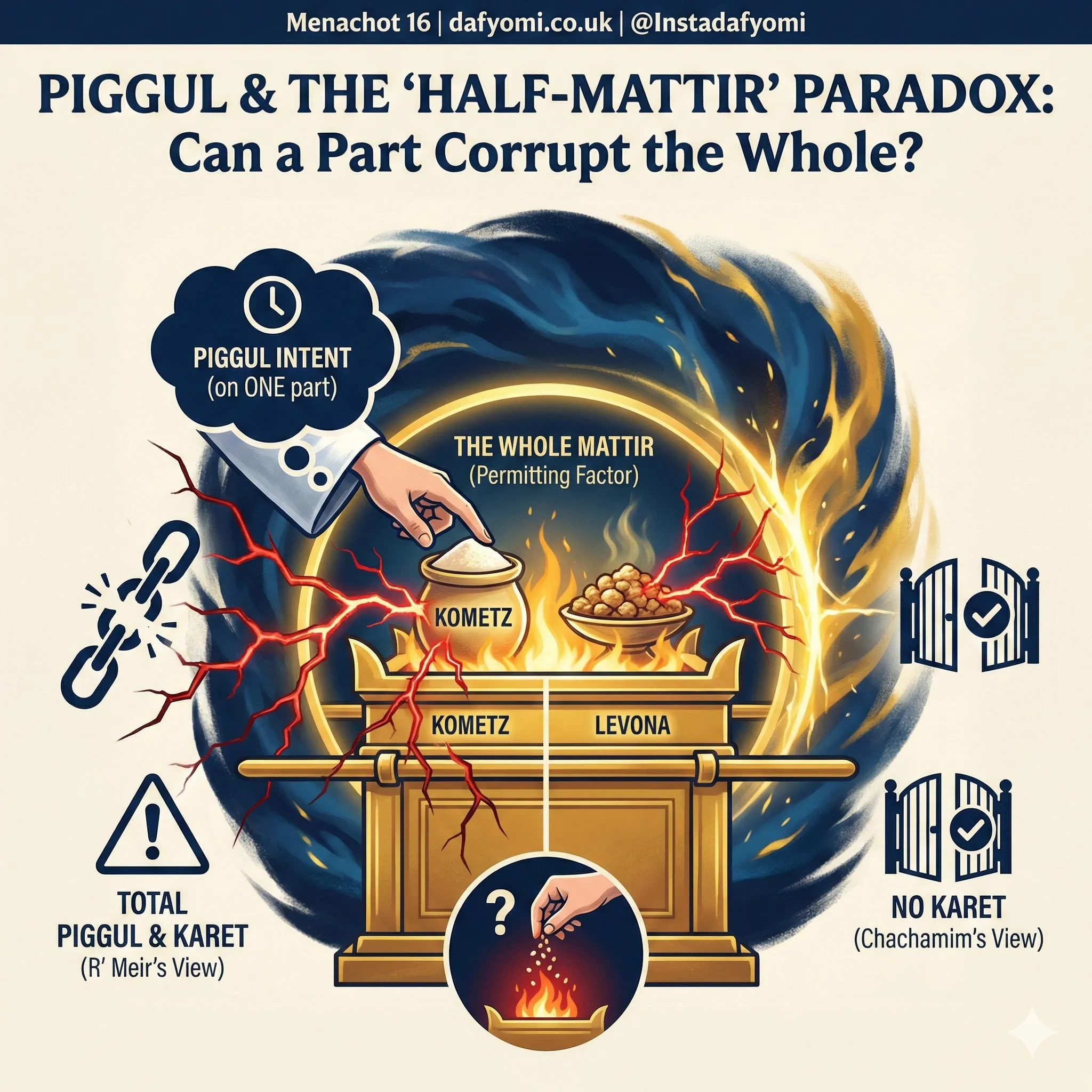
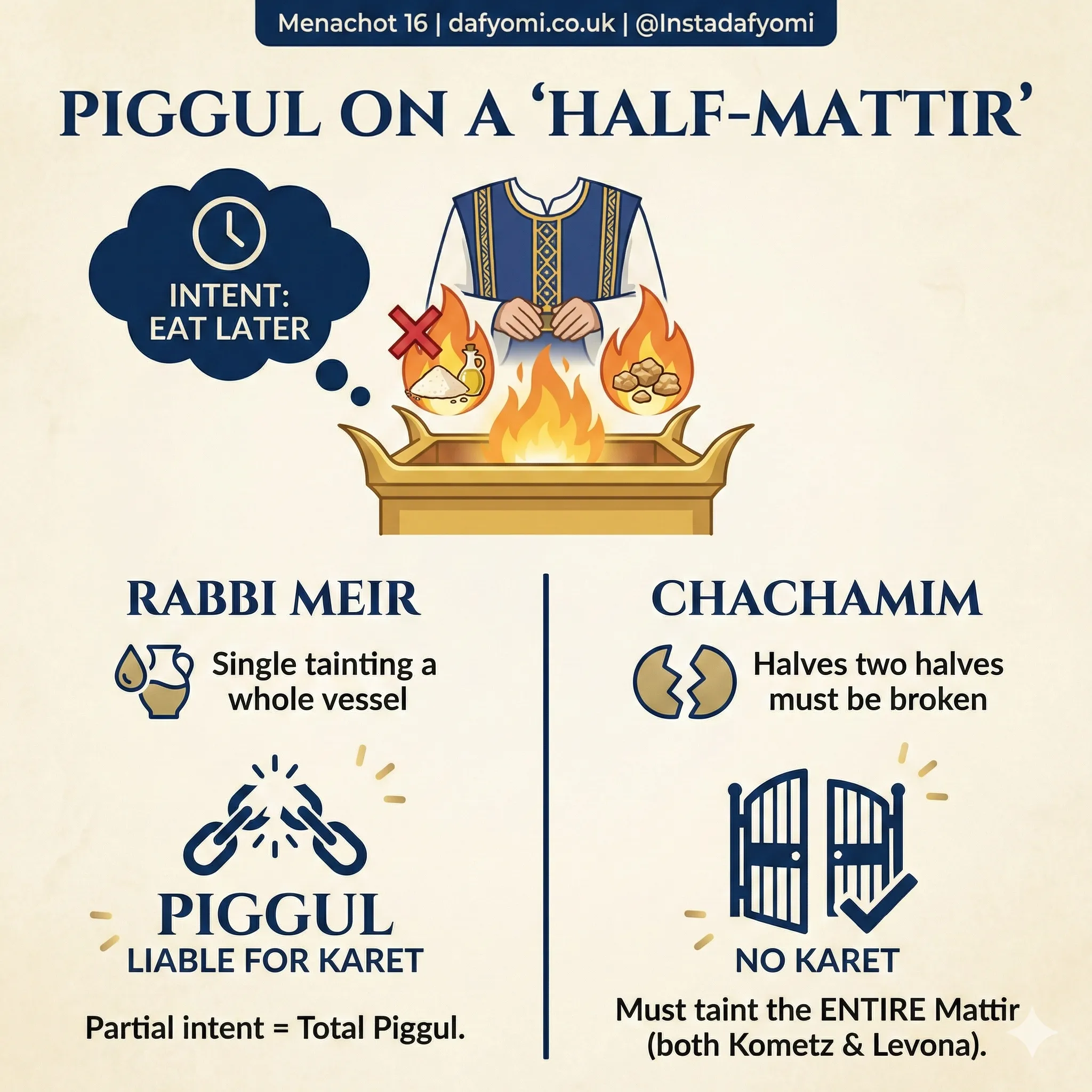
מַתְנִי׳ פִּיגֵּל בַּקּוֹמֶץ וְלֹא בַּלְּבוֹנָה, בַּלְּבוֹנָה וְלֹא בַּקּוֹמֶץ – רַבִּי מֵאִיר אוֹמֵר: פִּיגּוּל וְחַיָּיבִין עָלָיו כָּרֵת, וַחֲכָמִים אוֹמְרִים: אֵין בּוֹ כָּרֵת עַד שֶׁיְּפַגֵּל בְּכׇל הַמַּתִּיר.
English Translation:
MISHNA: With regard to the burning of the handful of a meal offering and the frankincense, both of which render the meal offering permitted for consumption: If the priest had an intention that can render the offering piggul during the burning of the handful but not during the burning of the frankincense, or during the burning of the frankincense but not during the burning of the handful, i.e., he burned one of them with the intention to eat the remainder of the offering beyond its designated time, Rabbi Meir says: The offering is piggul and one who eats it is liable to receive karet for its consumption. And the Rabbis say: There is no liability to receive karet in this case unless he renders the offering piggul during the sacrifice of the entire permitting factor, i.e., the burning of both the handful and the frankincense.
קלאוד על הדף:
This Mishna introduces a fundamental dispute about piggul when there are multiple permitting factors (matirin). A meal offering has two matirin: the handful (kometz) and the frankincense. Rabbi Meir holds that improper intent during either one alone is sufficient to create piggul. The Rabbis disagree – piggul requires improper intent throughout all permitting factors.
Key Terms:
- קוֹמֶץ (Kometz) = Handful removed from meal offering and burned
- לְבוֹנָה (Levonah) = Frankincense burned alongside the handful
- מַתִּיר (Matir) = Permitting factor; what enables the remainder to be consumed
- כָּרֵת (Karet) = Spiritual excision; punishment for eating piggul
Segment 2
TYPE: משנה – המשך
Cases where the Rabbis agree with Rabbi Meir
Hebrew/Aramaic:
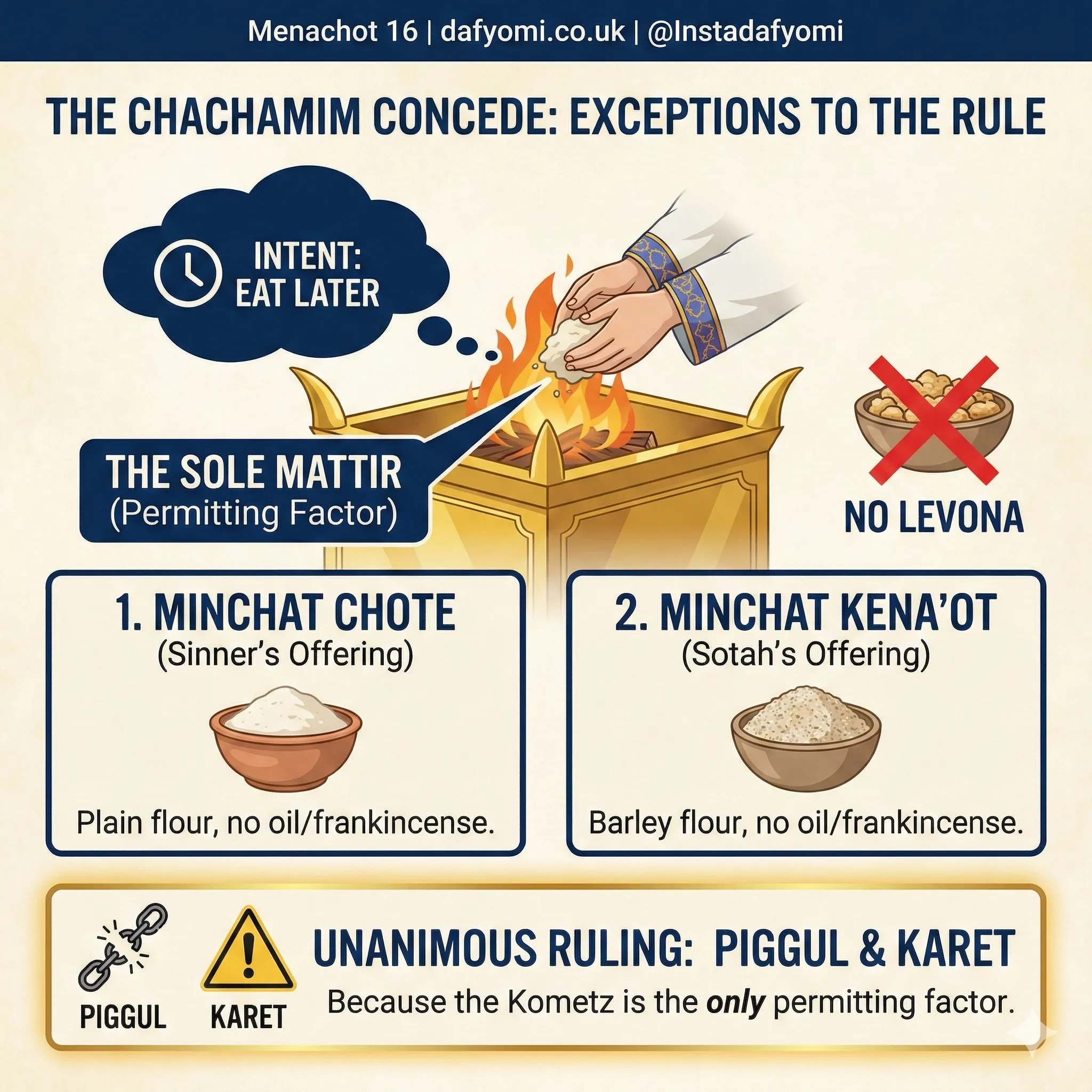
וּמוֹדִים חֲכָמִים לְרַבִּי מֵאִיר בְּמִנְחַת חוֹטֵא וּבְמִנְחַת קְנָאוֹת, שֶׁאִם פִּיגֵּל בַּקּוֹמֶץ, שֶׁהוּא פִּיגּוּל וְחַיָּיבִין עָלָיו כָּרֵת, שֶׁהַקּוֹמֶץ הוּא הַמַּתִּיר.
English Translation:
And the Rabbis concede to Rabbi Meir in the case of a meal offering of a sinner and in the case of a meal offering of jealousy of a sota that if one had intent of piggul during the burning of the handful, that the meal offering is piggul and one is liable to receive karet for its consumption, as here the handful is the sole permitting factor.
קלאוד על הדף:
The Rabbis’ position is clarified: they don’t disagree with the principle, only with whether partial intent suffices when there are multiple matirin. In cases where there’s only one matir (the sinner’s and jealousy offerings have no frankincense), they agree that piggul intent during that single matir creates full piggul liability.
Key Terms:
- מִנְחַת חוֹטֵא (Minchat Chotet) = Sinner’s meal offering brought by poor sinners
- מִנְחַת קְנָאוֹת (Minchat Kenaot) = Meal offering of jealousy brought by suspected adulteress
Segment 3
TYPE: משנה – המשך
Lambs and two loaves – Rabbi Meir vs. Rabbis
Hebrew/Aramaic:
שָׁחַט אֶחָד מִן הַכְּבָשִׂים לֶאֱכוֹל שְׁתֵּי חַלּוֹת לְמָחָר, הִקְטִיר אֶחָד מִן הַבָּזִיכִין לֶאֱכוֹל שְׁנֵי סְדָרִים לְמָחָר – רַבִּי מֵאִיר אוֹמֵר: פִּיגּוּל וְחַיָּיבִין עָלָיו כָּרֵת, וַחֲכָמִים אוֹמְרִים: אֵין בּוֹ כָּרֵת עַד שֶׁיְּפַגֵּל בְּכׇל הַמַּתִּיר.
English Translation:
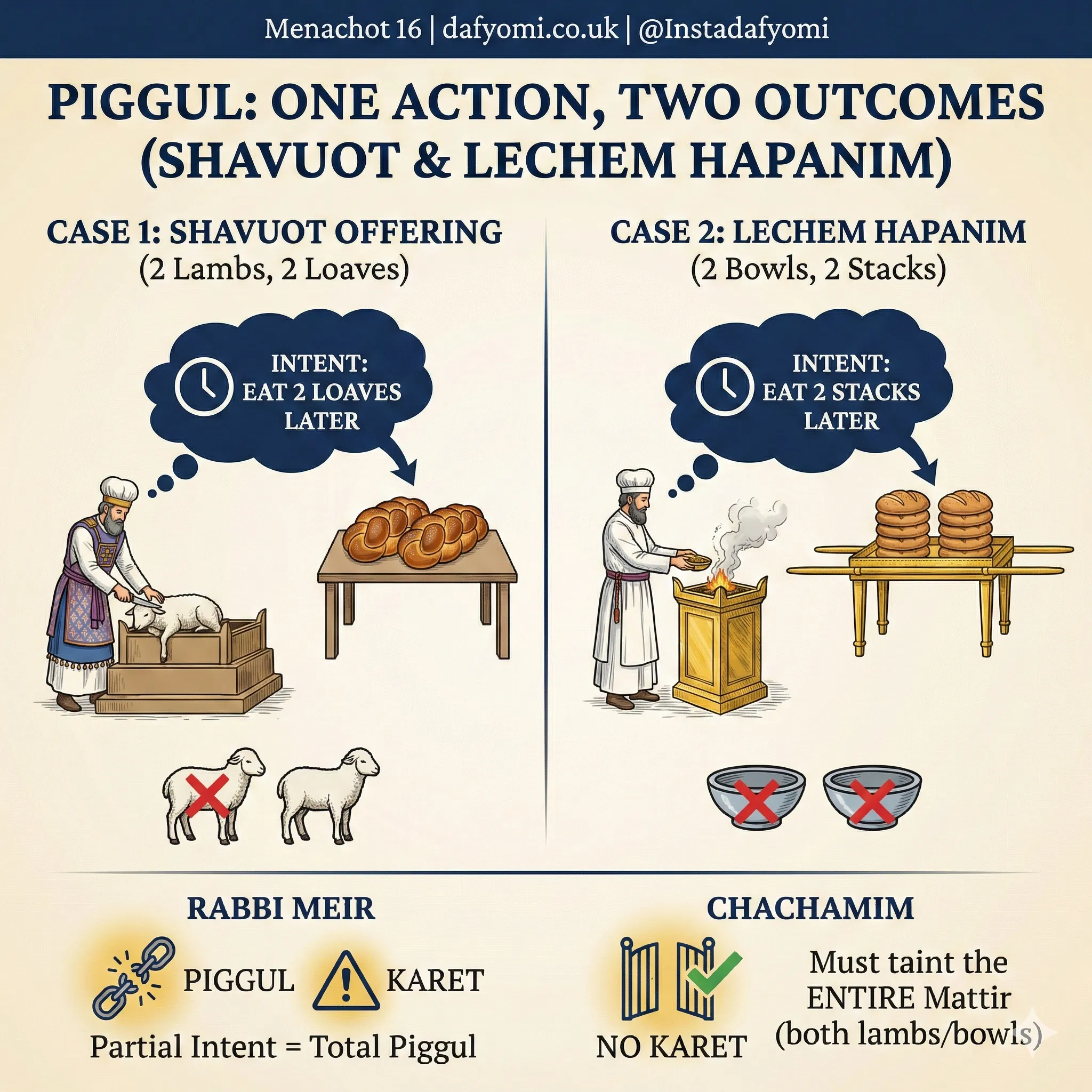
If one slaughtered one of the two lambs sacrificed with the two loaves on Shavuot with the intent to partake of the two loaves the next day, or if one burned one of the bowls of frankincense with the intent to partake of two arrangements of shewbread the next day, Rabbi Meir says: The meal offering is piggul and one is liable to receive karet for its consumption, and the Rabbis say: There is no liability to receive karet unless he has intent of piggul during the sacrifice of the entire permitting factor.
קלאוד על הדף:
The Mishna extends the dispute to cases where one offering has two permitting factors that are separate items (two lambs, two bowls of frankincense). Rabbi Meir holds that piggul intent during just one of them creates full piggul; the Rabbis require intent during both.
Key Terms:
- כְּבָשִׂים (Kevasim) = Lambs of Shavuot
- בָּזִיכִין (Bazichin) = Bowls of frankincense for the showbread
- סְּדָרִים (Sedarim) = Arrangements of showbread
Segment 4
TYPE: משנה – המשך
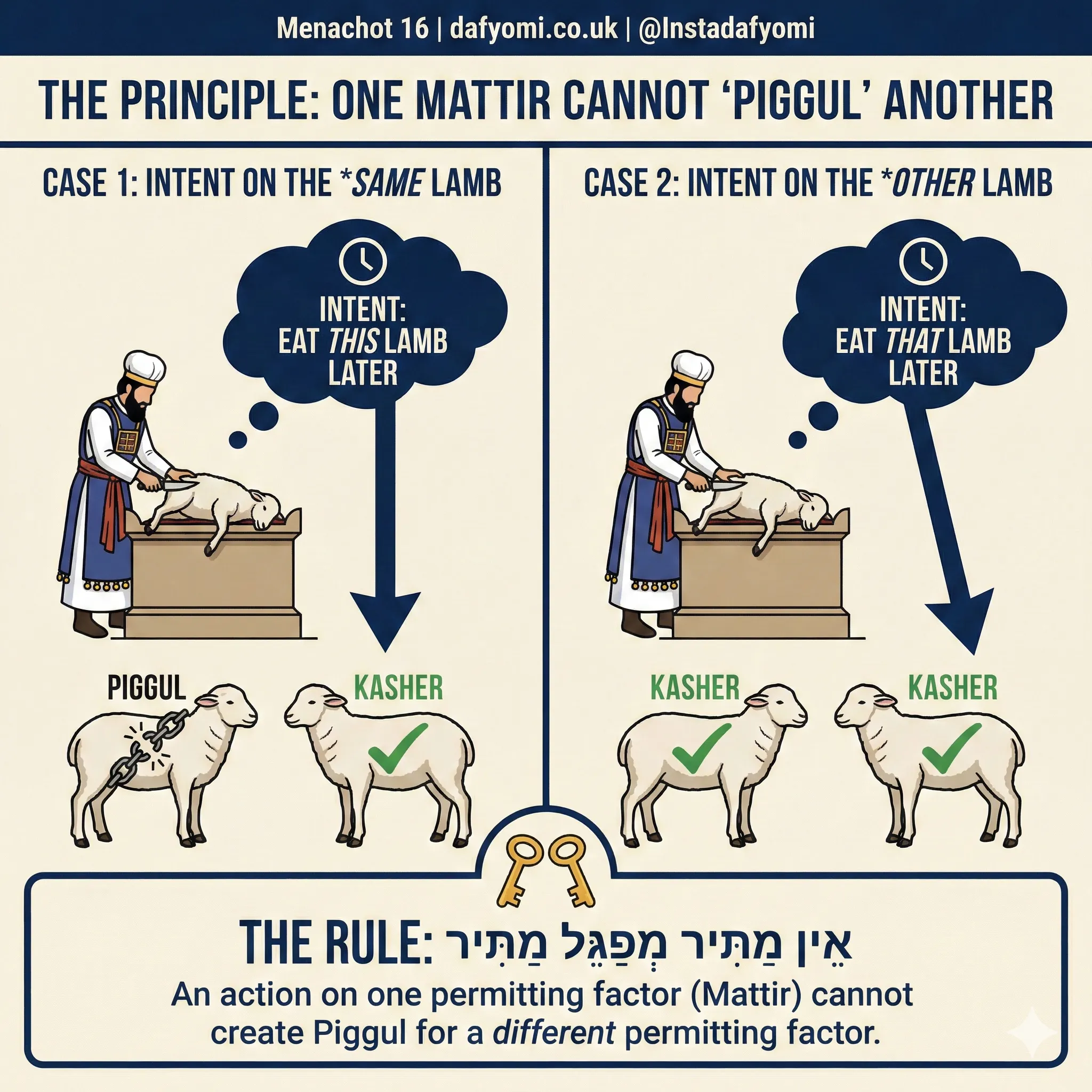
One matir cannot render another matir piggul
Hebrew/Aramaic:
שָׁחַט אֶחָד מִן הַכְּבָשִׂים לֶאֱכוֹל מִמֶּנּוּ לְמָחָר – הוּא פִּיגּוּל, וַחֲבֵירוֹ כָּשֵׁר; לֶאֱכוֹל מֵחֲבֵירוֹ לְמָחָר – שְׁנֵיהֶם כְּשֵׁרִים.
English Translation:
If one slaughtered one of the lambs with the intent to partake of it the next day, that lamb is piggul and the other is a fit offering. If he slaughtered one lamb with the intent to partake of the other the next day, both lambs are fit offerings, as one permitting factor does not render another permitting factor piggul.
קלאוד על הדף:
This segment introduces a new principle: one matir cannot render another matir piggul. The two Shavuot lambs each serve as permitting factors for the two loaves. If a priest has piggul intent about one lamb while slaughtering it, that lamb becomes piggul. But intent about the other lamb (a different matir) during this slaughter has no effect – both remain fit.
Key Terms:
- אֵין הַמַּתִּיר מְפַגֵּל אֶת הַמַּתִּיר = One permitting factor does not render another permitting factor piggul
Segment 5
TYPE: גמרא
Rav’s interpretation of the dispute
Hebrew/Aramaic:
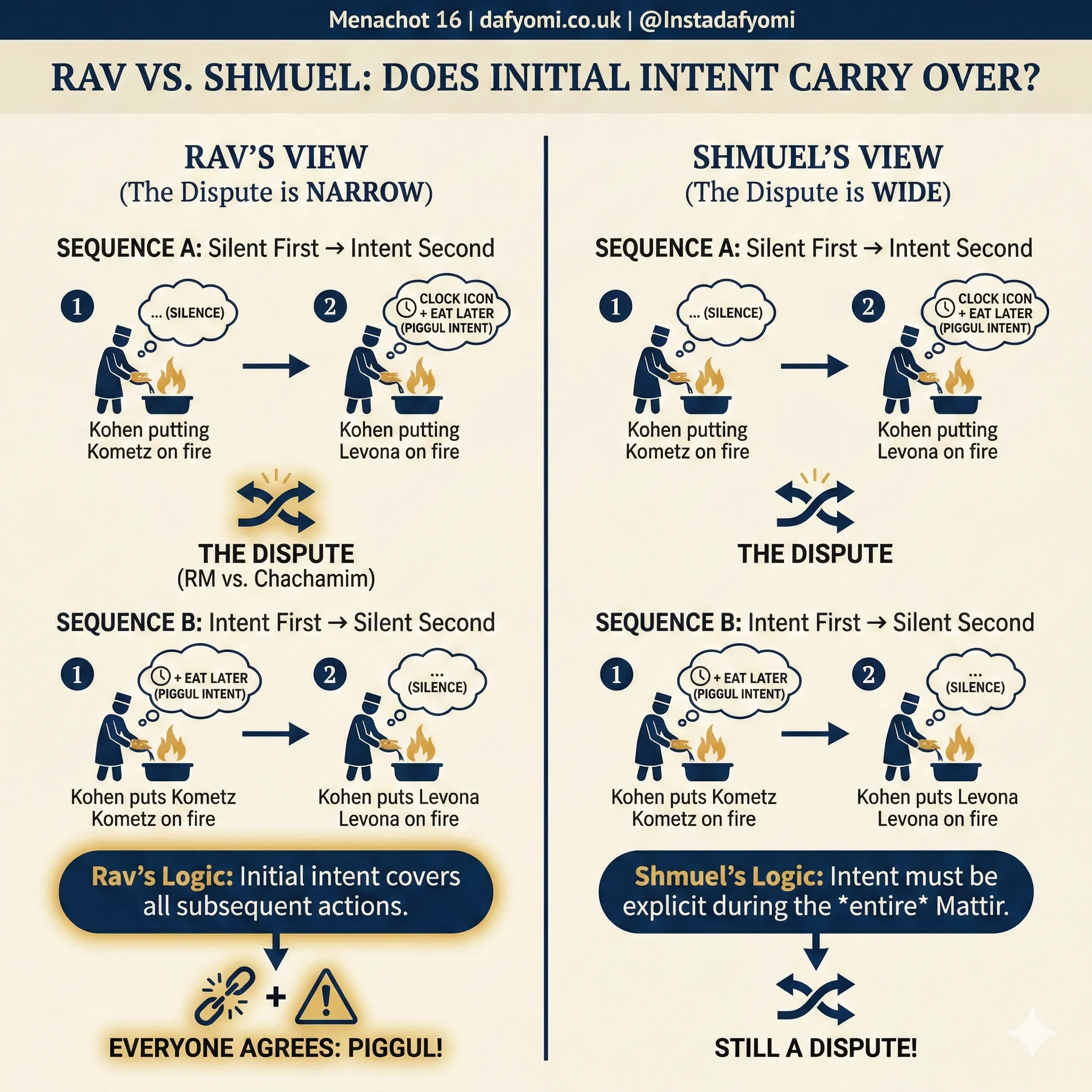
גְּמָ׳ אָמַר רַב: מַחְלוֹקֶת שֶׁנָּתַן אֶת הַקּוֹמֶץ בִּשְׁתִיקָה, וְאֶת הַלְּבוֹנָה בְּמַחְשָׁבָה.
English Translation:
GEMARA: Rav says: The dispute between Rabbi Meir and the Rabbis with regard to a case where one has intent of piggul by either the handful or the frankincense applies only, for instance, when he placed the handful upon the altar in silence, i.e., without specific intent, and thereafter placed the frankincense with intent to partake of the remainder the next day. In such a case, it is evident that his intent relates only to the frankincense.
קלאוד על הדף:
Rav begins to limit the scope of the dispute. He says the argument between Rabbi Meir and the Rabbis applies specifically when the handful was burned silently (without improper intent) and only the frankincense was burned with piggul intent.
Key Terms:
- בִּשְׁתִיקָה (Bishtikah) = In silence; without improper intent
- בְּמַחְשָׁבָה (Bemachashavah) = With improper intent
Segment 6
TYPE: גמרא – המשך
Rav continues; Shmuel disagrees
Hebrew/Aramaic:
אֲבָל נָתַן הַקּוֹמֶץ בְּמַחְשָׁבָה, וְאֶת הַלְּבוֹנָה בִּשְׁתִיקָה – דִּבְרֵי הַכֹּל פִּיגּוּל, שֶׁכׇּל הָעוֹשֶׂה עַל דַּעַת רִאשׁוֹנָה הוּא עוֹשֶׂה. וּשְׁמוּאֵל אָמַר: עֲדַיִין הִוא מַחְלוֹקֶת.
English Translation:
But if he placed the handful with the intent to partake of the remainder the next day and then placed the frankincense in silence, all agree that the meal offering is piggul, as anyone who performs the rites in such a manner performs them in accordance with his initial intent. And Shmuel says: Even in such a case, there is still a dispute between the Rabbis and Rabbi Meir.
קלאוד על הדף:
Rav limits the scope of the dispute. The handful is the primary matir – it’s what actually “permits” the remainder. Frankincense, while required, is secondary. If piggul intent was during the handful first, Rav says everyone agrees it’s piggul because subsequent actions follow the initial intent. Shmuel disagrees – he holds the dispute continues even in that case.
Key Terms:
- עַל דַּעַת רִאשׁוֹנָה הוּא עוֹשֶׂה = He performs in accordance with his initial intent
Segment 7
TYPE: גמרא – קושיא
Challenge to Rav from a baraita
Hebrew/Aramaic:
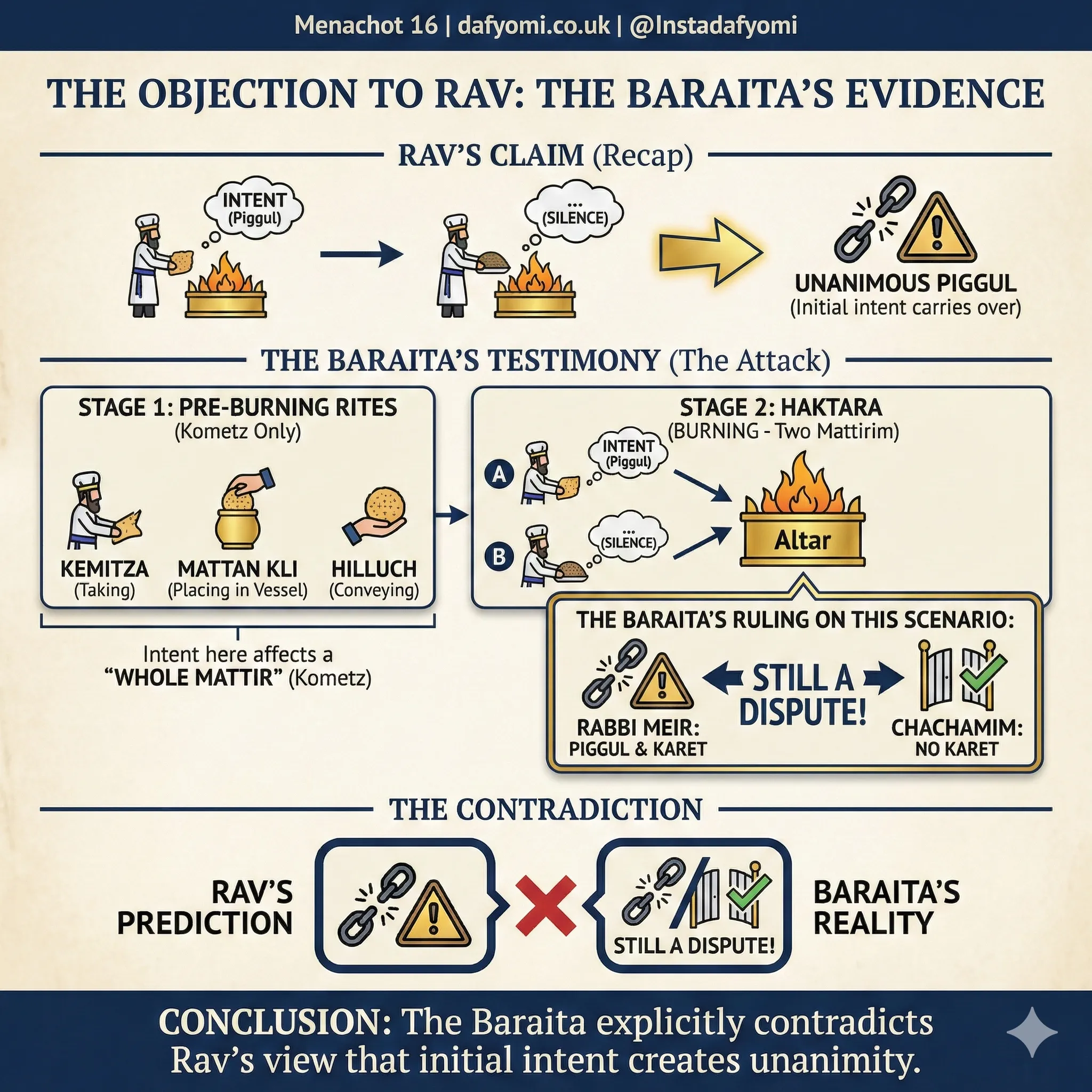
יָתֵיב רָבָא וְקָאָמַר לַהּ לְהָא שְׁמַעְתָּא, אֵיתִיבֵיהּ רַב אַחָא בַּר רַב הוּנָא לְרָבָא: בַּמֶּה דְּבָרִים אֲמוּרִים – בִּקְמִיצָה, וּבְמַתַּן כְּלִי, וּבְהִילּוּךְ.
English Translation:
Rava sat and stated this halakha in accordance with the opinion of Rav. Rav Acha bar Rav Huna raised an objection to Rava from a baraita: In what case is this statement, that intent of piggul concerning only the handful renders the meal offering piggul, said? It is stated in a case where one had such intent during the removal of the handful, or during the placement of the handful in a service vessel, or during the conveying of the vessel to the altar. Since these rites are not performed with the frankincense, during these stages the handful is the only relevant permitting factor.
קלאוד על הדף:
Rav Acha bar Rav Huna challenges Rava (who was teaching Rav’s position) from a baraita. The baraita distinguishes between early stages of the meal offering service (removal, placement, conveying) and the burning stage. During the early stages, only the handful is involved, so the dispute applies only to intent during the handful.
Key Terms:
- קְמִיצָה (Kemitzah) = Removal of the handful
- מַתַּן כְּלִי (Matan Kli) = Placement in a service vessel
- הִילּוּךְ (Hiluch) = Conveying/carrying to the altar
Segment 8
TYPE: גמרא – ברייתא
The baraita about burning
Hebrew/Aramaic:
בָּא לוֹ לְהַקְטָרָה, נָתַן אֶת הַקּוֹמֶץ בִּשְׁתִיקָה וְאֶת הַלְּבוֹנָה בְּמַחְשָׁבָה, אֶת הַקּוֹמֶץ בְּמַחְשָׁבָה וְאֶת הַלְּבוֹנָה בִּשְׁתִיקָה – רַבִּי מֵאִיר אוֹמֵר: פִּיגּוּל וְחַיָּיבִין עָלָיו כָּרֵת, וַחֲכָמִים אוֹמְרִים: אֵין בּוֹ כָּרֵת עַד שֶׁיְּפַגֵּל בְּכׇל הַמַּתִּיר.
English Translation:
The baraita continues: But once the priest comes to perform the burning of the handful, then if he placed the handful on the fire of the altar in silence and he placed the frankincense with intent of piggul, or if he placed the handful with intent and the frankincense in silence, Rabbi Meir says: It is piggul and one is liable to receive karet for its consumption, and the Rabbis say: There is no liability to receive karet unless he has intent of piggul during the sacrifice of the entire permitting factor.
קלאוד על הדף:
This baraita explicitly shows that even at the burning stage (the final service), the dispute continues in both directions – whether intent was only during the handful or only during the frankincense. This refutes Rav’s limitation and supports Shmuel’s position.
Segment 9
TYPE: גמרא – קושיא
Challenge to Rav
Hebrew/Aramaic:
קָתָנֵי מִיהָא: נָתַן אֶת הַקּוֹמֶץ בְּמַחְשָׁבָה וְאֶת הַלְּבוֹנָה בִּשְׁתִיקָה, וּפְלִיגִי.
English Translation:
Rav Acha bar Rav Huna explains his objection: In any event, the baraita teaches a case where he placed the handful with intent and the frankincense in silence, and yet the Rabbis disagree with Rabbi Meir and they do not say that one performs the rite of the frankincense with one’s initial intent.
קלאוד על הדף:
The Gemara notes that this baraita poses a direct challenge to Rav. Rav claimed all agree it’s piggul when intent was during the handful. Yet the baraita explicitly states the dispute continues even in that case. This appears to conclusively refute Rav.
Segment 10
TYPE: גמרא – תירוץ ודחייה
Attempted answer and rejection
Hebrew/Aramaic:
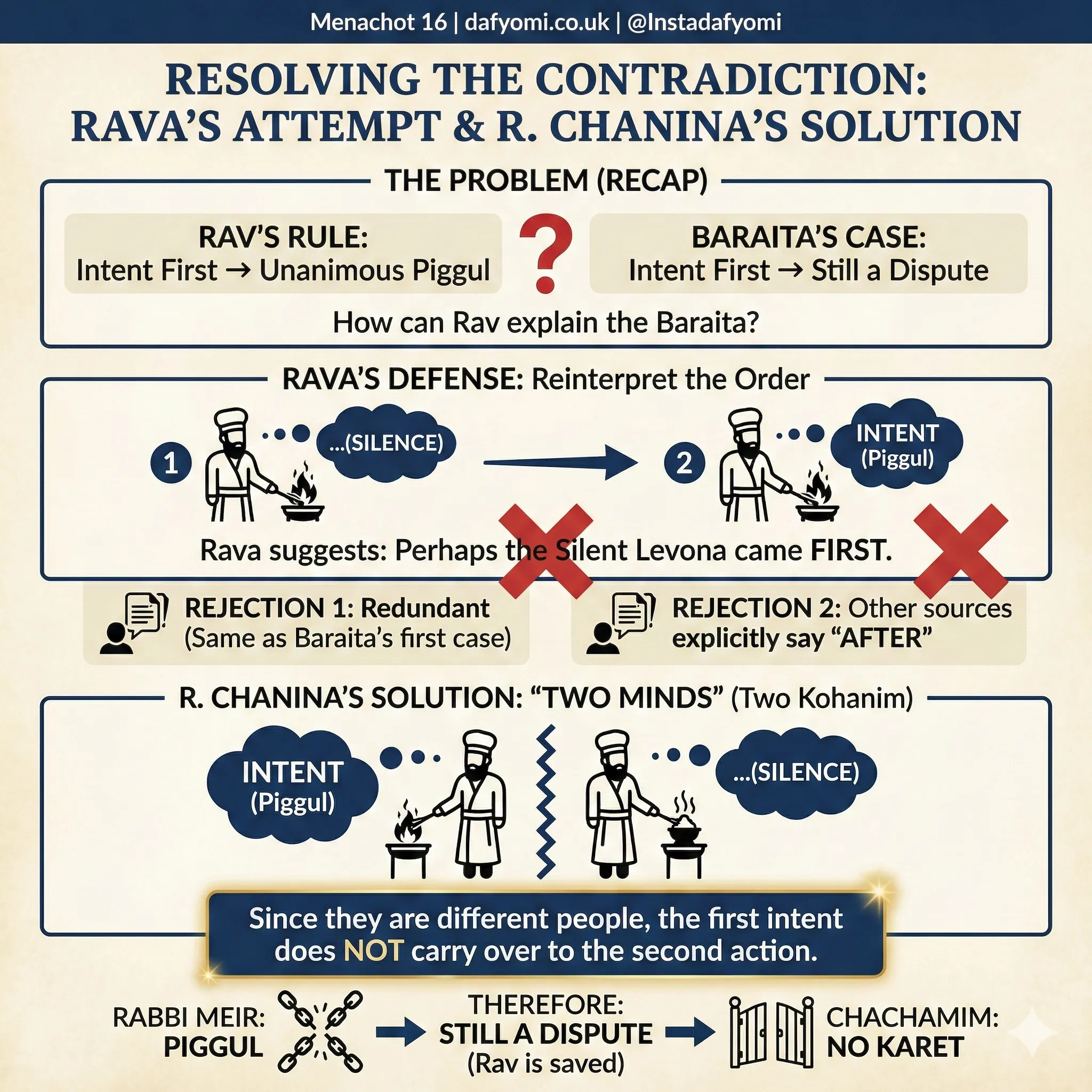
אֵימָא: וּכְבָר נָתַן אֶת הַלְּבוֹנָה בִּשְׁתִיקָה מֵעִיקָּרָא. שְׁתֵּי תְּשׁוּבוֹת בַּדָּבָר: חֲדָא, דְּהַיְינוּ קַמַּיְיתָא, וְעוֹד, הָתַנְיָא: אַחַר כָּךְ.
English Translation:
Rava answered: Say that this is what the baraita means: If he placed the handful with intent, and he had already placed the frankincense in silence from the outset, then Rabbi Meir and the Rabbis disagree. The Gemara rejects this statement: There are two possible refutations of this statement. One is that if Rava’s answer is accepted, then this case is identical to the first case of the baraita, which already taught that there is a dispute if the initial permitting factor was sacrificed in silence. And furthermore, isn’t it taught explicitly in another baraita: After placing the handful he burned the frankincense.
קלאוד על הדף:
Rava attempts to save Rav’s position by reinterpreting the baraita, but the Gemara rejects this with two arguments: (1) it would make the case redundant with the first case, and (2) another baraita explicitly states the frankincense was burned “afterward,” not beforehand.
Segment 11
TYPE: גמרא – תירוץ רב חנינא
Rav Chanina’s resolution
Hebrew/Aramaic:
תַּרְגְּמַהּ רַב חֲנִינָא בִּשְׁתֵּי דֵּיעוֹת.
English Translation:
Rabbi Chanina interpreted this baraita in accordance with the opinion of Rav: This baraita is referring to a case of two intentions, i.e., there were two priests, the first one of whom burned the handful with intent of piggul, and the second burned the frankincense in silence. Since the intent of one priest is entirely independent of the other, it cannot be said that the second priest burns the frankincense in accordance with the intent of the first priest.
קלאוד על הדף:
Rav Chanina offers a clever reinterpretation to save Rav’s position. The baraita isn’t discussing one priest with different intents – it’s discussing two different priests. Since each priest’s intent is independent, the second priest’s silence cannot be attributed to the first priest’s intent. This explains why the dispute continues.
Key Terms:
- שְׁתֵּי דֵּיעוֹת (Shtei De’ot) = Two intentions/minds; two different priests
Segment 12
TYPE: גמרא – ברייתא נוספת
Blood on the inner altar
Hebrew/Aramaic:
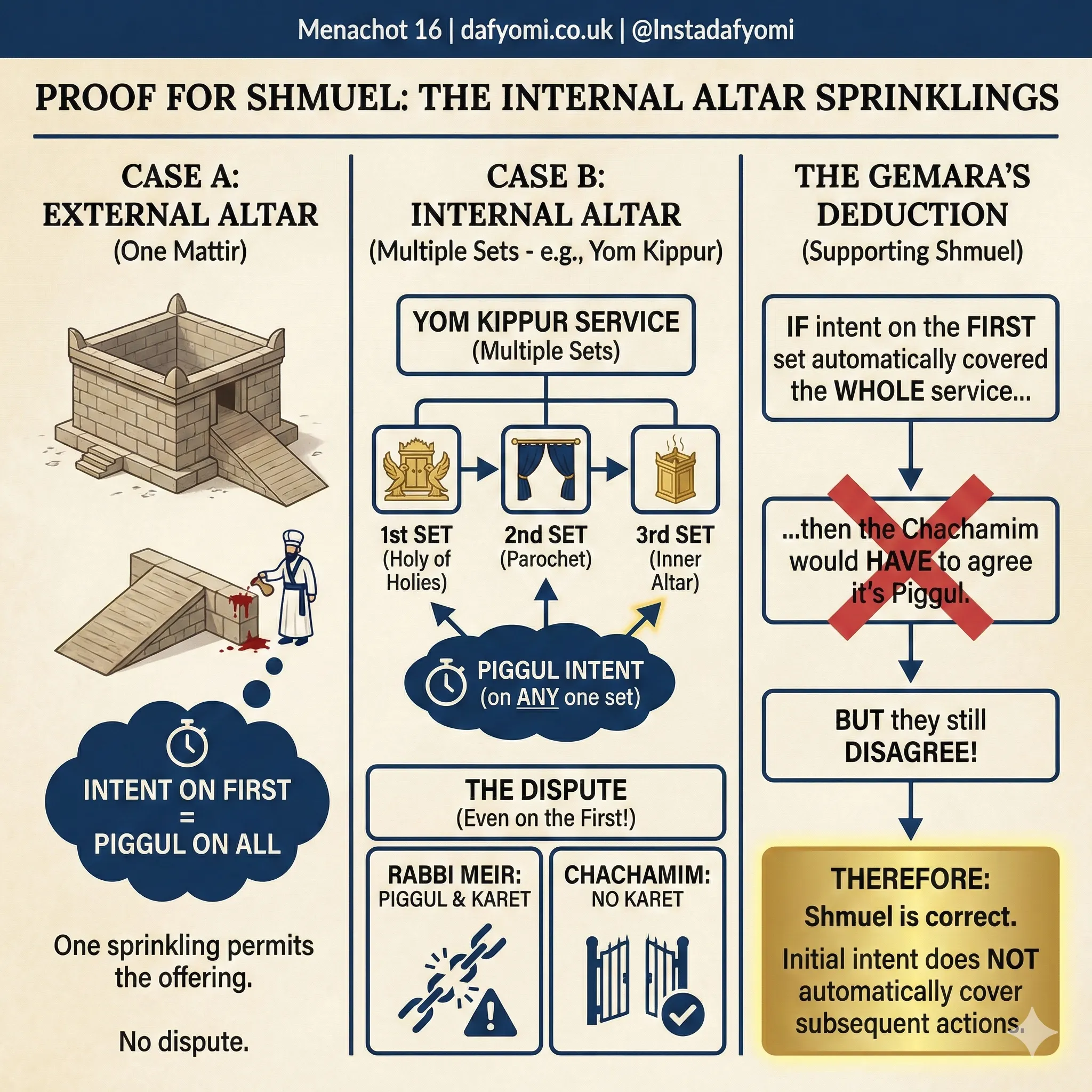
תָּא שְׁמַע: בַּמֶּה דְּבָרִים אֲמוּרִים? בְּדָמִים הַנִּיתָּנִין עַל מִזְבֵּחַ הַחִיצוֹן.
English Translation:
The Gemara continues: Come and hear a proof for the opinion of Shmuel from a baraita that addresses piggul during the sprinkling of the blood. In what case is this statement, that the offering is rendered piggul even when he intends only while performing the first placement to eat it beyond its designated time, said? It is rendered piggul in the case of blood that is placed on the external altar, where one placement renders the offering permitted.
קלאוד על הדף:
The Gemara introduces a new context: blood presentations on the outer vs. inner altar. For the outer altar, a single placement of blood permits the offering. The baraita will now contrast this with the inner altar service.
Key Terms:
- מִזְבֵּחַ הַחִיצוֹן (Mizbeach HaChitzon) = Outer altar in the courtyard
Segment 13
TYPE: גמרא – ברייתא המשך
Yom Kippur presentations
Hebrew/Aramaic:
אֲבָל דָּמִים הַנִּיתָּנִין עַל מִזְבֵּחַ הַפְּנִימִי, כְּגוֹן אַרְבָּעִים וְשָׁלֹשׁ שֶׁל יוֹם הַכִּיפּוּרִים, וְאַחַת עֶשְׂרֵה שֶׁל פַּר כֹּהֵן מָשׁוּחַ, וְאַחַת עֶשְׂרֵה שֶׁל פַּר הֶעְלֵם דָּבָר שֶׁל צִיבּוּר, פִּיגֵּל בֵּין בָּרִאשׁוֹנָה בֵּין בַּשְּׁנִיָּה וּבֵין בַּשְּׁלִישִׁית, רַבִּי מֵאִיר אוֹמֵר: פִּיגּוּל וְחַיָּיבִין עָלָיו כָּרֵת, וַחֲכָמִים אוֹמְרִים: אֵין בּוֹ כָּרֵת עַד שֶׁיְּפַגֵּל בְּכׇל הַמַּתִּיר.
English Translation:
But with regard to the blood placed inside, in the Holy of Holies, on the Curtain, and on the inner altar, for example, the forty-three presentations of the blood of the bull and goat of Yom Kippur, and the eleven presentations of the blood of the bull for an unwitting sin of the anointed priest, and the eleven presentations of the blood of the bull for an unwitting communal sin, if the priest had an intention that can render the offering piggul, whether in the first set of presentations, whether in the second set, or whether in the third set, i.e., in any of the requisite sets of presentations, e.g., in the case of the Yom Kippur bull in the Holy of Holies, on the Curtain, and on the inner altar, Rabbi Meir says: The offering is piggul and one is liable to receive karet for its consumption. And the Rabbis say: There is no liability to receive karet unless he had an intention that can render the offering piggul during the performance of the entire permitting factor.
קלאוד על הדף:
The Gemara introduces a new context: blood presentations on the inner altar. On Yom Kippur, there are 43 presentations; for the anointed priest’s bull, 11 presentations; for the communal sin offering bull, 11 presentations. The same dispute applies – Rabbi Meir says piggul intent during any one stage creates full piggul; the Rabbis require intent throughout all stages.
Key Terms:
- מִזְבֵּחַ הַפְּנִימִי (Mizbeach HaPenimi) = Inner altar; golden altar inside the Sanctuary
- פַּר כֹּהֵן מָשׁוּחַ (Par Kohen Mashiach) = Bull of the anointed priest
- פַּר הֶעְלֵם דָּבָר (Par He’elem Davar) = Bull for unwitting communal sin
Segment 14
TYPE: גמרא – קושיא
Challenge from the baraita
Hebrew/Aramaic:
קָתָנֵי מִיהָא: פִּיגֵּל בֵּין בָּרִאשׁוֹנָה, בֵּין בַּשְּׁנִיָּה, וּבֵין בַּשְּׁלִישִׁית, וּפְלִיגִי.
English Translation:
The Gemara explains the proof: In any event, this baraita teaches: If the priest had an intention that can render the offering piggul, whether in the first set of presentations, whether in the second set, or whether in the third set; and Rabbi Meir and the Rabbis disagree in this case as well. Evidently, the Rabbis are not of the opinion that anyone who performs a rite performs it in accordance with his initial intent.
קלאוד על הדף:
This baraita poses a challenge to Rav’s principle. The baraita shows that even when piggul intent occurred in the first stage, the dispute continues. This contradicts Rav’s view that initial intent carries over to subsequent stages.
Segment 15
TYPE: גמרא – קושיא נוספת
Additional challenge about two priests
Hebrew/Aramaic:
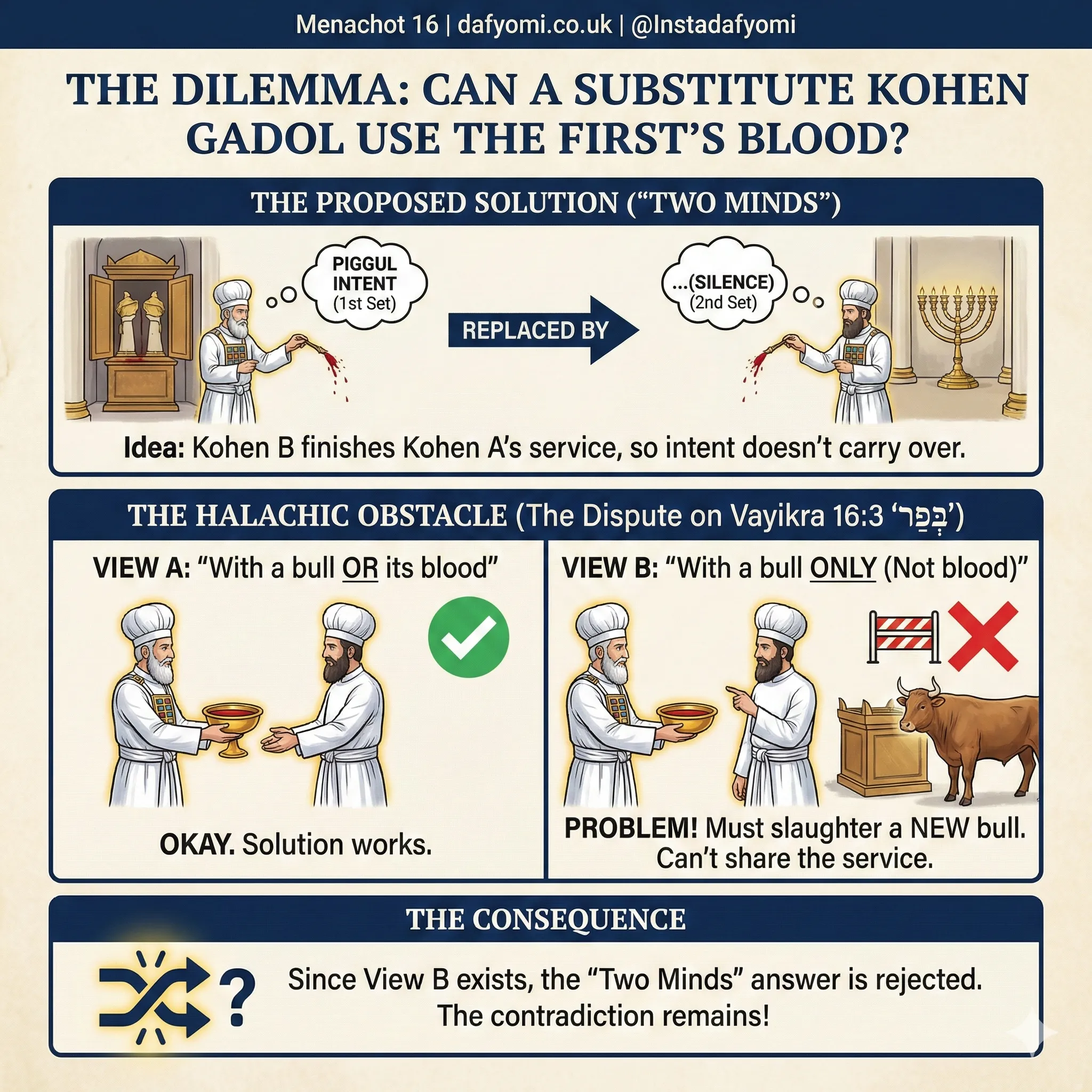
וְכִי תֵּימָא, הָכָא נָמֵי בִּשְׁתֵּי דֵּעוֹת – הָנִיחָא לְמַאן דְּאָמַר ״בְּפַר״ וַאֲפִילּוּ בְּדָמוֹ שֶׁל פַּר, אֶלָּא לְמַאן דְּאָמַר ״בְּפַר״ וְלֹא בְּדָמוֹ שֶׁל פַּר, מַאי אִיכָּא לְמֵימַר?
English Translation:
And if you would say that here too, the baraita is referring to a case of two intentions, e.g., one High Priest performed the initial presentation and was thereafter disqualified from performing the other presentations, and a second priest replaced him and performed the remaining presentations, there is still a difficulty: This works out well according to the one who says that the verse: “With this shall Aaron come into the sacred place: With a young bull” (Leviticus 16:3), indicates that a High Priest may enter the Sanctuary even with the blood of a bull, i.e., he may continue the presentations with the blood of the offerings slaughtered by another High Priest. But according to the one who says that the verse indicates that a High Priest may enter “with a young bull,” but not with the blood of a bull, i.e., a replacement High Priest must slaughter another bull and begin the presentations again, what can be said? If so, it is impossible for these presentations to be performed by two priests.
קלאוד על הדף:
The Gemara tries to apply Rav Chanina’s solution (two priests) to the Yom Kippur case but encounters a difficulty. According to one opinion, a replacement High Priest cannot use blood from the first priest’s offering – he must start over. If so, it’s impossible for two different priests to perform different stages, undermining Rav Chanina’s answer.
Segment 16
TYPE: גמרא – תירוץ רבא
Rava’s alternative interpretation
Hebrew/Aramaic:
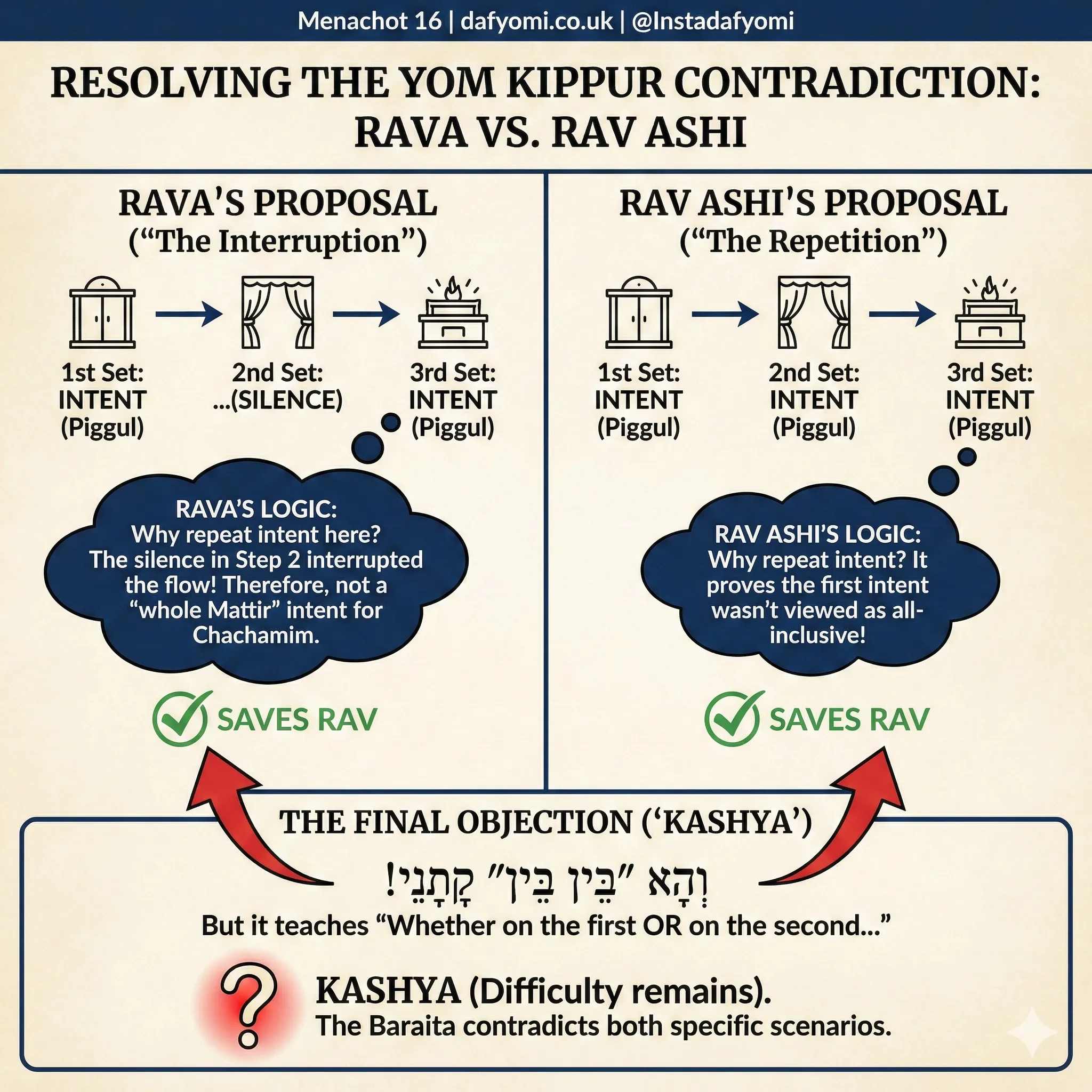
אָמַר רָבָא: הָכָא בְּמַאי עָסְקִינַן? כְּגוֹן שֶׁפִּיגֵּל בָּרִאשׁוֹנָה, וְשָׁתַק בַּשְּׁנִיָּה, וּפִיגֵּל בַּשְּׁלִישִׁית, דְּאָמְרִינַן: אִי סָלְקָא דַּעְתָּךְ כׇּל הָעוֹשֶׂה עַל דַּעַת רִאשׁוֹנָה הוּא עוֹשֶׂה, מִיהְדָּר פַּיגּוֹלֵי בַּשְּׁלִישִׁית לְמָה לִי?
English Translation:
Rava said: According to Rav, here, in the baraita, we are dealing with a case where the High Priest had intent of piggul during the first set of presentations and was silent during the second set, and again had intent of piggul during the third set. In such a case, we say: If it enters your mind to say that anyone who performs a rite performs it in accordance with his initial intention, then why do I need the High Priest to repeat his intent of piggul during the third set? The fact that he repeats his intention during the third set indicates that he did not perform the second set in accordance with his initial intent. Accordingly, the Rabbis hold that the offering is not piggul, as he did not have intent of piggul during the presentation of the entire permitting factor.
קלאוד על הדף:
Rava offers an interpretation to save Rav’s position. The baraita discusses a case where the priest had piggul intent in the first set, was silent in the second, and had intent again in the third. The fact that he repeated the intent in the third set shows he didn’t consider his initial intent to continue – otherwise why repeat it?
Segment 17
TYPE: גמרא – דחיית רב אשי
Rav Ashi’s objection
Hebrew/Aramaic:
מַתְקֵיף לַהּ רַב אָשֵׁי: מִידֵּי שָׁתַק קָתָנֵי? אֶלָּא אָמַר רַב אָשֵׁי: הָכָא בְּמַאי עָסְקִינַן – כְּגוֹן שֶׁפִּיגֵּל בָּרִאשׁוֹנָה וּבַשְּׁנִיָּה וּבַשְּׁלִישִׁית, דְּאָמְרִינַן: אִי סָלְקָא דַּעְתָּךְ כׇּל הָעוֹשֶׂה עַל דַּעַת רִאשׁוֹנָה הוּא עוֹשֶׂה, מִיהְדָּר פַּגּוֹלֵי בַּשְּׁנִיָּה וּבַשְּׁלִישִׁית לְמָה לִי?
English Translation:
Rav Ashi objects to this explanation: Does the baraita teach that the High Priest was silent? Rather, Rav Ashi said: Here we are dealing with a case where he had explicit intent of piggul during the first, second, and third presentations, and was silent during the subsequent presentations. In such a case, we say: If it enters your mind to say that anyone who performs a rite performs it in accordance with his initial intention, why do I need the High Priest to repeat his intent of piggul during the second and third presentations?
קלאוד על הדף:
Rav Ashi challenges Rava’s interpretation – the baraita doesn’t mention silence! He offers an alternative: the case is where the priest had explicit intent in all three stages. The question is why he needed to repeat the intent if it carries over automatically.
Amud Bet (16b)
Segment 1
TYPE: גמרא – קושיא
Difficulty with the baraita’s wording
Hebrew/Aramaic:
וְהָא ״בֵּין בֵּין״ קָתָנֵי! קַשְׁיָא.
English Translation:
The Gemara raises a difficulty against Rav Ashi’s interpretation: But the baraita teaches: Whether during the first presentation or whether during the second, which indicates that the Rabbis disagree with Rabbi Meir even with regard to a case where the priest had intent of piggul during any one of the presentations. The Gemara notes: Indeed, this poses a difficulty.
קלאוד על הדף:
The Gemara notes an unresolved problem. The baraita’s language (“whether… whether… whether…”) suggests all stages are equivalent and independent. But according to Rav Ashi’s interpretation, we need intent repeated across stages. The difficulty remains unresolved – marked as “kashya.”
Segment 2
TYPE: גמרא – קושיא
Discussion of karet requirement
Hebrew/Aramaic:
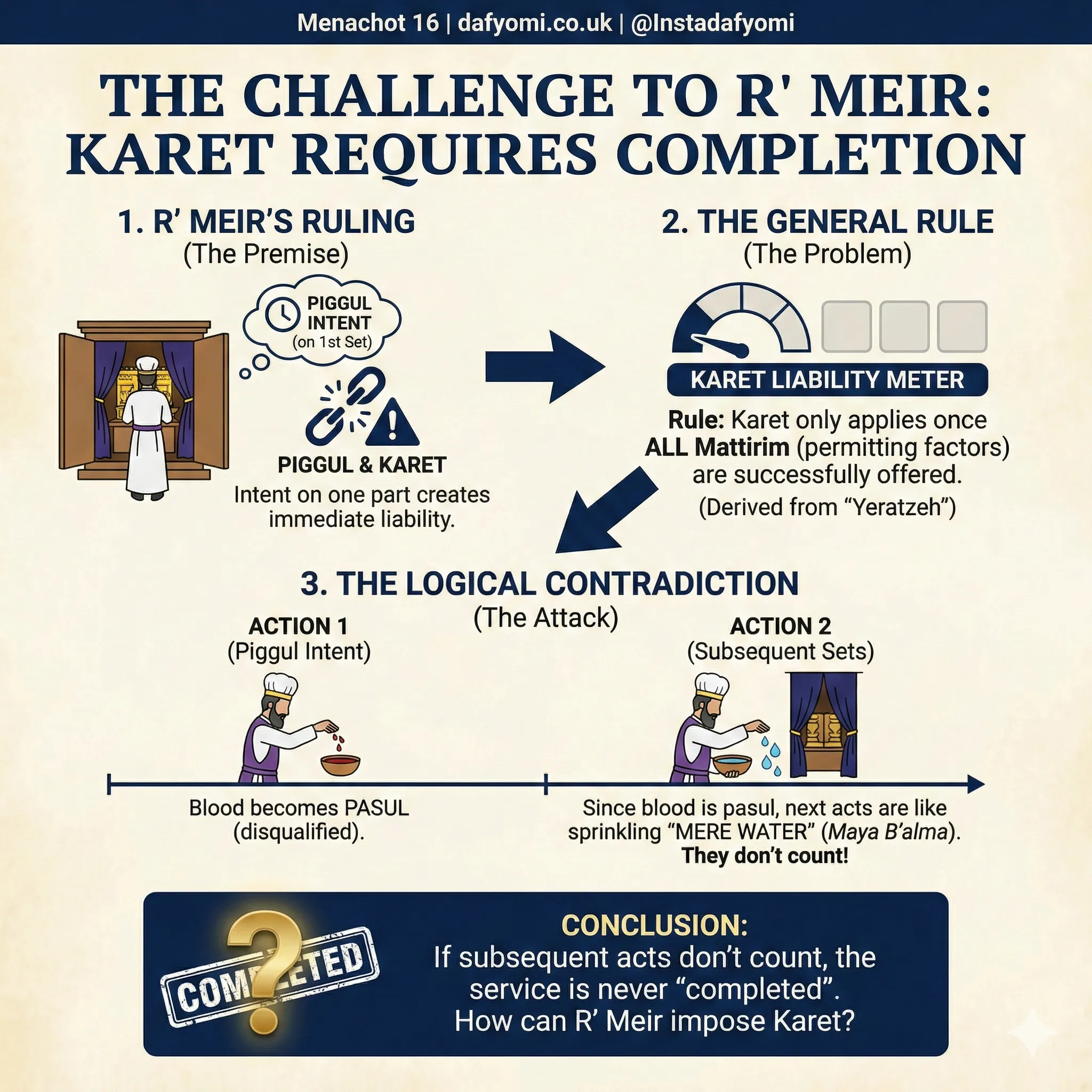
אָמַר מָר: רַבִּי מֵאִיר אוֹמֵר פִּגּוּל, וְחַיָּיבִין עָלָיו כָּרֵת. מִכְּדֵי, כָּרֵת לָא מִיחַיַּיב עַד שֶׁיִּקְרְבוּ כׇּל הַמַּתִּירִין.
English Translation:
The Master said above: If the priest had intent of piggul, whether in the first set of presentations, whether in the second set, or whether in the third set, Rabbi Meir says: The offering is piggul and one is liable to receive karet for its consumption, despite the fact that he performed the rest of the rite silently. The Gemara asks: Now consider, one is not liable to receive karet unless all the permitting factors of the offering have been sacrificed, i.e., if the whole service is completed, including the presentation of the blood.
קלאוד על הדף:
The Gemara now raises a fundamental conceptual problem with piggul: karet liability requires completion of the permitting factors. This sets up the paradox that will be discussed in the following segments.
Segment 3
TYPE: גמרא – ברייתא
Source for the karet requirement
Hebrew/Aramaic:
דְּאָמַר מָר: ״יֵרָצֶה״ – כְּהַרְצָאַת כָּשֵׁר, כָּךְ הַרְצָאַת פָּסוּל; מָה הַרְצָאַת כָּשֵׁר עַד שֶׁיִּקְרְבוּ כׇּל הַמַּתִּירִין, אַף הַרְצָאַת פָּסוּל עַד שֶׁיִּקְרְבוּ כׇּל הַמַּתִּירִין.
English Translation:
As the Master said that the verse states with regard to piggul: “It shall not be accepted” (Leviticus 7:18), which indicates that the acceptance of a disqualified offering is like the acceptance of a valid offering, of which the verse states: “It shall be accepted” (Leviticus 22:27), and just as there is no acceptance of a valid offering unless all its permitting factors have been sacrificed, so too there is no lack of acceptance of a disqualified offering, i.e., it is not rendered piggul, unless all its permitting factors have been sacrificed.
קלאוד על הדף:
The Gemara provides the scriptural source for the principle that piggul requires completion of all permitting factors. The verse “It shall not be accepted” is compared to “It shall be accepted” – teaching that just as a valid offering needs all matirin to be “accepted,” so too a disqualified offering needs all matirin to become piggul.
Segment 4
TYPE: גמרא – קושיא
The paradox: disqualified blood is like water
Hebrew/Aramaic:
וְהַאי, כֵּיוָן דְּחַשֵּׁיב בֵּהּ בִּפְנִים – פַּסְלֵיהּ, כִּי מַדֵּי בְּהֵיכַל – מַיָּא בְּעָלְמָא הוּא דְּקָא מַדֵּי.
English Translation:
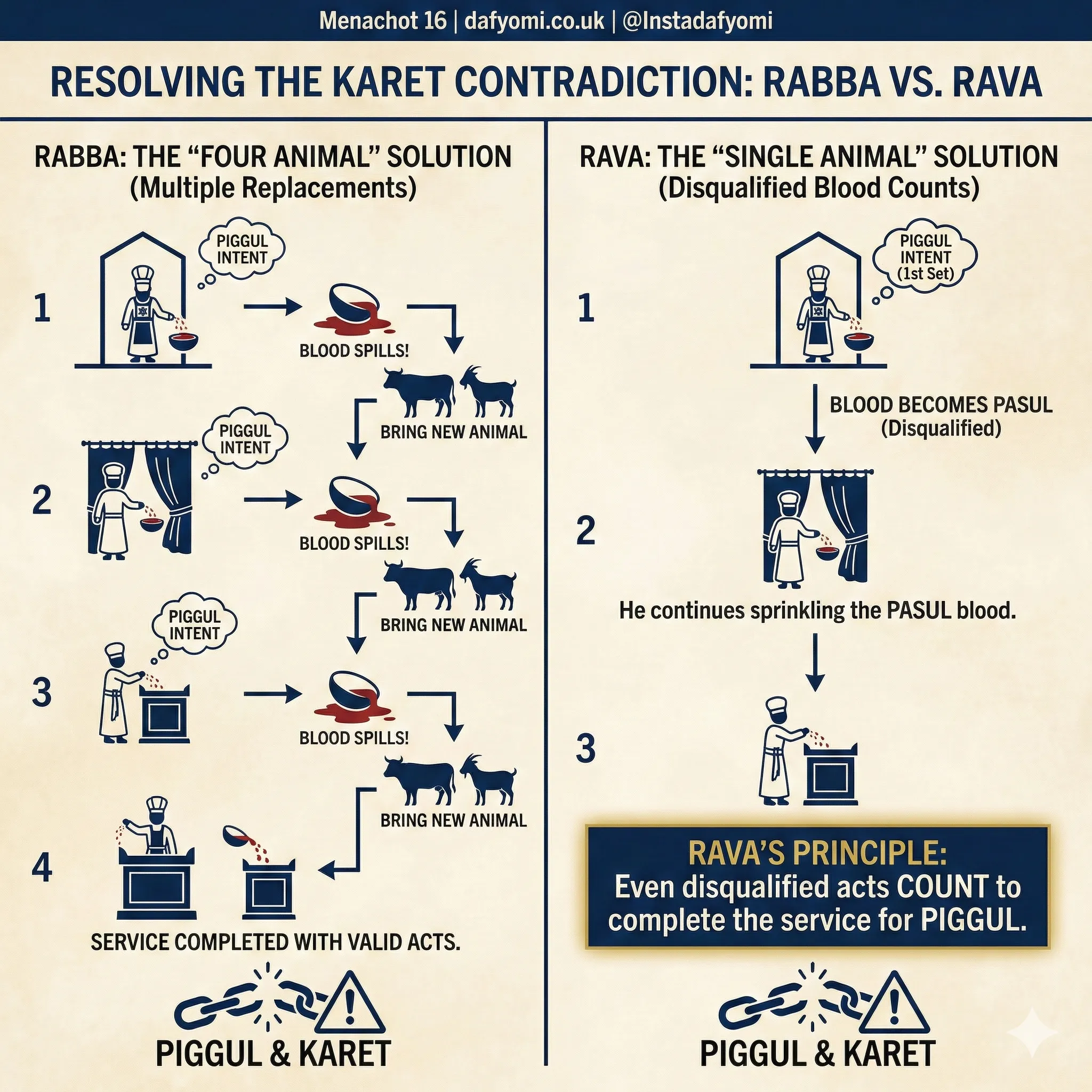
Accordingly, the Gemara challenges: And with regard to this case, of the blood of the bull and goat brought on Yom Kippur, since he had intent of piggul with regard to it when he was presenting the blood inside the Holy of Holies, he has disqualified it. If so, when he sprinkles the blood again later in the Sanctuary, on the Curtain and the inner altar, it is as though he is merely sprinkling water, and not the blood of the offering. Consequently, the permitting factors of the offering have not been sacrificed, and therefore the offering should not be rendered piggul.
קלאוד על הדף:
The Gemara raises a fundamental problem. For piggul to carry karet liability, the offering must be completed. But once someone has piggul intent, the blood becomes pasul (disqualified). Disqualified blood is like water – it cannot complete the service! So how can we ever reach karet liability?
Segment 5
TYPE: גמרא – תירוץ רבה
Rabbah’s answer: four bulls and four goats
Hebrew/Aramaic:
אָמַר רַבָּה: מַשְׁכַּחַתְּ לַהּ בְּאַרְבָּעָה פָּרִים וְאַרְבָּעָה שְׂעִירִים.
English Translation:
Rabba said: You find it possible in a case where there were four bulls and four goats, i.e., in a case where after the High Priest presented the blood inside the Holy of Holies with piggul intent, the remaining blood spilled. Consequently, he was required to bring another bull and goat in order to present their blood on the Curtain separating the Sanctuary and Holy of Holies. During that presentation he had intent of piggul, after which the remaining blood spilled, requiring him to bring another bull and goat in order to present their blood on the corners of the golden altar. He again had intent of piggul during that presentation, and then the blood spilled, which meant he had to bring yet another bull and goat in order to present their blood upon the golden altar itself.
קלאוד על הדף:
Rabbah offers a technical solution. Imagine bringing multiple animals – four bulls and four goats. Use different blood for each stage. If piggul intent occurred only during one stage (with that animal’s blood), the other stages were performed properly with different blood. The service is thus completed, enabling karet liability.
Segment 6
TYPE: גמרא – תירוץ רבא
Rava’s alternative answer
Hebrew/Aramaic:
רָבָא אָמַר: אֲפִילּוּ תֵּימָא פַּר אֶחָד וְשָׂעִיר אֶחָד, לְפַגּוֹלֵי מְרַצֵּי.
English Translation:
Rava said: You may even say that the baraita is referring to a case of only one bull and one goat, and the remaining blood was in fact disqualified. Nevertheless, with regard to rendering an offering piggul, the presentations performed with the disqualified blood effect acceptance, as though the entire permitting factor was performed in its proper manner. In other words, even though the High Priest sprinkled the blood inside the Holy of Holies with improper intent, and thereby disqualified the offering, nevertheless, since he completed the service he is considered as having sacrificed all the permitting factors with regard to piggul.
קלאוד על הדף:
Rava disagrees with Rabbah’s technical solution. He proposes a different principle: for piggul purposes, the service is considered “completed” even though practically the blood is disqualified. The Torah’s requirement that “all matirin be offered” is satisfied once the presentations are performed, even if the offering is pasul. This creates the paradox of piggul – a completed but disqualified offering.
Key Terms:
- לְפַגּוֹלֵי מְרַצֵּי = For piggul purposes, the presentations effect acceptance
Segment 7
TYPE: גמרא – ספירת המתנות
Counting the presentations: 43 vs. 47
Hebrew/Aramaic:
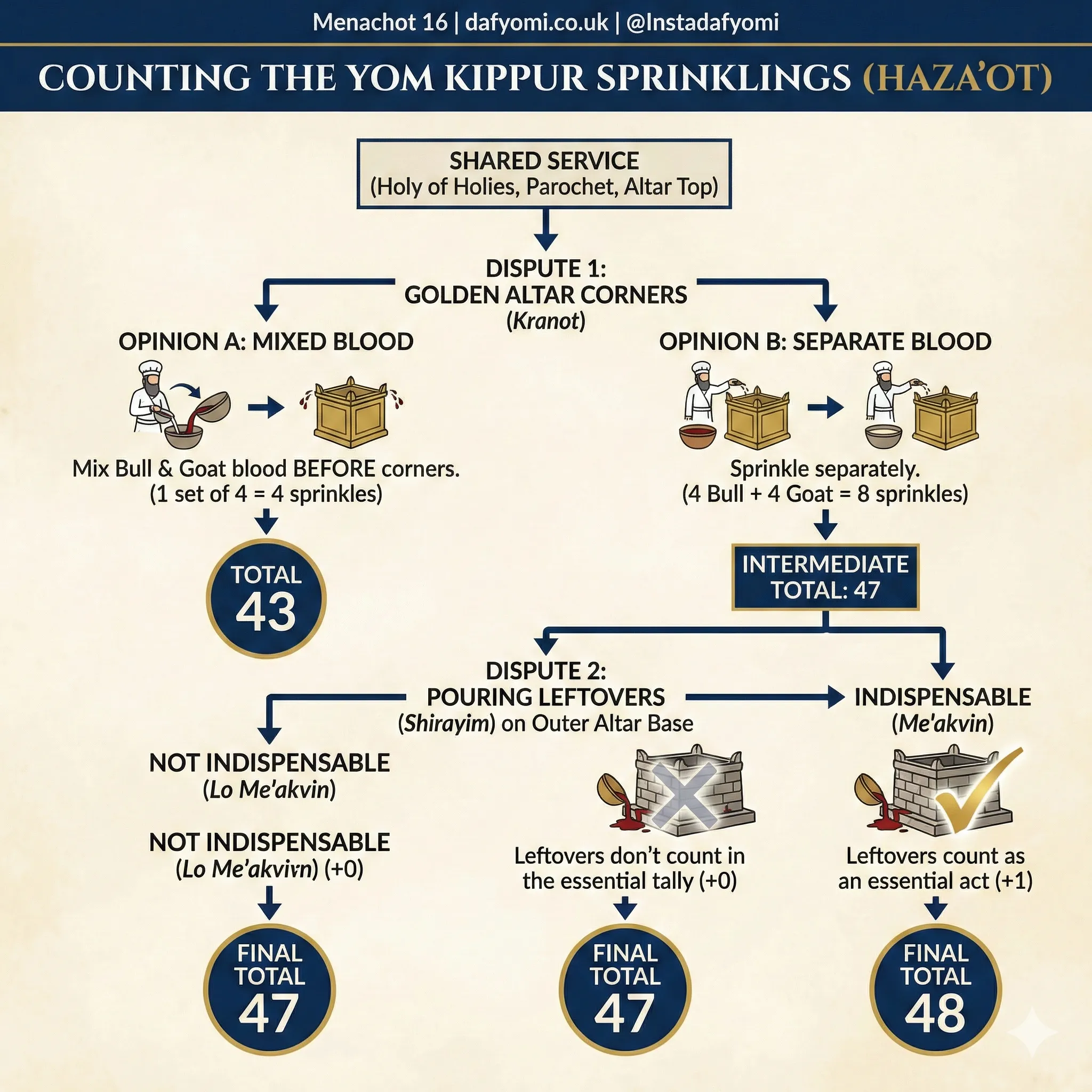
אַרְבָּעִים וְשָׁלֹשׁ, וְהָתַנְיָא: אַרְבָּעִים וָשֶׁבַע! לָא קַשְׁיָא, הָא כְּמַאן דְּאָמַר: מְעָרְבִין לִקְרָנוֹת, וְהָא כְּמַאן דְּאָמַר: אֵין מְעָרְבִין.
English Translation:
The baraita mentioned that there are forty-three presentations of the blood of the bull and the goat sacrificed on Yom Kippur. The Gemara asks: But isn’t it taught otherwise in a different baraita, which states that there are forty-seven presentations of that blood? The Gemara answers: This is not difficult. This statement, that there are forty-three presentations, is in accordance with the opinion of the one who says that the High Priest mixes the blood of the bull and the goat before placing it on the corners of the inner altar, rather than placing the blood of each one separately. And that statement, that there are forty-seven presentations, is in accordance with the opinion of the one who says that the High Priest does not mix the two types of blood before placing them on the corners, but sprinkles four times from the blood of the bull and another four times from the blood of the goat, and only afterward mixes the blood of the two animals for placement on the top of the altar.
קלאוד על הדף:
The Gemara resolves the discrepancy between 43 and 47 presentations. 43 = bloods mixed before the corners (one set of applications). 47 = bloods not mixed (separate applications for bull and goat blood on the corners).
Key Terms:
- מְעָרְבִין לִקְרָנוֹת = Mixing the bloods before placing on the corners
Segment 8
TYPE: גמרא – ספירת המתנות המשך
48 presentations
Hebrew/Aramaic:
וְהָתַנְיָא: אַרְבָּעִים וּשְׁמוֹנָה! לָא קַשְׁיָא, הָא כְּמַאן דְּאָמַר: שִׁירַיִם מְעַכְּבִין, הָא כְּמַאן דְּאָמַר: שִׁירַיִם לֹא מְעַכְּבִין.
English Translation:
The Gemara raises another difficulty: But isn’t it taught in yet another baraita that there are forty-eight presentations? The Gemara answers: This is not difficult. This statement, that there are forty-eight presentations, is in accordance with the opinion of the one who says that the pouring of the remainder of the blood on the base of the external altar is indispensable, and therefore this act is added to the total. That statement, that there are only forty-seven presentations, is in accordance with the opinion of the one who says that the pouring of the remainder of the blood is not indispensable.
קלאוד על הדף:
The Gemara adds a third count: 48 presentations. This includes the shirayim (remainder) poured at the base as an indispensable step. 47 = shirayim not indispensable; 48 = shirayim indispensable.
Key Terms:
- שִׁירַיִם (Shirayim) = Remainder of the blood poured at the altar base
- מְעַכְּבִין (Me’akvin) = Indispensable; required for the service
Segment 9
TYPE: גמרא – בעיא
Dilemma about conveying (holakhah)
Hebrew/Aramaic:
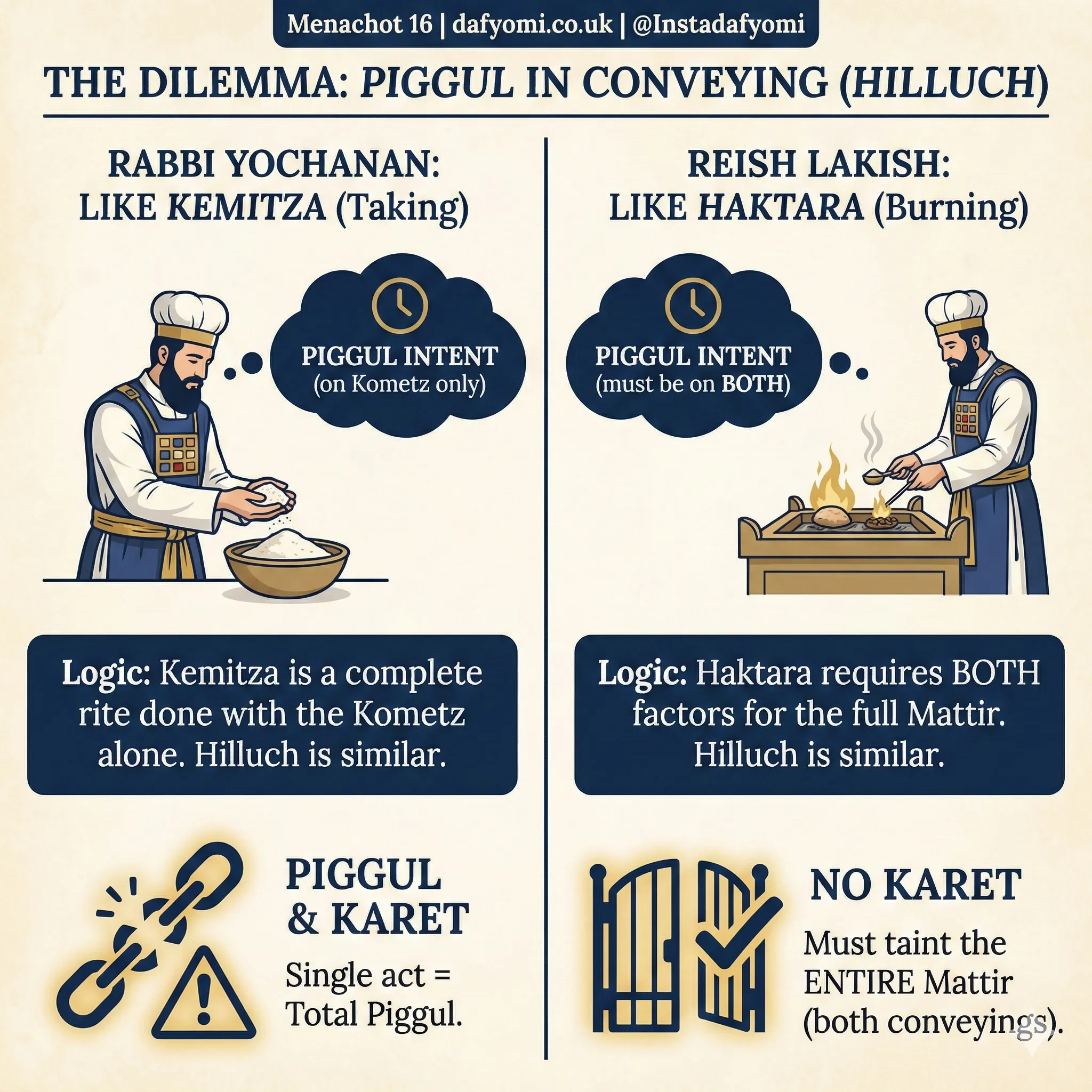
אִיבַּעְיָא לְהוּ: פִּיגֵּל בְּהוֹלָכָה, מַהוּ?
English Translation:
The mishna teaches: If one had intent of piggul during the sacrifice of only part of the permitting factors, e.g., during the burning of the handful but not during the burning of the frankincense, the Rabbis rule that the offering is not piggul. Concerning this, a dilemma was raised before the Sages: If one had intent of piggul during the conveying of the handful to the altar but not during the conveying of the frankincense, what is the halakha?
קלאוד על הדף:
A new dilemma emerges about holakhah – carrying the blood from where it was received to the altar. The Gemara asks: What if piggul intent was only during conveying the handful, but not during conveying the frankincense?
Key Terms:
- הוֹלָכָה (Holakhah) = Conveying/carrying to the altar
Segment 10
TYPE: גמרא – מחלוקת
Rabbi Yochanan vs. Reish Lakish
Hebrew/Aramaic:
אָמַר רַבִּי יוֹחָנָן: הוֹלָכָה כִּקְמִיצָה, וְרֵישׁ לָקִישׁ אָמַר: הוֹלָכָה כְּהַקְטָרָה.
English Translation:
Rabbi Yochanan says: The halakha with regard to conveying the handful is like that of the removing of the handful. Just as intent of piggul with regard to removing only the handful renders the offering piggul, as it is the sole permitting factor with which the rite of removal is performed, the same applies to conveying the handful. And Reish Lakish says: The conveying of the handful is like its burning. Just as intent of piggul is required during the burning of both the handful and the frankincense for the offering to be rendered piggul, as both of them are burned on the altar, the same halakha applies to conveying.
קלאוד על הדף:
Rabbi Yochanan says conveying is comparable to the early stages (like removing the handful) – intent during conveying alone is subject to the Rabbi Meir vs. Rabbis dispute. Reish Lakish says conveying is like burning – must complete both.
Segment 11
TYPE: גמרא – ביאור המחלוקת
Explaining the positions
Hebrew/Aramaic:
בִּשְׁלָמָא לְרֵישׁ לָקִישׁ, אִיכָּא נָמֵי הוֹלָכָה דִּלְבוֹנָה, אֶלָּא לְרַבִּי יוֹחָנָן מַאי טַעְמָא?
English Translation:
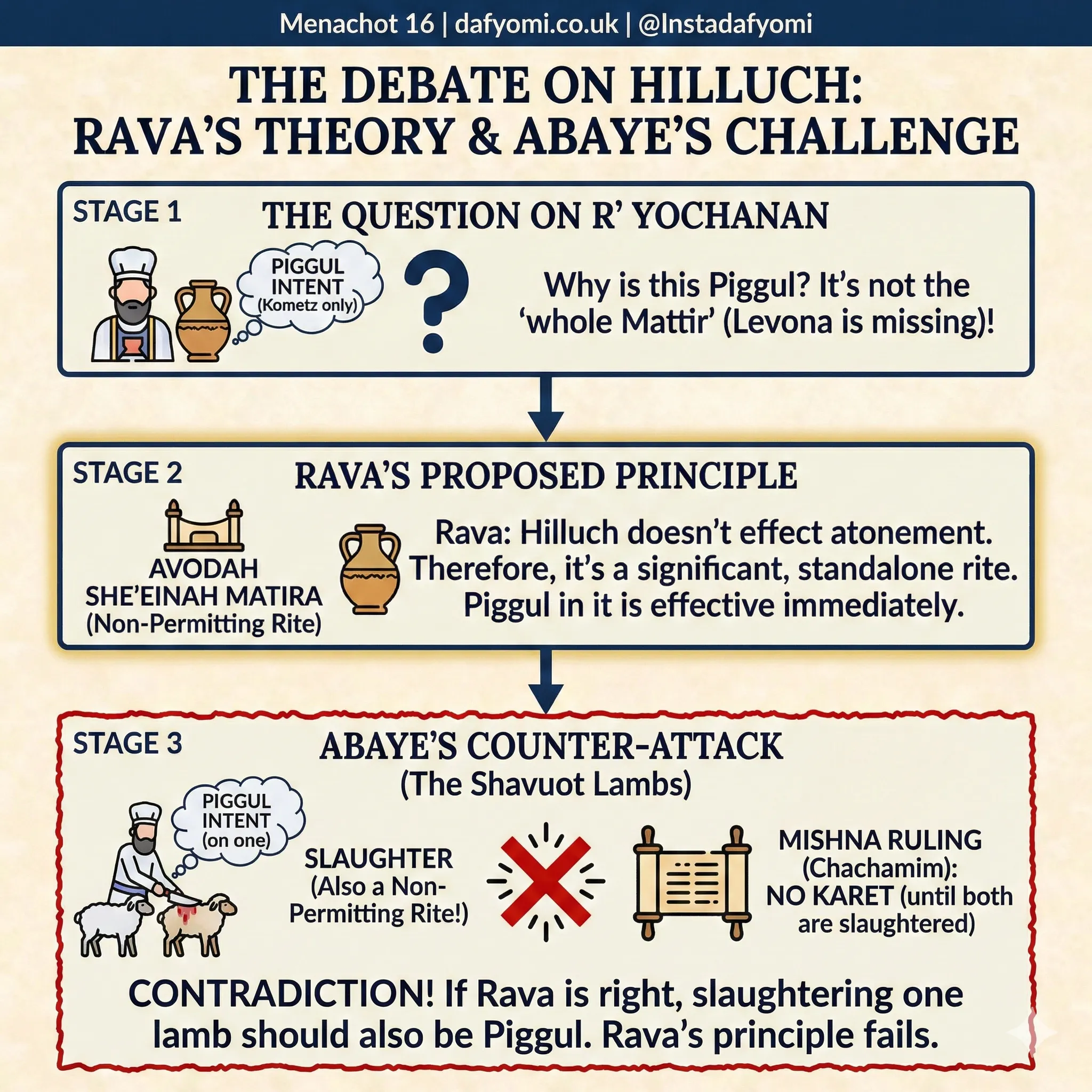
The Gemara asks: Granted, one can understand the ruling of Reish Lakish, as the conveying of the handful is only part of the permitting factors, since there is also the conveying of the frankincense. But as for the ruling of Rabbi Yochanan, what is the reason that intent of piggul during the conveying of only the handful renders the offering piggul? After all, he has not had intent of piggul during the conveying of all of the permitting factors.
קלאוד על הדף:
The Gemara analyzes both positions. For Reish Lakish, the logic is clear: conveying happens for both the handful and frankincense separately, so it’s naturally grouped with the burning (which also happens separately). But why does Rabbi Yochanan group conveying with the early stages?
Segment 12
TYPE: גמרא – הסבר רבא
Rava’s explanation of Rabbi Yochanan
Hebrew/Aramaic:
אָמַר רָבָא, קָסָבַר רַבִּי יוֹחָנָן: כׇּל עֲבוֹדָה שֶׁאֵינָהּ מַתֶּרֶת, עֲבוֹדָה חֲשׁוּבָה הִיא לְפַגֵּל עָלֶיהָ בִּפְנֵי עַצְמָהּ.
English Translation:
Rava said: Rabbi Yochanan holds that if one performed any sacrificial rite that does not permit the offering, e.g., conveying, even if he performed it with only one of the permitting factors, such as with the handful and not with the frankincense, it is considered a significant rite with regard to rendering the offering piggul on account of it, by itself. It is not comparable to a case of intent of piggul during the sacrifice of only part of the permitting factors, as this rite of conveying does not render the offering permitted.
קלאוד על הדף:
Rava explains Rabbi Yochanan’s principle. Services fall into two categories: those that are themselves matirin (permitting factors, like burning) and those that aren’t (like conveying). Non-matir services can create piggul on their own according to Rabbi Yochanan, even without completing the matir services.
Key Terms:
- עֲבוֹדָה שֶׁאֵינָהּ מַתֶּרֶת = A rite that does not render the offering permitted
Segment 13
TYPE: גמרא – קושיא מאביי
Abaye’s challenge
Hebrew/Aramaic:
אֲמַר לֵיהּ אַבָּיֵי: הֲרֵי שְׁחִיטַת אֶחָד מִן הַכְּבָשִׂים, דַּעֲבוֹדָה שֶׁאֵינָהּ מַתִּירָתָהּ, וּפְלִיגִי.
English Translation:
Abaye said to Rava: But what about the slaughter of one of the lambs brought with the two loaves on Shavuot, which is a rite that does not permit the offering, as neither the sacrifice of its portions designated for burning upon the altar nor the consumption of the meat of the offering and the two loaves is permitted by this slaughter, and yet the Rabbis disagree with Rabbi Meir in this case?
קלאוד על הדף:
Abaye challenges Rava’s principle. The slaughter of one Shavuot lamb is a “non-permitting service” (since both lambs together permit the loaves). Yet the Rabbis dispute Rabbi Meir even there! This seems to contradict the principle that non-matir services create piggul independently.
Segment 14
TYPE: גמרא – ראיה מהמשנה
Proof from the Mishna
Hebrew/Aramaic:
דִּתְנַן: שָׁחַט אֶחָד מִן הַכְּבָשִׂים לֶאֱכוֹל שְׁתֵּי חַלּוֹת לְמָחָר, הִקְטִיר אֶחָד מִן הַבָּזִיכִין לֶאֱכוֹל שְׁנֵי סְדָרִים לְמָחָר, רַבִּי מֵאִיר אוֹמֵר: פִּגּוּל וְחַיָּיבִין עָלָיו כָּרֵת, וַחֲכָמִים אוֹמְרִים: אֵין בּוֹ כָּרֵת עַד שֶׁיְּפַגֵּל בְּכׇל הַמַּתִּיר.
English Translation:
As we learned in the mishna: If one slaughtered one of the two lambs with the intent to partake of two loaves the next day, or if one burned one of the bowls of frankincense with the intent to partake of two arrangements of shewbread the next day, Rabbi Meir says: The meal offering is piggul and one is liable to receive karet for its consumption, and the Rabbis say: There is no liability to receive karet unless he has intent of piggul during the sacrifice of the entire permitting factor. Although the slaughter of one of the lambs is a rite that does not render an offering permitted, nevertheless the Rabbis maintain that it is not considered a significant rite with regard to rendering the offering piggul by itself.
קלאוד על הדף:
Abaye brings proof from our Mishna itself. The slaughter of one lamb is clearly a non-permitting service, yet the Rabbis still dispute Rabbi Meir. This challenges Rava’s explanation of Rabbi Yochanan.
Segment 15
TYPE: גמרא – תירוץ רבא
Rava’s response about sanctification
Hebrew/Aramaic:
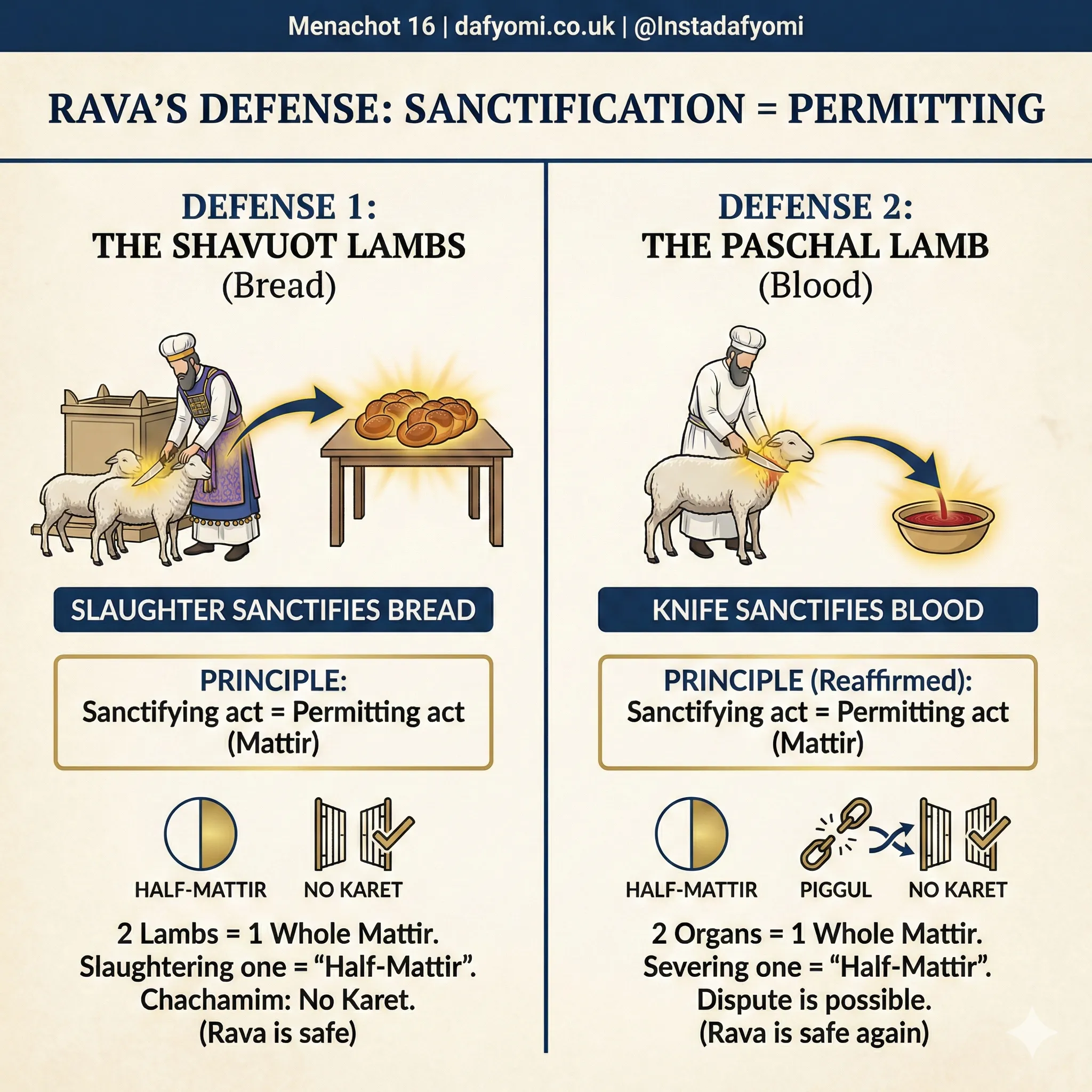
אֲמַר לֵיהּ: מִי סָבְרַתְּ לֶחֶם בְּתַנּוּר קָדוֹשׁ? שְׁחִיטַת כְּבָשִׂים מְקַדְּשָׁא לֵיהּ, וְהַבָּא לְקַדֵּשׁ כְּבָא לְהַתִּיר דָּמֵי.
English Translation:
Rava said to Abaye: Do you maintain that the two loaves of bread are already sanctified from when they are in the oven, and require only the sprinkling of the blood to render them permitted for consumption? In fact, the slaughter of the lambs sanctifies the loaves, and an act that comes to sanctify is considered like that which comes to permit. Since the slaughter of the two lambs sanctifies the loaves, the slaughter of each lamb is considered half a permitting factor; the slaughter of each lamb independently cannot render the loaves piggul.
קלאוד על הדף:
Rava offers a subtle response. The slaughter of the lambs doesn’t just permit the loaves – it sanctifies them. Before slaughter, the loaves aren’t fully sanctified. Since sanctification and permitting are functionally equivalent, the lamb slaughter is actually a matir-type service, not a regular non-matir service.
Key Terms:
- מְקַדְּשָׁא (Mekadsha) = Sanctifies
- הַבָּא לְקַדֵּשׁ כְּבָא לְהַתִּיר = That which comes to sanctify is like that which comes to permit
Segment 16
TYPE: גמרא – קושיא מרב שימי
Rav Shimi bar Ashi’s objection
Hebrew/Aramaic:
מֵתִיב רַב שִׁימִי בַּר אָשֵׁי: אֲחֵרִים אוֹמְרִים: הִקְדִּים מוּלִים לַעֲרֵלִים – כָּשֵׁר, הִקְדִּים עֲרֵלִים לְמוּלִים – פָּסוּל.
English Translation:
Rav Shimi bar Ashi raises an objection from a baraita that discusses the slaughter of the Paschal offering. The first tanna rules that if one slaughtering the Paschal offering intended for it to be consumed by both disqualified individuals, e.g., uncircumcised males, and fit individuals, e.g., circumcised males, the offering is not disqualified. Acherim say: In a case where one slaughtered a Paschal offering and severed one of the two organs of ritual slaughter with a disqualifying intention, and severed the other organ with a valid intention, then if one’s intent with regard to circumcised males preceded the intent with regard to the uncircumcised males, the offering is valid. But if the intent with regard to the uncircumcised males preceded the intent with regard to the circumcised males, it is disqualified.
קלאוד על הדף:
Rav Shimi brings another challenge from a baraita about the Pesach offering. The “circumcised” and “uncircumcised” refer to the two simanim (trachea and esophagus) that must be severed during slaughter. The dispute concerns whether intent during half the slaughter affects the whole offering.
Segment 17
TYPE: גמרא – יישוב
Resolution about blood sanctification
Hebrew/Aramaic:
וְקַיְימָא לַן, דְּבַחֲצִי מַתִּיר פְּלִיגִי. אֲמַר לֵיהּ: מִי סָבְרַתְּ דָּם בְּצַוַּאר בְּהֵמָה קָדוֹשׁ? דַּם – סַכִּין מְקַדְּשָׁא לֵיהּ, וְהַבָּא לְקַדֵּשׁ כְּבָא לְהַתִּיר דָּמֵי.
English Translation:
Rav Shimi bar Ashi continues: And we maintain that the first tanna and Acherim disagree with regard to whether the sacrifice of half a permitting factor with disqualifying intent disqualifies the entire offering. In this case, although this slaughter does not sanctify anything, the severing of one of the organs is considered half of a permitting factor. Rava said to Rav Shimi bar Ashi: Do you maintain that the blood is already sanctified while inside the neck of the animal? In fact, the knife sanctifies the blood, and that which comes to sanctify is considered like that which comes to permit. Consequently, the slaughter of the animal is a permitting factor, and the severing of one of its organs is half a permitting factor.
קלאוד על הדף:
Rava uses the same principle. Just as the loaves are sanctified by the lambs’ slaughter, blood is sanctified by the slaughter itself. The slaughtering knife creates sanctification. Therefore, slaughter is a sanctifying/permitting act, fitting Rava’s framework.
Key Terms:
- סַכִּין מְקַדְּשָׁא לֵיהּ = The knife sanctifies it
Segment 18
TYPE: גמרא – ראיה מברייתא
Evidence from a baraita
Hebrew/Aramaic:
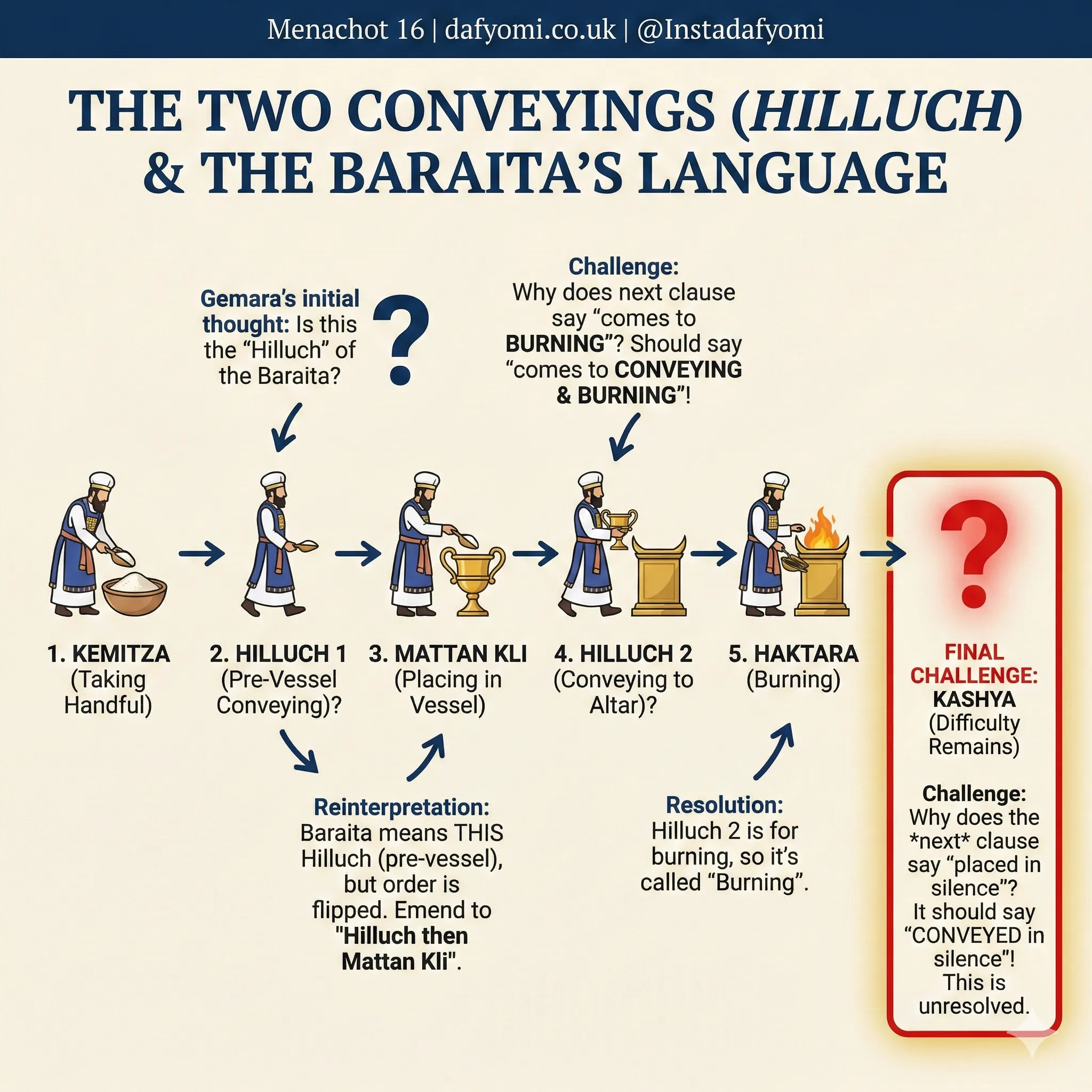
תָּא שְׁמַע: בַּמֶּה דְּבָרִים אֲמוּרִים – בִּקְמִיצָה, וּבְמַתַּן כְּלִי, וּבְהִילּוּךְ.
English Translation:
The Gemara attempts to adduce proof for the opinion of Rabbi Yochanan. Come and hear a proof from a baraita: In what case is this statement, that there is a dispute between Rabbi Meir and the Rabbis, said? It is said with regard to a case where one had such intent during the removal of the handful, or during the placement of the handful in a service vessel, or during the conveying of the handful.
קלאוד על הדף:
The Gemara brings a baraita as proof for Rabbi Yochanan’s position. The baraita lists three stages where the dispute applies: removal of the handful (kemitza), placement in a vessel (matan kli), and conveying (hiluch).
Segment 19
TYPE: גמרא – דחייה
Rejection: conveying before placement
Hebrew/Aramaic:
מַאי לָאו הִילּוּךְ דְּהַקְטָרָה? לָא, הִילּוּךְ דְּמַתַּן כְּלִי.
English Translation:
The Gemara clarifies the proof: What, is it not correct to say that the baraita is referring to the conveying of the handful for burning upon the altar, in which case it is teaching that intent of piggul with regard to the handful during its conveying renders the offering piggul? The Gemara responds: No; the baraita is referring to the conveying of the handful before its placement into the service vessel that sanctifies it. Since the frankincense is not placed into a vessel, in this case the conveying of the handful alone is considered the performance of the entire rite.
קלאוד על הדף:
The Gemara rejects this proof. The “conveying” mentioned in the baraita might refer to carrying the handful from the place where it was removed to the service vessel – not carrying it to the altar for burning. This would support Reish Lakish’s view.
Segment 20
TYPE: גמרא – קושיא על הסדר
Challenge from the order
Hebrew/Aramaic:
אִי הָכִי, בְּמַתַּן כְּלִי וּבְהִילּוּךְ? בְּהִילּוּךְ וּבְמַתַּן כְּלִי מִיבְּעֵי לֵיהּ! הָא לָא קַשְׁיָא, תָּנֵי הָכִי.
English Translation:
The Gemara asks: If so, why does the baraita state: During the placement of the handful in a vessel or during the conveying? This indicates that it is referring to an act of conveying that occurs after the placement. It should have stated: During the conveying or during the placement of the handful in a vessel. The Gemara responds: This is not difficult, as one should emend the baraita and teach it in that order, i.e., with the conveying before the placement.
קלאוד על הדף:
The Gemara challenges this interpretation based on the order of the baraita’s wording. If hiluch means conveying to the vessel, the baraita should list it before matan kli. The Gemara responds by suggesting emending the baraita’s order.
Segment 21
TYPE: גמרא – קושיא נוספת
Another challenge
Hebrew/Aramaic:
בָּא לוֹ לְהַקְטָרָה? בָּא לוֹ לְהוֹלָכָה מִיבְּעֵי לֵיהּ! הָא לָא קַשְׁיָא, כֵּיוָן דְּהוֹלָכָה צוֹרֶךְ דְּהַקְטָרָה הִיא, קָרֵי לַהּ הַקְטָרָה.
English Translation:
The Gemara raises another objection from the next clause of the same baraita: Once he comes to perform the burning of the handful, there is no liability to receive karet unless he has intent of piggul during the sacrifice of the frankincense as well. The Gemara asks: According to Reish Lakish, the baraita should have stated: Once he comes to perform the conveying and to perform the burning. Reish Lakish maintains that the conveying mentioned previously in the baraita occurs earlier, before its placement into a service vessel, which means that there is another act of conveying. The Gemara responds: This is not difficult; since this conveying is for the purpose of burning, it is called burning in the baraita.
קלאוד על הדף:
Another textual challenge. If Reish Lakish is correct that conveying is part of the burning stage, why does the baraita say “once he comes to burning” without mentioning conveying? The Gemara resolves: since conveying is for the purpose of burning, it’s called “burning.”
Segment 22
TYPE: גמרא – קושיא סופית
Final difficulty
Hebrew/Aramaic:
אֶלָּא, נָתַן אֶת הַקּוֹמֶץ בִּשְׁתִיקָה – הוֹלִיךְ מִיבְּעֵי לֵיהּ! קַשְׁיָא.
English Translation:
The Gemara further challenges: But the baraita also states: If he placed the handful on the altar in silence, and he placed the frankincense with intent of piggul. According to Reish Lakish, it should have also stated: If he carried the handful in silence, and the frankincense with intent of piggul, as according to Reish Lakish it is the act of conveying that he is performing at this stage. The Gemara responds: Indeed, this is a difficulty.
קלאוד על הדף:
The Gemara notes a final problem. The baraita’s wording about the burning stage doesn’t mention conveying at all. If conveying is significant (as both Amoraim agree, just differently), it should be mentioned. The difficulty remains unresolved (kashya).
Segment 23
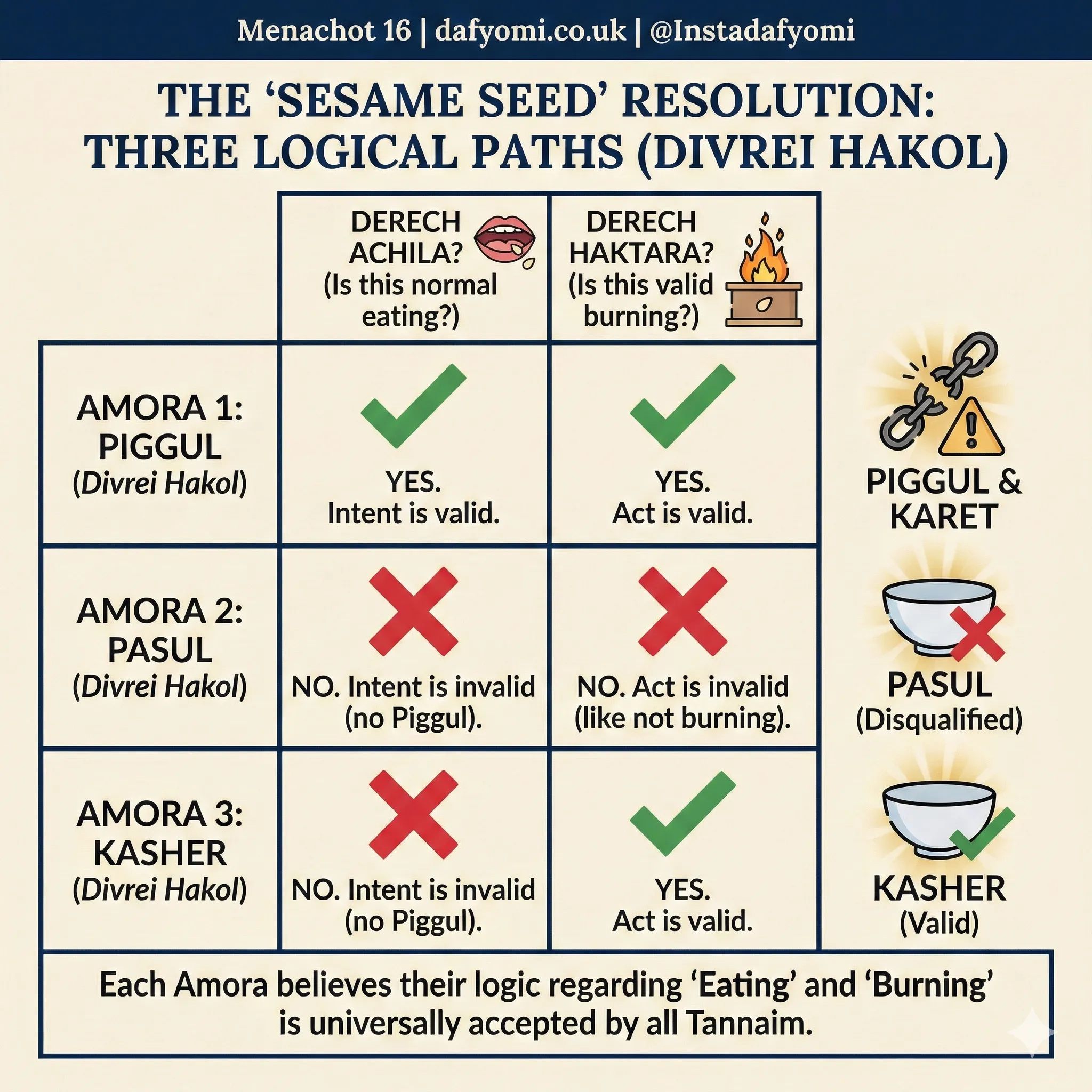
TYPE: גמרא – שומשום
Burning sesame seed by sesame seed
Hebrew/Aramaic:
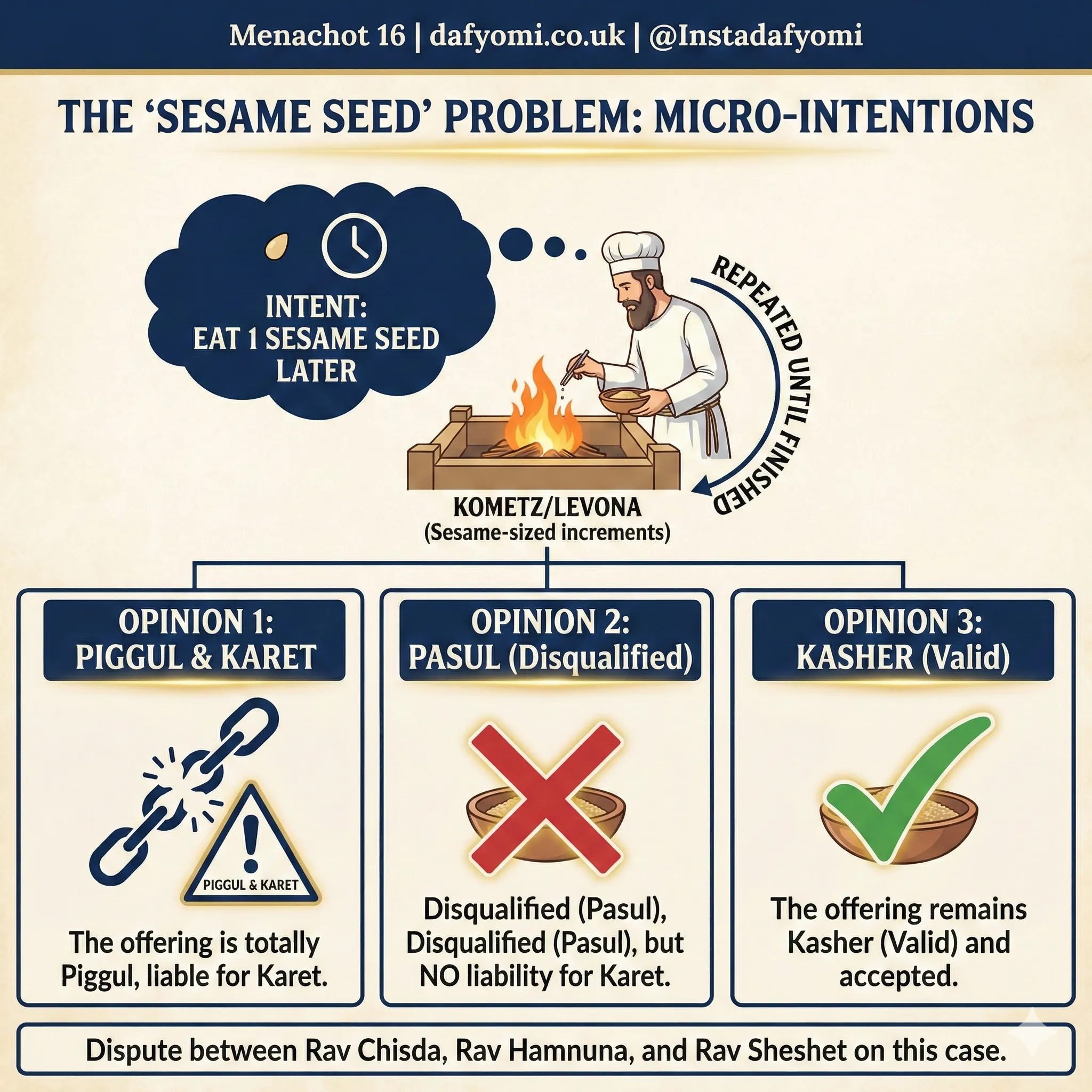
הִקְטִיר שׁוּמְשׁוּם לֶאֱכוֹל שׁוּמְשׁוּם, עַד שֶׁכָּלָה קוֹמֶץ כּוּלּוֹ – רַב חִסְדָּא וְרַב הַמְנוּנָא וְרַב שֵׁשֶׁת: חַד אָמַר: פִּיגּוּל, וְחַד אָמַר: פָּסוּל, וְחַד אָמַר: כָּשֵׁר.
English Translation:
The Gemara continues its discussion of piggul intent that occurred during the sacrifice of part of a permitting factor. If one burned an amount the size of a sesame seed of the handful and frankincense with the intent to consume an amount the size of a sesame seed from the remainder the next day, and he repeated the same action with the accompanying intent until he burned the entire measure of the handful and frankincense, the halakha in this case is a matter of dispute between Rav Chisda, Rav Hamnuna, and Rav Sheshet. One says that the entire meal offering is piggul, and one says that the offering is disqualified but is not piggul, and one says that the offering remains fit.
קלאוד על הדף:
A new sugya: What if someone burns the handful sesame-seed by sesame-seed, each time intending to eat a sesame-seed’s worth of the remainder tomorrow? Three Amoraim – Rav Chisda, Rav Hamnuna, and Rav Sheshet – dispute this case with three different positions: piggul, pasul (disqualified), or kasher (fit).
Key Terms:
- שׁוּמְשׁוּם (Shumshem) = Sesame seed; a tiny amount
Segment 24
TYPE: גמרא – ניסיון לזהות
Attempt to identify the positions
Hebrew/Aramaic:
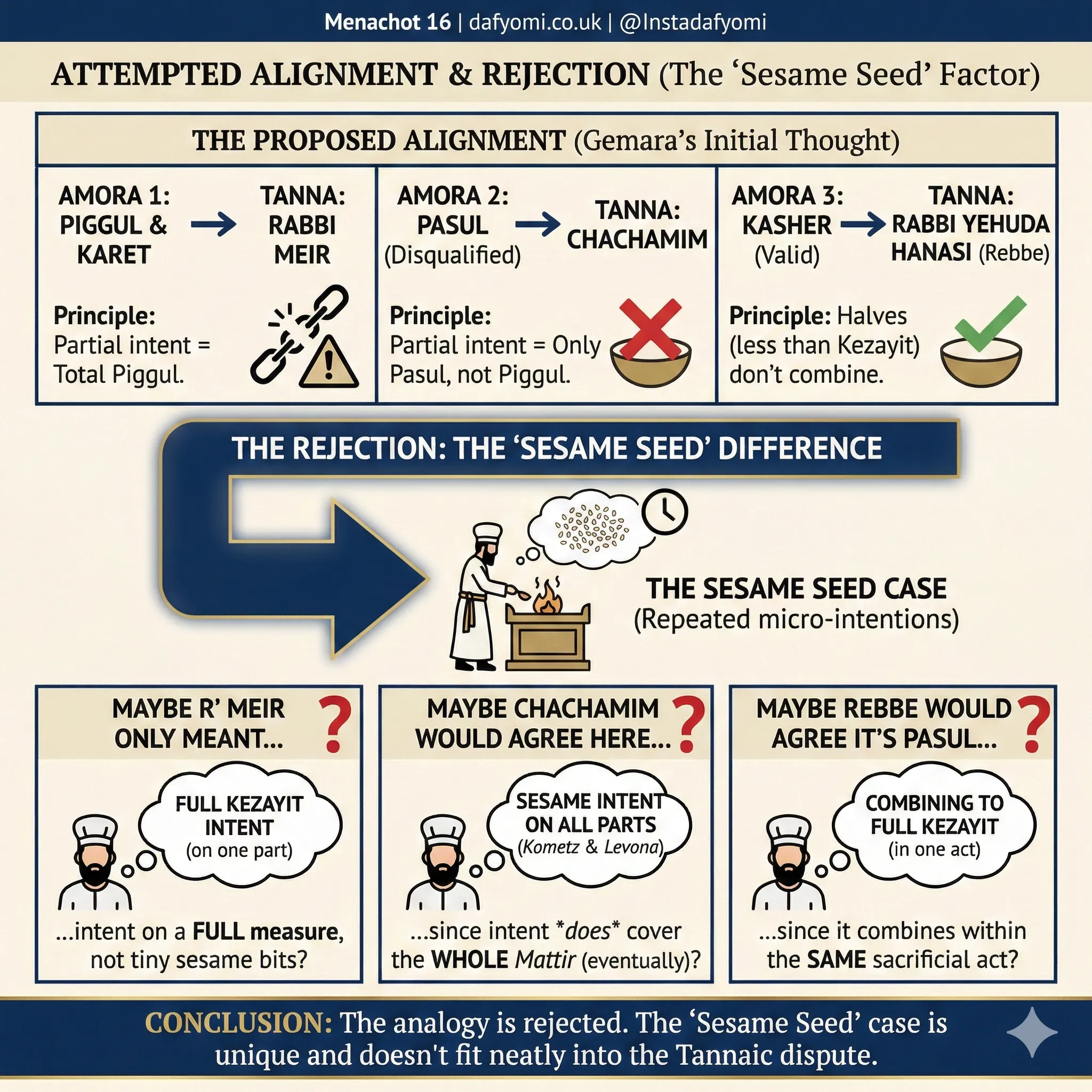
לֵימָא: מַאן דְּאָמַר פִּיגּוּל – כְּרַבִּי מֵאִיר, וּמַאן דְּאָמַר פָּסוּל – כְּרַבָּנַן, וּמַאן דְּאָמַר כָּשֵׁר – כְּרַבִּי.
English Translation:
The Gemara suggests: Let us say that the one who says that the meal offering is piggul holds in accordance with the opinion of Rabbi Meir, who says that one renders an offering piggul on account of piggul intent during the sacrifice of even part of its permitting factors. And the one who says that the offering is disqualified holds in accordance with the opinion of the Rabbis, who say that such intent disqualifies an offering but does not render it piggul. And finally, the one who says that the offering is fit holds in accordance with the opinion of Rabbi Yehuda HaNasi, who says (14a) that if one slaughters each of the two lambs brought on Shavuot with the two loaves, each time intending to consume half an olive-bulk from a different loaf the next day, the offering is fit, as the halves do not combine to render the offering piggul.
קלאוד על הדף:
The Gemara tries to connect the three Amoraic positions to the Tannaitic dispute. Perhaps: piggul = Rabbi Meir, pasul = Rabbis, kasher = Rabbi Yehuda HaNasi (from daf 14a about half-measures not combining).
Segment 25
TYPE: גמרא – דחייה
Rejection of the identification
Hebrew/Aramaic:
מִמַּאי? דִּלְמָא עַד כָּאן לָא קָאָמַר רַבִּי מֵאִיר הָתָם, אֶלָּא דְּחִישֵּׁב בְּשִׁיעוּרוֹ, אֲבָל הָכָא דְּלֹא חִישֵּׁב בְּשִׁיעוּרוֹ – לָא.
English Translation:
The Gemara rejects this suggestion: From where is this conclusion drawn? Perhaps Rabbi Meir states that one renders an offering piggul on account of piggul intent during the sacrifice of part of the permitting factors only there, where he had intent with regard to its entire measure. But here, where he did not have intent with regard to its entire measure, but instead had a series of intentions with regard to a measure equivalent to a sesame seed, it is possible that Rabbi Meir does not render the offering piggul.
קלאוד על הדף:
The Gemara rejects the suggested identifications. Rabbi Meir’s position might only apply when one has intent about the full measure at once, not when intent is piecemeal (sesame seed by sesame seed).
Segment 26
TYPE: גמרא – דחייה נוספת
Further rejection regarding the Rabbis
Hebrew/Aramaic:
וְעַד כָּאן לָא קָא אָמְרִי רַבָּנַן הָתָם, אֶלָּא דְּלָא חַשֵּׁב בֵּיהּ בְּכוּלֵּיהּ מַתִּיר, אֲבָל הָכָא דְּחַשֵּׁב בֵּיהּ בְּכוּלֵּיהּ מַתִּיר – הָכִי נָמֵי דְּפַגֵּיל.
English Translation:
And furthermore, perhaps the Rabbis state that one does not render an offering piggul unless he has piggul intent during the sacrifice of the entire permitting factor only there, where he did not have intent concerning it during the entire permitting factor, but only during the burning of the handful. But here, where he had intent during the entire permitting factor, i.e., during the burning of both the handful and the frankincense, he has indeed rendered the offering piggul, despite the fact that each intention referred only to a small portion of the entire measure.
קלאוד על הדף:
Similarly, the Rabbis’ position might differ here. They might agree it’s piggul in the sesame case because the intent occurred throughout the entire matir (both handful and frankincense), even if the amounts were small each time.
Segment 27
TYPE: גמרא – דחייה בעניין רבי
Rejection regarding Rabbi Yehuda HaNasi
Hebrew/Aramaic:
וְעַד כָּאן לָא קָא אָמַר רַבִּי הָתָם, אֶלָּא דְּלָא הֲדַר מַלְּיֵיהּ מֵאוֹתָהּ עֲבוֹדָה, אֲבָל הָכָא דַּהֲדַר מַלְּיֵיהּ מֵאוֹתָהּ עֲבוֹדָה – הָכִי נָמֵי דְּפָסֵיל.
English Translation:
And perhaps Rabbi Yehuda HaNasi states that the offering is valid if one had intent of piggul with regard to half an olive-bulk from each loaf only there, where he did not subsequently complete his intention with regard to a full measure from the same sacrificial rite, as he had piggul intent with regard to half an olive-bulk during the slaughter of each lamb independently. But here, where he subsequently completed his intention with regard to a full measure from the same rite, perhaps he has indeed disqualified the offering.
קלאוד על הדף:
Rabbi Yehuda HaNasi’s leniency (on 14a) might also not apply here. There, the half-measures came from different rites (different lamb slaughters). Here, all the sesame-seed intents come from the same rite (one continuous burning), so they might combine.
Segment 28
TYPE: גמרא – מסקנה
Conclusion: each position is universal
Hebrew/Aramaic:
אֶלָּא, מַאן דְּאָמַר פִּיגּוּל – דִּבְרֵי הַכֹּל, מַאן דְּאָמַר פָּסוּל – דִּבְרֵי הַכֹּל, מַאן דְּאָמַר כָּשֵׁר – דִּבְרֵי הַכֹּל.
English Translation:
Rather, the one who says that an offering is piggul when one repeatedly burns an amount the size of a sesame seed from the handful and frankincense with the intent to consume an amount the size of a sesame seed from the remainder the next day, would claim that all of the tanna’im agree that it is piggul. Similarly, the one who says that it is disqualified would contend that all agree that it is disqualified, and the one who says that it is fit would maintain that all agree that it is fit.
קלאוד על הדף:
The Gemara concludes that each Amora holds their position is universal – not dependent on which Tanna you follow. Each Amora believes all Tannaim would agree with his position in this specific case.
Segment 29
TYPE: גמרא – הסבר
Explanation of each position
Hebrew/Aramaic:
מַאן דְּאָמַר פִּיגּוּל דִּבְרֵי הַכֹּל, קָסָבַר: דֶּרֶךְ אֲכִילָה בְּכָךְ, וְדֶרֶךְ הַקְטָרָה בְּכָךְ. וּמַאן דְּאָמַר פָּסוּל דִּבְרֵי הַכֹּל, קָסָבַר: אֵין דֶּרֶךְ אֲכִילָה בְּכָךְ, וְאֵין דֶּרֶךְ הַקְטָרָה בְּכָךְ, וְהָוְיָא לָהּ כְּמִנְחָה שֶׁלֹּא הוּקְטְרָה. וּמַאן דְּאָמַר כָּשֵׁר דִּבְרֵי הַכֹּל, קָסָבַר: דֶּרֶךְ הַקְטָרָה בְּכָךְ, וְאֵין דֶּרֶךְ אֲכִילָה בְּכָךְ.
English Translation:
The Gemara elaborates: The one who says that all agree it is piggul maintains that the manner of its consumption is in such a manner, i.e., in small portions, and likewise the manner of its burning is also in such a manner. And the one who says that all agree it is disqualified holds that the manner of its consumption is not in such a manner. Accordingly, this type of piggul intent does not render the offering piggul. And the manner of its burning is also not in such a manner, and consequently it is like a meal offering whose handful was not burned properly, and is therefore disqualified. And finally, the one who says that all agree it is fit holds that the manner of its burning is in such a manner, and therefore the burning was performed properly, but the manner of its consumption is not in such a manner, which means that the piggul intent is inconsequential.
קלאוד על הדף:
The Gemara explains the underlying logic of each position:
- Piggul = Normal to burn and eat in small amounts; full piggul created
- Pasul = Not normal to burn or eat this way; improper burning disqualifies but no piggul
- Kasher = Normal to burn this way (valid burning) but not to eat this way (invalid piggul intent)
Key Terms:
- דֶּרֶךְ אֲכִילָה (Derech Achilah) = The normal manner of eating
- דֶּרֶךְ הַקְטָרָה (Derech Haktarah) = The normal manner of burning
Segment 30
TYPE: גמרא – סיום
Continuation indicator
Hebrew/Aramaic:
אָמְרִי
English Translation:
So say
קלאוד על הדף:
This final word indicates the continuation of the discussion onto the next daf (17a).