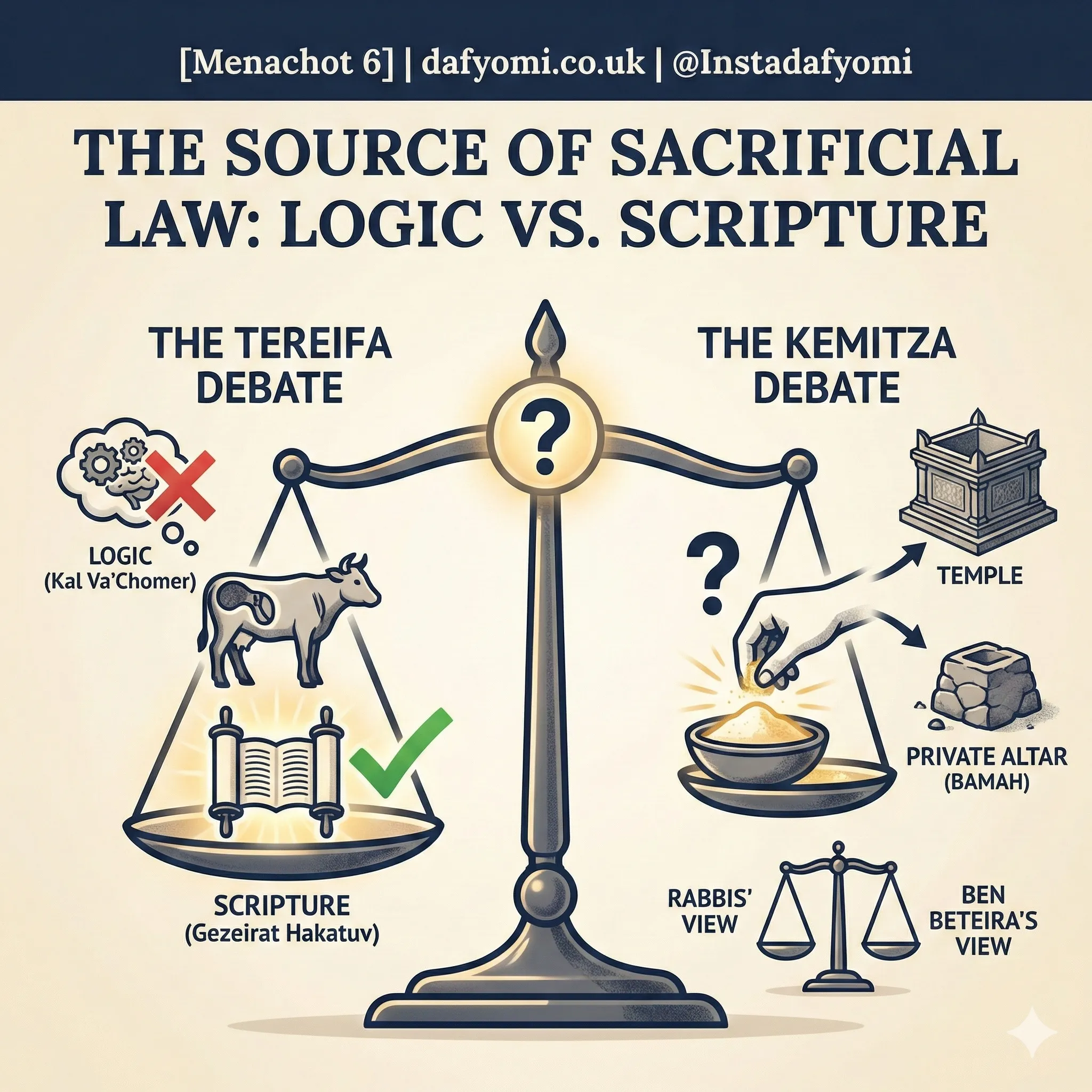
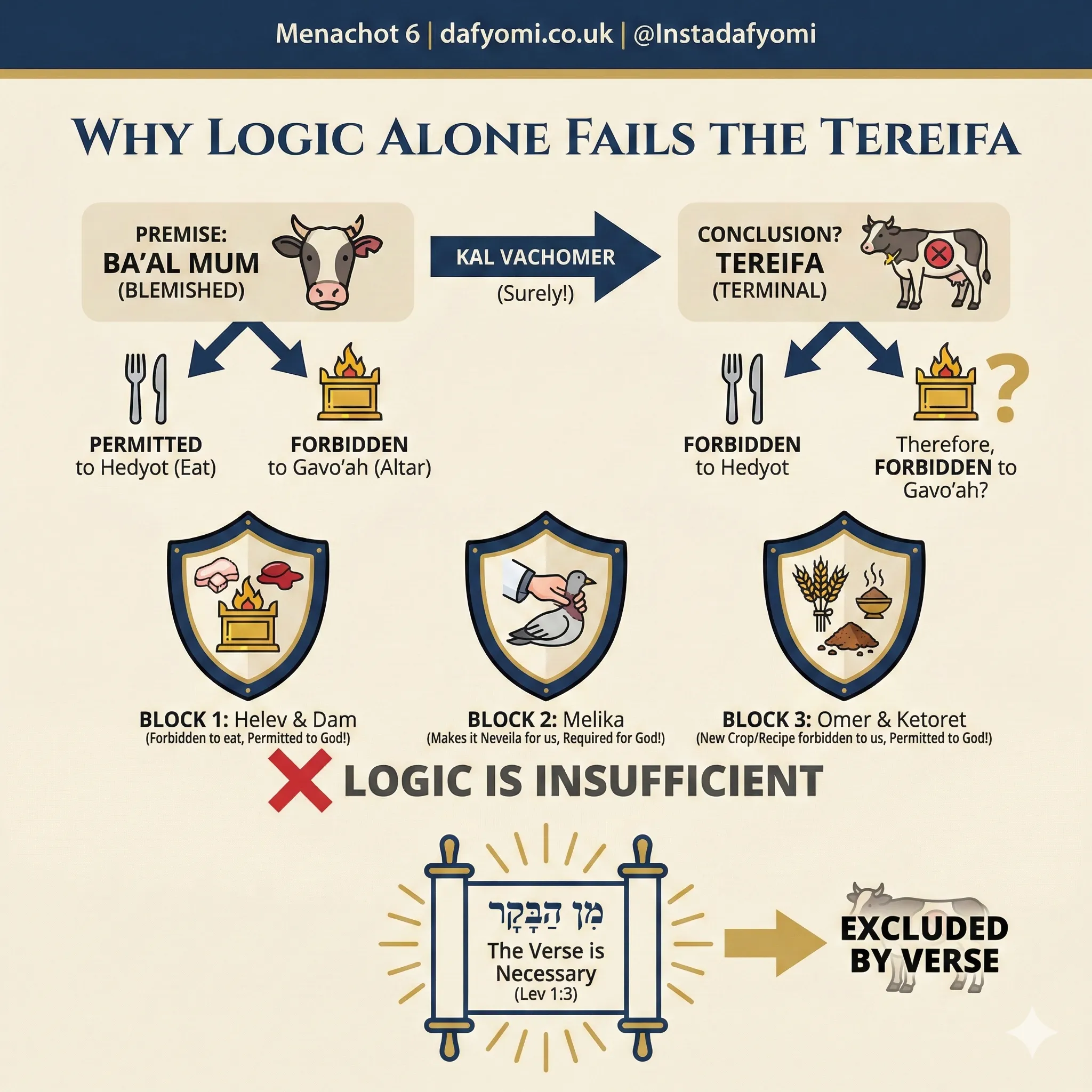
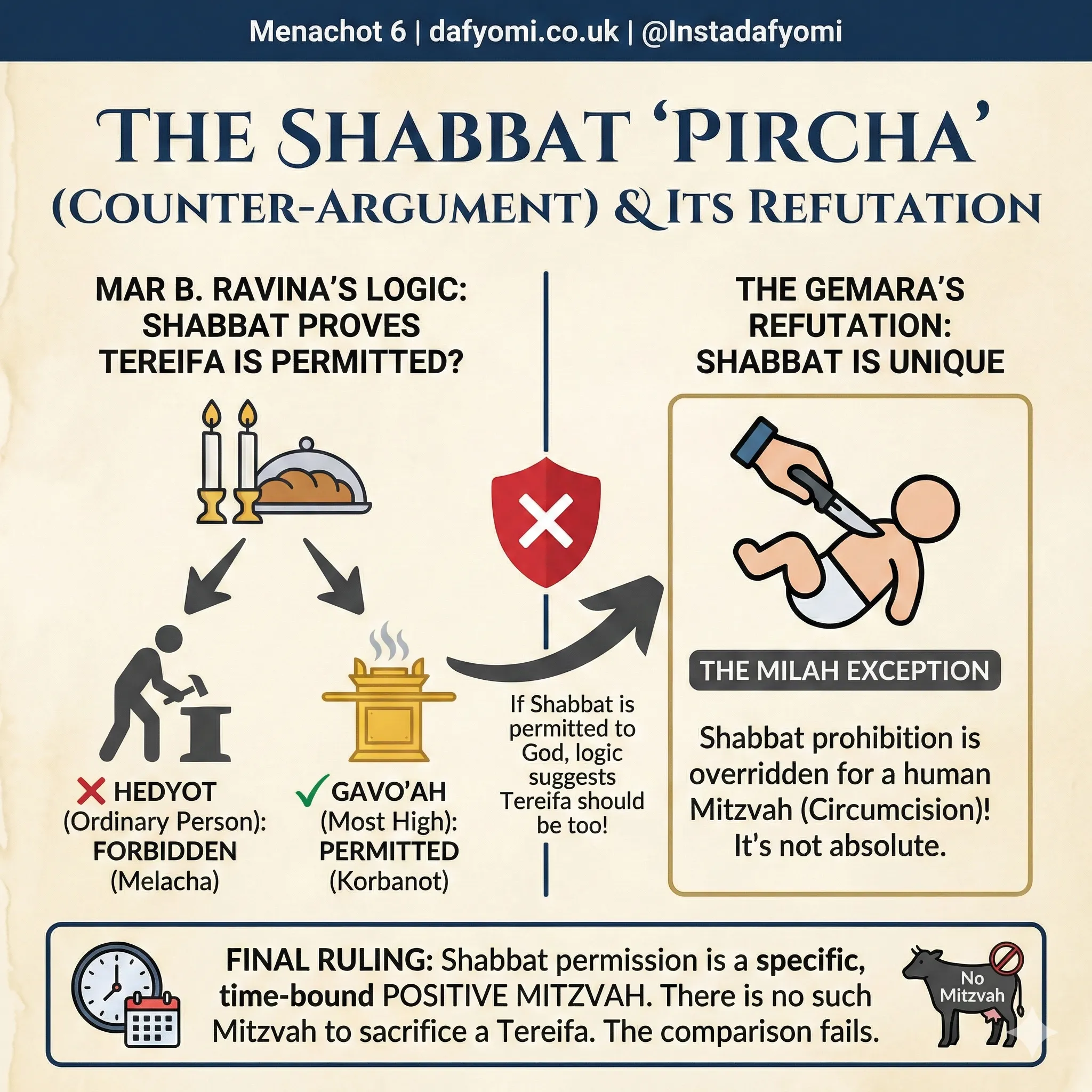
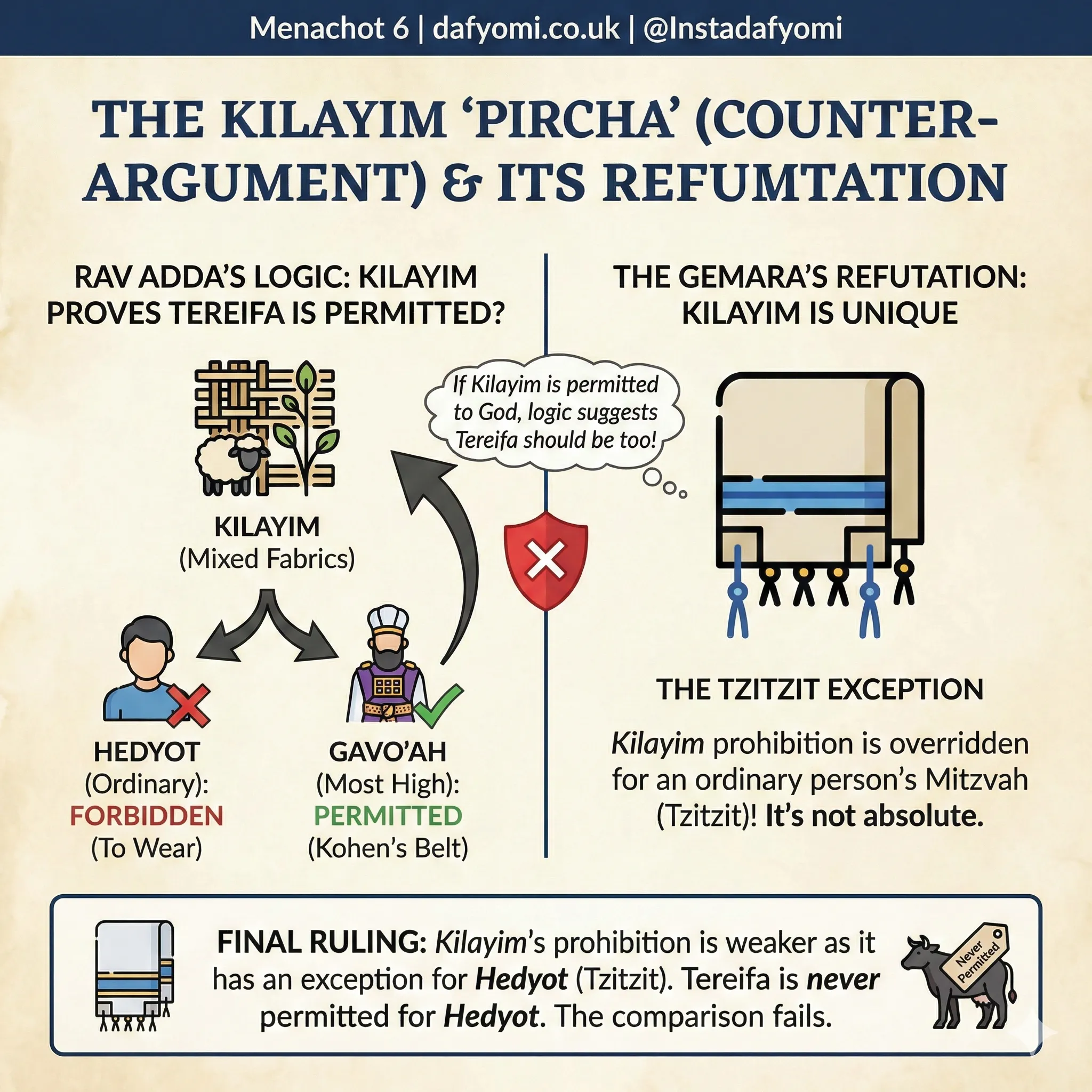
Menachot Daf 6 (מנחות דף ו׳)
Daf: 6 | Amudim: 6a – 6b
📖 Breakdown
Amud Aleph (6a)
Segment 1
TYPE: גמרא
Continuation of discussion on deriving tereifa’s disqualification
Hebrew/Aramaic:
מָה לְכִלְאַיִם שֶׁמִּצְוָתוֹ בְּכָךְ.
English Translation:
What is notable about diverse kinds? It is notable in that its mitzva is in this manner, since the belt of the priestly vestments must be sewn from diverse kinds.
קלאוד על הדף:
The Gemara continues from the previous daf, attempting to derive why a tereifa (mortally wounded animal) is unfit for sacrifice. When trying to use kilayim (diverse kinds) as part of a binyan av (logical inference), the Gemara notes that kilayim is different because there is actually a mitzva to use diverse kinds in the priestly belt – making it an exception rather than a rule.
Key Terms:
- כלאים = Diverse kinds (wool and linen together)
- מצותו בכך = Its mitzva is in this manner
Segment 2
TYPE: גמרא – תירוץ
Rav Sheisha’s approach to deriving the tereifa disqualification
Hebrew/Aramaic:
רַב שִׁישָׁא בְּרֵיהּ דְּרַב אִידִי אָמַר: מִשּׁוּם דְּאִיכָּא לְמֵימַר, לִיהְדַּר דִּינָא וְתֵיתֵי בַּ״מָּה הַצַּד״.
English Translation:
Rav Sheisha, son of Rav Idi, said: The halakha that a tereifa is unfit for sacrifice must be derived from the verse, because it can be said: Let this claim be derived by analogy from the common element of two sources.
קלאוד על הדף:
Rav Sheisha explains why a verse is necessary to teach that tereifa is unfit. Although one might try to derive it through logical inference (kal vachomer or binyan av), the derivation can be challenged. Therefore, a direct scriptural source is required.
Key Terms:
- מה הצד = “What is the common element” – a type of halachic derivation
- ליהדר דינא = Let the inference revert to its starting point
Segment 3
TYPE: גמרא – פירכא
Challenging the derivation from melikah
Hebrew/Aramaic:
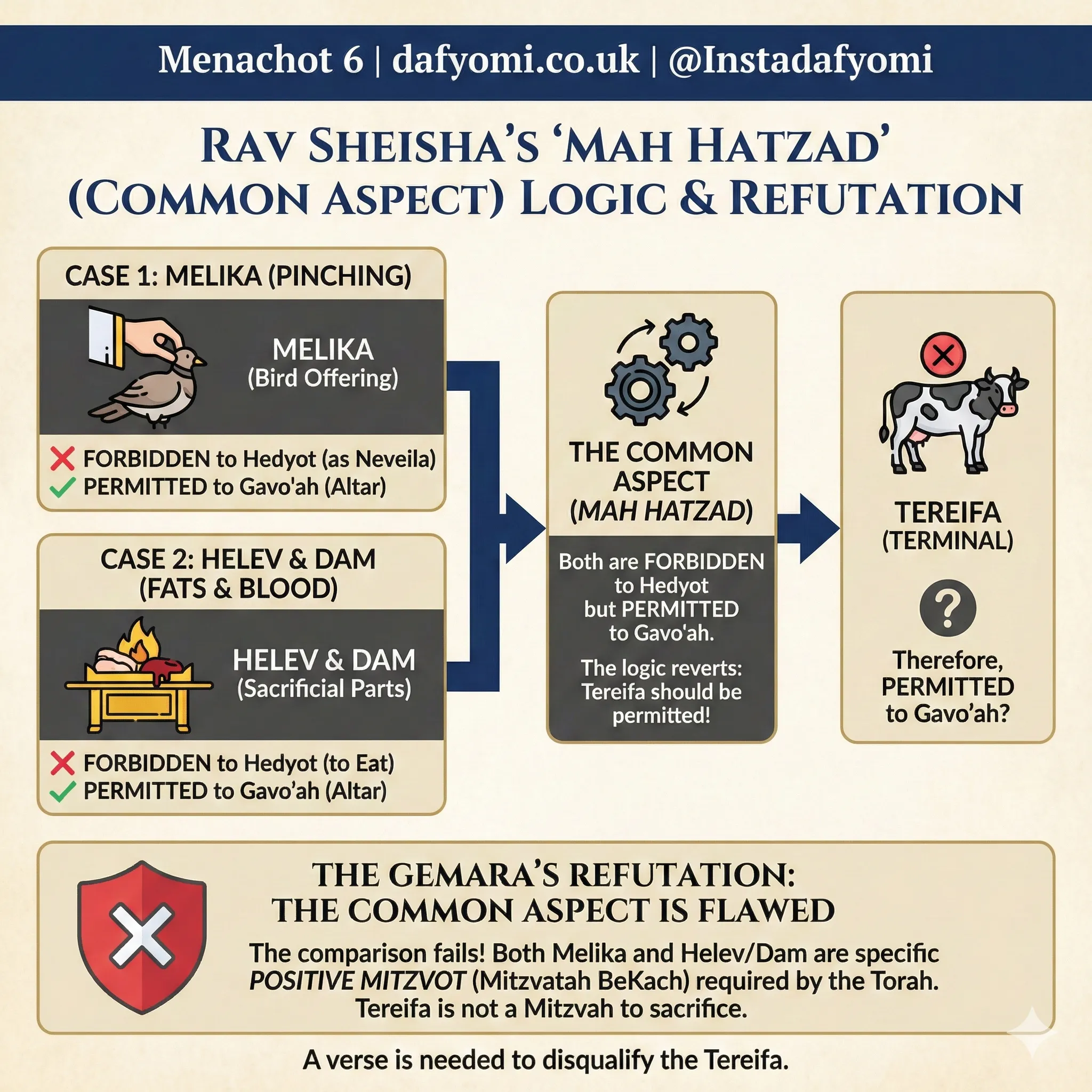
מָה לִמְלִיקָה שֶׁכֵּן קְדוּשָּׁתָהּ אוֹסַרְתָּהּ, חֵלֶב וָדָם יוֹכִיחוּ.
English Translation:
What is notable about pinching? It is notable in that its sanctity prohibits it. Fat and blood prove that this consideration is not enough to reject the a fortiori inference.
קלאוד על הדף:
The Gemara raises a challenge: melikah (pinching a bird’s neck) cannot be used as a source because its unique feature is that its sanctity prohibits it for ordinary consumption. Fat and blood counter this challenge – they too are prohibited to ordinary people yet permitted on the altar, without having the “sanctity prohibits” feature.
Key Terms:
- מליקה = Pinching (the method of killing bird offerings)
- קדושתה אוסרתה = Its sanctity prohibits it
- חלב ודם = Fat and blood
Segment 4
TYPE: גמרא – פירכא
Counter-challenge regarding fat and blood
Hebrew/Aramaic:
מָה לְחֵלֶב וָדָם, שֶׁכֵּן בָּאִים מִכְּלַל הֶיתֵּר – מְלִיקָה תּוֹכִיחַ.
English Translation:
What is notable about fat and blood? They are notable in that they come from an item that is generally permitted. Pinching proves that this consideration is not decisive.
קלאוד על הדף:
The Gemara presents a counter: fat and blood come from permitted animals (the meat is kosher), so they’re not analogous to tereifa which is entirely forbidden. Melikah counters this – the bird before pinching was permitted, yet through melikah becomes a tereifa-like state and is still offered.
Segment 5
TYPE: גמרא – מה הצד
The cyclical argument and common element
Hebrew/Aramaic:
וְחָזַר הַדִּין, לֹא רְאִי זֶה כִרְאִי זֶה וְלֹא רְאִי זֶה כִּרְאִי זֶה, הַצַּד הַשָּׁוֶה שֶׁבָּהֶן שֶׁאֲסוּרִין לַהֶדְיוֹט וּמוּתָּרִין לַגָּבוֹהַּ.
English Translation:
And accordingly, the inference has reverted to its starting point. The aspect of this case is not like the aspect of that case. Their common element is that they are prohibited to an ordinary person yet permitted for the Most High.
קלאוד על הדף:
The Gemara reaches a “mah hatzad” (common element) derivation: both melikah and fat/blood share the feature that they’re forbidden to people but offered to God. We might derive that tereifa too – forbidden to people – should be permitted to God. This would eliminate the need for a verse.
Segment 6
TYPE: גמרא – פירכא על מה הצד
Refuting the common element argument
Hebrew/Aramaic:
אַף אֲנִי אָבִיא טְרֵפָה – אַף עַל פִּי שֶׁאֲסוּרָה לַהֶדְיוֹט תְּהֵא מוּתֶּרֶת לַגָּבוֹהַּ, מָה לְהַצַּד הַשָּׁוֶה שֶׁבָּהֶן שֶׁכֵּן מִצְוָתָהּ בְּכָךְ!
English Translation:
So too I will derive regarding a tereifa – even though it is prohibited to an ordinary person, it should be permitted for the Most High! But what is notable about their common element? It is notable in that their mitzva is fulfilled in this manner!
קלאוד על הדף:
The Gemara refutes the mah hatzad: both melikah and offering fat/blood are themselves mitzvot – their offering is how the commandment is performed. Tereifa has no such mitzva – there’s no commandment to offer a tereifa. Therefore, the derivation fails and a verse is needed.
Segment 7
TYPE: גמרא – Rav Ashi
Rav Ashi’s fundamental objection
Hebrew/Aramaic:
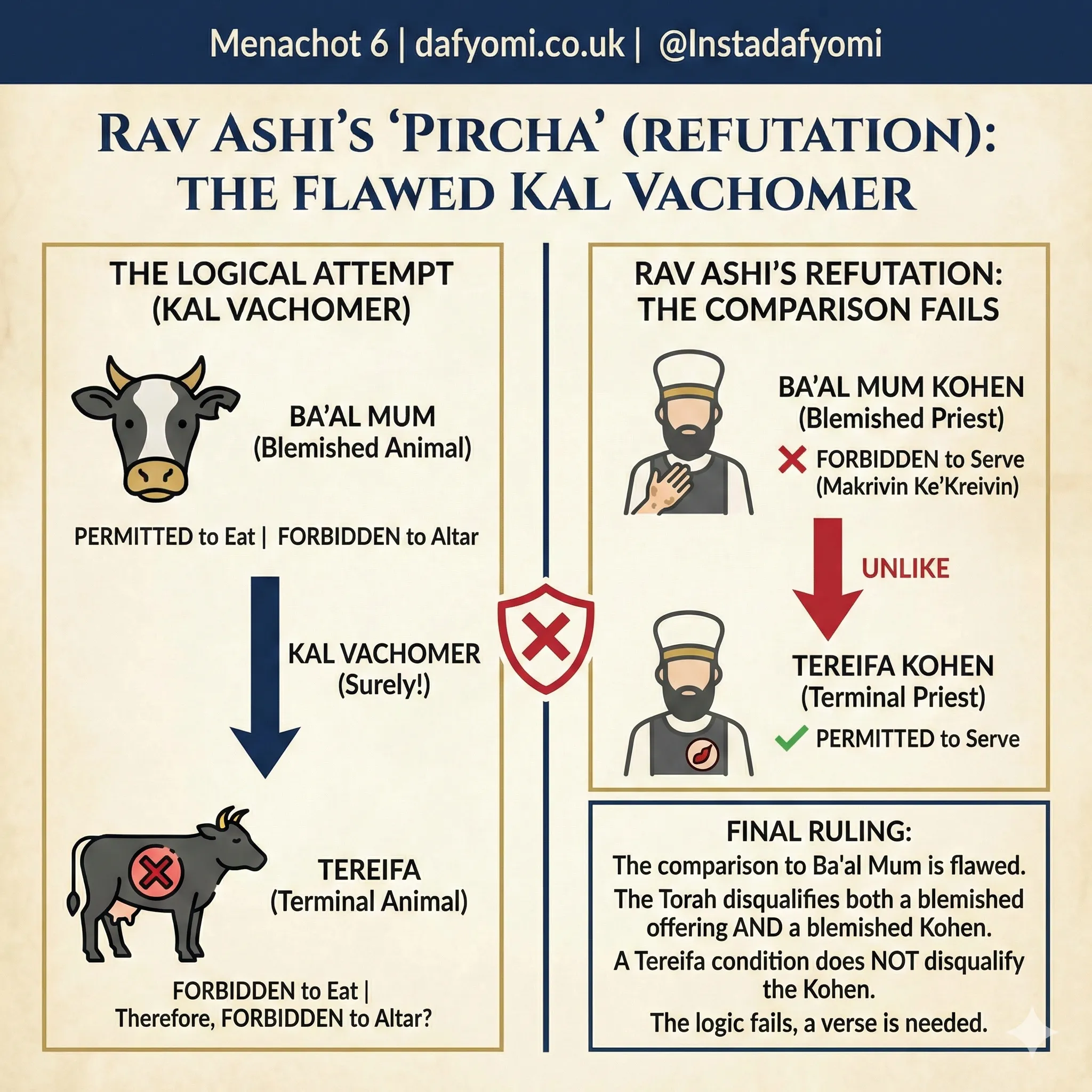
אֶלָּא אָמַר רַב אָשֵׁי, מִשּׁוּם דְּאִיכָּא לְמֵימַר: מֵעִיקָּרָא דְּדִינָא פִּרְכָא, מֵהֵיכָא קָא מַיְיתֵית לַהּ? מִבַּעַל מוּם –
English Translation:
Rather, Rav Ashi said: It is necessary to derive the halakha of a tereifa from a verse because one can say that the refutation of the a fortiori inference is present from the outset. From where do you wish to derive it? From a blemished animal –
קלאוד על הדף:
Rav Ashi takes a different approach. He argues that the logical inference is flawed from its very beginning. If we try to derive tereifa’s disqualification from baal mum (a blemished animal), there’s an immediate fundamental problem.
Key Terms:
- מעיקרא דדינא פירכא = The refutation exists from the outset
- בעל מום = A blemished animal
Segment 8
TYPE: גמרא – פירכא
The problem with deriving from blemished animals
Hebrew/Aramaic:
מָה לְבַעַל מוּם, שֶׁכֵּן עָשָׂה בּוֹ מַקְרִיבִין כִּקְרֵיבִין.
English Translation:
What is notable about a blemished animal? It is notable in that with regard to blemishes the Torah rendered those who sacrifice like that which is sacrificed.
קלאוד על הדף:
Rav Ashi identifies a unique feature of baal mum: the Torah equated the sacrificer with the sacrifice regarding blemishes. A blemished kohen cannot serve, just as a blemished animal cannot be offered. This parallel doesn’t exist for tereifa – there’s no “tereifa kohen” concept.
Key Terms:
- מקריבין כקריבין = Those who sacrifice like that which is sacrificed
Segment 9
TYPE: גמרא – קושיא
Rav Acha Sava’s challenge
Hebrew/Aramaic:
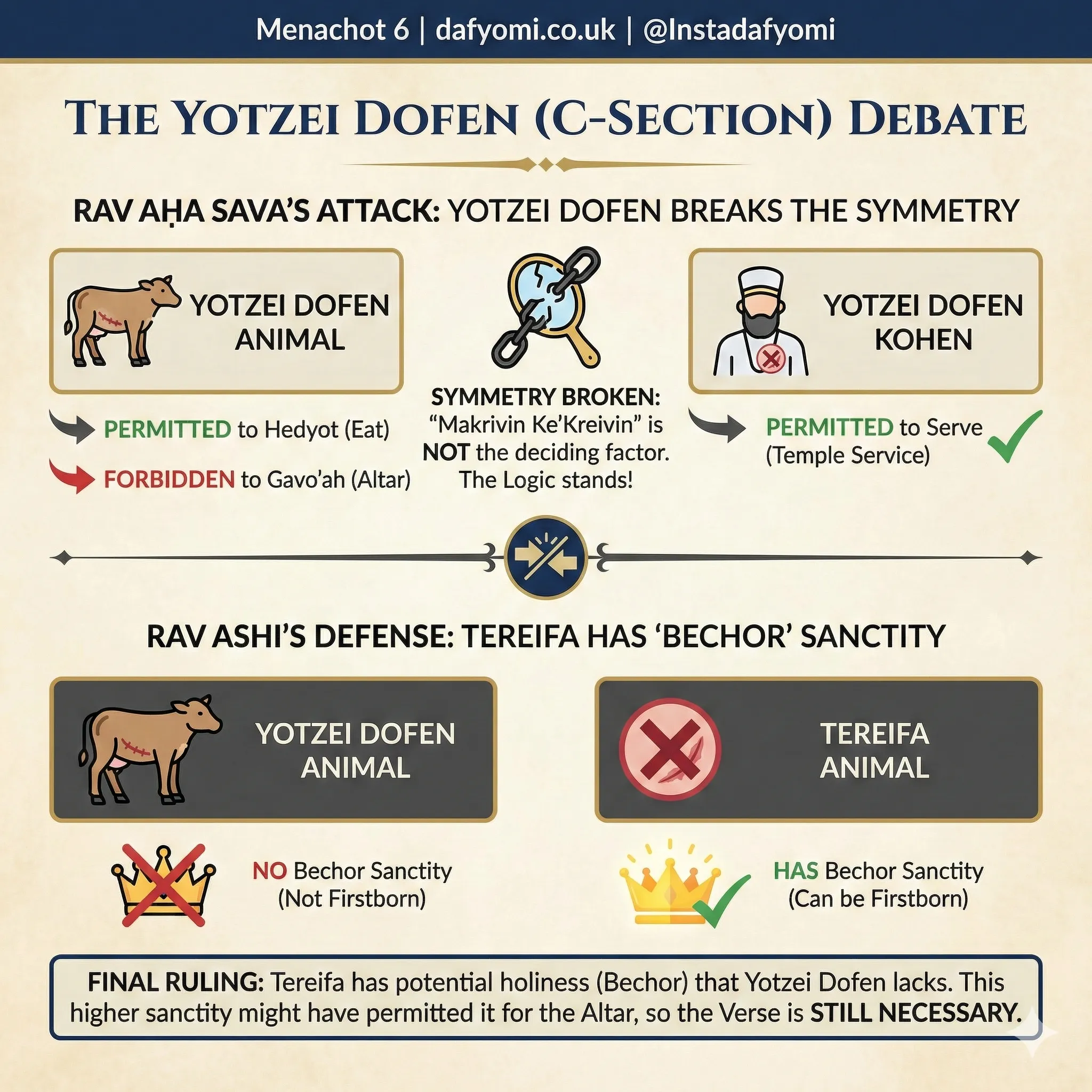
אֲמַר לֵיהּ רַב אַחָא סָבָא לְרַב אָשֵׁי: יוֹצֵא דּוֹפֶן יוֹכִיחַ, שֶׁלֹּא עָשָׂה בּוֹ מַקְרִיבִין כִּקְרֵיבִין, וּמוּתָּר לַהֶדְיוֹט וְאָסוּר לַגָּבוֹהַּ.
English Translation:
Rav Acha Sava said to Rav Ashi: But an animal born by caesarean section proves that this a fortiori inference cannot be rejected based on that consideration. The Torah did not render the sacrificer like the sacrifice regarding caesarean birth, and yet it is permitted for consumption to an ordinary person and prohibited for the Most High.
קלאוד על הדף:
Rav Acha Sava brings a powerful counter-example: a yotzei dofen (caesarean-born animal) is kosher for eating but cannot be sacrificed – yet there’s no parallel “yotzei dofen kohen” disqualification. This undermines Rav Ashi’s reasoning.
Key Terms:
- יוצא דופן = Born through the side (caesarean birth)
Segment 10
TYPE: גמרא – תירוץ
Rav Ashi’s response about firstborn sanctity
Hebrew/Aramaic:
מָה לְיוֹצֵא דּוֹפֶן, שֶׁכֵּן אֵינוֹ קָדוֹשׁ בִּבְכוֹרָה.
English Translation:
Rav Ashi responds: What is notable about an animal born by caesarean section? It is notable in that such an animal is not sanctified with firstborn status.
קלאוד על הדף:
Rav Ashi distinguishes yotzei dofen: it has a unique weakness – it doesn’t become automatically sanctified as a firstborn. This makes it an unsuitable source for derivations about other animals.
Key Terms:
- קדוש בבכורה = Sanctified with firstborn status
Segment 11
TYPE: גמרא – פירכא
Rav Acha Sava’s counter using baal mum
Hebrew/Aramaic:
בַּעַל מוּם יוֹכִיחַ, מָה לְבַעַל מוּם שֶׁכֵּן עָשָׂה בּוֹ מַקְרִיבִין כִּקְרֵיבִין, יוֹצֵא דּוֹפֶן יוֹכִיחַ.
English Translation:
A blemished animal proves that this is not the decisive consideration, as it does become sanctified with the sanctity of a firstborn. [And if you challenge based on “sacrificer like sacrifice,”] an animal born by caesarean section proves otherwise.
קלאוד על הדף:
Rav Acha Sava creates a cyclical argument: each source covers the other’s weakness. Baal mum IS sanctified as firstborn (answering Rav Ashi’s objection about yotzei dofen), and yotzei dofen doesn’t have the “sacrificer like sacrifice” issue.
Segment 12
TYPE: גמרא – מה הצד
The reverted common element argument
Hebrew/Aramaic:
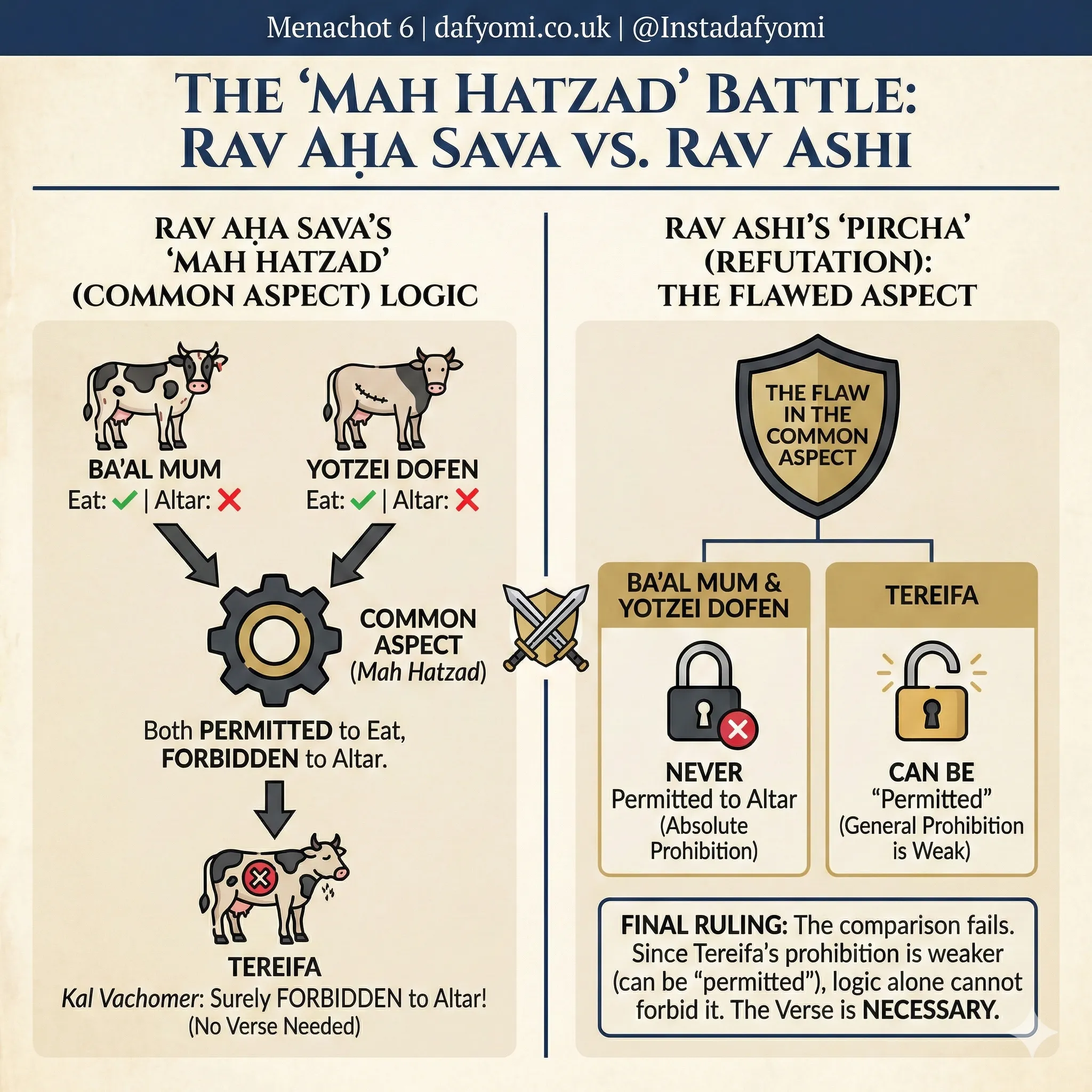
וְחָזַר הַדִּין, לֹא רְאִי זֶה כִּרְאִי זֶה וְלֹא רְאִי זֶה כִּרְאִי זֶה, הַצַּד הַשָּׁוֶה שֶׁבָּהֶן שֶׁמּוּתָּרִין לַהֶדְיוֹט וַאֲסוּרִים לַגָּבוֹהַּ.
English Translation:
And therefore, the inference has reverted to its starting point. Their common element is that they are permitted for consumption to an ordinary person and prohibited for the Most High.
קלאוד על הדף:
We return to the mah hatzad argument: both baal mum and yotzei dofen share the feature that they’re permitted to eat but forbidden to sacrifice. Perhaps tereifa, which is forbidden even to eat, should certainly be forbidden to sacrifice!
Segment 13
TYPE: גמרא – kal vachomer
The kal vachomer argument
Hebrew/Aramaic:
וְכׇל שֶׁכֵּן טְרֵפָה שֶׁאֲסוּרָה לַהֶדְיוֹט תְּהֵא אֲסוּרָה לַגָּבוֹהַּ.
English Translation:
And all the more so a tereifa, which is prohibited to an ordinary person, should be prohibited for the Most High.
קלאוד על הדף:
This creates a powerful kal vachomer: if animals that ARE kosher for eating (baal mum, yotzei dofen) cannot be sacrificed, certainly a tereifa that is NOT kosher for eating cannot be sacrificed! If this logic holds, we don’t need a verse.
Segment 14
TYPE: גמרא – פירכא
Rav Ashi’s final refutation
Hebrew/Aramaic:
מָה לְהַצַּד הַשָּׁוֶה שֶׁבָּהֶן, שֶׁכֵּן לֹא הוּתְּרוּ מִכְּלָלָן, תֹּאמַר בִּטְרֵיפָה שֶׁהוּתְּרָה מִכְּלָלָהּ.
English Translation:
What is notable about their common element? It is notable in that their general prohibition was not permitted. Will you say that the same applies to a tereifa, whose general prohibition was permitted?
קלאוד על הדף:
Rav Ashi delivers the decisive blow: baal mum and yotzei dofen were NEVER permitted for sacrifice – their prohibition was never “released.” But tereifa’s general prohibition WAS permitted in certain circumstances (as will be explained). Therefore, we cannot derive tereifa from them.
Key Terms:
- לא הותרו מכללן = Their prohibition was not released
- הותרה מכללה = Its prohibition was released/permitted
Segment 15
TYPE: גמרא – בעיא
Rav Acha son of Rava’s question
Hebrew/Aramaic:
אֲמַר לֵיהּ רַב אַחָא בְּרֵיהּ דְּרָבָא לְרַב אָשֵׁי: טְרֵפָה שֶׁהוּתְּרָה מִכְּלָלָהּ מַאי הִיא?
English Translation:
Rav Acha, son of Rava, said to Rav Ashi: This tereifa whose general prohibition was permitted, what is it, i.e., to what case is this referring?
קלאוד על הדף:
Rav Acha bar Rava asks for clarification: where exactly do we see that the tereifa prohibition was “released” or permitted? This is the crux of Rav Ashi’s argument.
Segment 16
TYPE: גמרא – תירוץ
Explaining the permitted tereifa – bird burnt offering
Hebrew/Aramaic:
אִילֵימָא מְלִיקָה דְּעוֹלַת הָעוֹף לַגָּבוֹהַּ, בַּעַל מוּם נָמֵי בְּעוֹפוֹת אִשְׁתְּרוֹיֵי אִשְׁתְּרִי, תַּמּוּת וְזַכְרוּת בִּבְהֵמָה, וְאֵין תַּמּוּת וְזַכְרוּת בָּעוֹפוֹת!
English Translation:
If we say that it is referring to the pinching of a bird burnt offering for the Most High, whereby the bird is initially rendered a tereifa at the start of the pinching process, and nevertheless it is sacrificed upon the altar, then the same may be said of a blemished animal as well. As with regard to birds it is permitted to sacrifice a blemished bird. This is in accordance with the halakha that the requirement that an offering must be unblemished and male applies to animal offerings, but there is no requirement that an offering must be unblemished and male in the case of bird offerings.
קלאוד על הדף:
The Gemara first suggests: melikah creates a tereifa-state (the pinched bird is technically a nevelah/tereifa), yet it’s offered. This shows “tereifa was permitted.” But this is rejected – blemished birds are ALSO permitted, so birds aren’t a valid source for animal halacha!
Key Terms:
- תמות וזכרות = Unblemished and male requirements
- עופות = Bird offerings
Segment 17
TYPE: גמרא – תירוץ חלופי
Alternative explanation – bird sin offering for priests
Hebrew/Aramaic:
אֶלָּא, מְלִיקָה דְּחַטַּאת הָעוֹף לַכֹּהֲנִים – כֹּהֲנִים מִשּׁוּלְחַן גָּבוֹהַּ קָא זָכוּ.
English Translation:
Rather, this permitting the general prohibition found in the context of a tereifa is referring to the halakha that the pinching of a bird sin offering renders it permitted to the priests for consumption despite the fact that it was not slaughtered. This claim can be refuted as well, as the priests receive their portion from the table of the Most High.
קלאוד על הדף:
Second suggestion: the bird chatat is eaten by kohanim even though melikah made it a tereifa. But this too is rejected: the kohanim eat it only because it was first offered to God – they’re eating “from God’s table.” The permission stems from the altar, not from releasing the tereifa prohibition.
Segment 18
TYPE: גמרא – מסקנה
Final refutation of the common element
Hebrew/Aramaic:
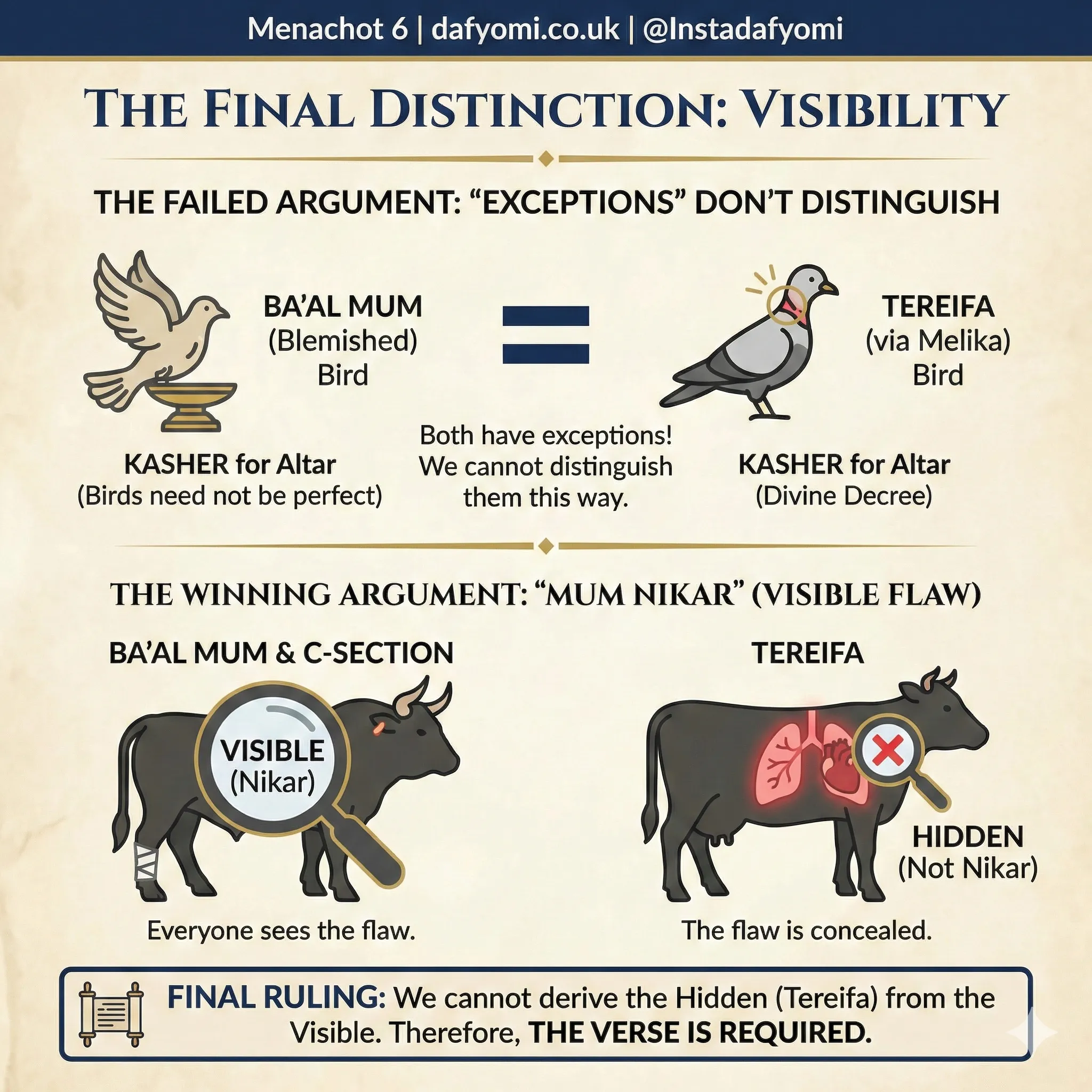
וְאֶלָּא פָּרֵיךְ הָכִי: מָה לְהַצַּד הַשָּׁוֶה שֶׁבָּהֶן שֶׁכֵּן מוּמָן נִיכָּר, תֹּאמַר בִּטְרֵיפָה שֶׁכֵּן אֵין מוּמָהּ נִיכָּר!
English Translation:
Rather, refute the a fortiori inference like this: What is notable about their common element? It is notable in that with regard to both a blemished animal and one born by caesarean section, their blemish is noticeable, as a blemished animal is visibly blemished and it is well known when an animal is born by caesarean section. Will you say that they can serve as the source of the halakha of a tereifa, whose blemish is not necessarily noticeable?
קלאוד על הדף:
The Gemara settles on a different refutation: baal mum and yotzei dofen both have VISIBLE defects. A tereifa’s defect may be internal and invisible. This difference prevents deriving tereifa from them, necessitating a verse.
Key Terms:
- מומן ניכר = Their blemish is noticeable
- אין מומה ניכר = Its blemish is not noticeable
Segment 19
TYPE: גמרא – מסקנה
Conclusion: A verse is necessary
Hebrew/Aramaic:
מִשּׁוּם הָכִי אִיצְטְרִיךְ קְרָא.
English Translation:
Due to that reason, the verse “Of the herd” was necessary, to teach that a tereifa is unfit for sacrifice.
קלאוד על הדף:
The conclusion: since no logical derivation can withstand scrutiny, the verse “min habakar” (from the cattle) is necessary to teach that tereifa is unfit for sacrifice.
Segment 20
TYPE: גמרא – קושיא
Question: Isn’t there another source for tereifa’s disqualification?
Hebrew/Aramaic:
וּטְרֵיפָה מֵהָכָא נָפְקָא? מֵהָתָם נָפְקָא: ״מִמַּשְׁקֵה יִשְׂרָאֵל״ – מִן הַמּוּתָּר לְיִשְׂרָאֵל!
English Translation:
But is the halakha that a tereifa is unfit for sacrifice derived from here? It is derived from there, i.e., from the verse: “From the well-watered pastures of Israel” (Ezekiel 45:15), from which it is derived that an offering may be brought only from that which is permitted to the Jewish people.
קלאוד על הדף:
The Gemara challenges: we already have a verse teaching this! “Mimashkeh Yisrael” teaches that offerings must come from what is permitted to Jews – which excludes tereifa. Why do we need “min habakar”?
Key Terms:
- ממשקה ישראל = From the well-watered pastures of Israel (Ezekiel 45:15)
Segment 21
TYPE: גמרא – קושיא נוספת
Another potential source – the rod verse
Hebrew/Aramaic:
מִ״כֹּל אֲשֶׁר יַעֲבוֹר תַּחַת הַשָּׁבֶט״ – נָפְקָא, פְּרָט לַטְּרֵיפָה שֶׁאֵינָהּ עוֹבֶרֶת.
English Translation:
Alternatively, this halakha can be derived from a verse discussing animal tithe offerings: “Whatever passes under the rod, the tenth shall be holy for the Lord” (Leviticus 27:32). This teaches that all animals may be sacrificed as the animal tithe, excluding a tereifa, as it does not pass under the rod on account of its weakness.
קלאוד על הדף:
Yet another source: the verse about maaser beheimah (animal tithe) says “whatever passes under the rod.” A weak tereifa cannot walk under the rod, so it’s excluded. From here the disqualification was extended to all offerings.
Key Terms:
- כל אשר יעבור תחת השבט = Whatever passes under the rod
- מעשר בהמה = Animal tithe
Segment 22
TYPE: גמרא – תירוץ
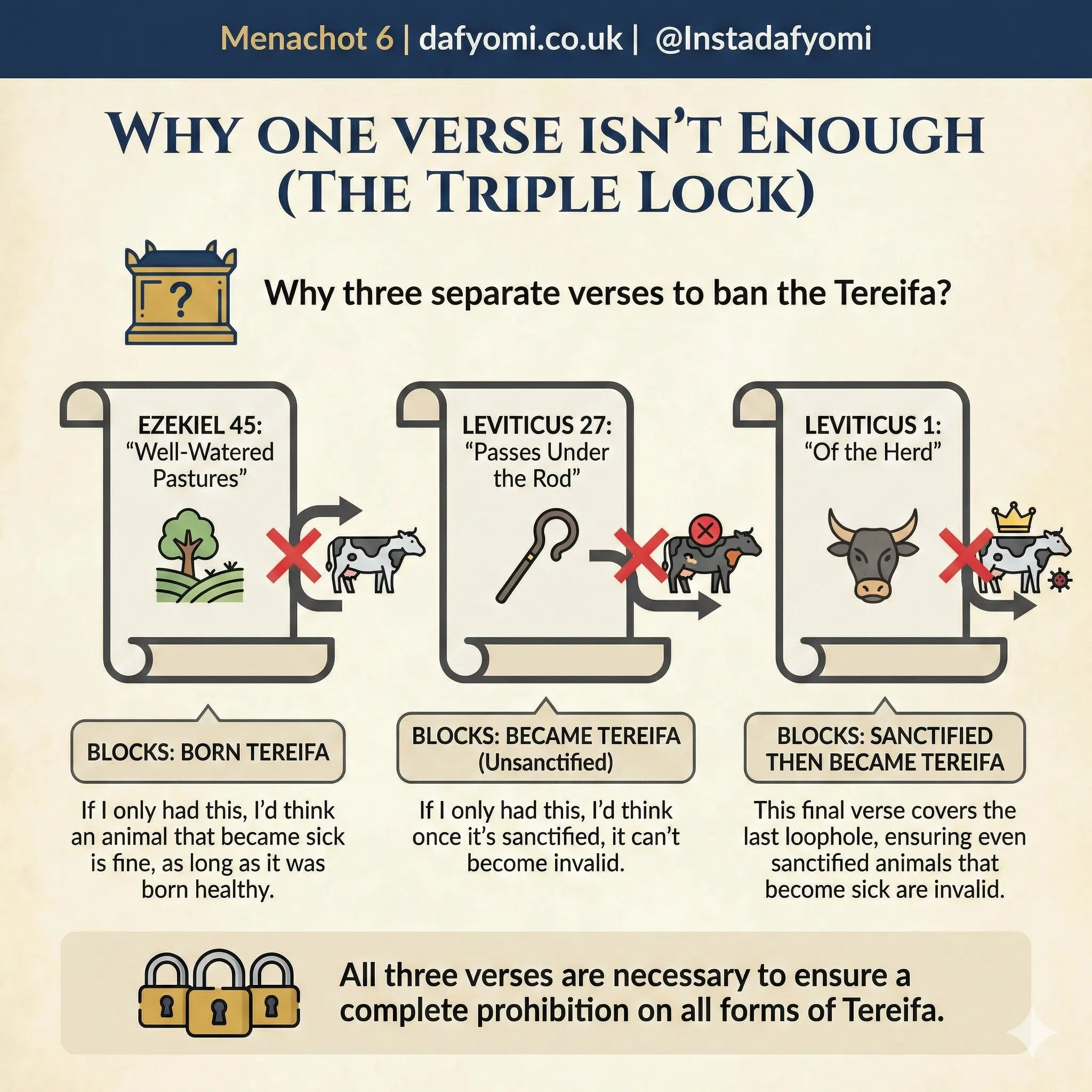
Resolution: All three verses are necessary
Hebrew/Aramaic:
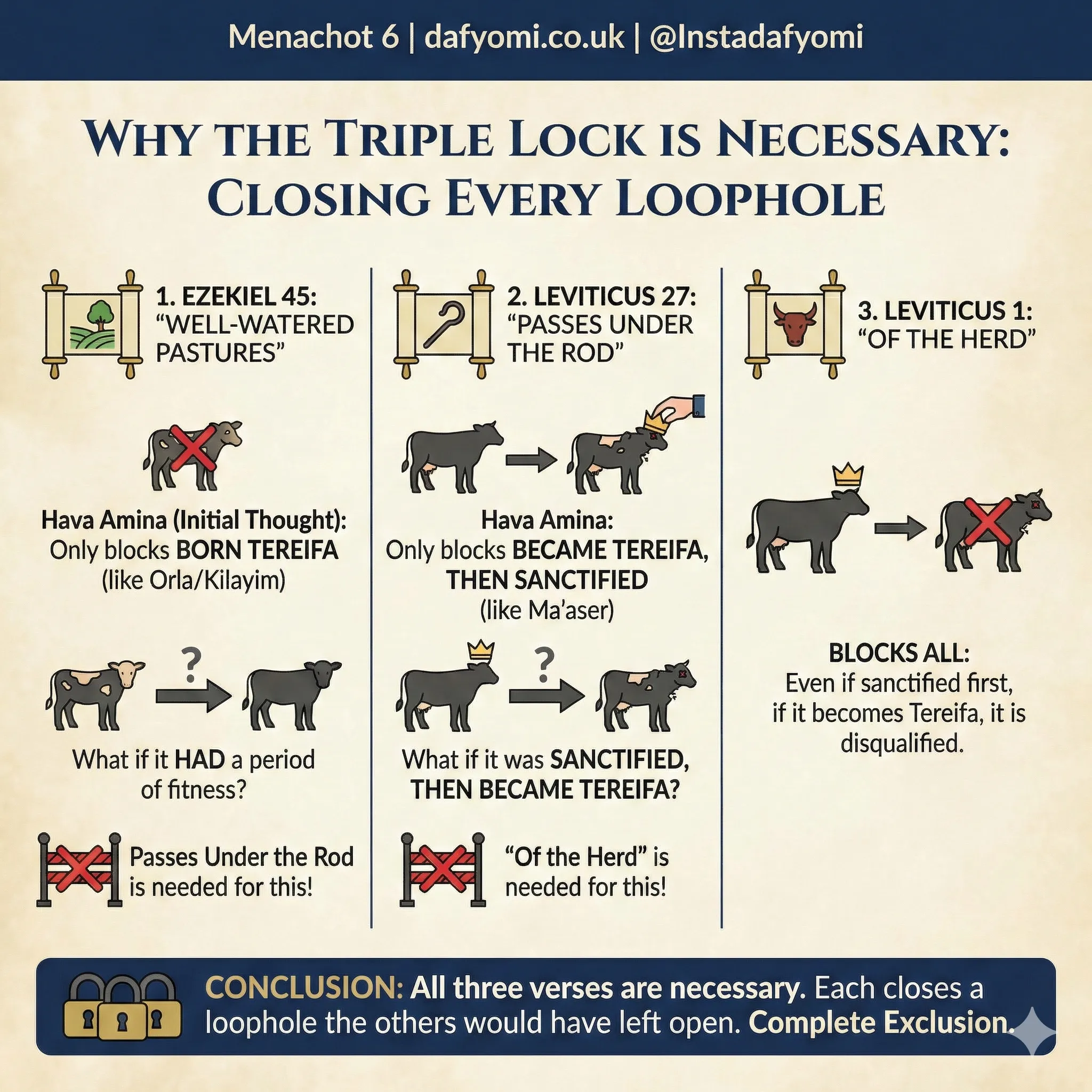
צְרִיכִי, דְּאִי מִ״מַּשְׁקֵה יִשְׂרָאֵל״ הֲוָה אָמֵינָא לְמַעוֹטֵי הֵיכָא דְּלֹא הָיְתָה לָהּ שְׁעַת הַכּוֹשֶׁר.
English Translation:
All of these verses are necessary. Because if the disqualification of a tereifa was derived from the verse “the well-watered pastures of Israel,” I would say that this verse serves to exclude a tereifa only in a case where it did not have a period of fitness, e.g., if it was born a tereifa and was therefore never fit.
קלאוד על הדף:
The Gemara resolves: all three verses are necessary for different scenarios. “Mimashkeh Yisrael” only teaches about an animal that was NEVER fit (born tereifa) – similar to orlah and kilayim which are forbidden from the start.
Key Terms:
- שעת הכושר = A period of fitness
- ערלה = Orlah (fruit from a tree’s first three years)
- כלאי הכרם = Diverse kinds planted in a vineyard
Segment 23
TYPE: גמרא – תירוץ (המשך)
Why the “passing under rod” verse is needed
Hebrew/Aramaic:
דֻּמְיָא דְּעׇרְלָה וְכִלְאֵי הַכֶּרֶם, אֲבָל הָיְתָה לָהּ שְׁעַת הַכּוֹשֶׁר אֵימָא תִּתַּכְשַׁר, כְּתַב רַחֲמָנָא ״כׇּל אֲשֶׁר יַעֲבוֹר״.
English Translation:
This is similar to the case of the fruit of a tree during the first three years after its planting [orla] and diverse kinds planted in a vineyard, whose disqualification is derived from this verse. But with regard to a tereifa that had a period of fitness, one might say that it should be fit. Therefore, the Merciful One writes: “Whatever passes under the rod.”
קלאוד על הדף:
If we only had the first verse, we’d think an animal that BECAME tereifa after being healthy would still be valid. The “rod” verse teaches otherwise – even an animal that was once fit is disqualified if it’s now a tereifa.
Segment 24
TYPE: גמרא – תירוץ (המשך)
Why the “from the cattle” verse is still needed
Hebrew/Aramaic:
וְאִי כְּתַב רַחֲמָנָא ״כׇּל אֲשֶׁר יַעֲבוֹר״, הֲוָה אָמֵינָא לְמַעוֹטֵי הֵיכָא דְּנִטְרְפָה וּלְבַסּוֹף הִקְדִּישָׁהּ.
English Translation:
And if the Merciful One had written only: “Whatever passes under the rod,” I would say that this verse serves to exclude a tereifa only where it was rendered a tereifa and its owner subsequently sanctified it.
קלאוד על הדף:
The “rod” verse might only apply to an animal that became tereifa BEFORE sanctification (like maaser, where the animal isn’t sanctified until selected). What about an animal sanctified first, then became tereifa?
Segment 25
TYPE: גמרא – תירוץ (המשך)
The final scenario requiring “min habakar”
Hebrew/Aramatic:
דֻּמְיָא דְּמַעֲשֵׂר. אֲבָל הִקְדִּישָׁהּ וּלְבַסּוֹף נִטְרְפָה, דִּבְעִידָּנָא דְּאַקְדְּשַׁהּ הֲוָה חַזְיָא, אֵימָא תִּתַּכְשַׁר.
English Translation:
This is similar to the case of animal tithes, as this verse is teaching that a tereifa cannot be subsequently sanctified as a tithe. But if the owner sanctified it and it was subsequently rendered a tereifa, which means that at the time when it was sanctified it was fit, one might say that it should be fit.
קלאוד על הדף:
The “rod” verse is limited to the maaser context – where the animal becomes tereifa before designation. An animal sanctified while healthy, then injured, might still be valid. Hence “min habakar” teaches that even this animal is disqualified.
Segment 26
TYPE: גמרא – מסקנה
Conclusion: All three verses are necessary
Hebrew/Aramaic:
כְּתַב רַחֲמָנָא ״מִן הַבָּקָר״, צְרִיכִי.
English Translation:
Therefore, the Merciful One wrote: “Of the herd,” to teach that even an animal that became a tereifa after it was already sanctified is unfit for sacrifice. Accordingly, all three verses are necessary.
קלאוד על הדף:
Three scenarios requiring three verses:
- Mimashkeh Yisrael – Born tereifa, never fit
- Kol asher ya’avor – Became tereifa before sanctification
- Min habakar – Sanctified, then became tereifa
Segment 27
TYPE: משנה
The Mishna: Disqualifications for removing the handful
Hebrew/Aramaic:
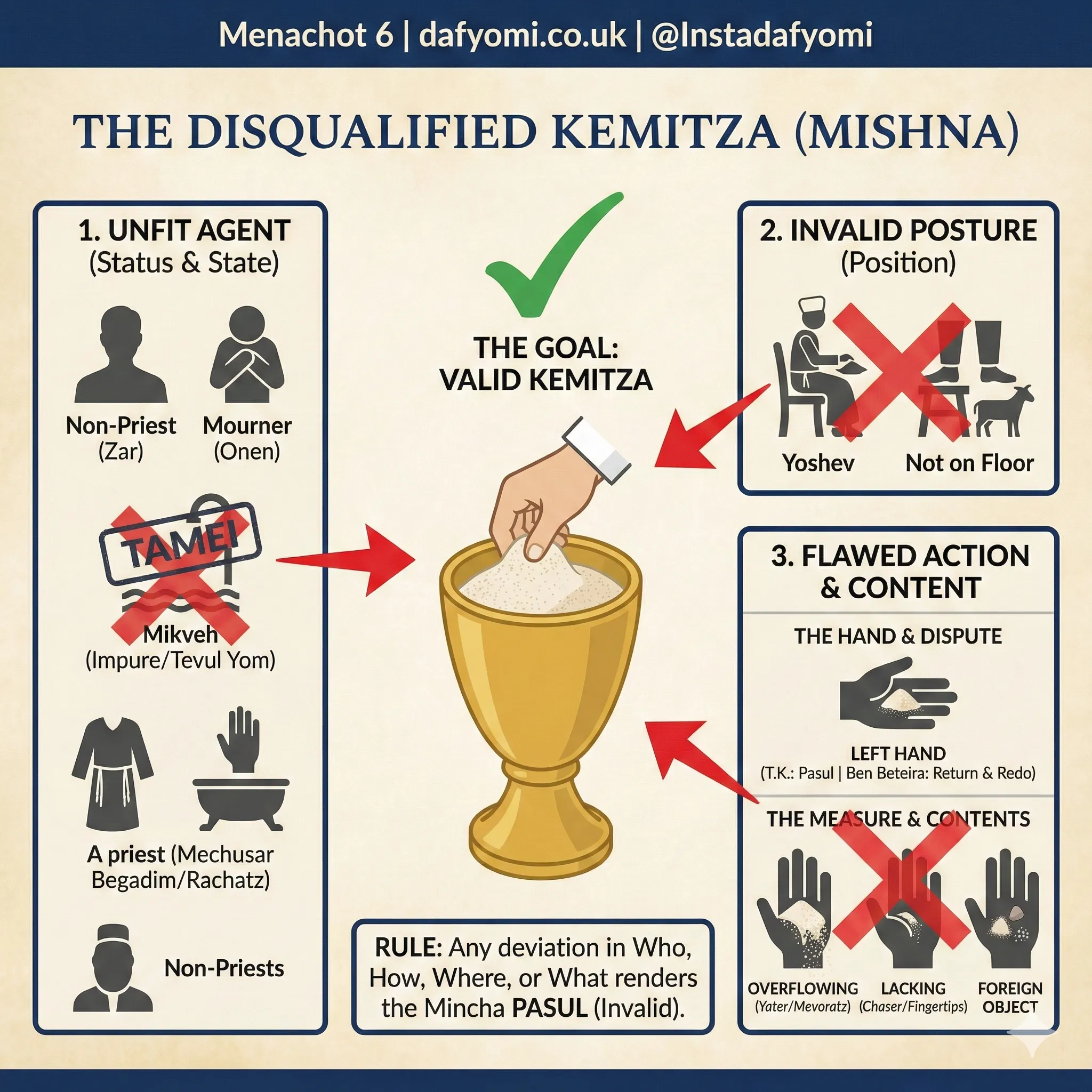
אֶחָד מִנְחַת חוֹטֵא וְאֶחָד כׇּל הַמְּנָחוֹת, שֶׁקְּמָצָן זָר, אוֹנֵן, טְבוּל יוֹם, מְחוּסַּר בְּגָדִים, מְחוּסַּר כִּיפּוּרִים.
English Translation:
MISHNA: Both the meal offering of a sinner and all other meal offerings with regard to which the one who removed their handful was a non-priest, or a priest who was an acute mourner, i.e., whose relative died and was not yet buried, or a priest who was ritually impure who immersed that day and was waiting for nightfall for the purification process to be completed, or a priest lacking the requisite priestly vestments, or a priest who had not yet brought an atonement offering to complete the purification process…
קלאוד על הדף:
The Mishna begins a new topic: disqualifications for kemitza (removing the handful from a meal offering). It lists categories of people whose kemitza invalidates the mincha.
Key Terms:
- מנחת חוטא = Meal offering of a sinner
- קמיצה = Removing the handful
- זר = Non-priest
- אונן = Acute mourner
- טבול יום = One who immersed that day (awaiting nightfall)
- מחוסר בגדים = Lacking priestly vestments
- מחוסר כיפורים = Lacking atonement offering
Segment 28
TYPE: משנה (המשך)
Continuation of disqualifying conditions
Hebrew/Aramaic:
שֶׁלֹּא רָחַץ יָדָיו וְרַגְלָיו, עָרֵל, טָמֵא, יוֹשֵׁב, עוֹמֵד עַל גַּבֵּי כֵלִים, עַל גַּבֵּי בְהֵמָה, עַל גַּבֵּי רַגְלֵי חֲבֵירוֹ – פָּסוּל.
English Translation:
…or a priest who did not wash his hands and feet from the water in the Basin prior to performing the Temple service, or an uncircumcised priest, or a ritually impure priest, or a priest who removed the handful while sitting, or while standing not on the floor of the Temple but upon vessels, or upon an animal, or upon the feet of another person; in all these cases the meal offerings are unfit for sacrifice.
קלאוד על הדף:
The Mishna continues: additional disqualifications include not washing at the kiyor, being uncircumcised, being impure, sitting during service, or not standing directly on the Temple floor.
Key Terms:
- רחיצת ידים ורגלים = Washing hands and feet
- ערל = Uncircumcised
- טמא = Ritually impure
- יושב = Sitting
- עומד על גבי כלים = Standing on vessels
Segment 29
TYPE: משנה (המשך)
The left-hand dispute
Hebrew/Aramaic:
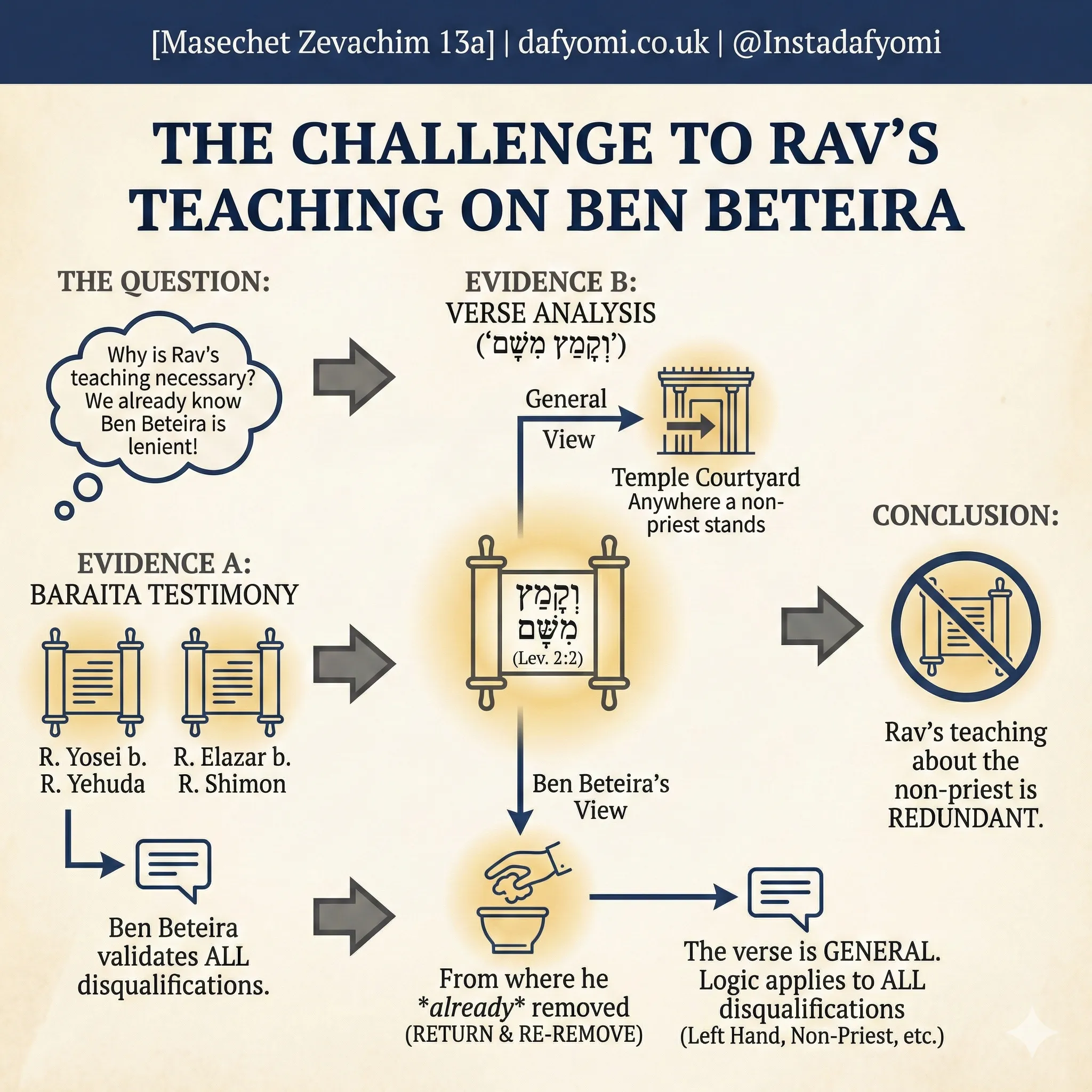
קָמַץ בִּשְׂמֹאל – פָּסוּל, בֶּן בְּתִירָא אוֹמֵר: יַחְזִיר וְיַחֲזוֹר וְיִקְמוֹץ בְּיָמִין.
English Translation:
If the priest removed the handful with his left hand the meal offering is unfit. Ben Beteira says: He must return the handful to the vessel that contains the meal offering and again remove the handful, this time with his right hand.
קלאוד על הדף:
A dispute: the Sages say kemitza with the left hand disqualifies permanently. Ben Beteira disagrees – the kohen can return the flour and redo the kemitza correctly with his right hand.
Key Terms:
- שמאל = Left hand
- ימין = Right hand
- בן בתירא = Ben Beteira (Tanna)
Segment 30
TYPE: משנה (המשך)
Foreign objects in the handful
Hebrew/Aramaic:
קָמַץ וְעָלָה בְּיָדוֹ צְרוֹר, אוֹ גַרְגֵּר מֶלַח, אוֹ קוֹרֶט שֶׁל לְבוֹנָה – פָּסוּל.
English Translation:
If a priest removed the handful of flour, and a stone, a grain of salt, or a pinch [koret] of frankincense emerged in his hand, the meal offering is unfit due to the fact that the Sages said: The handful that is outsized or that is lacking is unfit.
קלאוד על הדף:
If foreign objects (stone, salt, frankincense) are in the handful, the mincha is pasul because the requisite measure of pure flour is lacking.
Key Terms:
- צרור = Stone/pebble
- גרגר מלח = Grain of salt
- קורט של לבונה = Pinch of frankincense
Segment 31
TYPE: משנה (המשך)
Definition of outsized and lacking handfuls
Hebrew/Aramaic:
מִפְּנֵי שֶׁאָמְרוּ: הַקּוֹמֶץ הַיָּתֵר וְהֶחָסֵר – פָּסוּל. וְאֵיזֶהוּ הַיָּתֵר – שֶׁקְּמָצוֹ מְבוֹרָץ.
English Translation:
The existence of one of these foreign items in the handful means that the requisite measure of flour is lacking. And which is the outsized handful? It is one where he removed the handful overflowing [mevoratz] in a manner in which his fingers do not hold the flour.
קלאוד על הדף:
The Mishna defines the problematic handfuls. “Outsized” means overflowing beyond what the fingers contain. Both too much and too little invalidate.
Key Terms:
- יתר = Outsized/excessive
- חסר = Lacking/deficient
- מבורץ = Overflowing
Segment 32
TYPE: משנה (סיום)
Definition of lacking handful
Hebrew/Aramaic:
וְחָסֵר – שֶׁקְּמָצוֹ בְּרָאשֵׁי אֶצְבְּעוֹתָיו.
English Translation:
And which is the lacking handful? It is one where he removed the handful with the tips of his fingers.
קלאוד על הדף:
“Lacking” means the kohen only used his fingertips instead of his full palm and closed fingers. The handful must be a proper kometz – neither too much nor too little.
Key Terms:
- ראשי אצבעותיו = Tips of his fingers
Segment 33
TYPE: גמרא
Question on the Mishna’s formulation
Hebrew/Aramaic:
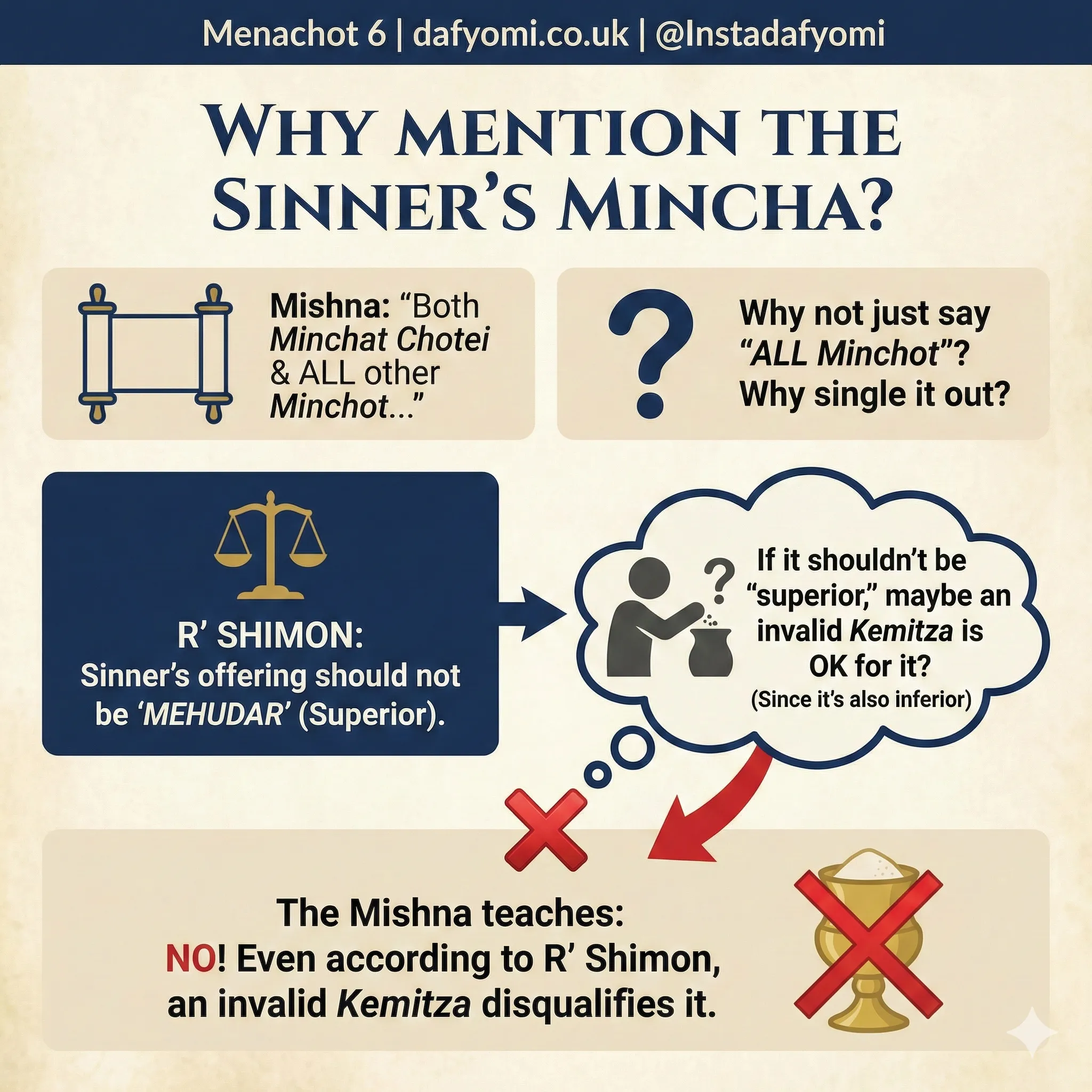
לְמָה לִי לְמִתְנָא ״אֶחָד מִנְחַת חוֹטֵא וְאֶחָד כׇּל הַמְּנָחוֹת״?
English Translation:
GEMARA: The Gemara asks: Why do I need the mishna to teach: “Both the meal offering of a sinner and all other meal offerings”?
קלאוד על הדף:
The Gemara questions the Mishna’s redundant language. Why specify “minachat chotei” AND “all menachot”? Wouldn’t “all menachot” include the sinner’s offering?
Segment 34
TYPE: גמרא – קושיא
Restating the question
Hebrew/Aramaic:
לִיתְנֵי ״כׇּל הַמְּנָחוֹת שֶׁקְּמָצָן זָר וְאוֹנֵן״!
English Translation:
Let it teach: “All the meal offerings with regard to which the one who removed their handful was a non-priest or an acute mourner.” Why does the mishna single out the case of the meal offering of a sinner?
קלאוד על הדף:
Simply saying “all menachot” would suffice. Why specifically mention the sinner’s mincha?
Segment 35
TYPE: גמרא – תירוץ
Answer: According to Rabbi Shimon
Hebrew/Aramaic:
לְרַבִּי שִׁמְעוֹן אִיצְטְרִיךְ, דְּתַנְיָא: אָמַר רַבִּי שִׁמְעוֹן: בְּדִין הוּא שֶׁתְּהֵא מִנְחַת חוֹטֵא טְעוּנָה שֶׁמֶן וּלְבוֹנָה.
English Translation:
The Gemara responds: It was necessary for the mishna to teach this halakha in this manner in accordance with the opinion of Rabbi Shimon. As it is taught in a baraita that Rabbi Shimon says: By right the meal offering of a sinner should require oil and frankincense like other meal offerings.
קלאוד על הדף:
The answer: according to Rabbi Shimon, there’s something unique about minachat chotei. Rabbi Shimon holds that logically it SHOULD require oil and frankincense – unlike other menachot.
Key Terms:
- רבי שמעון = Rabbi Shimon
- שמן ולבונה = Oil and frankincense
Segment 36
TYPE: גמרא – ברייתא
Rabbi Shimon’s reasoning
Hebrew/Aramaic:
שֶׁלֹּא יְהֵא חוֹטֵא נִשְׂכָּר, וּמִפְּנֵי מָה אֵינָהּ טְעוּנָה? שֶׁלֹּא יְהֵא קׇרְבָּנוֹ מְהוּדָּר.
English Translation:
So that the sinner will not profit. And for what reason does it not require oil and frankincense? So that his offering will not be of superior quality.
קלאוד על הדף:
Rabbi Shimon explains: the sinner SHOULD have to bring oil and frankincense so he doesn’t “profit” by bringing a cheaper offering than innocent people. But God waived this requirement so the sinner’s offering wouldn’t be fancy – balancing the competing concerns.
Key Terms:
- חוטא נשכר = The sinner profits
- קרבנו מהודר = His offering is of superior quality
Segment 37
TYPE: גמרא – ברייתא (המשך)
Extension to sin offering requiring libations
Hebrew/Aramaic:
וּבַדִּין הוּא שֶׁתְּהֵא חַטַּאת חֵלֶב טְעוּנָה נְסָכִים,
English Translation:
And likewise, by right the sin offering of forbidden fat, i.e., the offering brought by one who unwittingly ate the forbidden fat of a domesticated animal, should require libations.
קלאוד על הדף:
Rabbi Shimon extends the logic: the chatat brought for accidentally eating cheilev should logically require nesachim (libations). The same reasoning applies – the sinner shouldn’t profit.
Key Terms:
- חטאת חלב = Sin offering for [eating] forbidden fat
- נסכים = Libations
Amud Bet (6b)
Segment 1
TYPE: גמרא – ברייתא (המשך)
Completion of Rabbi Shimon’s reasoning
Hebrew/Aramaic:
שֶׁלֹּא יְהֵא חוֹטֵא נִשְׂכָּר, וּמִפְּנֵי מָה אֵינָהּ טְעוּנָה? שֶׁלֹּא יְהֵא קׇרְבָּנוֹ מְהוּדָּר.
English Translation:
So that the sinner will not profit. And for what reason does his offering not require libations? So that his offering will not be of superior quality.
קלאוד על הדף:
The same logic: nesachim should be required (so the sinner doesn’t save money), but they’re waived (so his offering isn’t fancy). This completes Rabbi Shimon’s principle.
Segment 2
TYPE: גמרא – הוה אמינא
Why the Mishna needed to specify minachat chotei
Hebrew/Aramaic:
סָלְקָא דַּעְתָּךְ אָמֵינָא: הוֹאִיל וְאָמַר רַבִּי שִׁמְעוֹן שֶׁלֹּא יְהֵא קׇרְבָּנוֹ מְהוּדָּר, כִּי קָמְצִי לַהּ פְּסוּלִין נָמֵי תִּתַּכְשַׁר.
English Translation:
Accordingly, it might enter your mind to say that since Rabbi Shimon says: In order that his offering will not be of superior quality, when the handful is removed by one of those unfit for performing the Temple service, the offering should also be valid, as it too is of inferior quality.
קלאוד על הדף:
Now the Gemara explains: we might think that according to Rabbi Shimon, invalid kemitza would be VALID for minachat chotei! Since the goal is that the sinner’s offering shouldn’t be “mehudar,” an inferior kemitza (by a pasul person) achieves this goal!
Segment 3
TYPE: גמרא – קושיא
Challenge: Why doesn’t the same apply to animal offerings?
Hebrew/Aramaic:
אִי הָכִי, הָתָם נָמֵי לִיתְנֵי: אֶחָד חַטַּאת חֵלֶב וְאֶחָד כׇּל הַזְּבָחִים שֶׁקִּבְּלוּ דָּמָן זָר וְאוֹנֵן.
English Translation:
The Gemara asks: If so, then there as well, i.e., with regard to slaughtered offerings, let the mishna teach: Both the sin offering of forbidden fat and all the slaughtered offerings with regard to which the one who collected their blood was a non-priest or an acute mourner, are disqualified.
קלאוד על הדף:
The Gemara challenges: if this logic applies to menachot, it should apply to zevachim too! The chatat for cheilev should similarly validate improper kabalah! But we don’t find such a formulation in the Mishna about zevachim.
Segment 4
TYPE: גמרא – תירוץ
Resolution: The general term includes everything
Hebrew/Aramaic:
אַלְמָא, כֵּיוָן דִּתְנָא לֵיהּ ״כׇּל״ וְלָא קָתָנֵי ״חוּץ״ – כּוּלְּהוּ מַשְׁמַע.
English Translation:
Apparently, since the tanna teaches that mishna with the term: All, and he does not teach: Except, all offerings are indicated by the general disqualification, and there is no need to emphasize the halakha with regard to a sin offering.
קלאוד על הדף:
The Gemara answers: when the zevachim mishna says “all,” it truly means all – no exceptions needed. The menachot mishna specifies “minachat chotei” to counter Rabbi Shimon’s possible sevara. For zevachim, no such clarification is needed.
Segment 5
TYPE: גמרא – אמר רב
Rav’s ruling about returning the handful
Hebrew/Aramaic:
אָמַר רַב: זָר שֶׁקָּמַץ – יַחְזִיר.
English Translation:
Rav says: In the case of a non-priest who removed a handful, he should return the handful to the meal offering.
קלאוד על הדף:
Rav makes an important ruling: if a zar performed kemitza, he returns the flour to the mincha and a kohen can redo it properly. The mincha isn’t permanently invalidated.
Key Terms:
- יחזיר = He should return it
Segment 6
TYPE: גמרא – ביאור
Explaining the Mishna’s “pasul”
Hebrew/Aramaic:
מַאי ״פָּסַל״? פָּסַל עַד שֶׁיַּחֲזִיר.
English Translation:
The Gemara responds: What does the mishna mean when it says: Disqualified? It means that the non-priest has disqualified the meal offering until such time as he returns the handful to the meal offering.
קלאוד על הדף:
Rav reinterprets “pasul” in the Mishna: it doesn’t mean permanently invalid, but rather invalid UNTIL the flour is returned and kemitza is redone properly.
Segment 7
TYPE: גמרא – מחלוקת
When do the Rabbis and Ben Beteira disagree?
Hebrew/Aramaic:
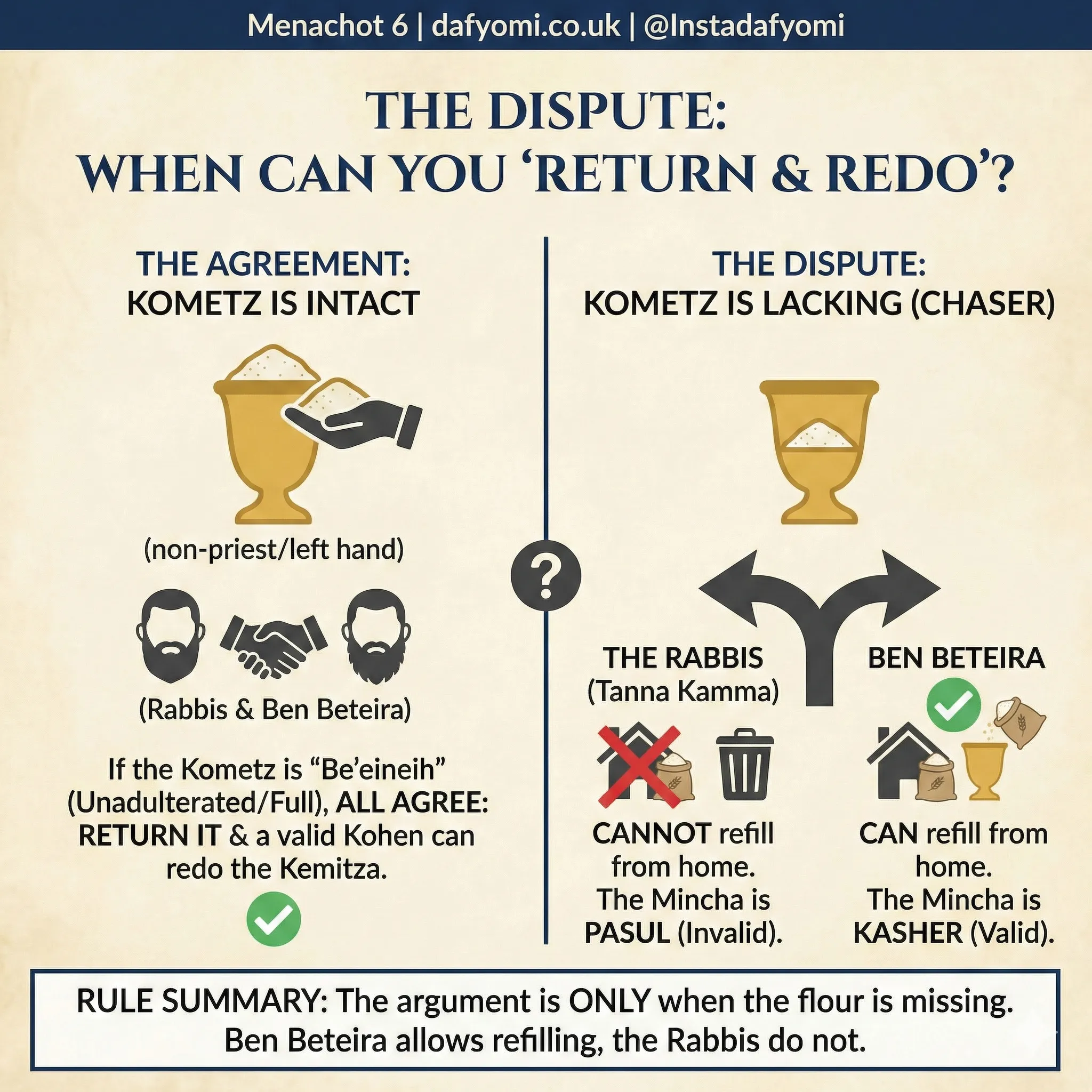
אִי דְּאִיתֵיהּ לְקוֹמֶץ בְּעֵינֵיהּ – לָא פְּלִיגִי רַבָּנַן עֲלֵיהּ דְּבֶן בְּתִירָא.
English Translation:
If the handful that was removed by one unfit for Temple service is in its unadulterated form, then the Rabbis do not disagree with the opinion of ben Beteira, and the handful is returned.
קלאוד על הדף:
The Gemara clarifies: when the kometz is intact and complete, even the Rabbis agree with Ben Beteira that it can be returned. The dispute is only about a different case.
Segment 8
TYPE: גמרא – מחלוקת (המשך)
The actual dispute: lacking handful
Hebrew/Aramaic:
כִּי פְּלִיגִי – דַּחֲסַר קוֹמֶץ. רַבָּנַן סָבְרִי: לָא יָבִיא מִתּוֹךְ בֵּיתוֹ וִימַלְּאֶנּוּ.
English Translation:
They disagree when the handful is lacking. The Rabbis hold: One does not bring flour from within his house and refill the vessel containing the handful.
קלאוד על הדף:
The dispute is when the handful is deficient. The Rabbis say you cannot add outside flour to complete it. Ben Beteira presumably allows completion. Rav’s ruling about returning applies to an intact handful.
Key Terms:
- חסר קומץ = Lacking/deficient handful
- לא יביא מתוך ביתו = He may not bring from his house
Segment 9
TYPE: גמרא – חידוש
What Rav’s statement teaches
Hebrew/Aramaic:
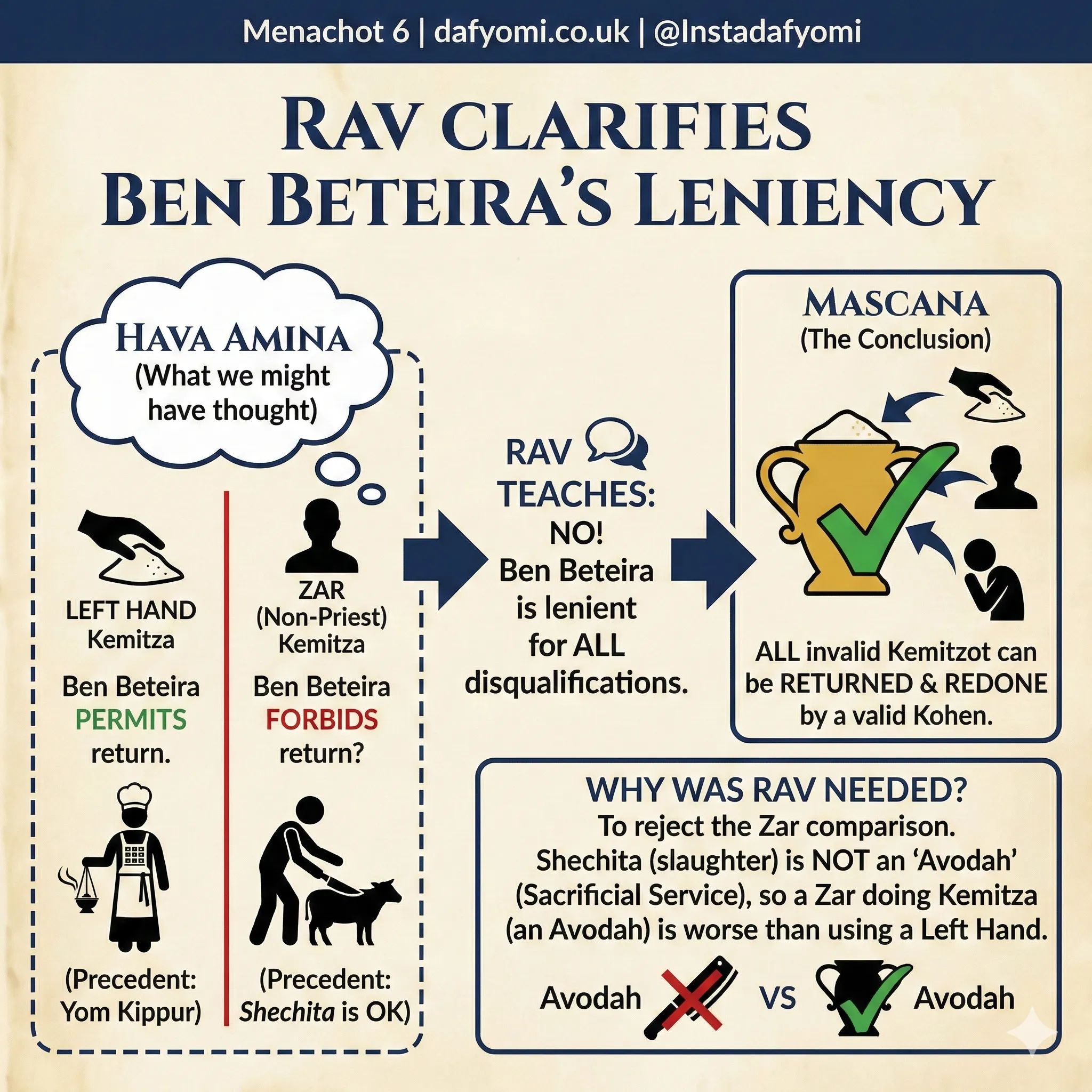
מַהוּ דְּתֵימָא: עַד כָּאן לָא קָא מַכְשַׁר בֶּן בְּתִירָא אֶלָּא בִּשְׂמֹאל, אֲבָל בִּשְׁאָר פְּסוּלִין לָא, קָא מַשְׁמַע לַן.
English Translation:
Rav’s statement is necessary lest you say that ben Beteira deems the meal offering fit only when the handful was removed with one’s left hand, but with regard to other disqualifications, he does not deem it fit. Rav teaches us that ben Beteira’s leniency extends to all disqualifications.
קלאוד על הדף:
Rav’s chiddush: we might think Ben Beteira only allows returning the kometz in the left-hand case specifically (mentioned in the Mishna). Rav teaches that Ben Beteira’s principle applies to all types of invalid kemitza.
Segment 10
TYPE: גמרא
Shechita is not considered avodah
Hebrew/Aramaic:
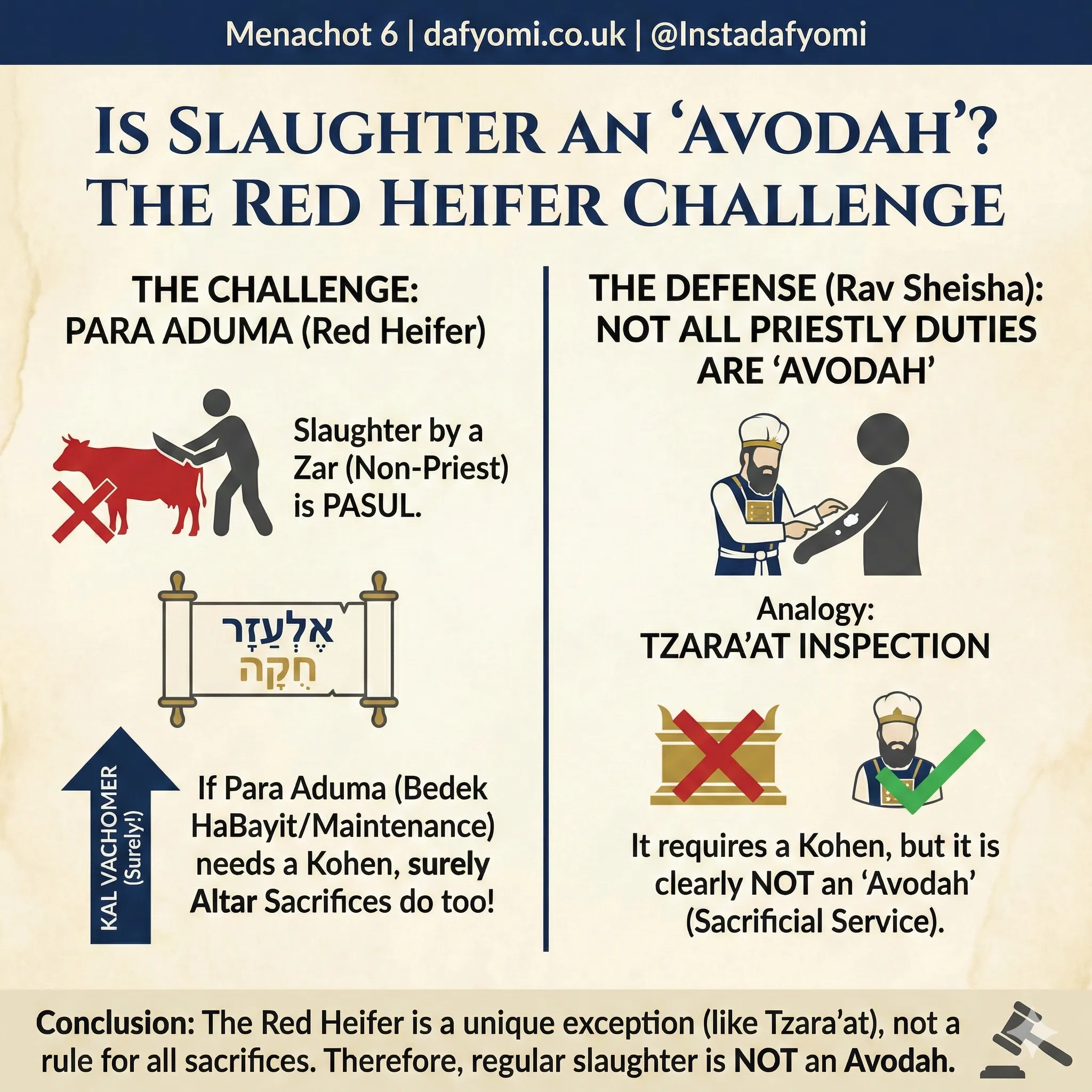
שְׁחִיטָה לָאו עֲבוֹדָה הִיא.
English Translation:
Slaughter is not considered a sacrificial rite, and it is for that reason that a non-priest may slaughter an offering.
קלאוד על הדף:
The Gemara mentions an important principle: shechita is not classified as an “avodah” (Temple service). Therefore, a zar (non-priest) may perform shechita on korbanot. This contrasts with kemitza, which IS an avodah.
Key Terms:
- שחיטה = Slaughter
- עבודה = Temple service
Segment 11
TYPE: גמרא
The red heifer is different
Hebrew/Aramaic:
שָׁאנֵי פָּרָה, דְּקׇדְשֵׁי בֶּדֶק הַבַּיִת הִיא.
English Translation:
The halakhot of the red heifer are different, as the heifer is considered sanctified for the purpose of Temple maintenance, not for sacrifice upon the altar.
קלאוד על הדף:
The Gemara distinguishes the parah adumah (red heifer): it’s classified as kodshei bedek habayit (Temple maintenance funds), not kodshei mizbeach (altar offerings). Different rules apply.
Key Terms:
- פרה = Parah adumah (red heifer)
- קדשי בדק הבית = Items sanctified for Temple maintenance
Segment 12
TYPE: גמרא – חידוש
Rav’s broader teaching
Hebrew/Aramaic:
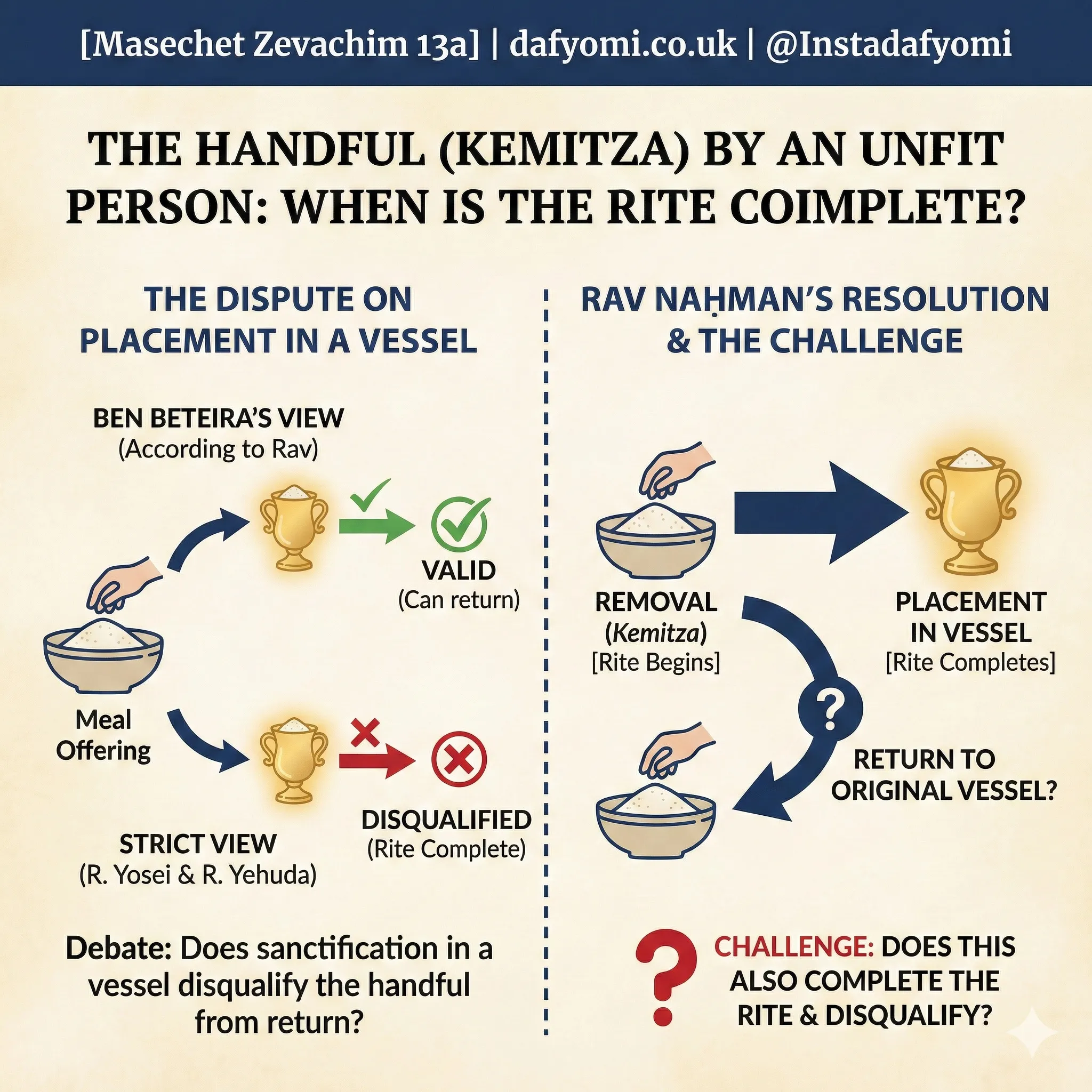
הָא קָמַשְׁמַע לַן רַב: קָמַץ וַאֲפִילּוּ קִידֵּשׁ.
English Translation:
Rather, this is what Rav teaches us: Ben Beteira holds that if one unfit for Temple service removed a handful it may be returned to the meal offering even if he sanctified the handful by placing it in a service vessel.
קלאוד על הדף:
Rav’s bigger chiddush: even if the pasul not only did kemitza but also placed the kometz in a kli sharet (sanctifying it), it can still be returned. The sanctification in the vessel doesn’t create an irreversible status.
Key Terms:
- קידש = Sanctified (by placing in a service vessel)
- כלי שרת = Service vessel
Segment 13
TYPE: גמרא – קושיא
Rav Nachman’s challenge
Hebrew/Aramaic:
מַאי קָא סָבְרִי הָנֵי תַּנָּאֵי? אִי קְמִיצַת פְּסוּלִין עֲבוֹדָה הִיא, אַף עַל גַּב דְּלָא עָבֵיד לֵיהּ מַתַּן כְּלִי!
English Translation:
Rav Nachman objects to this: What do these tanna’im hold? If they hold that the removal of a handful by one unfit for Temple service is considered the performance of a sacrificial rite, then the meal offering should be disqualified even though he did not perform the stage of the placement of the handful in a vessel.
קלאוד על הדף:
Rav Nachman questions the underlying logic: if kemitza by a pasul is considered “avodah,” the mincha should be disqualified the moment the kemitza is done – even without placing in a kli. Why would kidush b’kli make a difference?
Key Terms:
- קמיצת פסולין = Kemitza by disqualified persons
- מתן כלי = Placing in a vessel
Segment 14
TYPE: גמרא – תירוץ
Resolution: The service isn’t complete until vessel placement
Hebrew/Aramaic:
לְעוֹלָם עֲבוֹדָה הִיא, וְלָא גָּמְרָה עֲבוֹדָתָהּ עַד דְּעָבֵיד לֵהּ מַתַּן כְּלִי.
English Translation:
Rav Nachman then said: Actually, those tanna’im hold that the removal of a handful by one unfit for Temple service is considered the performance of a sacrificial rite, but the rite of the handful is not complete until he performs the stage of its placement in a vessel.
קלאוד על הדף:
Rav Nachman resolves: kemitza IS an avodah, but it’s a multi-stage avodah. It only becomes complete and irreversible when the kometz is placed in the kli sharet. Before that, returning the flour is possible.
Key Terms:
- לא גמרה עבודתה = Its service is not complete