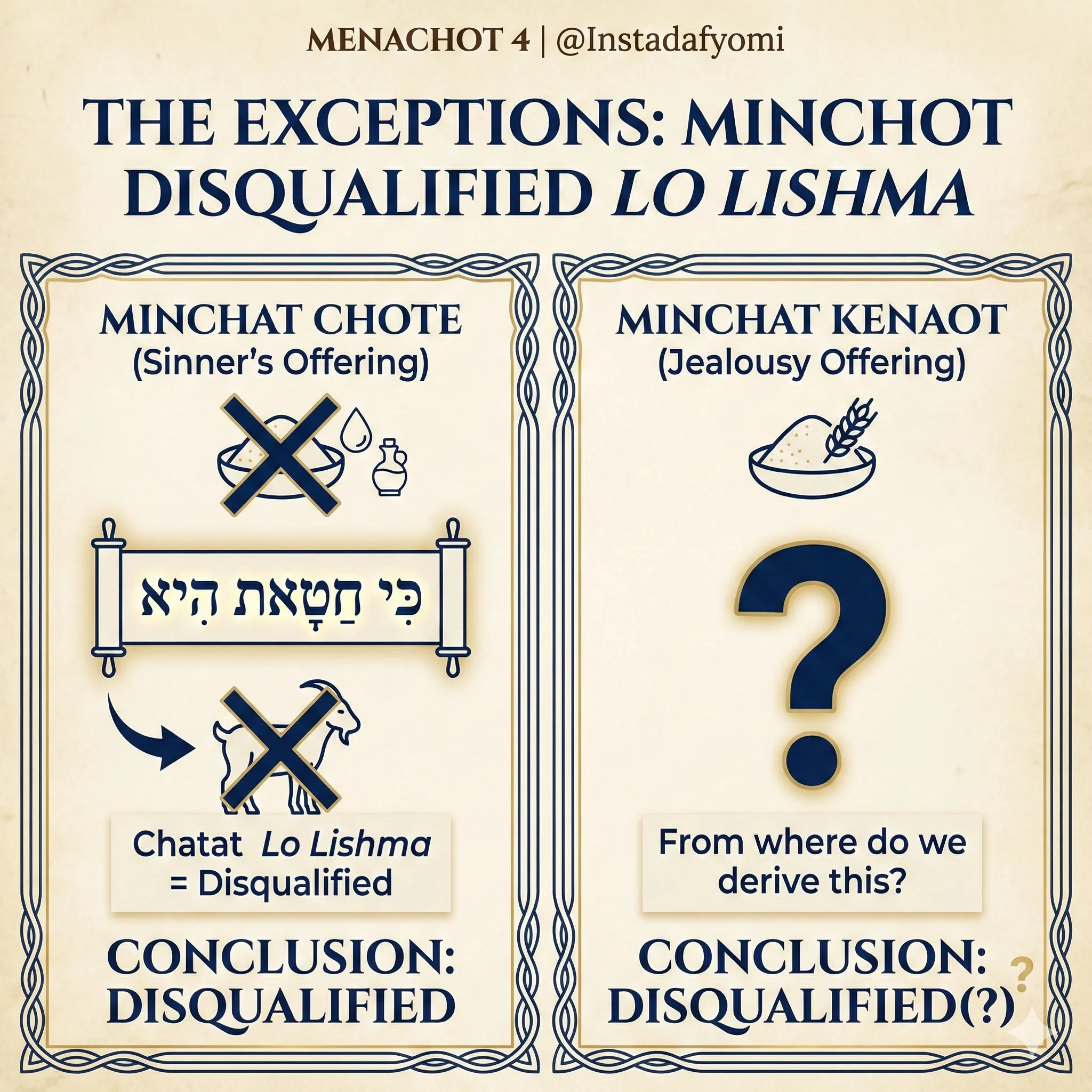
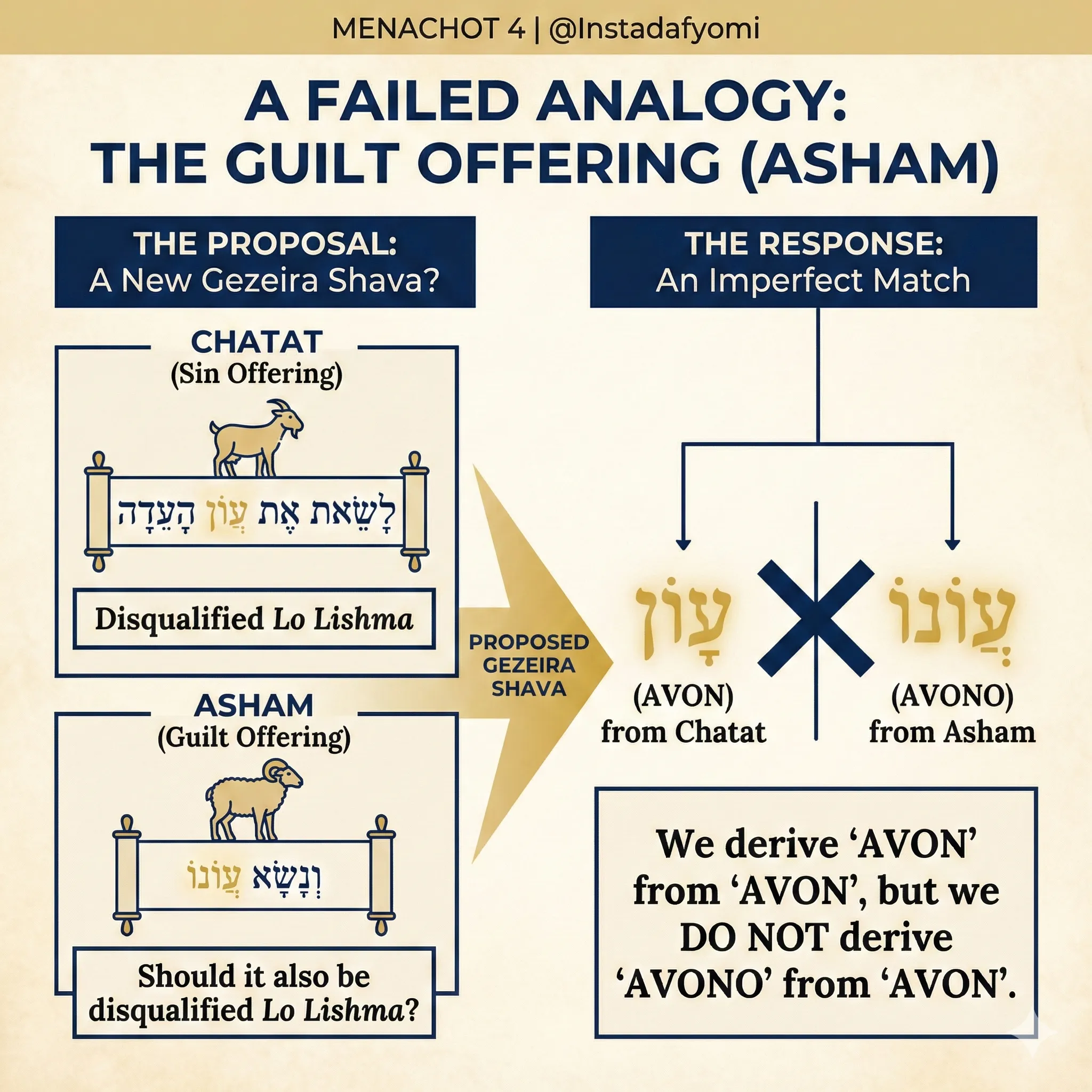
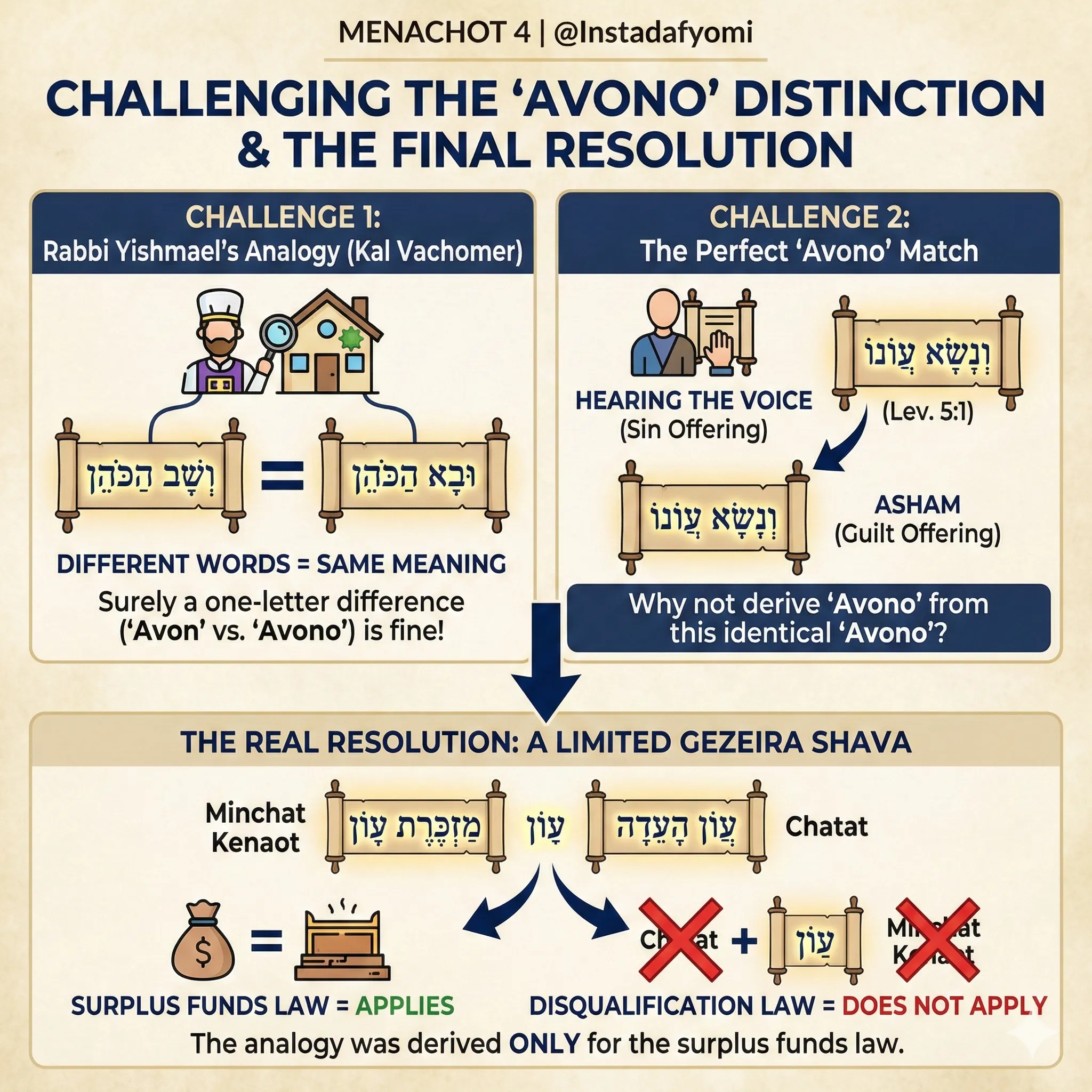
Menachot Daf 4 (מנחות דף ד׳)
Daf: 4 | Amudim: 4a – 4b | Date: January 16, 2026
📖 Breakdown
Amud Aleph (4a)
Segment 1
TYPE: גמרא
Explanation of Rabbi Shimon’s reasoning
Hebrew/Aramaic:
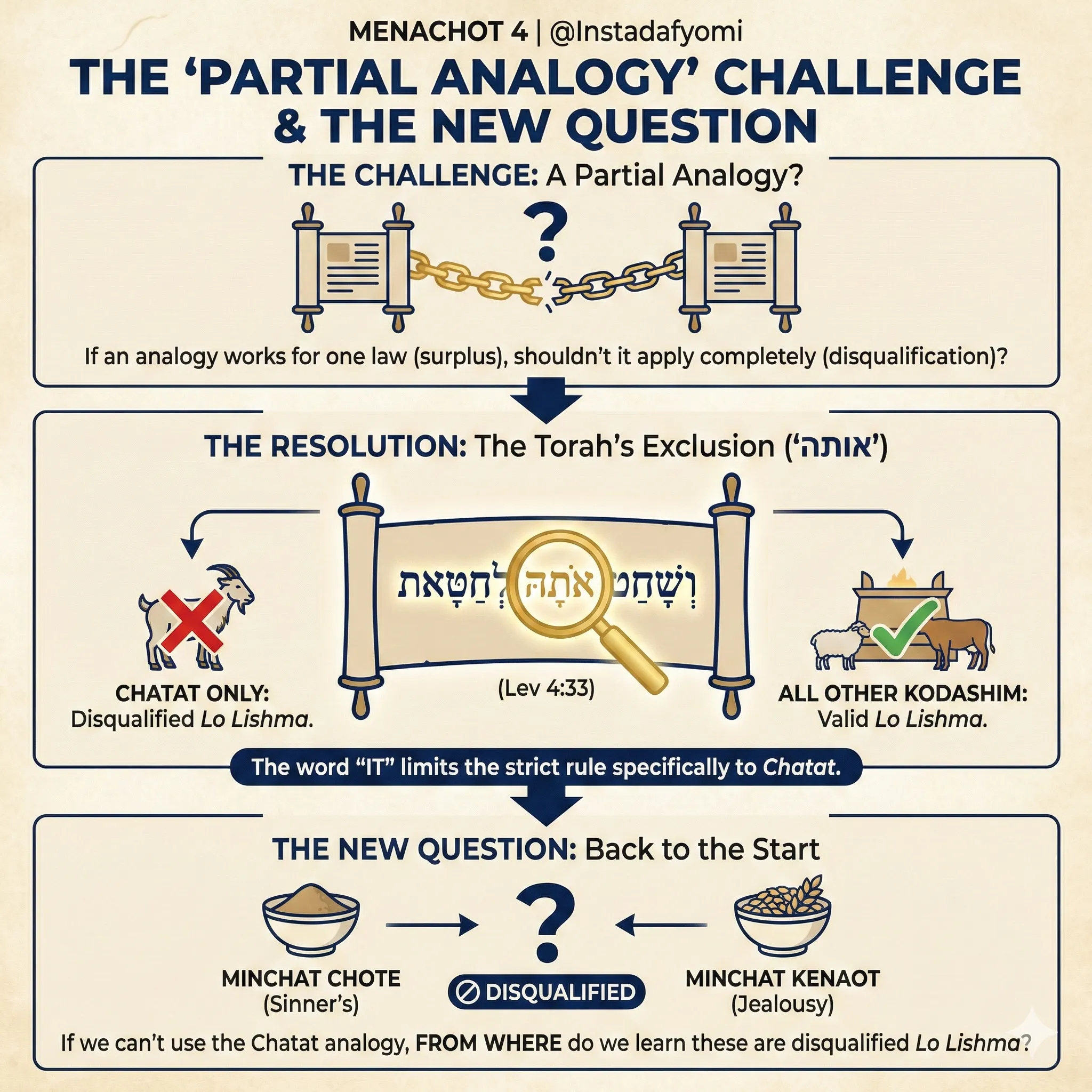
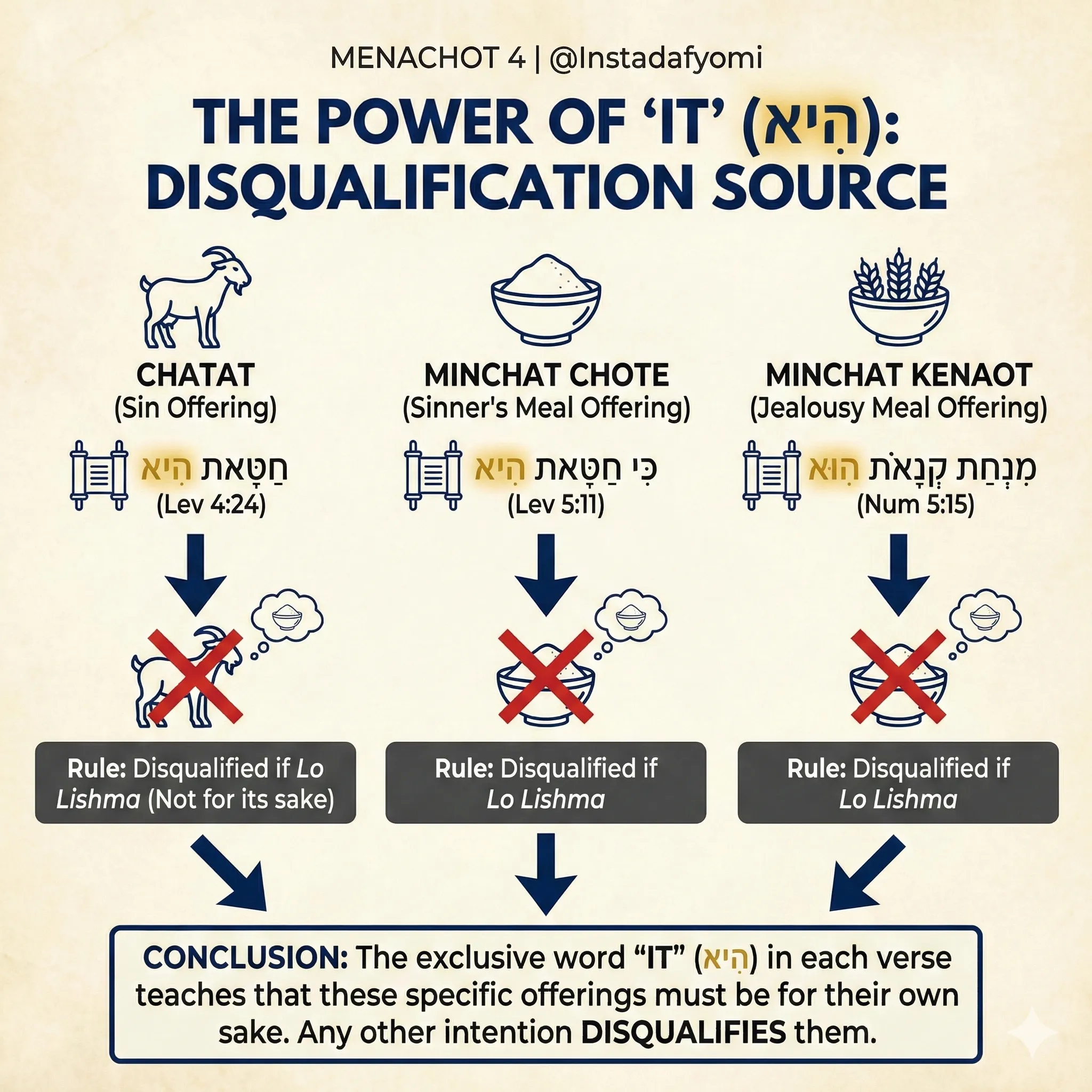
מאי טעמא דרבי שמעון גמר עון עון מתרומה מה התם לא הוזכר חטאת אף הכא לא הוזכר חטאת
English Translation:
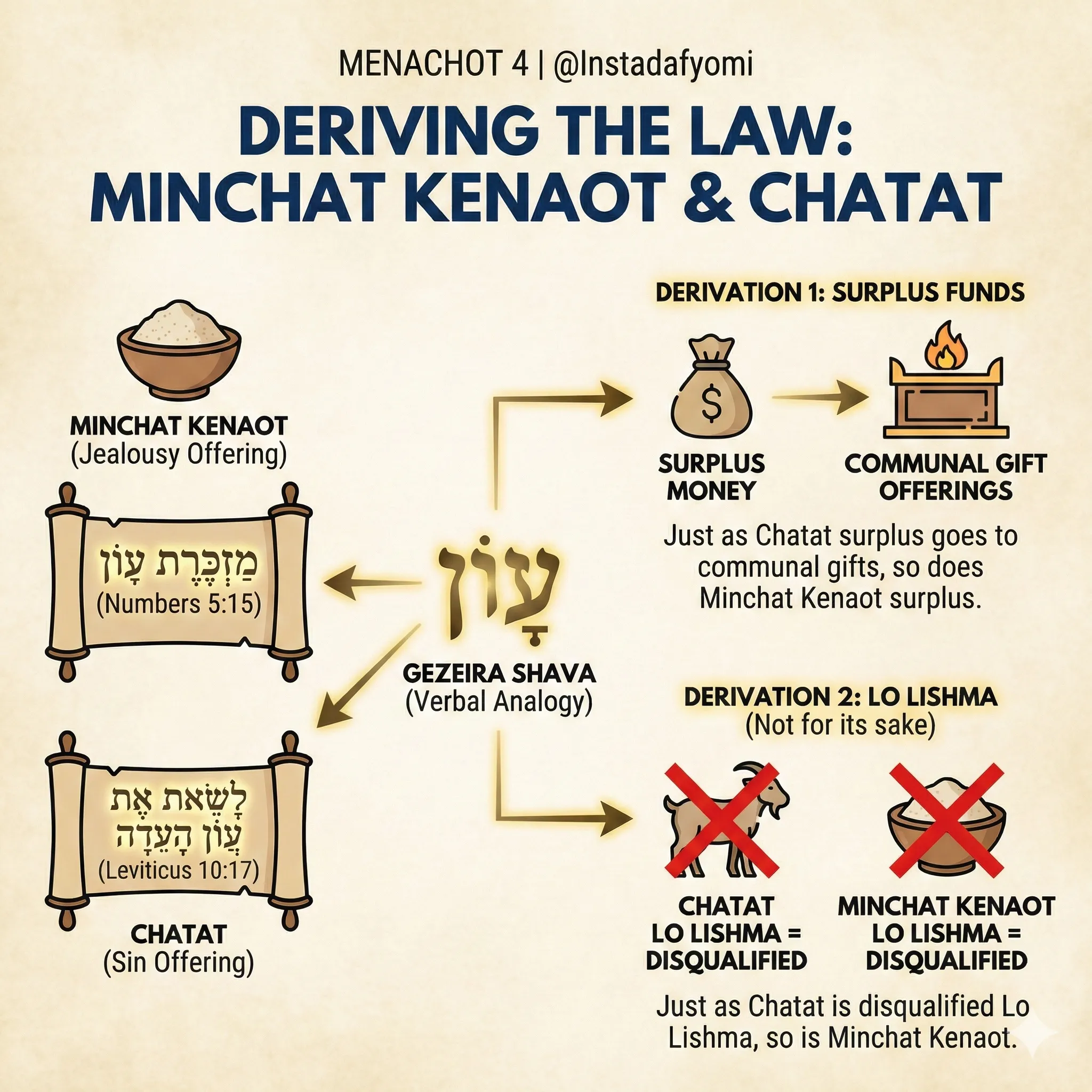
What is the reasoning of Rabbi Shimon? He derives a verbal analogy from the word “iniquity” (avon) written in the context of teruma. Just as there, sin-offering is not mentioned, so too here, sin-offering is not mentioned.
קלאוד על הדף:
The Gemara asks why Rabbi Shimon exempts sin-offerings from the rule of piggul (disqualification through improper intent). Rabbi Shimon uses a gezeirah shavah — a hermeneutical technique that links two passages sharing identical language. The word “avon” appears both regarding teruma (priestly portion) and sacrifices. Since sin-offerings aren’t mentioned in the teruma context, Rabbi Shimon argues they should similarly be exempt from the piggul rule regarding improper intent.
Key Terms:
- גזירה שווה (Gezeirah Shavah) = A hermeneutical principle linking two verses sharing identical words
- עוון (Avon) = Iniquity; used as the linking word in this derivation
- תרומה (Teruma) = The priestly portion separated from produce
Segment 2
TYPE: גמרא
Challenge to Rabbi Shimon’s methodology
Hebrew/Aramaic:
ורבנן ההוא עון עון לגזירה שוה הוא דאתא
English Translation:
And as for the Rabbis, that phrase “iniquity, iniquity” comes for a verbal analogy.
קלאוד על הדף:
The Gemara explains the Rabbis’ (Chakhamim’s) position: they also recognize the gezeirah shavah from “avon,” but they use it differently — to derive a separate law rather than to exclude sin-offerings. This highlights a methodological debate: when the same textual link can teach multiple things, which derivation takes precedence?
Segment 3
TYPE: גמרא
Further elaboration of the derivation
Hebrew/Aramatic:
ואידך עון עון לא משמע ליה
English Translation:
And the other [Rabbi Shimon], the phrase “iniquity, iniquity” does not connote this to him.
קלאוד על הדף:
The Gemara explains that Rabbi Shimon doesn’t interpret the doubled language of “avon, avon” as the Rabbis do. For Rabbi Shimon, the gezeirah shavah specifically excludes sin-offerings from piggul laws. This illustrates how tannaitic debates often hinge not on whether to use a particular hermeneutical tool, but on precisely how to apply it.
Segment 4
TYPE: גמרא
Alternative derivation for Rabbi Shimon
Hebrew/Aramaic:
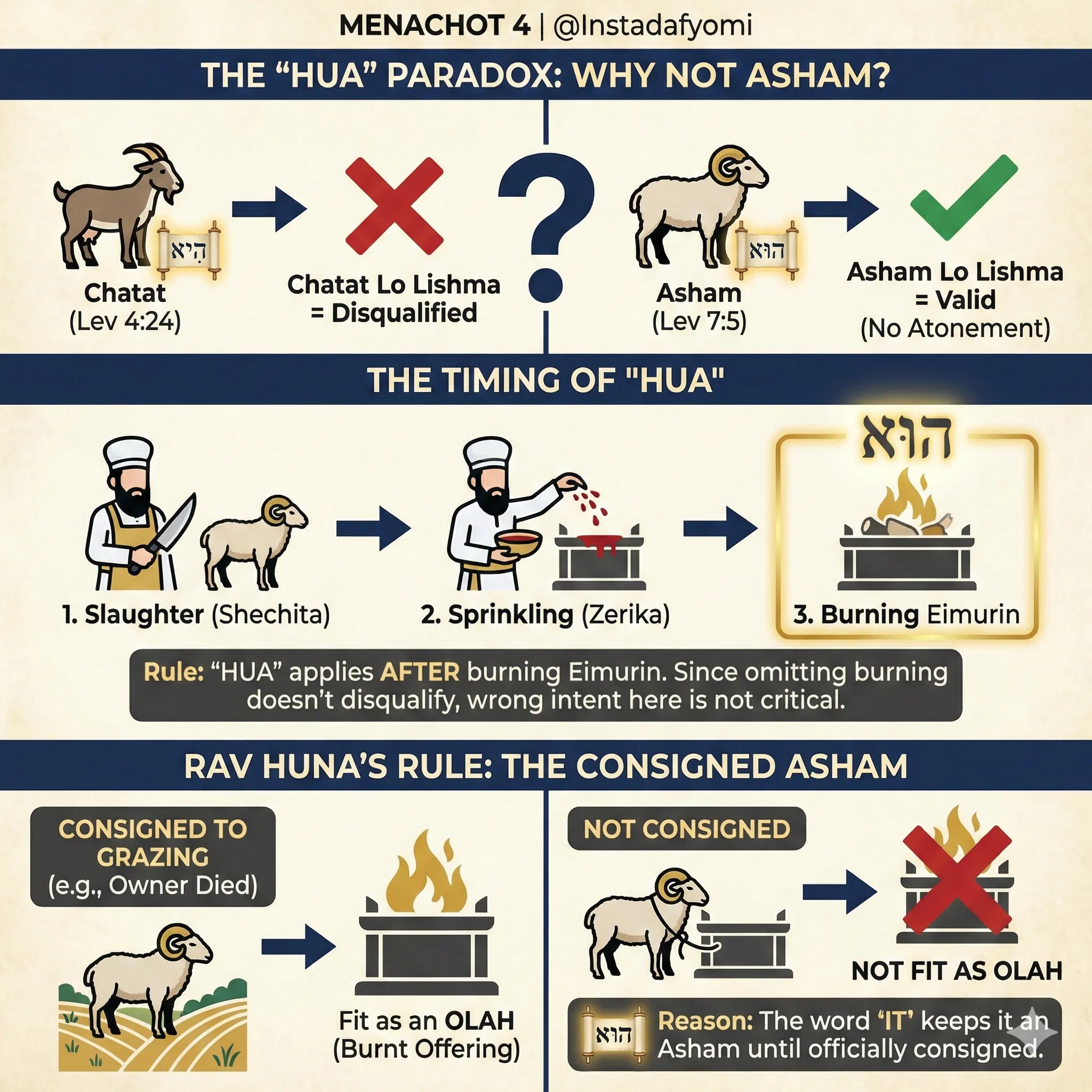
ורבי שמעון האי היא היא מאי עביד ליה מיבעי ליה לכדתניא היא פרט לשחוטה היא פרט לנשחטת
English Translation:
And Rabbi Shimon, what does he do with “she/it” (hi/hu)? He requires it for what was taught in a baraita: “She/it” — this excludes an already slaughtered animal; “she/it” — this excludes one being slaughtered.
קלאוד על הדף:
The Gemara explores another textual element: the word “hi” (she/it) that appears in the verse. Rabbi Shimon uses this word to derive two separate exclusions: (1) an animal that was already slaughtered cannot become piggul, and (2) an animal in the process of being slaughtered also cannot become piggul at that stage. This shows how every word in the Torah — even seemingly redundant pronouns — carries legal significance.
Key Terms:
- היא (Hi/Hu) = “She/it” — a pronoun used for legal derivations
- שחוטה (Shechuta) = Already slaughtered animal
- נשחטת (Nishchetet) = An animal currently being slaughtered
Segment 5
TYPE: גמרא
The Rabbis’ use of the same word
Hebrew/Aramaic:
ורבנן מאי טעמייהו דרבנן דכתיב ואם האכל יאכל
English Translation:
And the Rabbis, what is the reasoning of the Rabbis? As it is written: “And if it shall be eaten, it shall be eaten” (Leviticus 19:7).
קלאוד על הדף:
The Gemara now explains the Rabbis’ alternative derivation. They focus on the doubled language “im ha’achol ye’achel” — if it shall surely be eaten. This emphatic construction teaches them something different from what Rabbi Shimon derives from “hi.” The ongoing debate reveals how the same verses yield different halachic conclusions depending on interpretive methodology.
Segment 6
TYPE: גמרא
The significance of “hi” according to the Rabbis
Hebrew/Aramaic:
ורבנן האי היא מאי עבדי ליה מיבעי ליה לגופיה
English Translation:
And the Rabbis, what do they do with “she/it”? They require it for the actual body of the verse itself.
קלאוד על הדף:
The Rabbis argue that the word “hi” isn’t available for extra derivations — it’s needed simply to make the verse grammatically complete (“the verse itself needs it”). This reflects a fundamental principle: before using a word for homiletical derivation, one must first determine whether the word serves an essential grammatical or contextual function.
Segment 7
TYPE: גמרא
Rabbi Shimon’s view on “it shall be eaten”
Hebrew/Aramaic:
ורבי שמעון האי ואם האכל יאכל מאי עביד ליה מיבעי ליה לכדתניא
English Translation:
And Rabbi Shimon, what does he do with “and if it shall be eaten, it shall be eaten”? He requires it for what was taught in a baraita.
קלאוד על הדף:
The Gemara asks: if Rabbi Shimon uses “hi” for his derivations, what does he do with the doubled language that the Rabbis use? The answer is that Rabbi Shimon applies it to a teaching found in a baraita — a tannaitic source outside the Mishna. This demonstrates how each Tanna allocates different textual resources to derive different laws.
Segment 8
TYPE: גמרא
Rav’s teaching about “offerings that come to permit”
Hebrew/Aramaic:
אמר רב כל שבחטאת מתה בעולה תרד
English Translation:
Rav said: Any case where a sin-offering would die [if the same problem occurred], in the case of a burnt-offering, it should descend [from the altar, but not be burned].
קלאוד על הדף:
Rav introduces a significant principle: there are parallels between how we treat problematic sin-offerings versus burnt-offerings. When a sin-offering must die (be left to die rather than sacrificed), an analogous problem in a burnt-offering means it should be removed from the altar but not destroyed. This creates a framework for understanding proportional responses to different sacrificial issues.
Key Terms:
- חטאת מתה (Chatat Meta) = A sin-offering that must die (left to perish)
- עולה תרד (Olah Tered) = A burnt-offering that must descend from the altar
- קרבנות שבאין להתיר (Korbanot She’ba’in L’hatir) = Offerings that come to permit
Segment 9
TYPE: גמרא
Elaboration of Rav’s principle
Hebrew/Aramaic:
מאי קסבר אי קסבר כל העולין אין יורדין חטאת נמי לא תמות
English Translation:
What does he hold? If he holds that all offerings that ascend [the altar] do not descend, then a sin-offering also should not die.
קלאוד על הדף:
The Gemara probes Rav’s position: does he accept the general rule that once an offering goes up on the altar, it shouldn’t come down? If so, there’s an apparent inconsistency, because a sin-offering in certain cases must die even after ascending. This question tests the coherence of Rav’s parallel between sin-offerings and burnt-offerings.
Segment 10
TYPE: גמרא
Resolution of the apparent contradiction
Hebrew/Aramaic:
אלא לאו קסבר כל העולין אינן יורדין ושאני חטאת דגמרינן עון עון מתרומה
English Translation:
Rather, must it not be that he holds all offerings that ascend do not descend, but a sin-offering is different because we derive “iniquity, iniquity” from teruma.
קלאוד על הדף:
The Gemara resolves the contradiction: Rav does accept the general rule that altar offerings don’t descend, but sin-offerings are a special exception due to the gezeirah shavah from teruma. This “avon-avon” derivation creates unique rules for sin-offerings that don’t apply to other sacrifices. The burnt-offering, lacking this special derivation, follows the general rule of descent rather than death.
Segment 11
TYPE: גמרא
Application to burnt-offering
Hebrew/Aramaic:
עולה דלא גמרה עון עון מתרומה תרד
English Translation:
A burnt-offering, which does not have the derivation of “iniquity, iniquity” from teruma, should descend.
קלאוד על הדף:
The logical conclusion is stated explicitly: since the burnt-offering lacks the special sin-offering derivation, it follows the standard rule for problematic altar offerings — it should be removed (descend) but not destroyed. This illustrates how specific textual derivations create categories of exceptions to general rules.
Segment 12
TYPE: גמרא
Challenge from Rabbi Shimon
Hebrew/Aramaic:
ולרבי שמעון דאמר אין עון עון מתרומה הכי נמי דאין חטאת מתה
English Translation:
And according to Rabbi Shimon, who says there is no derivation of “iniquity, iniquity” from teruma, would the same apply that a sin-offering does not die?
קלאוד על הדף:
The Gemara raises a critical question: Rabbi Shimon, who uses the “avon-avon” derivation differently (to exclude sin-offerings from piggul), might logically conclude that sin-offerings in problematic cases don’t need to die at all. This tests the consistency of Rabbi Shimon’s broader approach to sacrificial law.
Segment 13
TYPE: גמרא
Rabbi Shimon’s alternative source
Hebrew/Aramaic:
אלא הא מני רבנן היא
English Translation:
Rather, whose view is this? It is that of the Rabbis.
קלאוד על הדף:
The Gemara clarifies that the rule about sin-offerings dying follows the Rabbis’ opinion specifically. Rabbi Shimon, with his different use of the gezeirah shavah, might have a different view on when sin-offerings must die. This demonstrates how interpretive differences cascade into practical halachic distinctions.
Segment 14
TYPE: גמרא
Further analysis of “offerings that come to permit”
Hebrew/Aramaic:
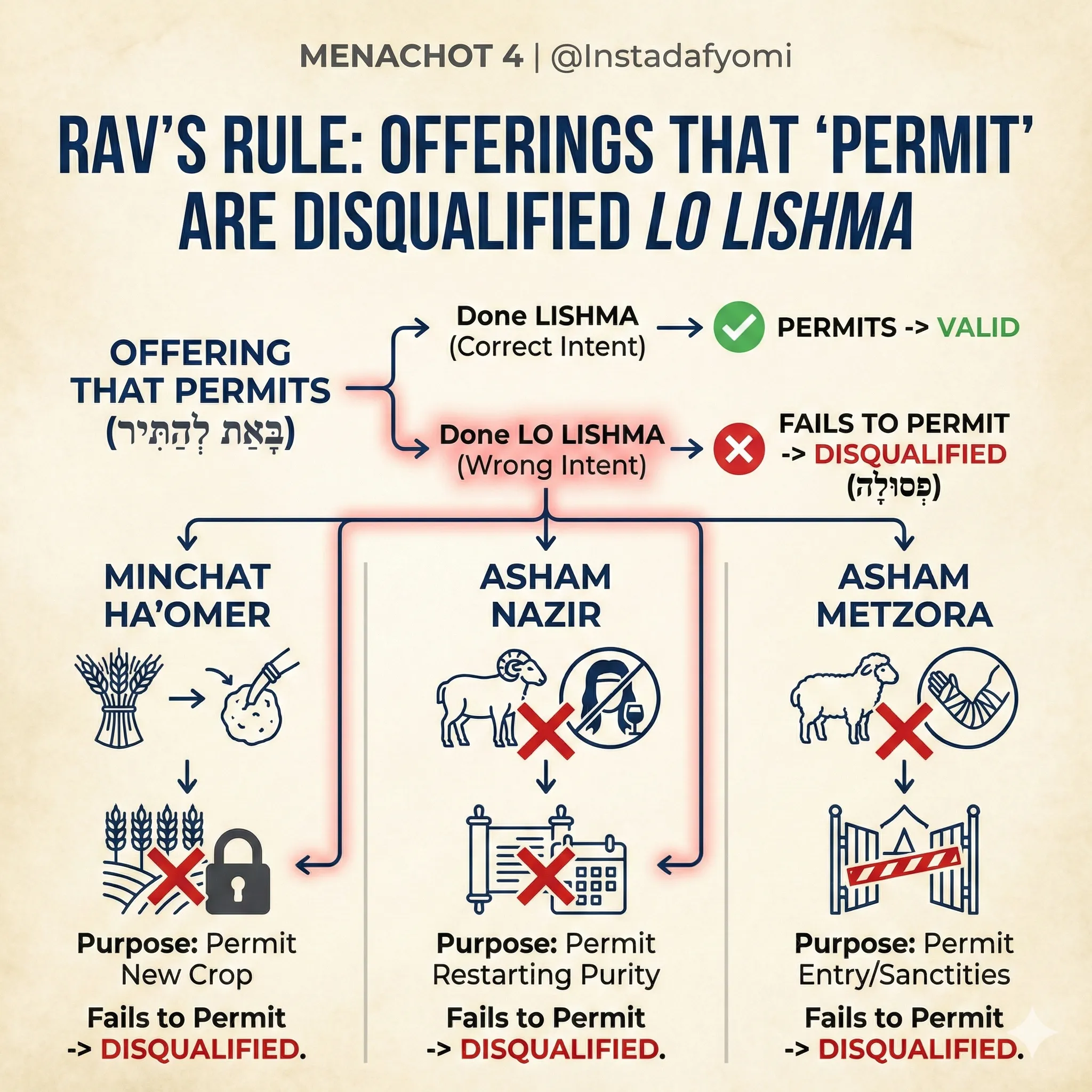
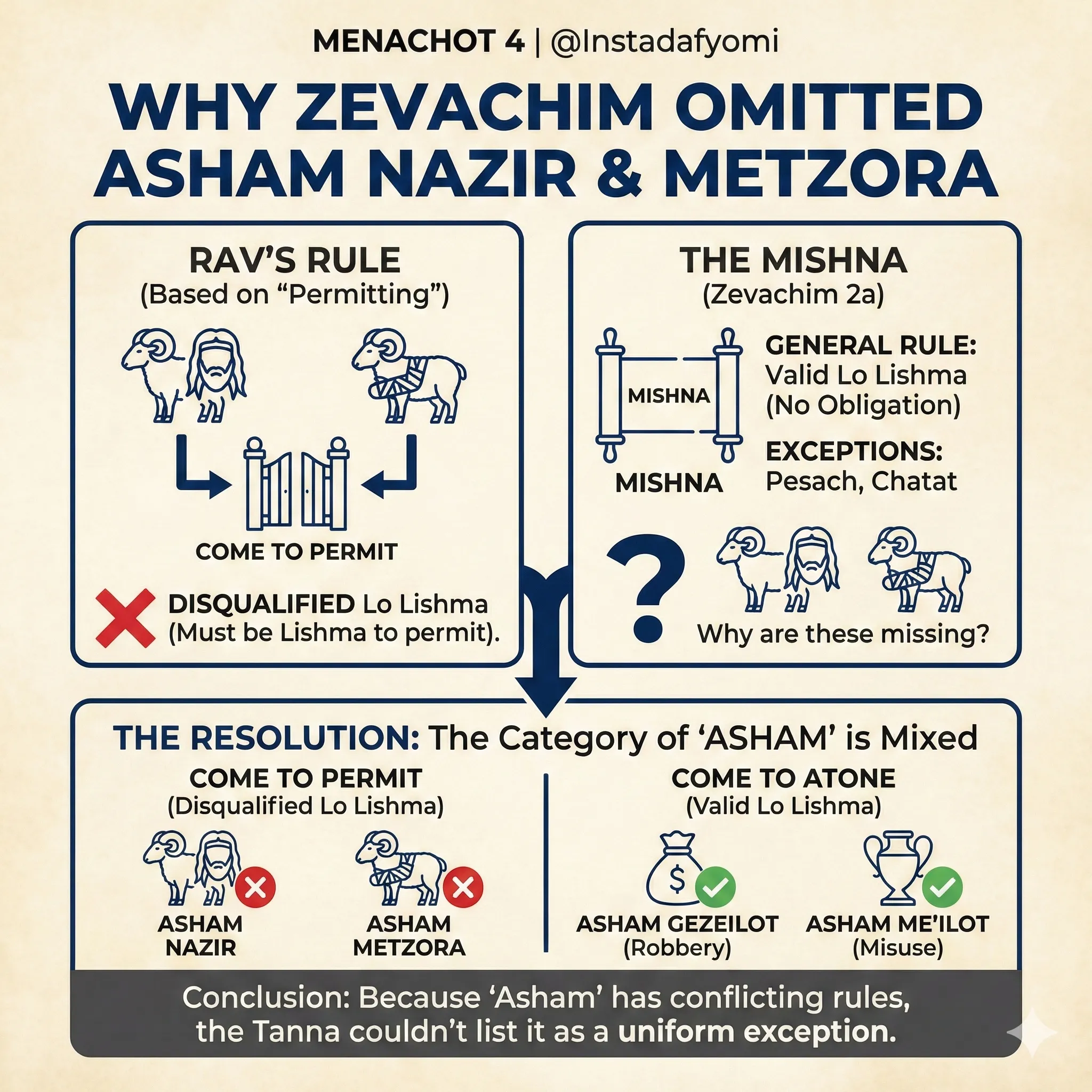
אמר רב כל הבאין להתיר הרי הן כמתירין
English Translation:
Rav said: All [offerings] that come to permit are treated like the permitting [portions] themselves.
קלאוד על הדף:
Rav introduces another key principle: certain offerings have the function of “permitting” — either allowing the owner to eat sacrificial meat or permitting the priests to receive their portions. These “permitting” offerings are treated with the same stringency as the portions that actually effect the permission. This principle helps categorize sacrifices by their function.
Key Terms:
- באין להתיר (Ba’in L’hatir) = Coming to permit — offerings whose sacrifice enables something
- מתירין (Matirin) = The permitting portions — parts of the sacrifice that effect the permission
Segment 15
TYPE: גמרא
Explanation of “comes to permit”
Hebrew/Aramaic:
מאי ניהו כגון חטאת ואשם דבאין להתיר בשר לבעלים
English Translation:
What are these? Such as a sin-offering and a guilt-offering, which come to permit the meat to the owners.
קלאוד על הדף:
The Gemara specifies what “offerings that come to permit” means: sin-offerings and guilt-offerings. Their sacrifice permits the owners to eat the meat. This categorization distinguishes these offerings from others like the burnt-offering, which is entirely consumed on the altar and doesn’t permit anything to the owner.
Key Terms:
- אשם (Asham) = Guilt-offering
- להתיר בשר לבעלים (L’hatir Basar L’va’alim) = To permit the meat to the owners
Segment 16
TYPE: גמרא
Distinction from atonement
Hebrew/Aramaic:
ולאפוקי עולה דבאה לכפרה ולא להתיר
English Translation:
And this excludes a burnt-offering, which comes for atonement and not to permit.
קלאוד על הדף:
The Gemara clarifies the distinction: a burnt-offering (olah) provides atonement but doesn’t “permit” anything because its meat isn’t eaten by anyone — it’s entirely burned on the altar. This functional distinction explains why different sacrificial categories are treated differently when disqualification issues arise.
Key Terms:
- לכפרה (L’kapparah) = For atonement — the atoning function of sacrifice
- להתיר (L’hatir) = To permit — enabling consumption of sacrificial portions
Segment 17
TYPE: גמרא
Question about the High Priest’s meal-offering
Hebrew/Aramaic:
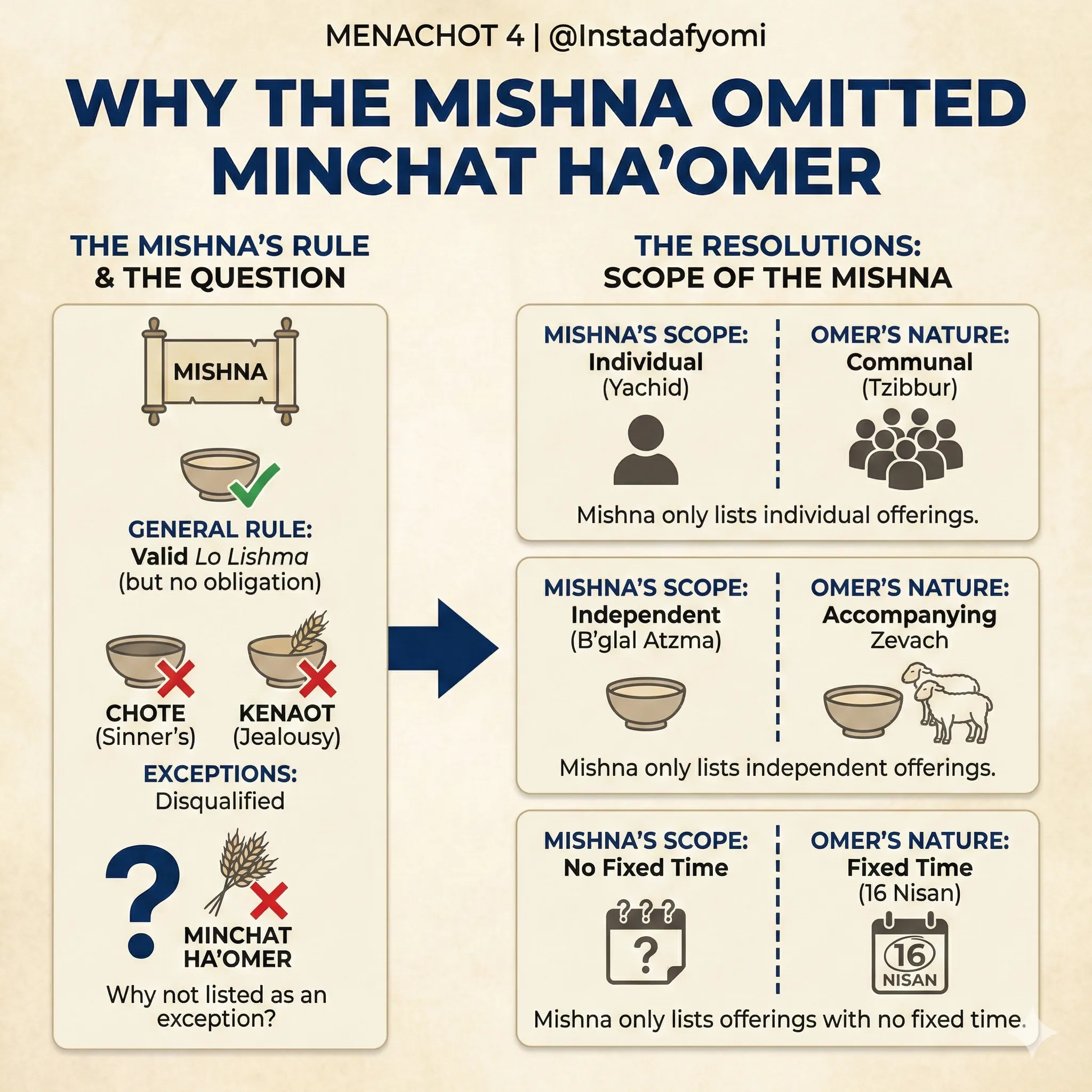
מנחת כהן גדול מהו
English Translation:
What is the law regarding the High Priest’s meal-offering?
קלאוד על הדף:
The Gemara raises a question about a specific offering: the daily meal-offering brought by the High Priest. Does it fall into the category of “offerings that come to permit,” or is it more like a burnt-offering that provides atonement without permitting? This tests the boundaries of Rav’s categorization.
Key Terms:
- מנחת כהן גדול (Minchat Kohen Gadol) = The High Priest’s meal-offering, brought daily
Segment 18
TYPE: גמרא
Analysis of the High Priest’s meal-offering
Hebrew/Aramaic:
מי אמרינן כיון דכליל היא כעולה דמיא
English Translation:
Do we say that since it is entirely burned, it is similar to a burnt-offering?
קלאוד על הדף:
The Gemara explores whether the High Priest’s meal-offering should be treated like a burnt-offering because, like the olah, it’s completely consumed on the altar with nothing permitted for eating. This would exclude it from Rav’s category of “permitting” offerings.
Segment 19
TYPE: גמרא
Alternative analysis
Hebrew/Aramaic:
או דילמא כיון דמנחה היא כמנחה דמיא
English Translation:
Or perhaps, since it is a meal-offering, it is similar to a [regular] meal-offering?
קלאוד על הדף:
The alternative view suggests that the High Priest’s meal-offering should follow the rules of regular meal-offerings, not burnt-offerings, simply because it’s categorically a “mincha.” This reflects a tension between classification by function (what the offering does) versus classification by type (what the offering is called).
Segment 20
TYPE: גמרא
Resolution of the question
Hebrew/Aramaic:
תיקו
English Translation:
Let it stand [unresolved].
קלאוד על הדף:
The Gemara leaves this question unresolved — “teku.” This technical term indicates that the matter remains undecided. In practical halacha, such unresolved questions typically result in stringent rulings, but the theoretical debate remains open. The High Priest’s meal-offering occupies a unique space between categories.
Key Terms:
- תיקו (Teku) = Let it stand — an unresolved halachic question
Segment 21
TYPE: גמרא
Question about tamei offerings
Hebrew/Aramaic:
בעי רב פפא טמא ששימש מהו
English Translation:
Rav Pappa asked: What is the law regarding a ritually impure [priest] who performed service?
קלאוד על הדף:
Rav Pappa raises a new question: if a priest who was tamei (ritually impure) performed the sacrificial service, what is the status of that service? This begins a new discussion about the validity of sacrificial acts performed under disqualifying conditions.
Key Terms:
- טמא ששימש (Tamei She’shimesh) = An impure person who performed Temple service
Amud Bet (4b)
Segment 1
TYPE: גמרא
Continuation of the impure priest question
Hebrew/Aramaic:
מי אמרינן כיון דמקטל קטליה רחמנא חילל עבודה
English Translation:
Do we say that since the Torah prescribes death [for him], he has desecrated the service?
קלאוד על הדף:
The Gemara continues analyzing the impure priest’s service. One position is that since the Torah mandates death for a tamei priest who serves, the severity of the prohibition indicates that his service is completely invalid (desecrated). The divine punishment suggests the act itself is fundamentally flawed.
Segment 2
TYPE: גמרא
Alternative view
Hebrew/Aramaic:
או דילמא עבודתו עבודה ואיהו הוא דאיענש
English Translation:
Or perhaps his service is valid service, and it is only he who is punished?
קלאוד על הדף:
The alternative view distinguishes between the priest’s personal liability and the validity of his actions. Perhaps the service itself is valid — achieving its ritual purpose — even though the priest personally deserves punishment for performing it while impure. This separates the subjective sin from the objective effectiveness of the ritual act.
Segment 3
TYPE: גמרא
Resolution
Hebrew/Aramaic:
תא שמע דתניא טמא ששימש רבי אומר במיתה וחכמים אומרים באזהרה
English Translation:
Come and hear, as it was taught in a baraita: A tamei [priest] who served — Rabbi [Yehuda HaNasi] says: [he is liable to] death; and the Sages say: [he transgresses only] a prohibition.
קלאוד על הדף:
A baraita provides the source for debate: Rabbi Yehuda HaNasi holds that an impure priest who serves is liable to death at the hands of Heaven, while the Sages hold he merely violates a prohibition but isn’t subject to death. This dispute about the severity of punishment doesn’t directly resolve whether the service is valid, but it provides the textual basis for the ongoing analysis.
Segment 4
TYPE: גמרא
Analysis of the dispute
Hebrew/Aramaic:
מאי לאו בהא קמיפלגי דמאן דאמר במיתה סבר חילל עבודה ומאן דאמר באזהרה סבר לא חילל עבודה
English Translation:
Is it not that they disagree about this: the one who says death holds that he has desecrated the service, and the one who says prohibition holds that he has not desecrated the service?
קלאוד על הדף:
The Gemara proposes that the tannaitic dispute about punishment reflects a deeper disagreement about validity. If death is warranted, it suggests the service is utterly desecrated; if only a prohibition is violated, perhaps the service remains valid despite the sin. This connection between punishment severity and act validity is a significant analytical move.
Segment 5
TYPE: גמרא
Rejection of this analysis
Hebrew/Aramaic:
לא דכולי עלמא לא חילל עבודה והכא בהאי קרא קמיפלגי
English Translation:
No, everyone agrees that he did not desecrate the service, and here they disagree about this verse.
קלאוד על הדף:
The Gemara rejects the proposed connection. Both Rabbi and the Sages may agree that the service is valid; their dispute is merely about which verse teaches the punishment and therefore what level of punishment applies. The validity question and the punishment question are separate issues.
Segment 6
TYPE: גמרא
The verse in question
Hebrew/Aramaic:
וינזרו מקדשי בני ישראל ולא יחללו את שם קדשי
English Translation:
“And they shall separate themselves from the holy things of the children of Israel, that they profane not My holy name” (Leviticus 22:2).
קלאוד על הדף:
The verse at issue commands priests to separate from holy things when impure. Rabbi and the Sages derive different penalties from this verse and its context. The word “v’yinazru” (they shall separate) and the phrase “v’lo yechalelu” (they shall not profane) are analyzed for their halachic implications.
Segment 7
TYPE: גמרא
Rabbi’s interpretation
Hebrew/Aramaic:
רבי סבר וינזרו קאי אטומאה ולא יחללו בטומאה
English Translation:
Rabbi holds: “they shall separate” refers to impurity, and “they shall not profane” [also refers] to impurity.
קלאוד על הדף:
Rabbi Yehuda HaNasi interprets both clauses of the verse as referring to impurity. The command to “separate” means separating from service while impure, and “not profaning” warns against profaning the sacred through impure service. This double reference to impurity justifies the more severe penalty of death.
Segment 8
TYPE: גמרא
The Sages’ interpretation
Hebrew/Aramaic:
ורבנן סברי וינזרו לאו אטומאה קאי אלא אפיגול ונותר
English Translation:
And the Sages hold: “they shall separate” does not refer to impurity, but rather to piggul and notar.
קלאוד על הדף:
The Sages interpret the verse differently: “they shall separate” refers not to impurity but to piggul (sacrifice with improper intent) and notar (leftover sacrificial meat). Only “they shall not profane” refers to impurity. With only one clause addressing impurity, the penalty is reduced to a regular prohibition rather than death.
Key Terms:
- נותר (Notar) = Leftover sacrificial meat beyond its permitted time
Segment 9
TYPE: גמרא
Further analysis
Hebrew/Aramaic:
ואיבעית אימא דכולי עלמא חילל עבודה
English Translation:
And if you wish, say: everyone agrees that he desecrated the service.
קלאוד על הדף:
The Gemara offers another possible understanding: perhaps both opinions agree that the impure priest’s service is desecrated (invalid). Their dispute would then concern only the severity of personal punishment, not the effectiveness of the service. This shows how the same tannaitic dispute can be framed in multiple ways.
Segment 10
TYPE: גמרא
Distinction between offerings that come to permit and those for atonement
Hebrew/Aramaic:
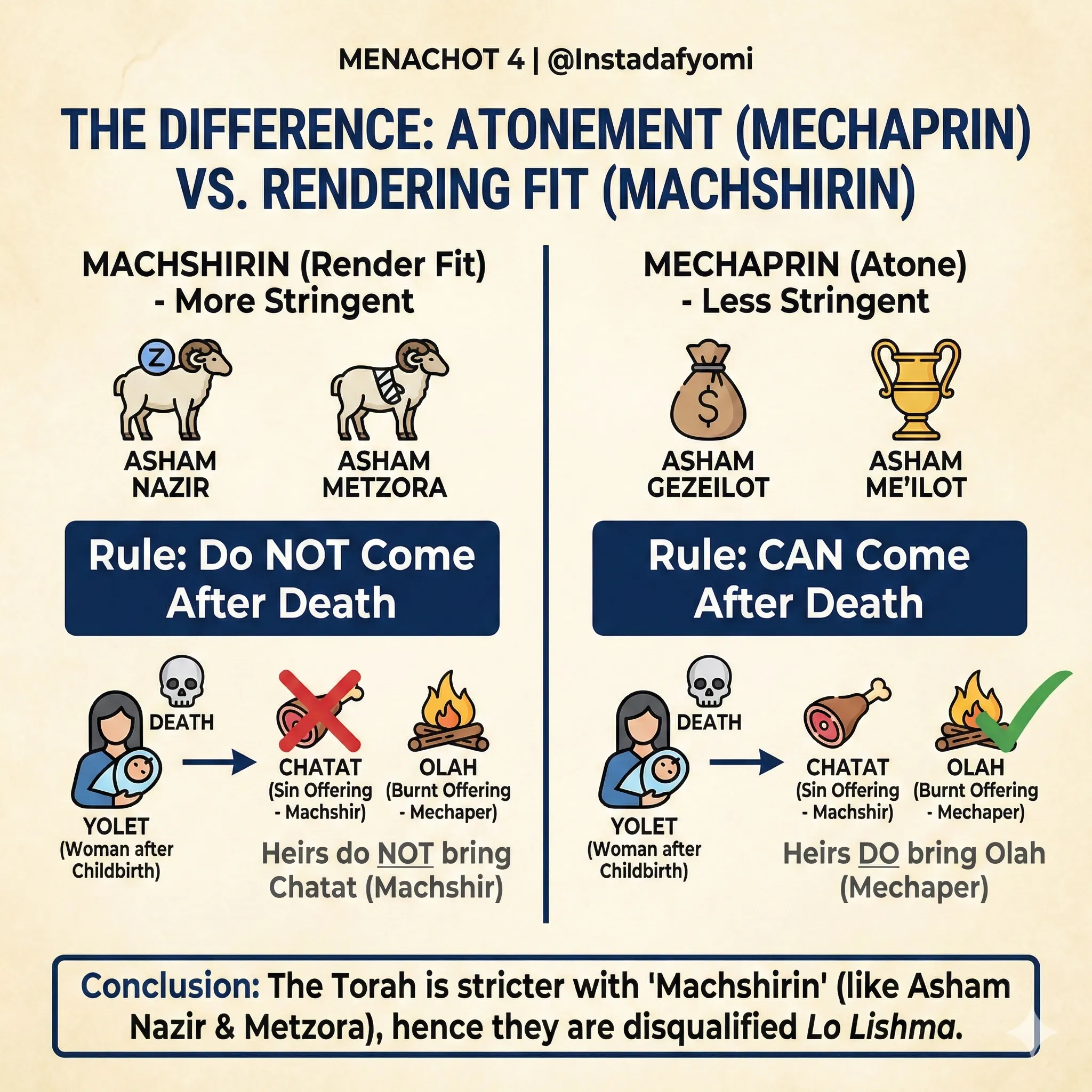
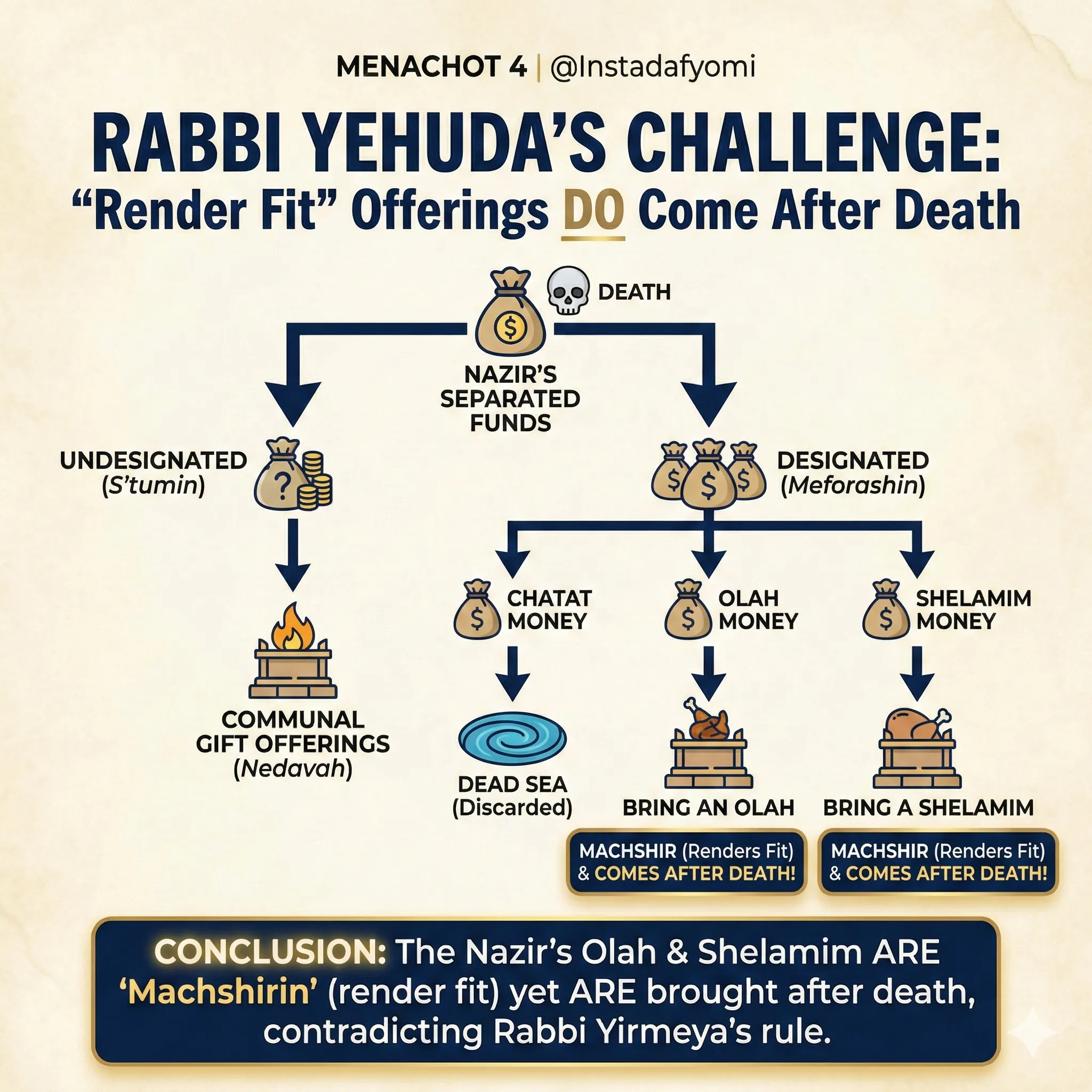
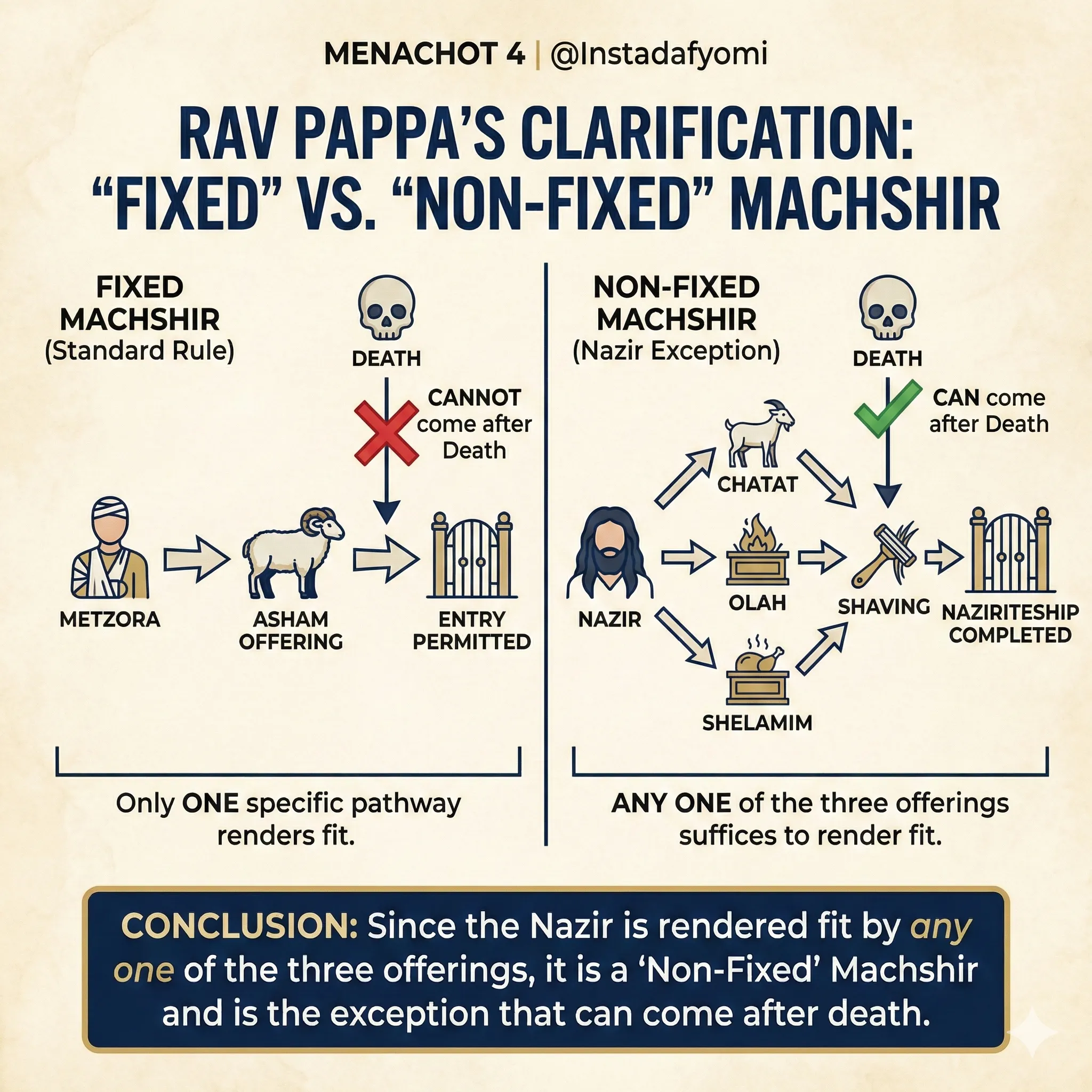
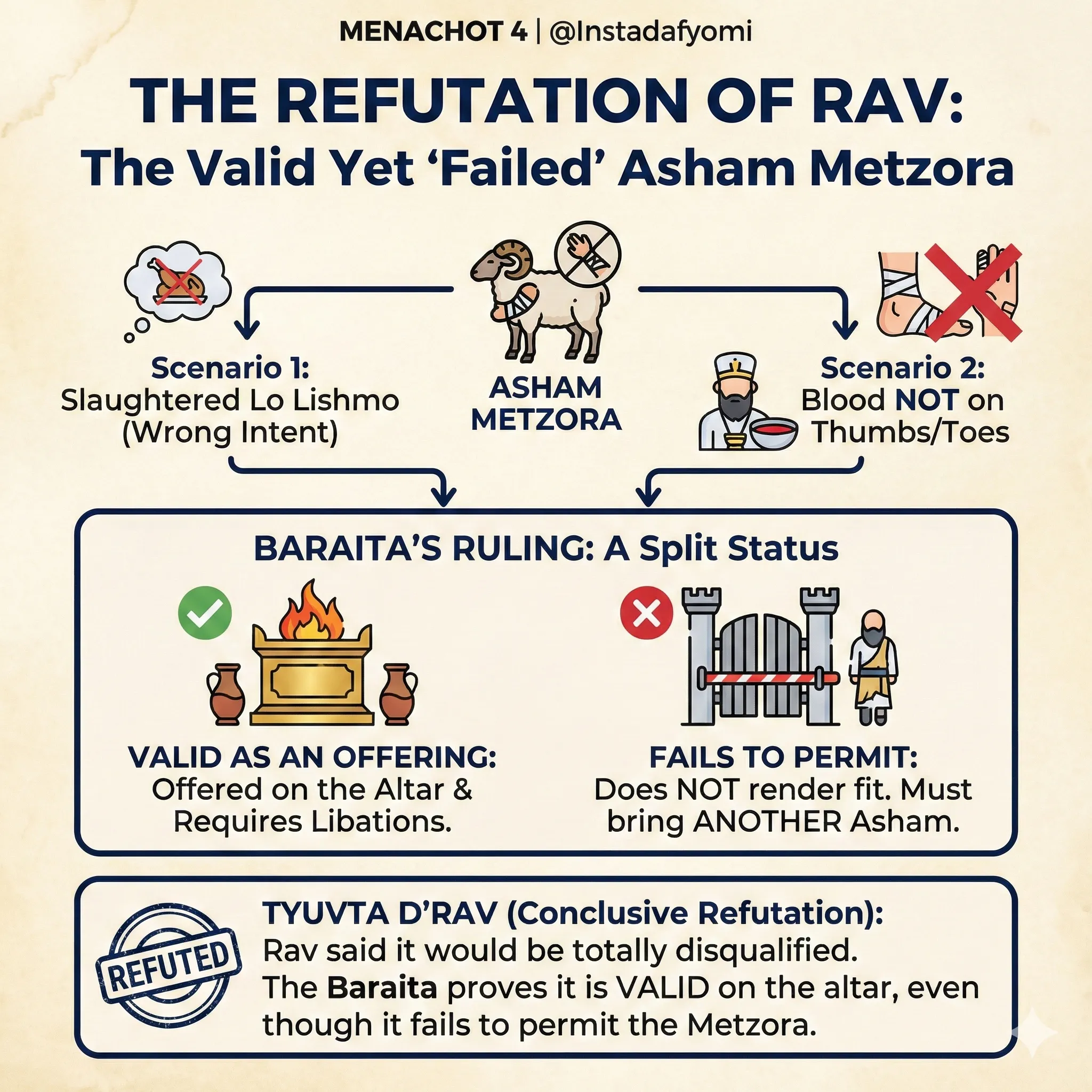
מיתיבי מה בין מכשיר לכפרה מכשיר הוא עצמו מתכשר וכפרה אינה מתכפרת
English Translation:
They raised an objection: What is the difference between a rendering-fit [offering] and an atonement [offering]? A rendering-fit [offering] itself becomes fit, whereas an atonement [offering] does not atone.
קלאוד על הדף:
The Gemara introduces an important distinction: “machshir” (rendering-fit) offerings versus “kaparah” (atonement) offerings. A machshir offering — like a zav’s or metzora’s offerings that enable them to eat kodashim — achieves its purpose even if later problems arise. An atonement offering’s effectiveness is more contingent on proper procedure throughout.
Key Terms:
- מכשיר (Machshir) = Rendering-fit offering — enables future actions
- כפרה (Kaparah) = Atonement — achieves forgiveness
Segment 11
TYPE: גמרא
Application of this distinction
Hebrew/Aramaic:
כיצד מכשיר זה קרבנות מצורע וזב וזבה ויולדת שהן מכשירין אותן לאכול בקדשים
English Translation:
How so? A rendering-fit [offering] — these are the offerings of a metzora, a zav, a zavah, and a woman who gave birth, for they render them fit to eat sacred food.
קלאוד על הדף:
The Gemara specifies which offerings are “machshir”: those brought by a metzora (one with tzara’at), zav (male with abnormal discharge), zavah (female with abnormal discharge), and yoledet (woman after childbirth). These people cannot eat sacrificial meat until they bring their offerings. The offerings “render them fit” for this purpose.
Key Terms:
- מצורע (Metzora) = One afflicted with tzara’at (often translated as leprosy)
- זב/זבה (Zav/Zavah) = Male/female with abnormal genital discharge
- יולדת (Yoledet) = Woman after childbirth
Segment 12
TYPE: גמרא
Further analysis of machshir offerings
Hebrew/Aramaic:
כפרה זה כל קרבנות שבתורה שאין מכשירין אלא מכפרין
English Translation:
Atonement — this refers to all [other] offerings in the Torah that do not render fit but rather atone.
קלאוד על הדף:
All other offerings fall into the “atonement” category. They achieve forgiveness for sins but don’t enable the owner to do anything they couldn’t do before (in terms of eating kodashim). This categorical distinction has practical implications for how we treat disqualified offerings in each category.
Segment 13
TYPE: גמרא
Conclusion of the sugya
Hebrew/Aramaic:
תנן התם מחוסרי כפרה שתי תורות תורה לקרבנותיהם ותורה לטומאתם
English Translation:
We learned in a Mishna there: Those lacking atonement [mechusrei kaparah] have two sets of laws — one law for their offerings and one law for their impurity.
קלאוד על הדף:
The Gemara references a Mishna about “mechusrei kaparah” — people who need to bring offerings to complete their purification process. They operate under two separate halachic frameworks: the laws governing their offerings and the laws governing their impurity status. This dual framework creates complexity in determining when they can participate in sacred activities.
Key Terms:
- מחוסרי כפרה (Mechusrei Kaparah) = Those lacking atonement — people whose purification requires a sacrifice