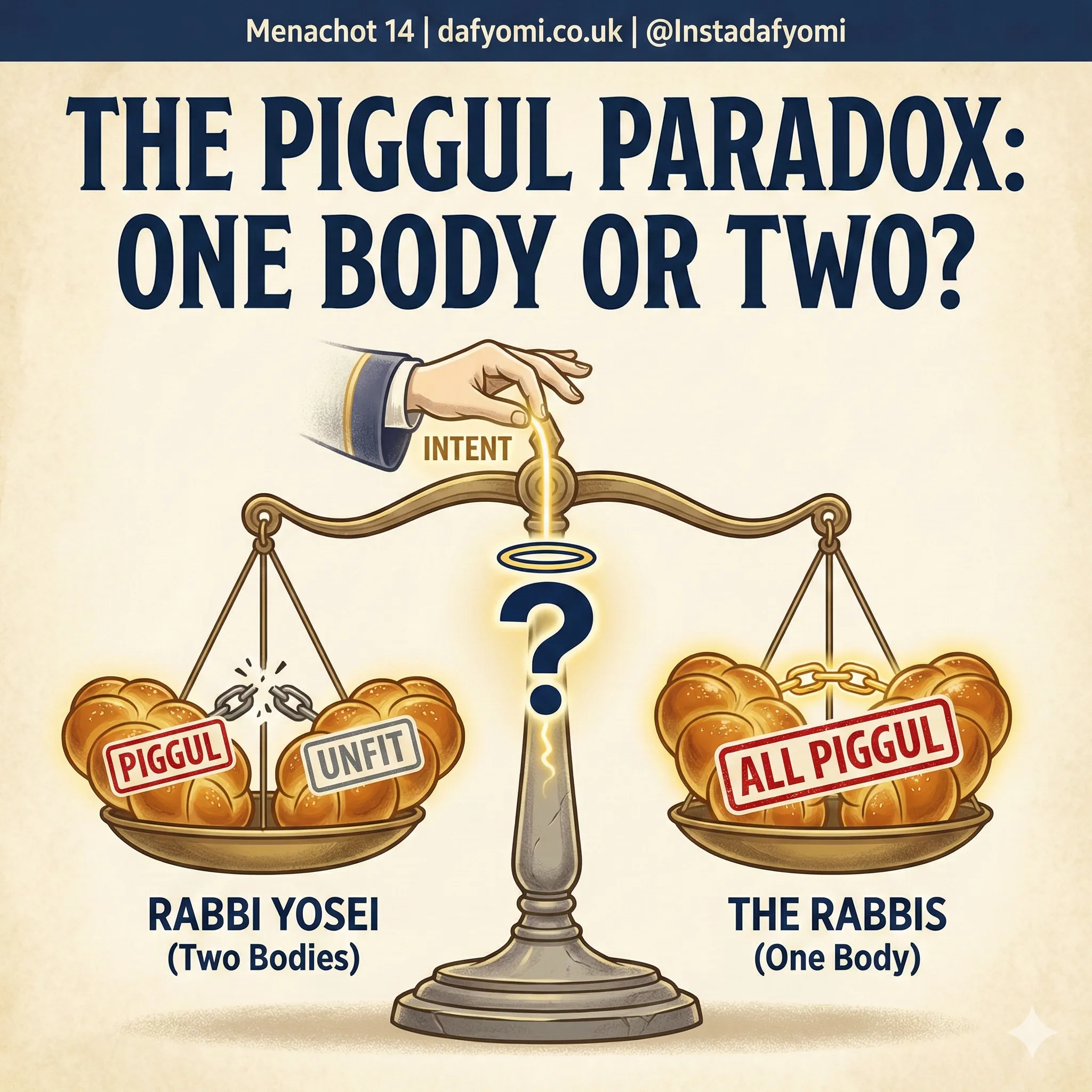
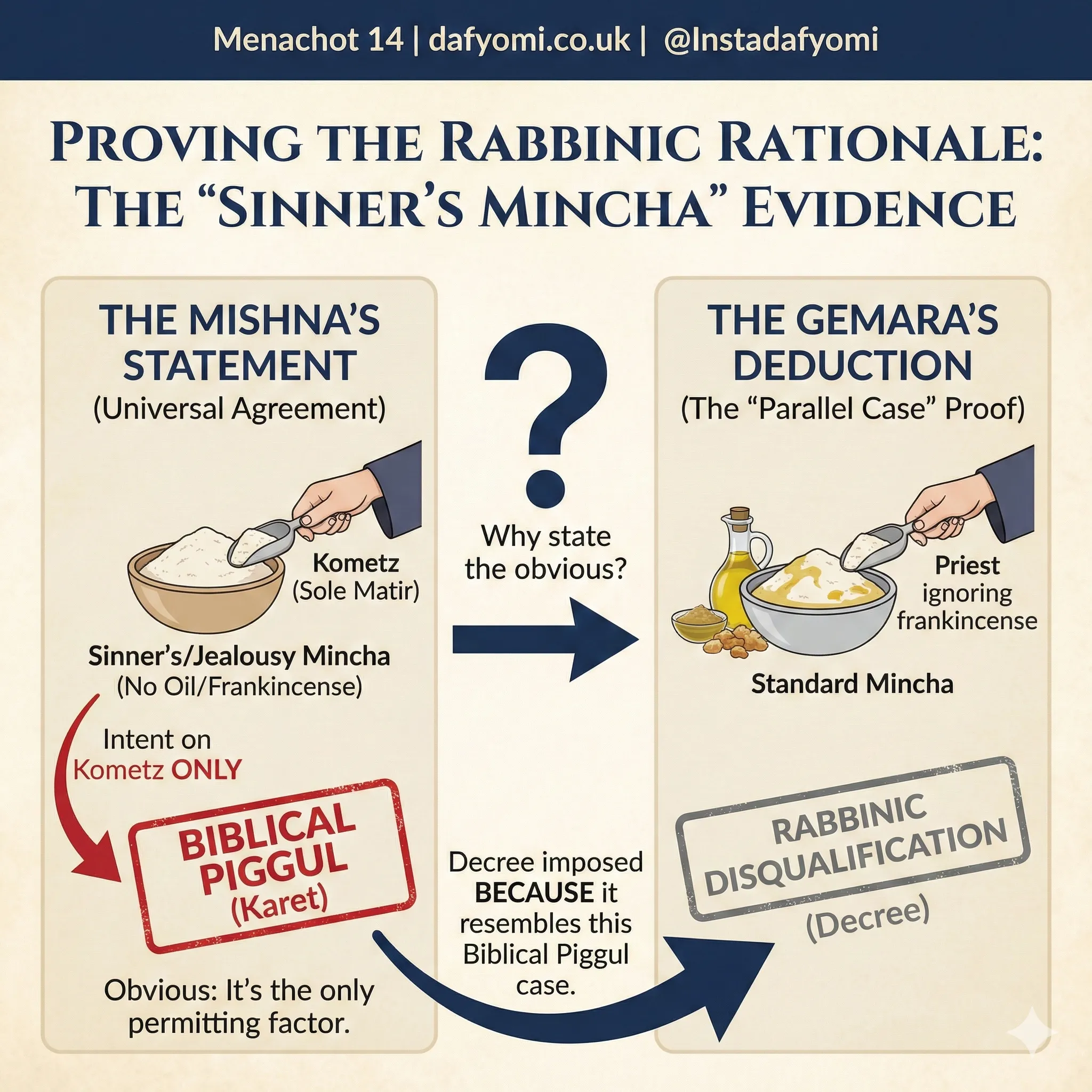
Menachot Daf 14 (מנחות דף י״ד)
Daf: 14 | Amudim: 14a – 14b | Date: January 26, 2026
📖 Breakdown
Amud Aleph (14a)
Segment 1
TYPE: גמרא
Continuation from Daf 13: Challenging whether two bodies combine
Hebrew/Aramaic:
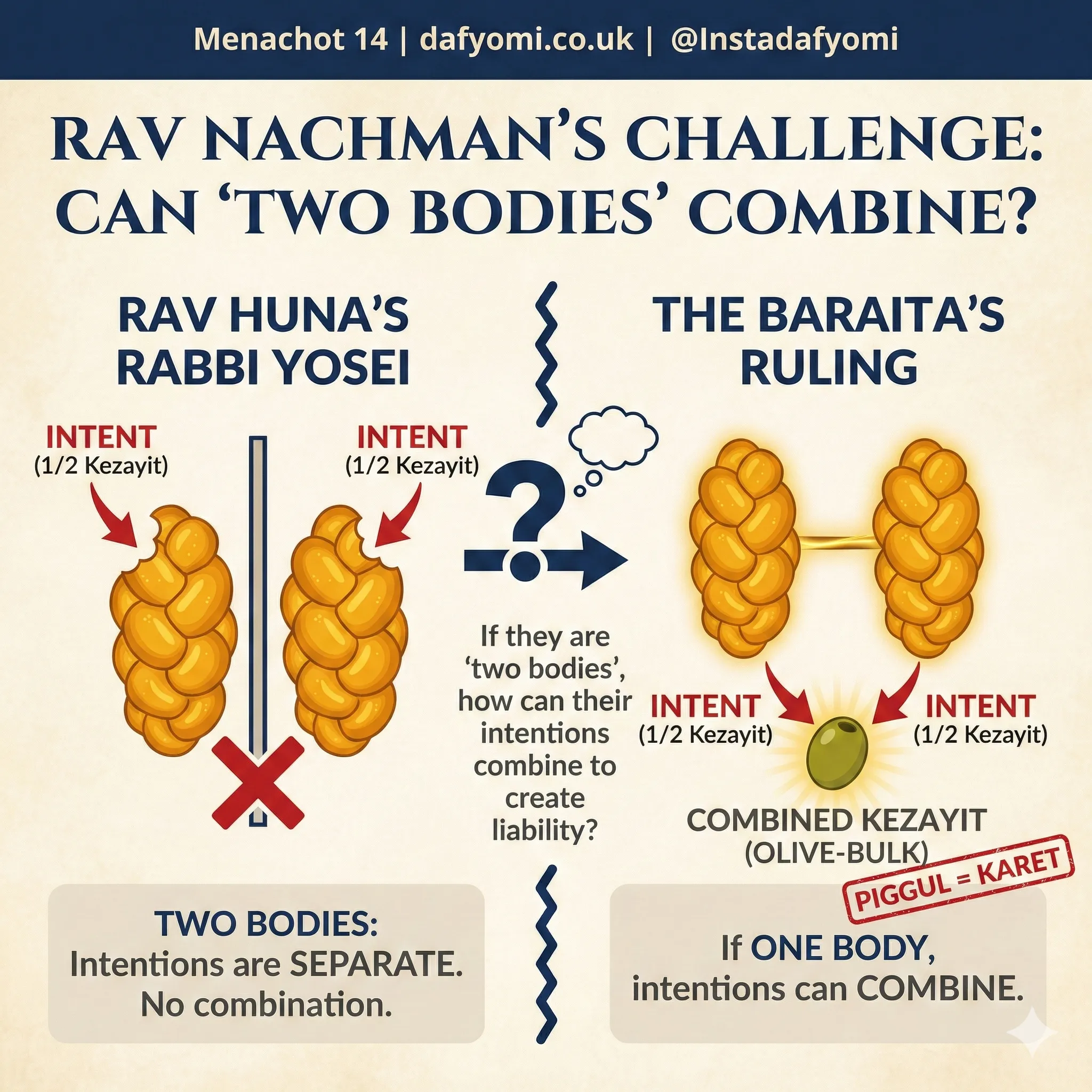
אֶלָּא אִי אָמְרַתְּ תְּרֵי גּוּפֵי נִינְהוּ – מִי מִיצְטָרְפִי?
English Translation:
But if you say that Rabbi Yosei holds that the right and left thighs of an offering are considered two distinct bodies, and therefore piggul intent with regard to one does not render the other piggul, then in the case of the two loaves, would the intentions concerning both loaves combine to render them both piggul?
קלאוד על הדף:
The Gemara continues directly from Daf 13, exploring the implications of Rabbi Yosei’s view. If the two thighs are truly “two distinct bodies” (תְּרֵי גּוּפֵי), then when the priest has half an olive-bulk intent about each loaf, these half-measures shouldn’t combine — they’re separate entities. This challenges how the baraita can be reconciled with Rav Huna’s interpretation of Rabbi Yosei.
Key Terms:
- תְּרֵי גּוּפֵי (Trei Gufei) = Two distinct bodies — separate entities that don’t combine
- מִיצְטָרְפִי (Mitztarfei) = Combine / join together
Segment 2
TYPE: גמרא
Attributing the baraita to Rabbi Yehuda HaNasi
Hebrew/Aramaic:
הָא מַנִּי? רַבִּי הִיא, דְּתַנְיָא: הַשּׁוֹחֵט אֶת הַכֶּבֶשׂ לֶאֱכוֹל חֲצִי זַיִת מֵחַלָּה זוֹ, וְכֵן חֲבֵירוֹ לֶאֱכוֹל חֲצִי זַיִת מֵחַלָּה זוֹ, רַבִּי אוֹמֵר: אוֹמֵר אֲנִי שֶׁזֶּה כָּשֵׁר.
English Translation:
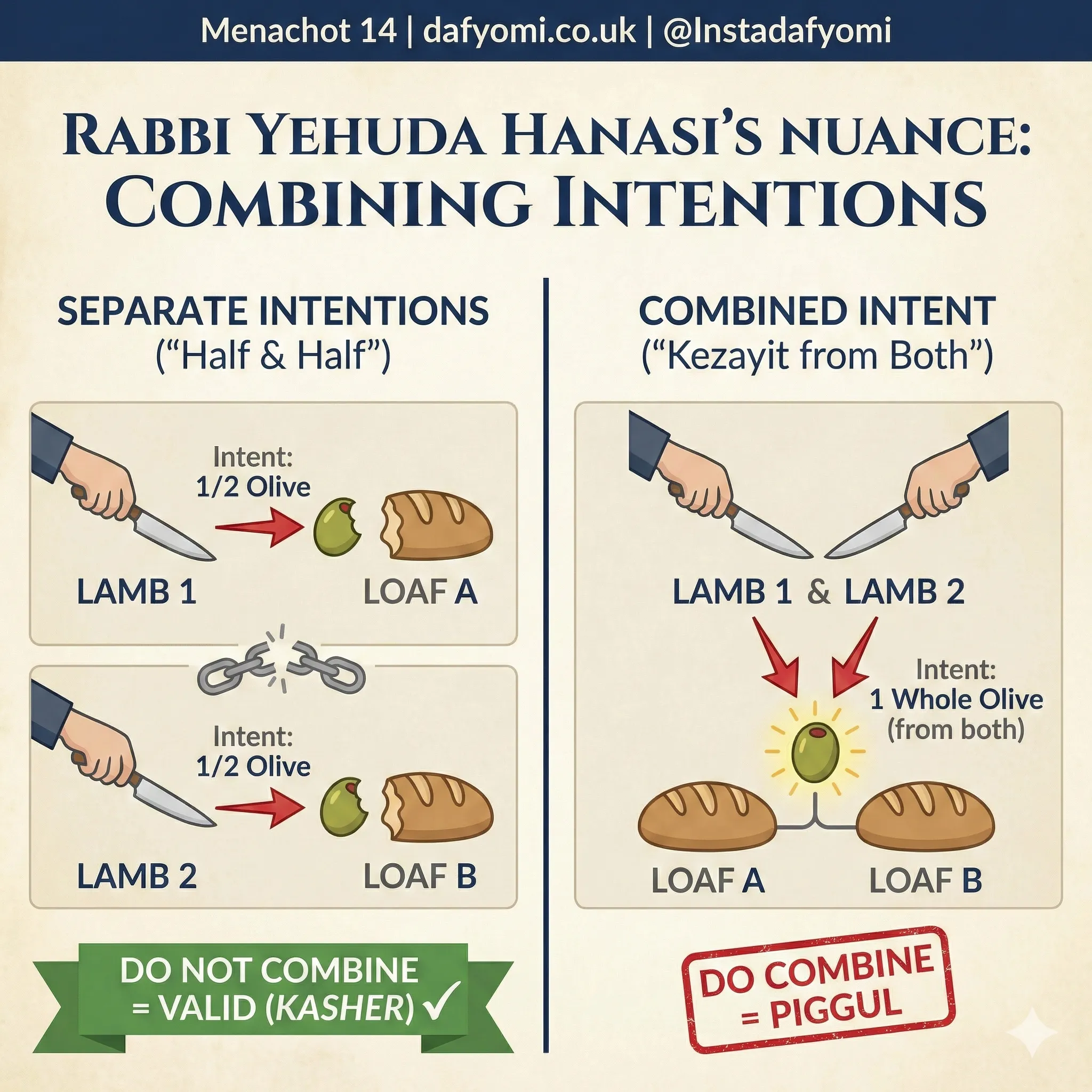
Rav Huna responds: One cannot infer anything from this baraita with regard to the opinion of Rabbi Yosei, as in accordance with whose opinion is this baraita? It is in accordance with the opinion of Rabbi Yehuda HaNasi, as it is taught in another baraita: With regard to one who slaughters one of the lambs brought as peace offerings on Shavuot with the intent to consume half an olive-bulk from this loaf the next day, and similarly, he slaughtered the other lamb with the intent to consume half an olive-bulk from that second loaf the next day, Rabbi Yehuda HaNasi says: I say that this offering is valid, as his intentions do not combine.
קלאוד על הדף:
Rav Huna deflects the challenge by attributing the baraita to Rabbi Yehuda HaNasi (simply called “Rabbi”), not Rabbi Yosei. Rabbi Yehuda HaNasi has his own position on this matter — when the priest slaughters each lamb with intent to eat half an olive-bulk from a different loaf, the offering remains valid (כָּשֵׁר) because the two half-measures don’t combine.
Key Terms:
- רַבִּי (Rabbi) = Rabbi Yehuda HaNasi — the redactor of the Mishna
Segment 3
TYPE: גמרא
Deriving: Separate expressions don’t combine, but unified expression does
Hebrew/Aramaic:
טַעְמָא דְּאָמַר ״חֲצִי חֲצִי״, אֲבָל אָמַר ״כְּזַיִת מִשְּׁתֵּיהֶן״ – מִצְטָרֵף.
English Translation:
Rav Huna continues: It may be inferred that the reason why the priest’s intentions do not combine is that his intent was said with regard to a half and a half, i.e., he slaughtered each lamb with the intent to consume half an olive-bulk from one loaf the next day. But if he said during the slaughter of each of the lambs that he is slaughtering it with the intent to consume an olive-bulk from both of them, then the halves combine to render the offering piggul.
קלאוד על הדף:
The Gemara extracts a crucial principle: Rabbi’s leniency applies specifically because the priest expressed each half separately (“half from this loaf… half from that loaf”). However, had he expressed a single unified intent (“an olive-bulk from both of them”), the intents would combine to create piggul. The FORMULATION of the intent determines whether the measures join together.
Key Terms:
- חֲצִי חֲצִי (Chatzi Chatzi) = Half and half — separately stated intents
- כְּזַיִת מִשְּׁתֵּיהֶן (K’zayit MiShteihen) = An olive-bulk from both of them — unified formulation
Segment 4
TYPE: גמרא
Whose view does Rabbi Yehuda HaNasi follow?
Hebrew/Aramaic:
וְרַבִּי, אַלִּיבָּא דְּמַאן? אִי אַלִּיבָּא דְּרַבָּנַן – אֲפִילּוּ בְּאַחַת מֵהֶן נָמֵי! אִי אַלִּיבָּא דְּרַבִּי יוֹסֵי – הָדַר קוּשְׁיַין לְדוּכְתֵּיהּ.
English Translation:
The Gemara asks: And as for Rabbi Yehuda HaNasi, who says that the two loaves are piggul only if he has intent with regard to an amount equal to an olive-bulk from both of them combined, in accordance with whose opinion is his statement? If it is in accordance with the opinion of the Rabbis of the mishna, who hold that piggul intent with regard to one loaf renders both loaves piggul, then even if his intent was with regard to only one of them, both loaves should be piggul. And if it is in accordance with the opinion of Rabbi Yosei, who holds that piggul intent with regard to one loaf does not render the second loaf piggul, then our difficulty returns to its place: If Rabbi Yosei holds that the right and left thighs are considered two distinct bodies, how can intentions with regard to two halves of an olive-bulk combine to render both loaves piggul?
קלאוד על הדף:
The Gemara now questions which earlier authority Rabbi Yehuda HaNasi follows. Neither the Rabbis nor Rabbi Yosei seem to fit perfectly: (1) If he follows the Rabbis — even intent about one loaf should affect both, so why require the unified formulation? (2) If he follows Rabbi Yosei — we return to the original problem about the two thighs being separate bodies. This creates a dilemma.
Segment 5
TYPE: גמרא
Resolution: Rabbi follows the Rabbis, reread the baraita
Hebrew/Aramaic:
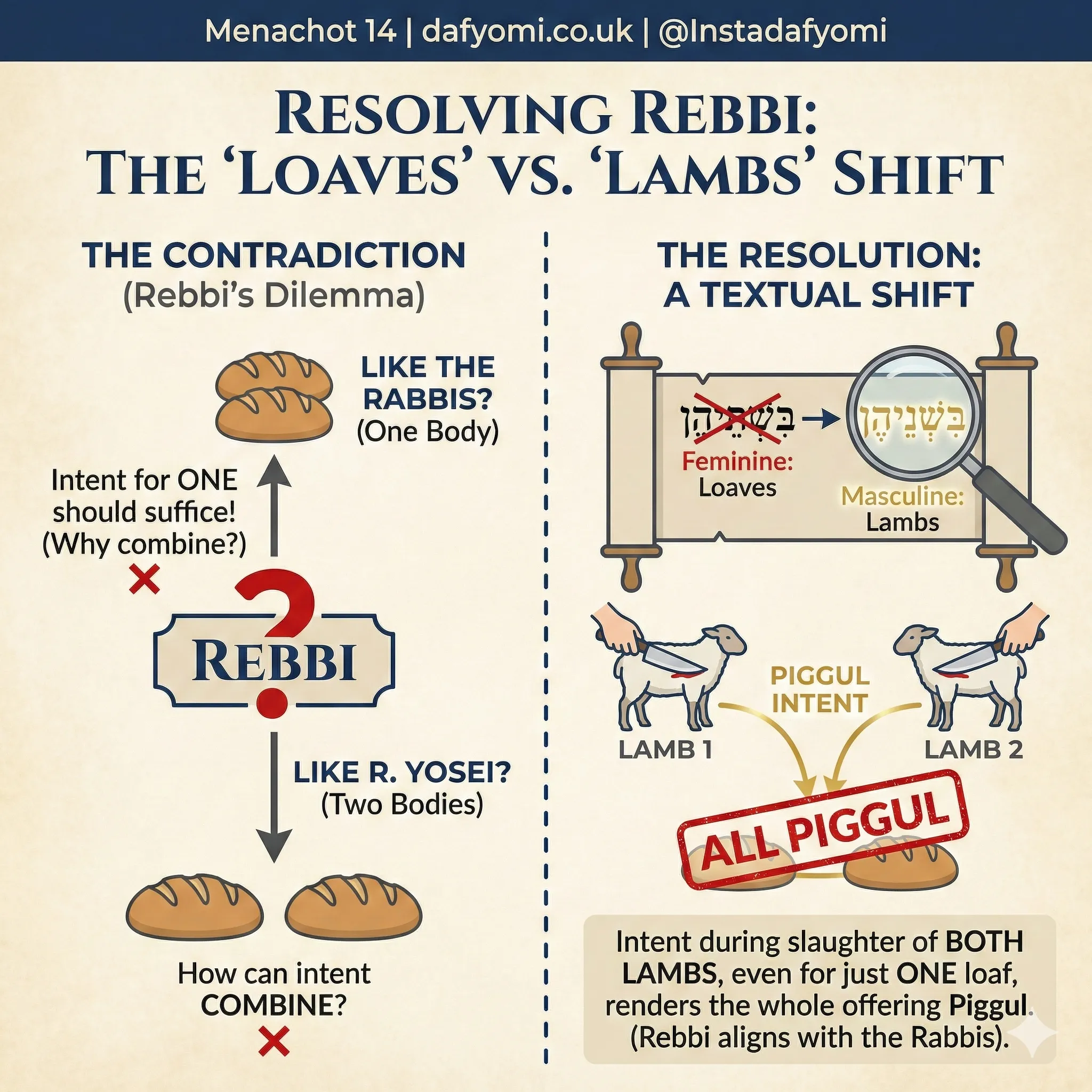
לְעוֹלָם אַלִּיבָּא דְּרַבָּנַן, וְלָא תֵּימָא ״עַד שֶׁיְּפַגֵּל בִּשְׁתֵּיהֶן״, אֶלָּא [אֵימָא] ״עַד שֶׁיְּפַגֵּל בִּשְׁנֵיהֶן״, וַאֲפִילּוּ בְּאַחַת מֵהֶן.
English Translation:
The Gemara responds: Actually, Rabbi Yehuda HaNasi’s statement is in accordance with the opinion of the Rabbis. And do not say that the baraita states: It is not piggul unless one has the intent of piggul with regard to both of them [bishteihen], in the feminine form, whereby the baraita would be referring to the loaves. Rather, the baraita states: With regard to both of them [bishneihen], in the masculine form, i.e., unless he slaughters both lambs with piggul intent, and in such a case, even if his intent was with regard to only one of the loaves, the offering is piggul.
קלאוד על הדף:
The Gemara provides a textual solution: reread the baraita! Don’t read “בִּשְׁתֵּיהֶן” (feminine — referring to both LOAVES), but rather “בִּשְׁנֵיהֶן” (masculine — referring to both LAMBS). This means: the offering isn’t piggul unless he slaughters BOTH lambs with piggul intent — but once both lambs are involved, even intent about only one loaf creates piggul. This aligns with the Rabbis’ view.
Key Terms:
- בִּשְׁתֵּיהֶן (Bishteihen) = With regard to both of them (feminine) — the loaves
- בִּשְׁנֵיהֶן (Bishneihen) = With regard to both of them (masculine) — the lambs
Segment 6
TYPE: גמרא
Excluding Rabbi Meir’s opinion
Hebrew/Aramaic:
וּלְאַפּוֹקֵי מִדְּרַבִּי מֵאִיר, דְּאָמַר: מְפַגְּלִין בַּחֲצִי מַתִּיר, קָא מַשְׁמַע לַן דְּלָא.
English Translation:
The Gemara adds: And this baraita serves to exclude the opinion of Rabbi Meir, who says in the mishna on 16a: One renders an offering piggul by means of intent during the sacrifice of half a permitting factor, e.g., if one slaughtered one of the lambs with the intent to consume the two loaves the next day, the loaves are piggul. This baraita teaches us that this is not the halakha.
קלאוד על הדף:
The baraita specifically rejects Rabbi Meir’s stringent view. Rabbi Meir holds that slaughtering even ONE lamb (half the permitting factor) with piggul intent is sufficient to create piggul. Rabbi Yehuda HaNasi disagrees — you need intent during BOTH lambs (the entire permitting factor) to render the offering piggul.
Key Terms:
- לְאַפּוֹקֵי (Le’apukei) = To exclude — the teaching comes to reject an alternative view
- חֲצִי מַתִּיר (Chatzi Mattir) = Half a permitting factor — one of two lambs
Segment 7
TYPE: גמרא
Questioning the emphatic language
Hebrew/Aramaic:
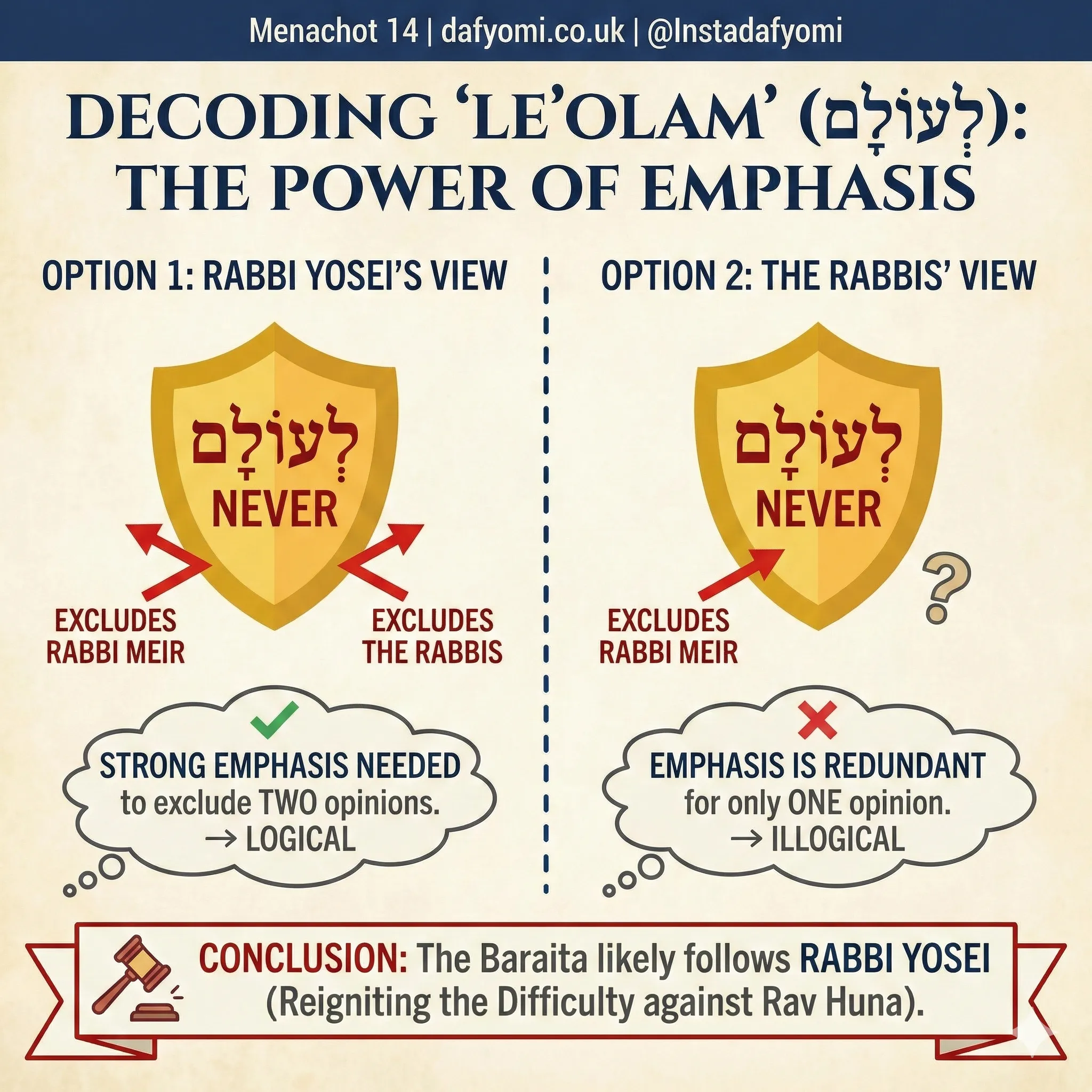
אִי הָכִי, מַאי ״לְעוֹלָם״? אִי אָמְרַתְּ בִּשְׁלָמָא בִּשְׁתֵּיהֶן וּבִשְׁנֵיהֶן, וְרַבִּי יוֹסֵי הִיא, וּלְאַפּוֹקֵי מִדְּרַבִּי מֵאִיר וּמִדְּרַבָּנַן קָאָתֵי – הַיְינוּ דְּקָאָמַר ״לְעוֹלָם״.
English Translation:
The Gemara asks: If so, then what is the meaning of the emphasis in the baraita: There is never liability? Granted, this phrase is understandable if you say that the baraita means that the loaves are not piggul unless he has intent with regard to both of the loaves and both of the lambs, i.e., they are piggul only if he slaughters both lambs with the intention to partake of both loaves the next day. In that case the baraita is in accordance with the opinion of Rabbi Yosei, and it comes to exclude the statements of both Rabbi Meir and the Rabbis, and this is the reason that the baraita states: There is never liability, to emphasize that Rabbi Yosei disagrees with both of these opinions.
קלאוד על הדף:
The Gemara challenges the resolution: the baraita uses emphatic language (“לְעוֹלָם” — “never/always”). Such emphasis suggests the teaching excludes multiple opinions, not just one. If the baraita follows the Rabbis and merely excludes Rabbi Meir, why the strong language? This suggests the baraita might actually follow Rabbi Yosei, excluding BOTH Rabbi Meir AND the Rabbis.
Segment 8
TYPE: גמרא
Difficulty remains if following the Rabbis
Hebrew/Aramaic:
אֶלָּא אִי אָמְרַתְּ רַבָּנַן, וּלְאַפּוֹקֵי מִדְּרַבִּי מֵאִיר, מַאי ״לְעוֹלָם״?
English Translation:
But if you say that the baraita is in accordance with the opinion of the Rabbis and that it serves to exclude only the opinion of Rabbi Meir, for what reason does the baraita stress: There is never liability? The tanna would not use such a word to exclude merely one opinion. Rather, it must be that the baraita is in accordance with the opinion of Rabbi Yosei. If so, then the difficulty raised against Rav Huna, who says that piggul intent concerning the right thigh does not render the left one piggul, remains unresolved.
קלאוד על הדף:
The challenge stands: if the baraita merely excludes Rabbi Meir, the emphatic “לְעוֹלָם” is unnecessary. The tanna wouldn’t use such strong language to exclude just one opinion. This suggests the baraita follows Rabbi Yosei, excluding both Rabbi Meir AND the Rabbis — which brings back the original difficulty with Rav Huna’s interpretation.
Segment 9
TYPE: גמרא
Rav Ashi’s challenge from a different baraita
Hebrew/Aramaic:
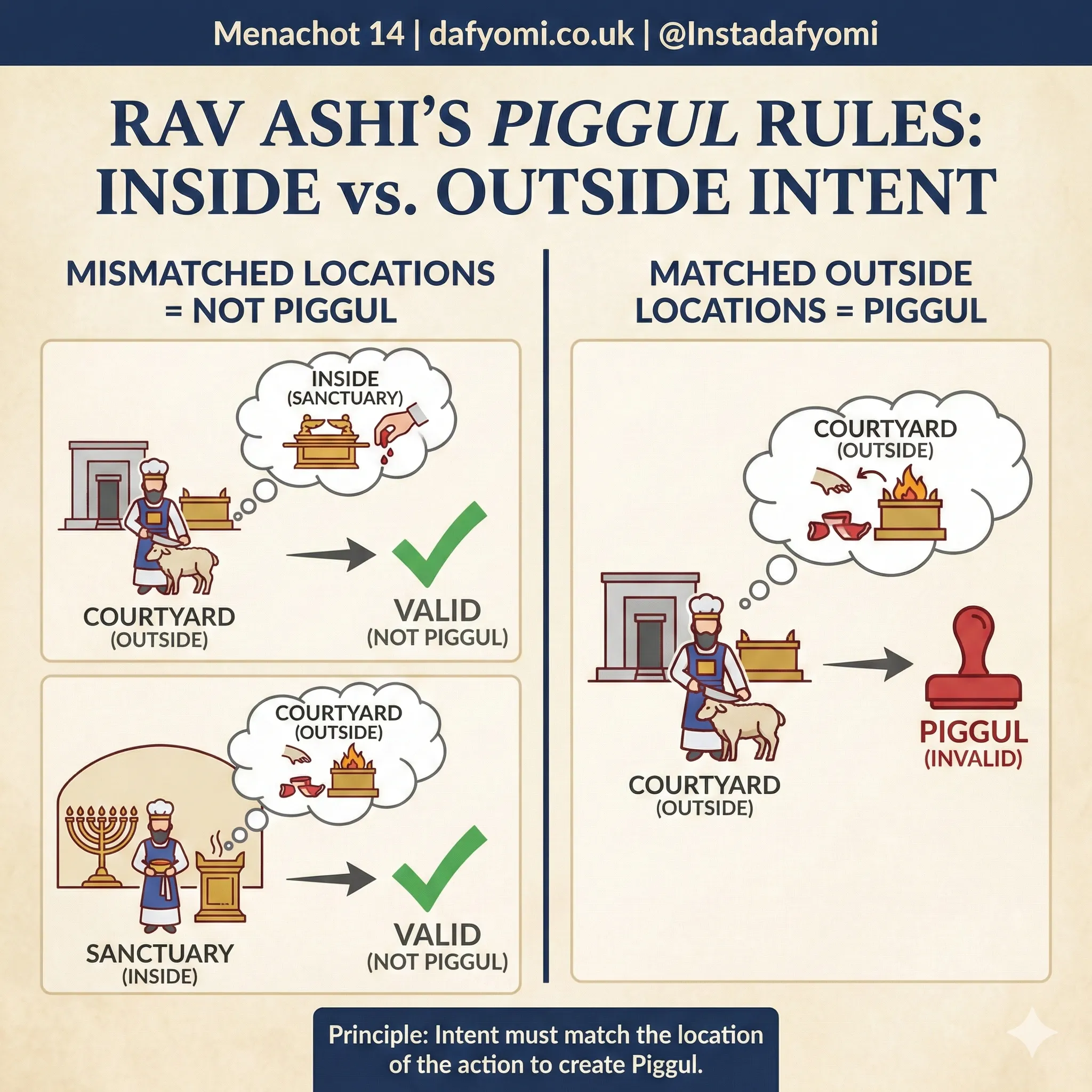
וְעוֹד, הָא אָמַר רַב אָשֵׁי: תָּא שְׁמַע, רַבִּי אוֹמֵר מִשּׁוּם רַבִּי יוֹסֵי: פִּיגֵּל בְּדָבָר הַנַּעֲשֶׂה בַּחוּץ – פִּיגֵּל, בְּדָבָר הַנַּעֲשֶׂה בִּפְנִים – לֹא פִּיגֵּל.
English Translation:
And furthermore, didn’t Rav Ashi say: Come and hear a refutation of the opinion of Rav Huna from a baraita: Rabbi Yehuda HaNasi says in the name of Rabbi Yosei that if, while performing the sacrificial rites for the bulls or goats which are burned as an offering, the priest had an intention that can render the offering piggul with regard to a matter that is performed outside the Sanctuary, i.e., in the Temple courtyard, he has rendered the offering piggul. If his intention was with regard to a matter that is performed inside the Sanctuary or the Holy of Holies, he has not rendered the offering piggul.
קלאוד על הדף:
Rav Ashi introduces another proof challenging Rav Huna. This baraita is from Rabbi Yehuda HaNasi in the name of Rabbi Yosei, establishing an important distinction: piggul intent about EXTERNAL matters (performed in the courtyard) creates piggul, but intent about INTERNAL matters (performed inside the Sanctuary) does not. This principle applies to the inner sin offerings (parim ha’nisrafin).
Key Terms:
- דָּבָר הַנַּעֲשֶׂה בַּחוּץ (Davar HaNa’aseh BaChutz) = A matter performed outside — in the Temple courtyard
- דָּבָר הַנַּעֲשֶׂה בִּפְנִים (Davar HaNa’aseh BiFnim) = A matter performed inside — in the Sanctuary
Segment 10
TYPE: ברייתא
Examples: Standing outside with intent about inside
Hebrew/Aramaic:
כֵּיצַד? הָיָה עוֹמֵד בַּחוּץ וְאָמַר: ״הֲרֵינִי שׁוֹחֵט עַל מְנָת לְהַזּוֹת מִדָּמוֹ לְמָחָר״ – לֹא פִּיגֵּל, שֶׁמַּחְשָׁבָה בַּחוּץ בְּדָבָר הַנַּעֲשֶׂה בְּפָנִים. הָיָה עוֹמֵד בִּפְנִים וְאָמַר: ״הֲרֵינִי מַזֶּה עַל מְנָת לְהַקְטִיר אֵימוּרִין לְמָחָר וְלִשְׁפּוֹךְ שִׁירַיִים לְמָחָר״ – לֹא פִּיגֵּל, שֶׁמַּחְשָׁבָה בִּפְנִים בְּדָבָר הַנַּעֲשֶׂה בַּחוּץ.
English Translation:
The baraita elaborates: How so? If he was standing outside when slaughtering the animal and said: I hereby slaughter the animal with the intention of sprinkling its blood tomorrow inside the Sanctuary, he has not rendered the offering piggul. The reason is that when one has an intention outside with regard to a matter that is performed inside, he has not rendered the offering piggul. Likewise, if he was standing inside when sprinkling, and said: I hereby sprinkle the blood of the sin offering in order to burn its sacrificial portions on the external altar tomorrow and to pour out its remainder on the base of the altar tomorrow, he has not rendered the offering piggul, as he had an intention inside with regard to a matter that is performed outside.
קלאוד על הדף:
The baraita provides concrete examples: (1) Standing OUTSIDE during slaughter, with intent about sprinkling INSIDE tomorrow — no piggul, because the intent location and the action location don’t match. (2) Standing INSIDE during sprinkling, with intent about burning eimurim OUTSIDE tomorrow — no piggul for the same reason. The location of the service must match the location referenced in the intent.
Key Terms:
- מַחְשָׁבָה בַּחוּץ בְּדָבָר הַנַּעֲשֶׂה בְּפָנִים = Intent outside about a matter performed inside — mismatch = no piggul
Segment 11
TYPE: ברייתא
When location matches: Standing outside with intent about outside
Hebrew/Aramaic:
הָיָה עוֹמֵד בַּחוּץ, וְאָמַר: ״הֲרֵינִי שׁוֹחֵט עַל מְנָת לִשְׁפּוֹךְ שִׁירַיִים לְמָחָר וּלְהַקְטִיר אֵימוּרִין לְמָחָר״ – פִּיגֵּל, שֶׁמַּחְשָׁבָה בַּחוּץ בְּדָבָר הַנַּעֲשֶׂה בַּחוּץ.
English Translation:
But if he was standing outside and said: I hereby slaughter the animal with the intention to pour out the remainder of its blood tomorrow, or to burn its sacrificial portions tomorrow, he has rendered the offering piggul, as he had an intention outside with regard to a matter that is performed outside.
קלאוד על הדף:
When the locations MATCH — standing outside during slaughter with intent about pouring shirayim or burning eimurim (both external actions) — piggul IS created. The principle is: intent during an external service about an external action creates piggul; but mismatched locations (inside/outside or outside/inside) do not.
Segment 12
TYPE: גמרא
Analyzing what becomes piggul from pouring intent
Hebrew/Aramaic:
לִשְׁפּוֹךְ שִׁירַיִים, לְאִיפַּגּוֹלֵי מַאי? אִילֵּימָא לְאִיפַּגּוֹלֵי דָּם – דָּם מִי מִיפַּגַּל? וְהָתְנַן: אֵלּוּ דְּבָרִים שֶׁאֵין חַיָּיבִין עֲלֵיהֶן מִשּׁוּם פִּיגּוּל: הַקּוֹמֶץ, וְהַלְּבוֹנָה, וְהַקְּטוֹרֶת, וּמִנְחַת כֹּהֲנִים, וּמִנְחַת נְסָכִים, וּמִנְחַת כֹּהֵן מָשִׁיחַ, וְהַדָּם!
English Translation:
The Gemara analyzes this baraita: With regard to the case where one slaughtered the offering with the intent to pour the remaining blood the next day, what could be rendered piggul? If we say the blood could be rendered piggul, one can ask: Does blood become piggul? But didn’t we learn in a mishna (Zevaḥim 42b): These are the items for which one is not liable to receive karet due to the prohibition of piggul: The handful; the frankincense; the incense; the meal offering of priests; the meal offering accompanying the libations brought with an animal offering; the meal offering of the anointed priest; and the blood!
קלאוד על הדף:
The Gemara probes deeper: when someone has piggul intent about pouring the blood remainder (shirayim) tomorrow, what exactly becomes piggul? It can’t be the BLOOD itself — a mishna in Zevachim explicitly lists blood among items that DON’T become piggul! The blood is a permitting factor, not a permitted item.
Key Terms:
- שִׁירַיִים (Shirayim) = Remainder — the leftover blood poured at the altar base
- דָּם מִי מִיפַּגַּל (Dam Mi Mifaggal) = Does blood become piggul? — the answer is no
Segment 13
TYPE: גמרא
The meat becomes piggul
Hebrew/Aramaic:
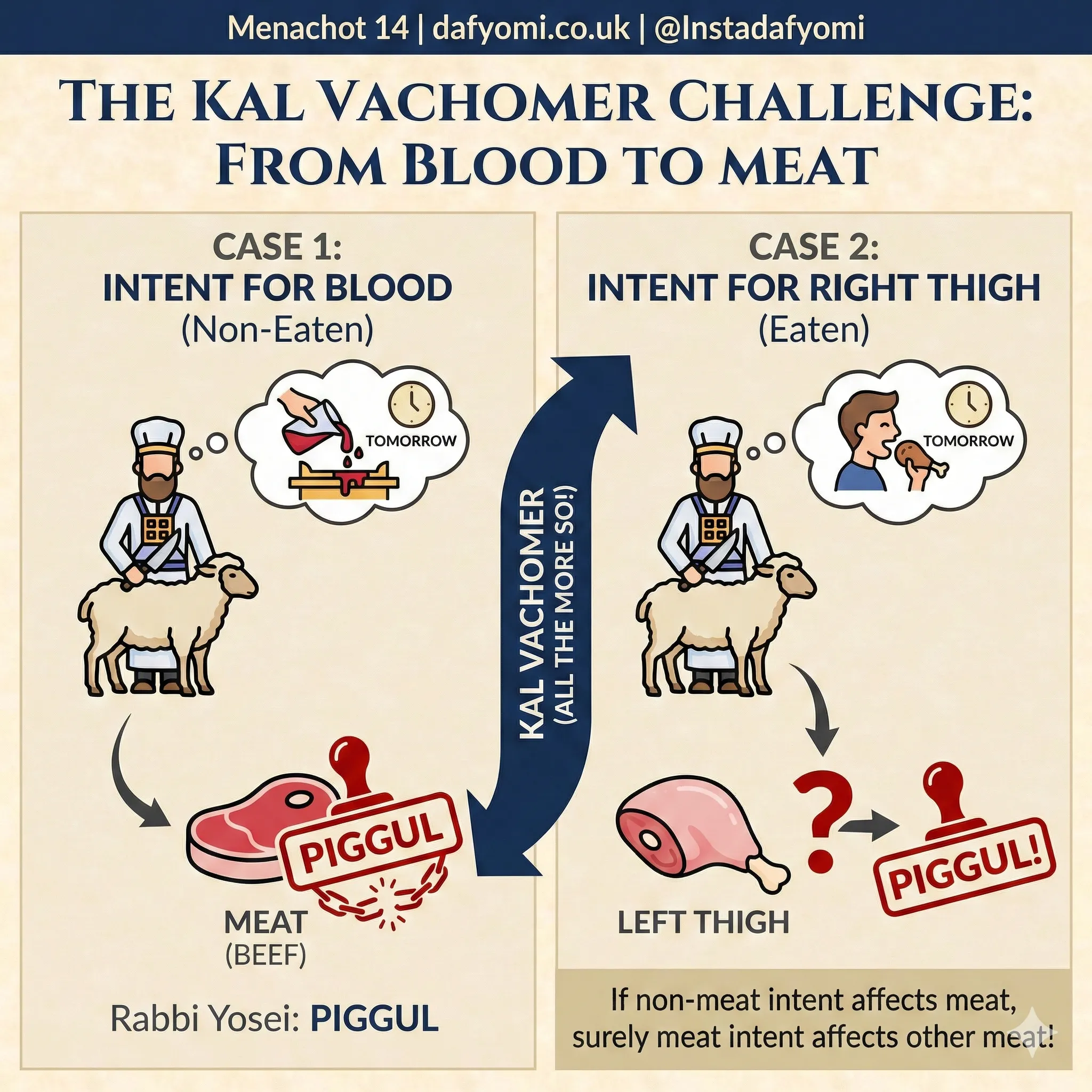
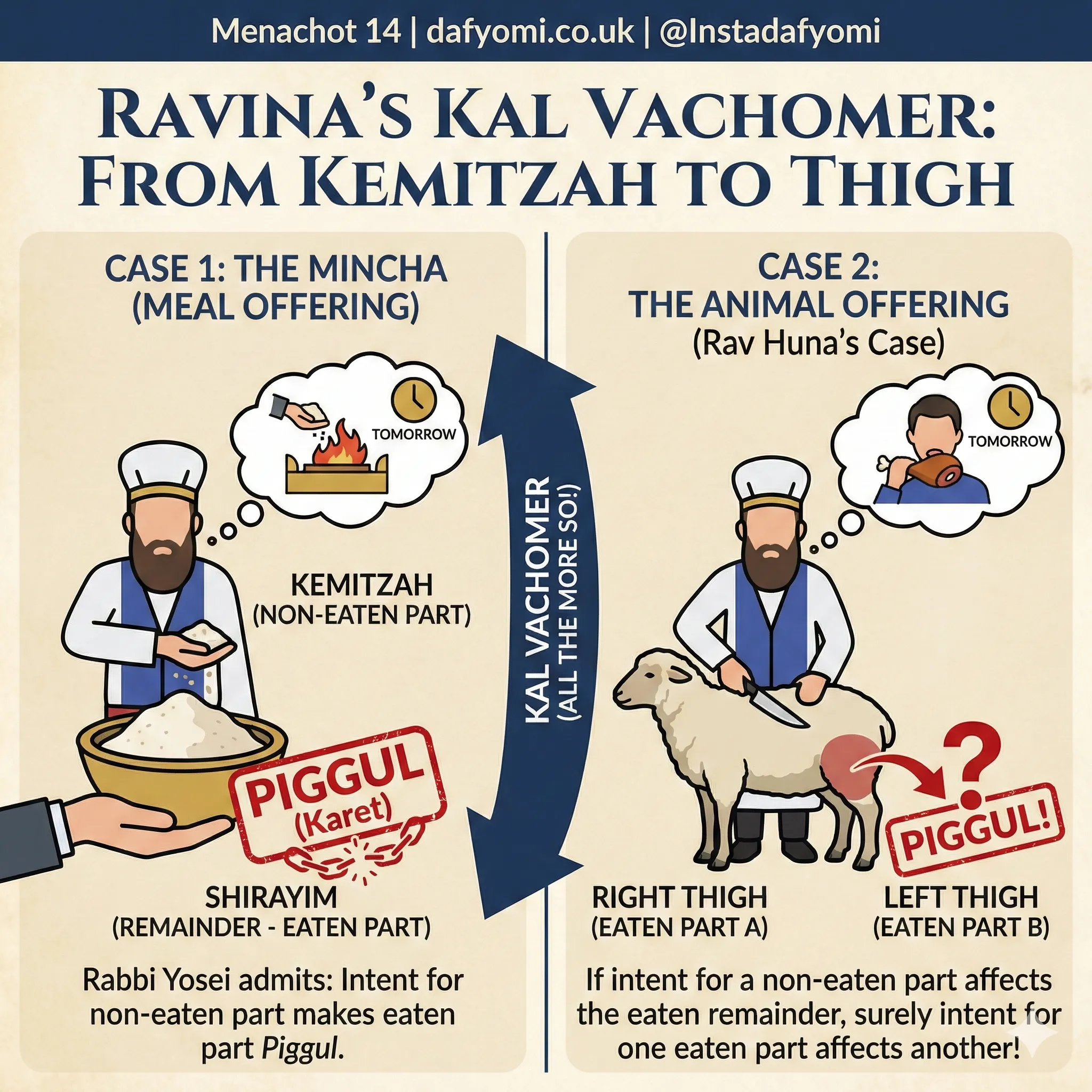
אֶלָּא פְּשִׁיטָא לְאִפַּגּוֹלֵי בָּשָׂר, הַשְׁתָּא וּמָה הָתָם דְּלָא חַשֵּׁיב בֵּיהּ בְּבָשָׂר גּוּפֵיהּ, אָמַר רַבִּי יוֹסֵי מִיפַּגַּל, הָכָא דְּחַשֵּׁיב בֵּיהּ בְּזֶבַח גּוּפֵיהּ, לֹא כׇּל שֶׁכֵּן דְּפִיגֵּל בְּיֶרֶךְ יָמִין פִּיגֵּל בְּיֶרֶךְ שְׂמֹאל?
English Translation:
Rather, it is obvious that the baraita means that it is the meat of the offering that could be rendered piggul. Now consider: And if there, in the baraita, where he did not have intent with regard to the meat itself, as his intention was not to partake of the meat the next day but to pour the remaining blood the next day, and yet Rabbi Yosei said that the meat is rendered piggul; then here, where he has intent to partake of the right thigh the next day, which is part of the offering itself, is it not all the more so that if he had intent of piggul with regard to the right thigh, he has rendered the left thigh piggul as well?
קלאוד על הדף:
The conclusion: it must be the MEAT that becomes piggul. This creates a powerful kal vachomer (a fortiori argument) against Rav Huna: In the baraita, Rabbi Yosei rules that even when the priest’s intent wasn’t about the meat itself (but about pouring blood), the meat still becomes piggul. All the more so, when the intent IS about part of the meat (the right thigh), the entire animal (including the left thigh) should become piggul!
Segment 14
TYPE: גמרא
Ravina’s additional challenge from the meal offering
Hebrew/Aramaic:
וְעוֹד, הָאָמַר רָבִינָא: תָּא שְׁמַע, הַקּוֹמֵץ אֶת הַמִּנְחָה לֶאֱכוֹל שְׁיָרֶיהָ אוֹ לְהַקְטִיר קוּמְצָהּ לְמָחָר, מוֹדֶה רַבִּי יוֹסֵי בָּזוֹ שֶׁפִּיגֵּל וְחַיָּיבִין עָלָיו כָּרֵת.
English Translation:
And furthermore, doesn’t Ravina say: Come and hear a refutation of the statement of Rav Huna from the mishna (13a): In the case of one who removes a handful from the meal offering with the intent to partake of its remainder or to burn its handful on the next day, Rabbi Yosei concedes in this instance that he has rendered the offering piggul and he is liable to receive karet for partaking of it.
קלאוד על הדף:
Ravina adds another proof from the mishna on Daf 13. Rabbi Yosei agrees that when the priest has intent to burn the KOMETZ tomorrow (not the shirayim!), the shirayim still become piggul. This further challenges Rav Huna’s interpretation of Rabbi Yosei.
Segment 15
TYPE: גמרא
Analyzing what becomes piggul when intent is about kometz
Hebrew/Aramaic:
לְהַקְטִיר קוּמְצָהּ, לְאִיפַּגּוֹלֵי מַאי? אִילֵימָא לְאִיפַּגּוֹלֵי קוֹמֶץ, קוֹמֶץ מִי מִיפַּגַּל? וְהָתְנַן: אֵלּוּ דְּבָרִים שֶׁאֵין חַיָּיבִין עֲלֵיהֶן מִשּׁוּם פִּיגּוּל: הַקּוֹמֶץ כּוּ׳! אֶלָּא פְּשִׁיטָא לְאִיפַּגּוֹלֵי שִׁירַיִים. הַשְׁתָּא וּמָה הָתָם, דְּלָא חַשֵּׁיב בְּהוּ בְּשִׁירַיִים גּוּפֵיהּ,
English Translation:
Ravina continues: When one removes the handful with the intent to burn its handful, what could be rendered piggul? If we say that the handful could be rendered piggul, does the handful become piggul? But didn’t we learn in a mishna (Zevaḥim 42b): These are the items for which one is not liable to receive karet due to the prohibition of piggul: The handful, etc. Rather, it is obvious that the remainder could be rendered piggul. Now consider: And if there, in the mishna, where he did not have intent with regard to the remainder itself, i.e., to partake of the remainder the next day,
קלאוד על הדף:
Ravina applies the same logic: when intent is about burning the kometz tomorrow, the KOMETZ itself can’t become piggul (it’s listed among items exempt from piggul). So the SHIRAYIM must become piggul. This sets up another kal vachomer.
Amud Bet (14b)
Segment 1
TYPE: גמרא
Completing the kal vachomer
Hebrew/Aramaic:
מִיפַּגְּלִי – הָכָא דְּחַשֵּׁיב בְּהוּ בִּזְבִיחָה גּוּפַהּ, לֹא כׇּל שֶׁכֵּן?
English Translation:
and yet Rabbi Yosei said that the remainder is rendered piggul; then here, where he has intent to partake of the right thigh the next day, which is part of the offering itself, is it not all the more so that both thighs should become piggul?
קלאוד על הדף:
The kal vachomer is completed: if the shirayim become piggul even when intent wasn’t about them directly, certainly the left thigh should become piggul when intent IS about the meat (the right thigh). This definitively challenges Rav Huna’s claim that Rabbi Yosei treats the thighs as separate bodies.
Segment 2
TYPE: גמרא
Rabbi Yochanan’s resolution: The Torah’s dual categorization
Hebrew/Aramaic:
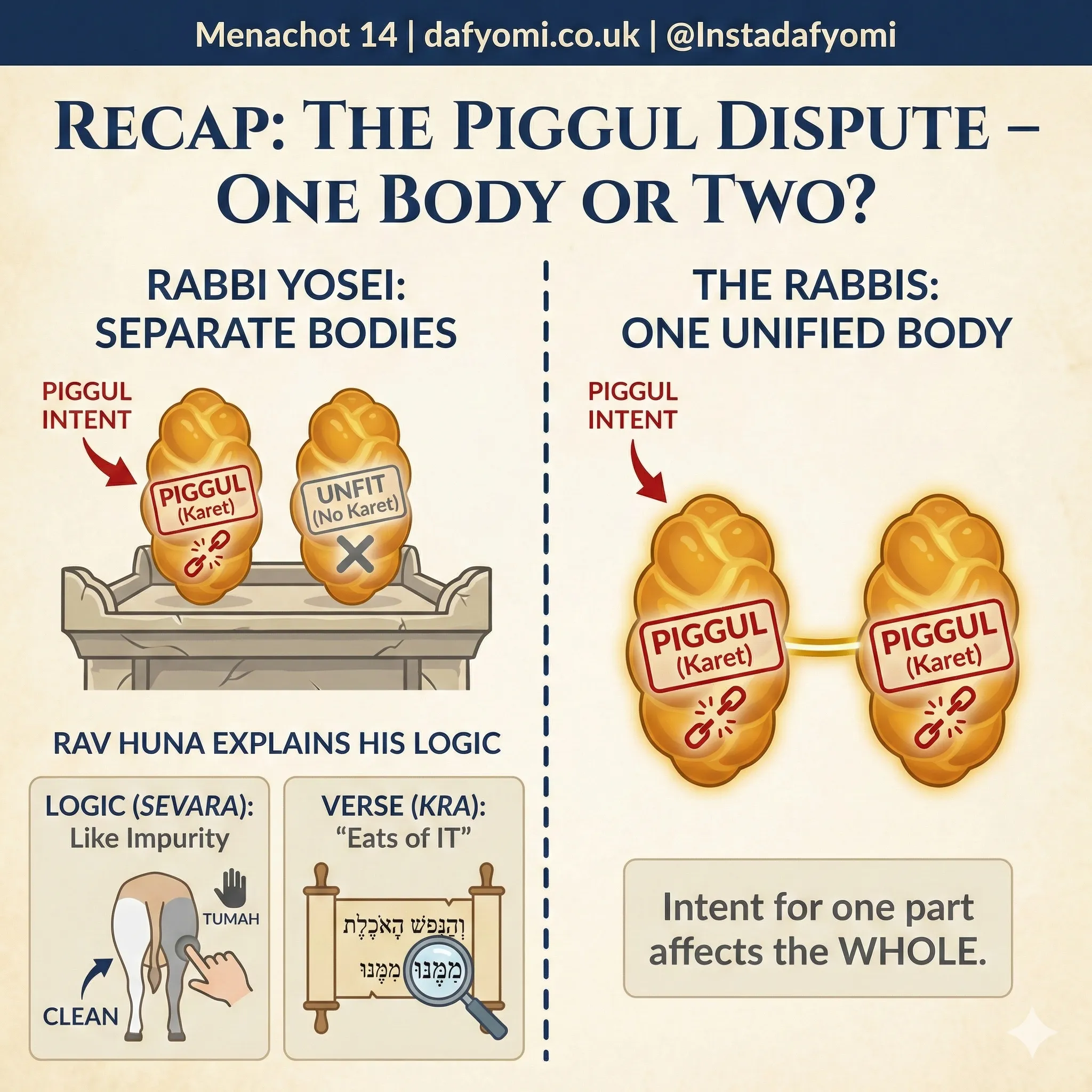
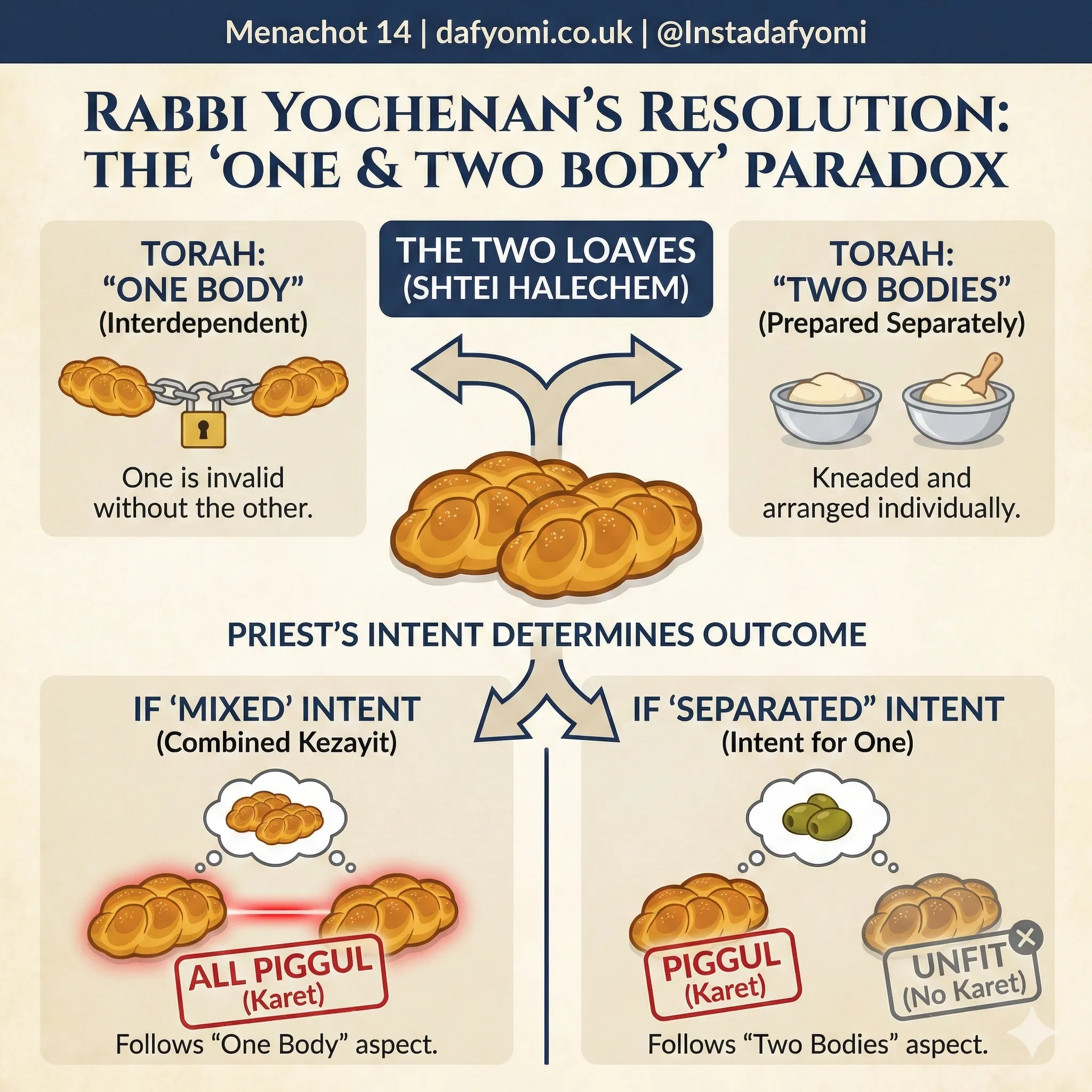
אֶלָּא אָמַר רַבִּי יוֹחָנָן: הַיְינוּ טַעְמָא דְּרַבִּי יוֹסֵי – הַכָּתוּב עֲשָׂאָן גּוּף אֶחָד, וְהַכָּתוּב עֲשָׂאָן שְׁנֵי גּוּפִין; גּוּף אֶחָד – דִּמְעַכְּבִי אַהֲדָדֵי, שְׁנֵי גּוּפִין – דְּאָמַר רַחֲמָנָא: הָא לְחוֹדַהּ עֲבִידָא וְהָא לְחוֹדַהּ עֲבִידָא.
English Translation:
Rather, Rabbi Yoḥanan said: Rabbi Yosei holds that intent of piggul with regard to one thigh renders the other thigh piggul as well, as they are of one body. Similarly, with regard to two loaves, Rabbi Yosei is of the opinion that if one intends to consume an amount equal to an olive-bulk from both loaves, both loaves are rendered piggul. And as for his statement that intent of piggul with regard to one loaf does not render the other loaf piggul, this is the reasoning of Rabbi Yosei: The verse renders the two loaves one body, and the verse also renders them two bodies. The verse renders them one body in the sense that they preclude one another, i.e., neither loaf is valid without the other. The verse also renders them two bodies, as the Merciful One states: This loaf is prepared alone and that is prepared alone, i.e., the kneading and arrangement of each loaf must be performed separately.
קלאוד על הדף:
Rabbi Yochanan provides the definitive explanation of Rabbi Yosei’s position: The Torah creates a DUAL status for the Two Loaves: (1) ONE body — they preclude each other (מְעַכְּבִי אַהֲדָדֵי), meaning neither is valid without the other. (2) TWO bodies — each must be prepared separately. This dual status explains when they combine and when they don’t.
Key Terms:
- גּוּף אֶחָד (Guf Echad) = One body — unified entity
- שְׁנֵי גּוּפִין (Shnei Gufin) = Two bodies — separate entities
- מְעַכְּבִי אַהֲדָדֵי (Me’akvei Ahadadi) = They preclude each other — mutual dependence
Segment 3
TYPE: גמרא
Mixed intent combines; separate intent doesn’t
Hebrew/Aramaic:
עָרְבִינְהוּ – מִתְעָרְבִין, דְּהַכָּתוּב עֲשָׂאָן גּוּף אֶחָד; פַּלְגִינְהוּ מִיפַּלְגִי, דְּהַכָּתוּב עֲשָׂאָן שְׁנֵי גּוּפִין.
English Translation:
Therefore, if the priest mixed them together by intending to consume an olive-bulk from both of them, then they are mixed and they are both piggul, as the verse renders them one body. But if he separated them by having intent with regard to only one loaf, in that case they are separated and only that loaf is piggul, as the verse renders them two bodies.
קלאוד על הדף:
The application is elegant: When the priest MIXES his intent (expressing a unified statement about BOTH loaves), the Torah’s “one body” aspect applies, and both become piggul. When he SEPARATES his intent (specifying only one loaf), the Torah’s “two bodies” aspect applies, and only that loaf becomes piggul. The priest’s formulation activates which Torah categorization applies!
Key Terms:
- עָרְבִינְהוּ (Arvinhu) = He mixed them — unified expression
- פַּלְגִינְהוּ (Palginhu) = He separated them — individual expression
Segment 4
TYPE: גמרא
Rabbi Yochanan’s dilemma: Thanks offering and baked meal offering
Hebrew/Aramaic:
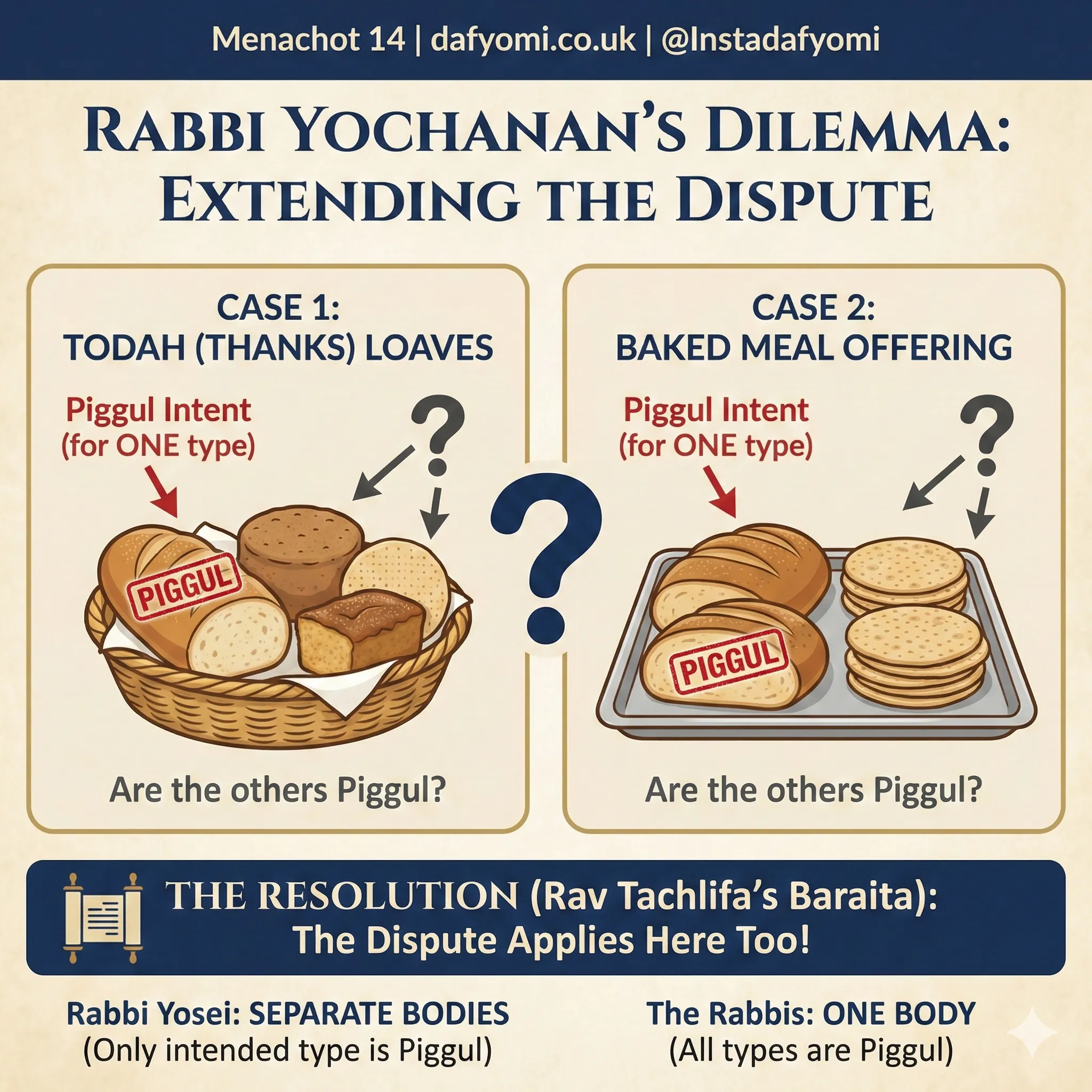
בָּעֵי רַבִּי יוֹחָנָן: פִּיגֵּל בְּלַחְמֵי תוֹדָה מַהוּ, בְּמִנְחַת מַאֲפֶה מַהוּ? תְּנָא לֵיהּ רַב תַּחְלִיפָא מִמַּעְרְבָא: וְכֵן אַתָּה אוֹמֵר בְּלַחְמֵי תוֹדָה, וְכֵן אַתָּה אוֹמֵר בְּמִנְחַת מַאֲפֶה.
English Translation:
Rabbi Yoḥanan raises a dilemma: If one had intent of piggul with regard to one type of loaf from the loaves of a thanks offering, what is the halakha concerning the remaining types of loaves, i.e., are they rendered piggul as well? Similarly, if one had intent of piggul with regard to either the loaves or the wafers of baked meal offerings, what is the halakha with regard to the remaining type? Rav Taḥlifa from the West, i.e., Eretz Yisrael, taught him a baraita that states: And likewise you say with regard to the bread of a thanks offering, and likewise you say with regard to a baked meal offering, that the halakha is a matter of dispute between Rabbi Yosei and the Rabbis.
קלאוד על הדף:
Rabbi Yochanan poses a fascinating question: does this principle extend to OTHER multi-component offerings? The thanks offering has FOUR types of bread; the baked meal offering has both loaves and wafers. If piggul intent is about ONE type, are the others affected? Rav Tachlifa from Eretz Yisrael provides a baraita: the same dispute between Rabbi Yosei and the Rabbis applies to these offerings too.
Key Terms:
- לַחְמֵי תוֹדָה (Lachmei Todah) = Loaves of the thanks offering — four different types
- מִנְחַת מַאֲפֶה (Minchat Ma’afeh) = Baked meal offering — containing loaves and wafers
Segment 5
TYPE: ברייתא
Half-measures during slaughter and sprinkling combine
Hebrew/Aramaic:
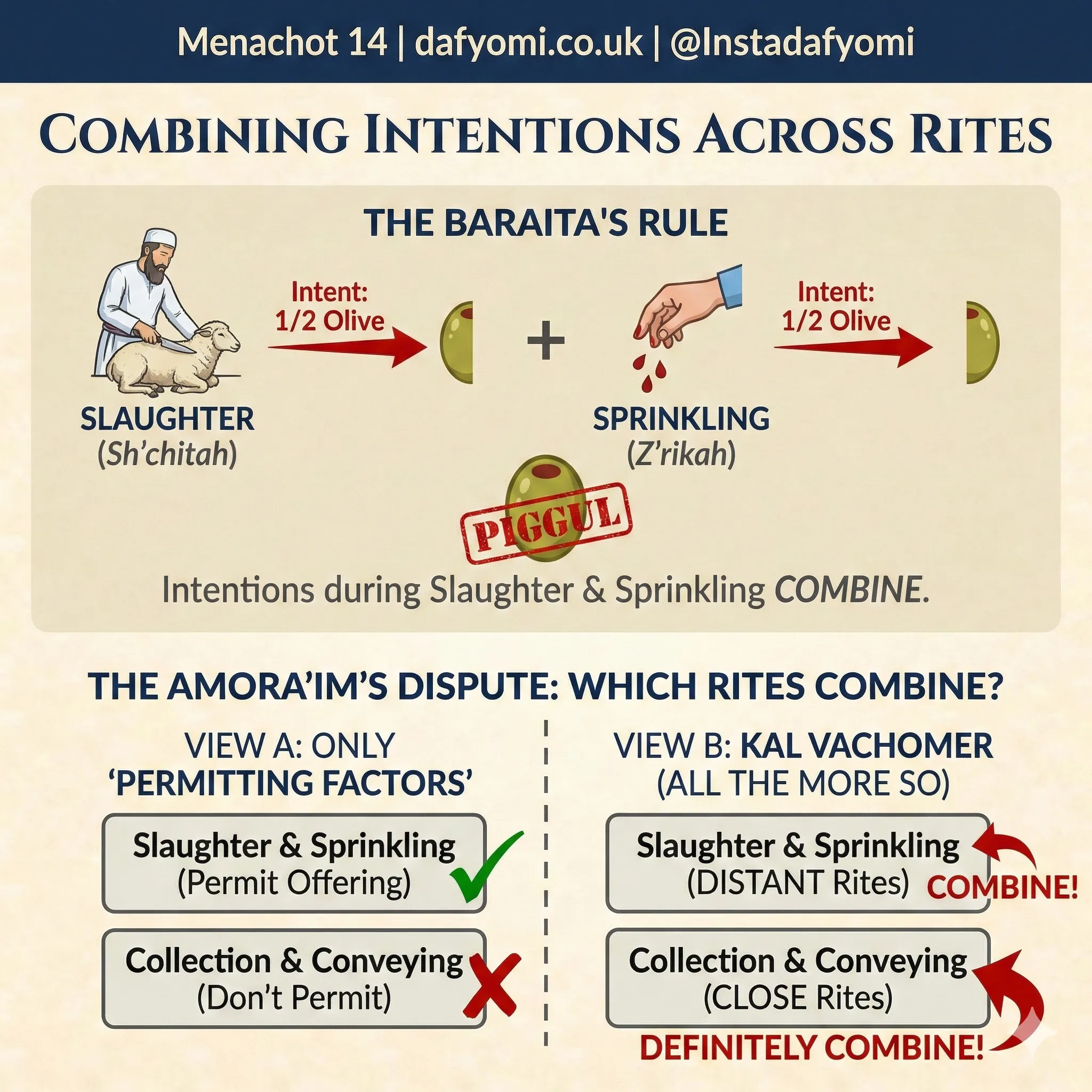
תָּנוּ רַבָּנַן: בִּשְׁעַת שְׁחִיטָה חִישֵּׁב לֶאֱכוֹל חֲצִי זַיִת, וּבִשְׁעַת זְרִיקָה חִישֵּׁב לֶאֱכוֹל חֲצִי זַיִת – פִּיגּוּל, מִפְּנֵי שֶׁשְּׁחִיטָה וּזְרִיקָה מִצְטָרְפִין.
English Translation:
The Sages taught in a baraita: If at the time of the slaughter of an offering one had intent to consume half an olive-bulk of its meat the next day, and at the time of the sprinkling of the blood he had intent to consume half of another olive-bulk of meat the next day, the offering is piggul, as intentions that occur during the slaughter and sprinkling combine to render an offering piggul.
קלאוד על הדף:
A new topic: combining intents across different SERVICES. If the priest has half-olive-bulk intent during SLAUGHTER and another half during SPRINKLING, these combine to create piggul. The baraita establishes that intentions during different services can join together.
Segment 6
TYPE: גמרא
Dispute about which services combine
Hebrew/Aramaic:
אִיכָּא דְּאָמְרִי: שְׁחִיטָה וּזְרִיקָה, דְּתַרְוַויְיהוּ מַתִּירִין – אִין, קַבָּלָה וְהוֹלָכָה – לָא. וְאִיכָּא דְּאָמְרִי: הָנָךְ דִּמְרַחֲקָן, וְכׇל שֶׁכֵּן הָנֵי דִּמְקָרְבָן.
English Translation:
There is a dispute between amora’im with regard to the halakha of this baraita: Some say that in the case of intentions that occur specifically during the slaughter and sprinkling, as both of them are permitting factors of the offering, yes, the intentions combine. But intentions that occur during the collection of the blood in a service vessel and the conveying of the blood to the altar do not combine, as neither rite is a permitting factor. And some say that if intentions during those rites that are distant from one another, i.e., the slaughter and sprinkling, combine, all the more so intentions during these rites that are close to one another, i.e., collection and conveying, certainly combine.
קלאוד על הדף:
Two amoraic views emerge: (1) ONLY slaughter and sprinkling combine, because both are “permitting factors” (mattirin). Kabbalah and holachah don’t combine because they’re intermediate steps. (2) If DISTANT services (slaughter/sprinkling) combine, certainly CLOSE services (collection/conveying) combine — a kal vachomer!
Key Terms:
- מַתִּירִין (Mattirin) = Permitting factors — services that directly enable consumption
- מְרַחֲקָן (Merachkan) = Distant from one another
- מְקָרְבָן (Mekarvan) = Close to one another
Segment 7
TYPE: גמרא
Challenge from Levi’s baraita
Hebrew/Aramaic:
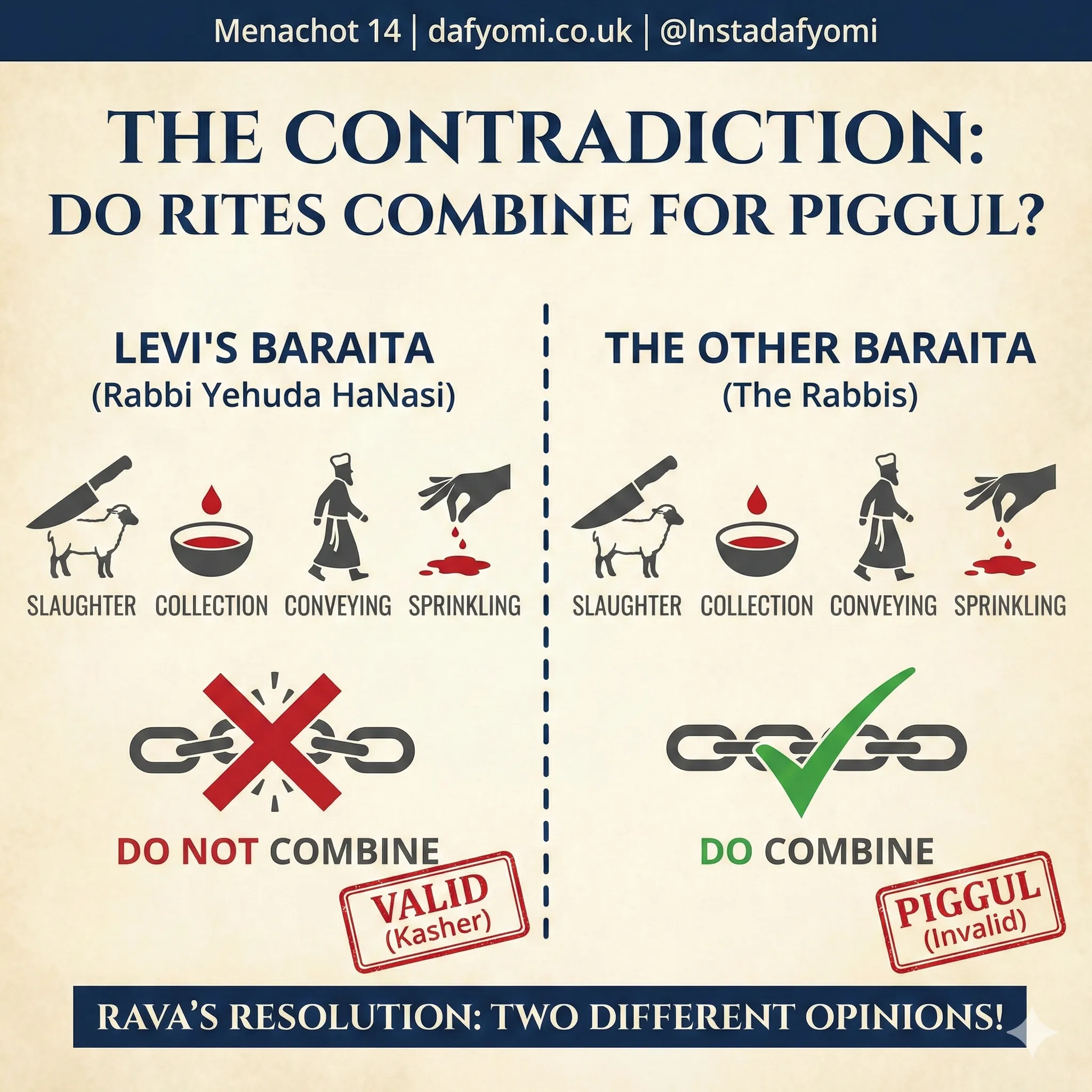
אִינִי? וְהָא תָּנֵי לֵוִי: אַרְבַּע עֲבוֹדוֹת אֵין מִצְטָרְפוֹת לְפִיגּוּל, שְׁחִיטָה וּזְרִיקָה, קַבָּלָה וְהוֹלָכָה! אָמַר רָבָא, לָא קַשְׁיָא: הָא רַבִּי, הָא רַבָּנַן.
English Translation:
The Gemara asks: Is that so, i.e., that intentions during the slaughter and sprinkling combine? But Levi teaches in a baraita: Intentions that occur during the four sacrificial rites do not combine to render an offering piggul, and those rites are: Slaughter and sprinkling, collection and conveying. Rava said: It is not difficult; this statement of Levi is in accordance with the opinion of Rabbi Yehuda HaNasi, whereas that baraita is in accordance with the opinion of the Rabbis.
קלאוד על הדף:
A contradicting baraita from Levi states that the four services DON’T combine for piggul! Rava resolves this: the two baraitot reflect different tannaitic opinions. Levi’s baraita follows Rabbi Yehuda HaNasi (intents don’t combine across services); the earlier baraita follows the Rabbis (they do combine).
Segment 8
TYPE: ברייתא
Supporting baraita for Rabbi’s position
Hebrew/Aramaic:
דְּתַנְיָא: הַשּׁוֹחֵט אֶת הַכֶּבֶשׂ לֶאֱכוֹל חֲצִי זַיִת מֵחַלָּה זוֹ, וְכֵן חֲבֵירוֹ לֶאֱכוֹל חֲצִי זַיִת מֵחַלָּה זוֹ, רַבִּי אוֹמֵר: אוֹמֵר אֲנִי שֶׁזֶּה כָּשֵׁר.
English Translation:
As it is taught in a baraita with regard to the two loaves and two lambs sacrificed on Shavuot: With regard to one who slaughters one of the lambs brought as peace offerings on Shavuot with the intent to consume half an olive-bulk from this loaf the next day, and similarly, he slaughtered the other lamb with the intent to consume half an olive-bulk from that second loaf the next day, Rabbi Yehuda HaNasi says: I say that this offering is valid. Clearly, Rabbi Yehuda HaNasi holds that intentions that occur during the performance of two permitting factors do not combine to render an offering piggul.
קלאוד על הדף:
This is the same baraita from the beginning of the daf, now used to prove that Rabbi Yehuda HaNasi holds intents across different services (two different lambs) don’t combine. Since slaughtering each lamb is a separate service, the half-measures remain separate.
Segment 9
TYPE: גמרא
Abaye’s challenge to Rava
Hebrew/Aramaic:
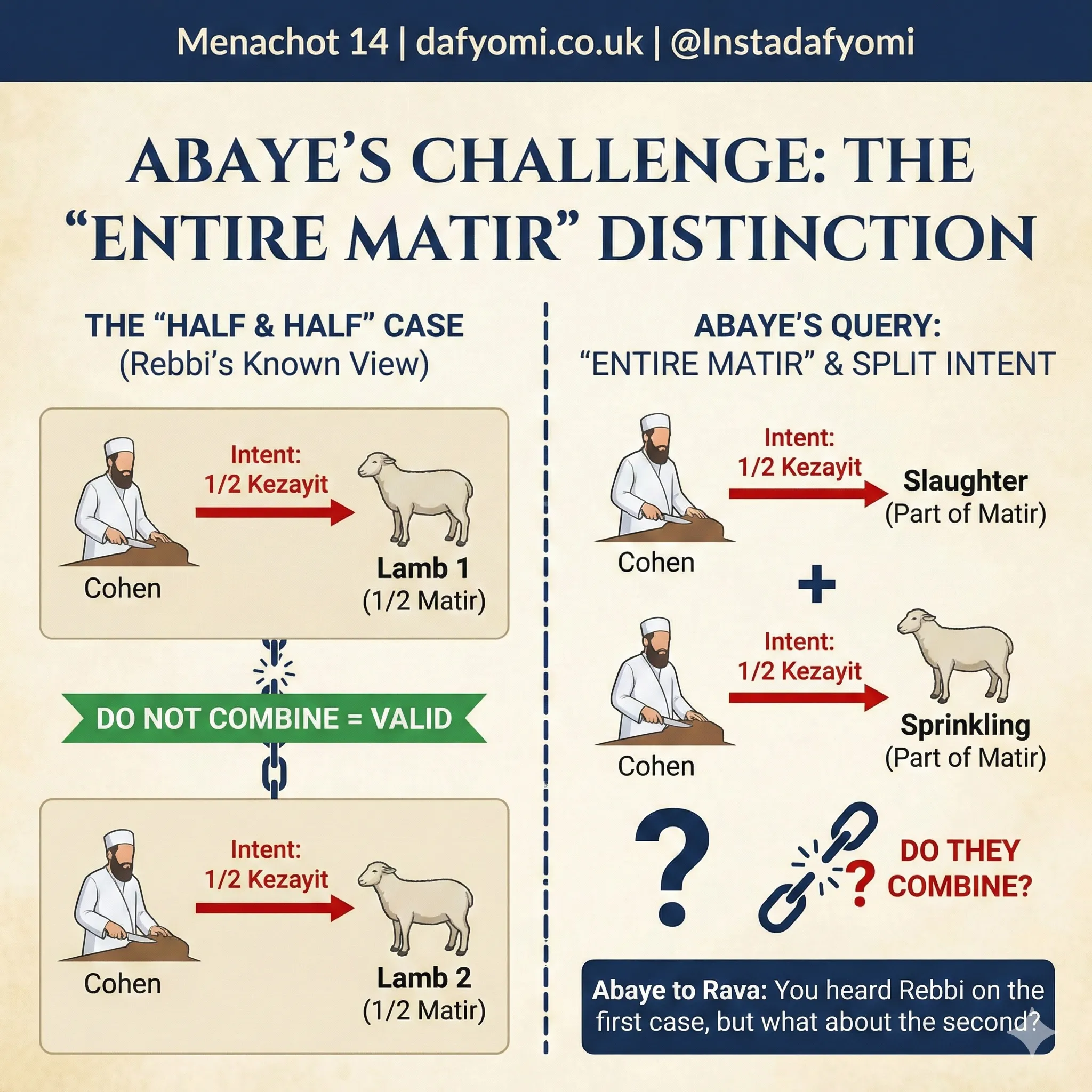
אֲמַר לֵיהּ אַבָּיֵי: אֵימַר דְּשָׁמְעַתְּ לֵיהּ לְרַבִּי – חֲצִי מַתִּיר וַחֲצִי אֲכִילָה, כּוּלּוֹ מַתִּיר וַחֲצִי אֲכִילָה מִי שָׁמְעַתְּ לֵיהּ?
English Translation:
Abaye said to Rava: You can say that you have heard that Rabbi Yehuda HaNasi holds that intentions do not combine to render an offering piggul when each intention is concerning half a permitting factor and half a measure of consumption, i.e., one lamb and half an olive-bulk. But in a case where one had intentions during the performance of an entire permitting factor, i.e., during the slaughter and sprinkling, and concerning half a measure of consumption, did you hear him say that such intentions do not combine?
קלאוד על הדף:
Abaye challenges Rava’s inference: the baraita shows Rabbi doesn’t combine half-mattir + half-measure. But what about WHOLE-mattir + half-measure? Perhaps Rabbi only limits combining when BOTH the permitting factor AND the consumption measure are halved. When the full permitting factor is present (both slaughter and sprinkling), maybe the half-measures DO combine.
Segment 10
TYPE: גמרא
Rava bar Rav Chanan’s question about decrees
Hebrew/Aramaic:
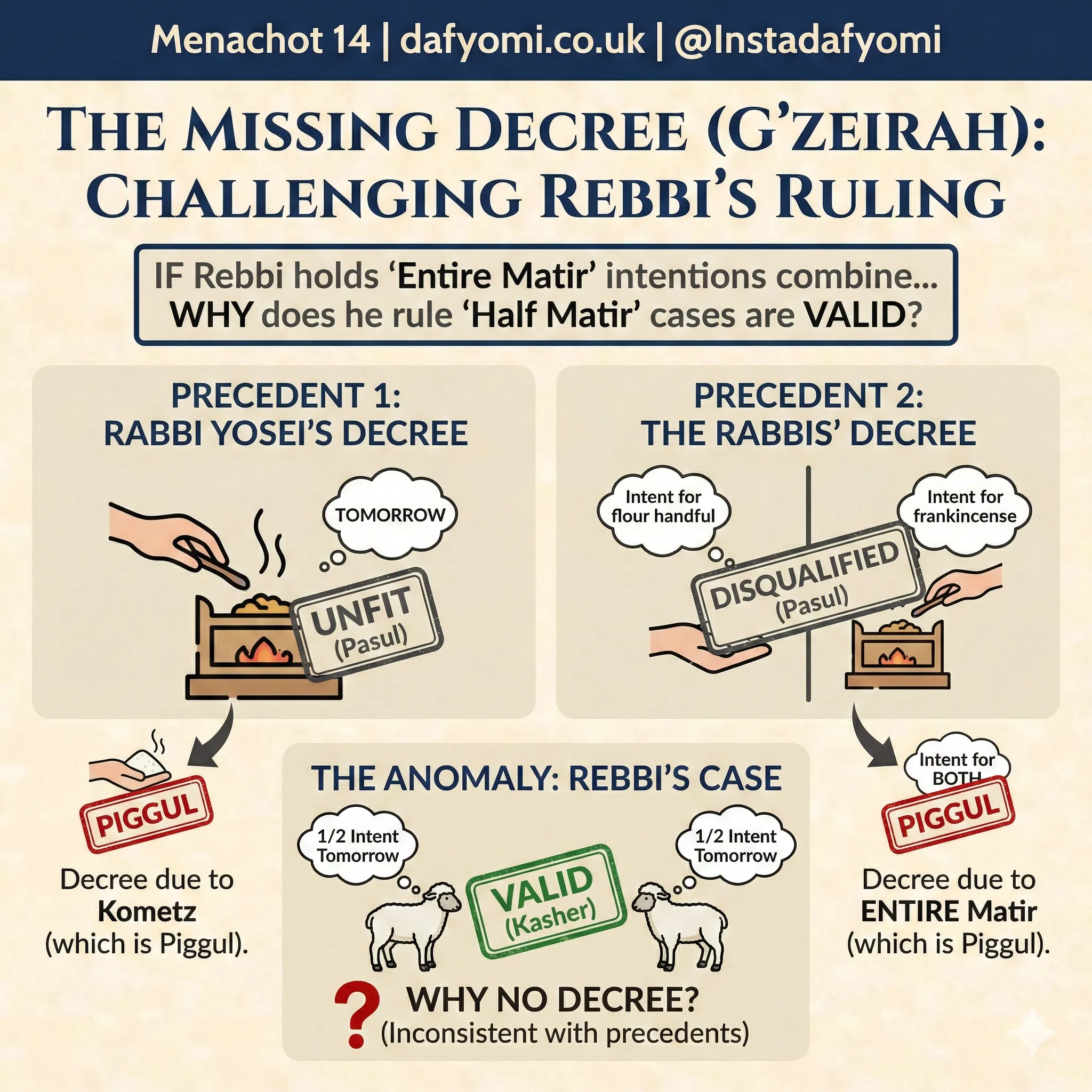
אֲמַר לֵיהּ רָבָא בַּר רַב חָנָן לְאַבָּיֵי: וְאִי אִית לֵיהּ לְרַבִּי כּוּלּוֹ מַתִּיר וַחֲצִי אֲכִילָה, לִגְזוֹר חֲצִי מַתִּיר וַחֲצִי אֲכִילָה אַטּוּ כּוּלּוֹ מַתִּיר וַחֲצִי אֲכִילָה, דְּהָא רַבִּי יוֹסֵי גָּזַר וְרַבָּנַן גָּזְרִי!
English Translation:
Rava bar Rav Ḥanan said to Abaye: But if Rabbi Yehuda HaNasi is of the opinion that intentions during the performance of an entire permitting factor and concerning half a measure of consumption combine to render an offering piggul, why does he rule that when one slaughters each lamb with the intent to consume half an olive-bulk from one loaf the next day the offering is entirely valid? Let him decree that intentions during half a permitting factor and concerning half a measure of consumption disqualify an offering, due to the fact that intentions during an entire permitting factor and concerning half a measure of consumption render the offering piggul, as one finds in similar instances that Rabbi Yosei decreed and the Rabbis decreed in this manner.
קלאוד על הדף:
Rava bar Rav Chanan counter-challenges: if Rabbi holds that whole-mattir + half-measure creates piggul, shouldn’t he decree that even half-mattir + half-measure disqualifies (as a protective measure)? After all, both Rabbi Yosei and the Rabbis enacted such protective decrees!
Segment 11
TYPE: גמרא
Rabbi Yosei’s decree
Hebrew/Aramaic:
רַבִּי יוֹסֵי גָּזַר, דִּתְנַן: לְהַקְטִיר לְבוֹנָתָהּ לְמָחָר, רַבִּי יוֹסֵי אוֹמֵר: פָּסוּל וְאֵין בּוֹ כָּרֵת, וַחֲכָמִים אוֹמְרִים: פִּיגּוּל וְחַיָּיבִין עָלֶיהָ כָּרֵת.
English Translation:
Rava bar Rav Ḥanan elaborates: Rabbi Yosei decreed in such a case, as we learned in a mishna (13a): With regard to one who removes a handful from the meal offering with the intent to burn its handful on the next day, everyone agrees that the meal offering is piggul. But if his intent was to burn its frankincense on the next day, Rabbi Yosei says: The meal offering is unfit, but partaking of it does not include liability to receive karet. And the Rabbis say: It is a case of piggul and one is liable to receive karet for partaking of the meal offering. Since one is not liable to receive karet, Rabbi Yosei evidently disqualifies the meal offering as a rabbinic decree due to concern over a case where his intention was to burn the handful the next day.
קלאוד על הדף:
The proof: Rabbi Yosei disqualifies (pasul) the meal offering when intent is about frankincense, even though it’s not FULL piggul (no karet). This is a protective decree — to prevent confusion with the case where intent is about the kometz, which IS full piggul.
Segment 12
TYPE: גמרא
The Rabbis’ decree
Hebrew/Aramaic:
וְרַבָּנַן נָמֵי גָּזְרִי, דִּתְנַן: פִּיגֵּל בַּקּוֹמֶץ וְלֹא בַּלְּבוֹנָה, בַּלְּבוֹנָה וְלֹא בַּקּוֹמֶץ – רַבִּי מֵאִיר אוֹמֵר: פִּיגּוּל וְחַיָּיבִין עָלָיו כָּרֵת, וַחֲכָמִים אוֹמְרִים: אֵין בּוֹ כָּרֵת עַד שֶׁיְּפַגֵּל בְּכׇל הַמַּתִּיר.
English Translation:
And the Rabbis decreed as well, as we learned in a mishna (16a): If one had intent of piggul during the burning of the handful but not during the burning of the frankincense, or if he had such intent during the burning of the frankincense but not during the burning of the handful, Rabbi Meir says: The meal offering is piggul and one is liable to receive karet for its consumption, and the Rabbis say: There is no liability to receive karet for its consumption unless he has intent of piggul during the burning of the entire permitting factor, i.e., both the handful and the frankincense. Since the Rabbis state that there is no liability to receive karet, but they do not rule that the offering is valid, evidently they maintain that the offering is disqualified by rabbinic law, due to concern over a case of piggul intent during the burning of the entire permitting factor.
קלאוד על הדף:
The Rabbis also decree: when piggul intent exists for only the kometz OR only the frankincense (but not both), there’s no karet liability — but they don’t say it’s valid. They disqualify it as a rabbinic decree, to prevent confusion with cases involving the entire mattir.
Segment 13
TYPE: גמרא
Abaye’s response: No analogous case for half-mattir half-measure
Hebrew/Aramaic:
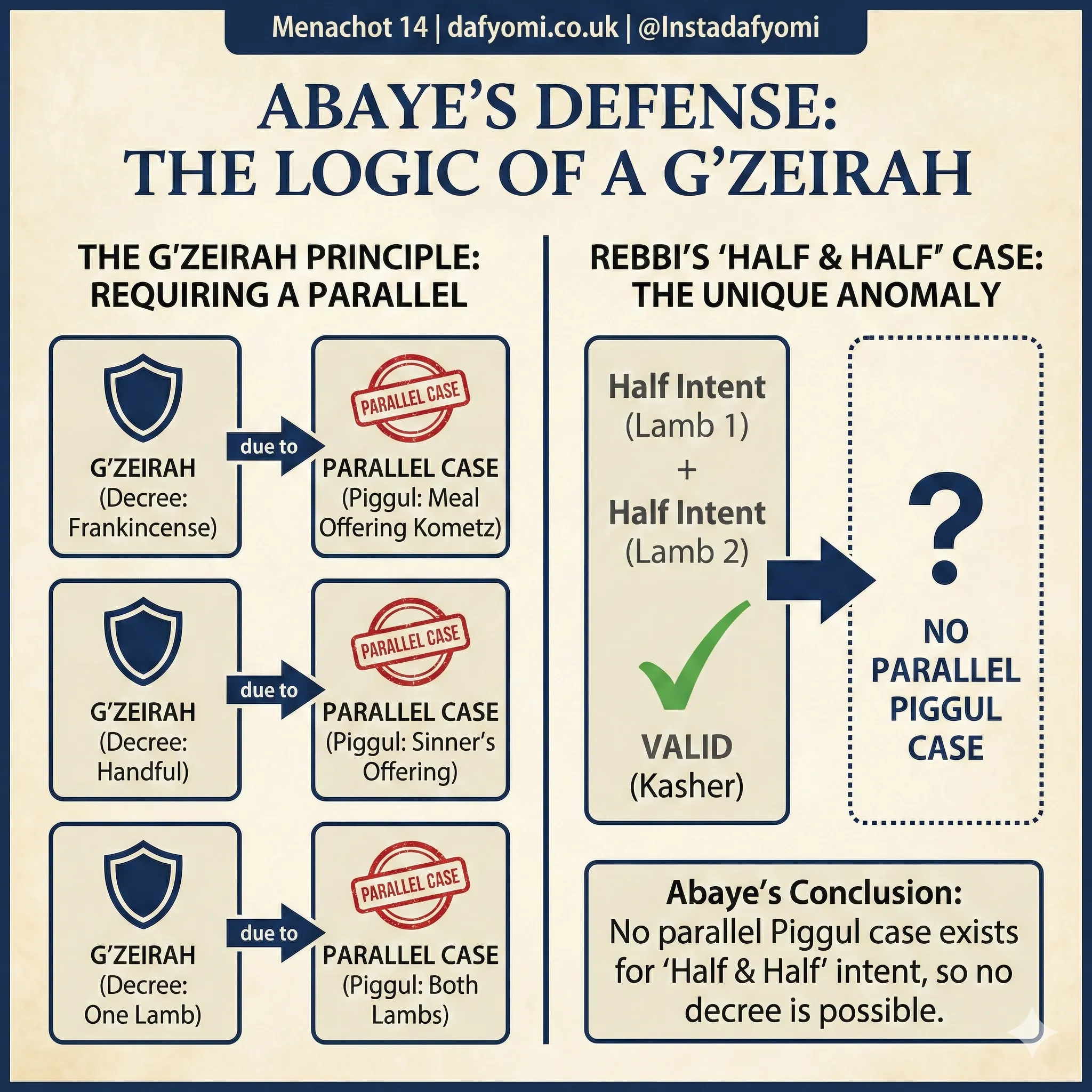
אֲמַר לֵיהּ: הָכִי הַשְׁתָּא? בִּשְׁלָמָא הָתָם, גָּזַר רַבִּי יוֹסֵי קוֹמֶץ דִּלְבוֹנָה אַטּוּ קוֹמֶץ דְּמִנְחָה.
English Translation:
Abaye said to Rava bar Rav Ḥanan: How can these cases be compared? Granted there, Rabbi Yosei decreed that the offering is disqualified in a case of intent involving the handful of frankincense due to the concern of intent involving the handful of the meal offering, as the two cases are similar.
קלאוד על הדף:
Abaye responds: those decrees work because there’s an ANALOGOUS case to protect against. Rabbi Yosei decrees about frankincense because of the similar kometz case. The Rabbis decree about partial-mattir because of the whole-mattir case.
Segment 14
TYPE: גמרא
The lambs and bowls cases
Hebrew/Aramaic:
רַבָּנַן גָּזְרִי קוֹמֶץ אַטּוּ קוֹמֶץ דְּמִנְחַת חוֹטֵא, וּלְבוֹנָה אַטּוּ לְבוֹנָה הַבָּאָה בְּבָזִיכִין.
English Translation:
Similarly, the Rabbis decreed that the offering is disqualified in a case of intent involving the handful due to a similar case of intent concerning the handful of the meal offering of a sinner. There is no frankincense in the case of a meal offering of a sinner, and consequently the priest’s intent with regard to the handful alone renders the offering piggul, as it is the sole permitting factor. And the Rabbis also decreed in a case of intent with regard to the frankincense due to a similar case of intent concerning the frankincense that comes in the bowls that accompany the shewbread. Here there is no handful, and consequently intent with regard to the frankincense alone renders the shewbread piggul.
קלאוד על הדף:
Abaye elaborates: the Rabbis decree about kometz-only because of the sinner’s meal offering (no frankincense — kometz alone is the mattir). They decree about frankincense-only because of the showbread bowls (no kometz — frankincense alone is the mattir). Each decree has an analogous case to protect against.
Segment 15
TYPE: גמרא
Continuation: lambs and bowls
Hebrew/Aramaic:
כְּבָשִׂים נָמֵי, כֶּבֶשׂ אַטּוּ כֶּבֶשׂ חֲבֵירוֹ.
English Translation:
In the case of the two lambs that accompany the two loaves brought on Shavuot as well (16a), the Rabbis rule that if one slaughters one of the lambs with the intent to consume both loaves the next day the offering is disqualified, but one is not liable to receive karet for partaking of it. This is a rabbinic decree in a case of intent during the slaughter of one lamb due to the other lamb, as were one to slaughter both lambs with intent of piggul, the loaves would be rendered piggul, since his intent occurred during the slaughter of the entire permitting factor.
קלאוד על הדף:
The pattern continues: the Rabbis disqualify when intent is during ONE lamb, as a decree due to the case of BOTH lambs. There’s always an analogous case to protect against.
Segment 16
TYPE: גמרא
Bowls of showbread
Hebrew/Aramaic:
בָּזֵךְ, אַטּוּ בָּזֵךְ חֲבֵירוֹ.
English Translation:
Similarly, when one burns a single bowl of frankincense from those that accompany the shewbread with the intent to consume both arrangements of shewbread the next day, the Rabbis disqualify the shewbread by rabbinic decree due to the other bowl, i.e., due to the concern over piggul intent during the burning of both bowls, as this intent involves the burning of the entire permitting factor.
קלאוד על הדף:
Same principle: one bowl is disqualified as a decree because of both bowls. Every decree has a parallel case that creates the concern.
Segment 17
TYPE: גמרא
Abaye’s conclusion: No analogous case for Rabbi’s ruling
Hebrew/Aramaic:
אֶלָּא הָכָא, מִי אִיכָּא חֲצִי מַתִּיר וַחֲצִי אֲכִילָה בְּעָלְמָא, דְּלֵיקוּם וְלִיגְזַר?
English Translation:
Abaye concludes: But here, in the case of the baraita where one slaughtered each of the two lambs with the intent to consume half an olive-bulk from a different loaf, is there another instance in general where intent during the performance of a rite concerning half a permitting factor and with regard to half a measure of consumption renders an offering piggul, that Rabbi Yehuda HaNasi will arise and decree that the lambs in this instance are disqualified?
קלאוד על הדף:
Abaye’s clinching argument: Rabbi Yehuda HaNasi has NO reason to decree in the half-mattir + half-measure case because there’s NO analogous case where such an intent creates actual piggul! Without a similar case to protect against, no decree is needed. This explains why Rabbi rules the offering is completely valid.
Segment 18
TYPE: גמרא
Proof from the Rabbis conceding to Rabbi Meir
Hebrew/Aramaic:
הָכִי נָמֵי מִסְתַּבְּרָא, דְּטַעְמָא דְּרַבָּנַן מִשּׁוּם הָכִי הוּא, דְּקָתָנֵי סֵיפָא: מוֹדִים חֲכָמִים לְרַבִּי מֵאִיר בְּמִנְחַת חוֹטֵא וּמִנְחַת קְנָאוֹת שֶׁאִם פִּיגֵּל בַּקּוֹמֶץ שֶׁפִּיגּוּל, וְחַיָּיבִין עָלֶיהָ כָּרֵת, שֶׁהַקּוֹמֶץ הוּא הַמַּתִּיר.
English Translation:
The Gemara notes: So too, it is reasonable that the reasoning of the Rabbis is due to that explanation, i.e., they disqualified the offerings in the aforementioned cases due to the fact that in similar instances the offering is piggul. This is evident from the fact that it is taught in the latter clause of the mishna (16a): The Rabbis concede to Rabbi Meir in the case of the meal offering of a sinner and the meal offering of jealousy that if one had intent of piggul during the burning of the handful, the meal offering is piggul and one is liable to receive karet for its consumption, as the handful is the sole permitting factor.
קלאוד על הדף:
Final proof: the mishna says the Rabbis CONCEDE to Rabbi Meir in cases where the kometz is the ONLY mattir (sinner’s meal offering, jealousy meal offering). This confirms the Rabbis only decree when there’s an analogous piggul case — where there’s only one mattir, kometz-only intent creates full piggul.
Segment 19
TYPE: גמרא
Confirming the reasoning
Hebrew/Aramaic:
הָא לְמָה לִי לְמִיתְנָא כְּלָל? פְּשִׁיטָא, מִי אִיכָּא מַתִּיר אַחֲרִינָא? אֶלָּא לָאו הָא קָא מַשְׁמַע לַן, דְּטַעְמָא דְּקוֹמֶץ מִשּׁוּם דְּאִיכָּא קוֹמֶץ דְּמִנְחַת חוֹטֵא דְּדָמֵי לֵיהּ.
English Translation:
The Gemara explains this proof: Why do I need the mishna to teach this last statement at all? Isn’t it obvious that these meal offerings are piggul, as is there another permitting factor aside from the handful? Rather, is it not correct to say that this is what the mishna teaches us, that the reason that the Rabbis disqualified a standard meal offering when only the handful was removed with the intent of piggul is because there is the case of the handful of the meal offering of a sinner, which is similar to it and is rendered piggul due to intent involving the handful alone?
קלאוד על הדף:
The Gemara asks: why state the obvious? Of course sinner’s meal offering becomes piggul with kometz intent — there’s no other mattir! The answer: the mishna teaches WHY the Rabbis decree for regular meal offerings — because the sinner’s meal offering is an analogous case. Every decree has its parallel.
Segment 20
TYPE: משנה
New Mishna: Impurity affecting one of a pair
Hebrew/Aramaic:
מַתְנִי׳ נִטְמֵאת אַחַת מִן הַחַלּוֹת, אוֹ אֶחָד מִן הַסְּדָרִים – רַבִּי יְהוּדָה אוֹמֵר: שְׁנֵיהֶם יֵצְאוּ לְבֵית הַשְּׂרֵיפָה, שֶׁאֵין קׇרְבַּן צִיבּוּר חָלוּק. וַחֲכָמִים אוֹמְרִים: הַטָּמֵא בְּטוּמְאָתוֹ וְהַטָּהוֹר יֵאָכֵל.
English Translation:
MISHNA: If one of the two loaves of Shavuot or one of the two arrangements of the shewbread became ritually impure, Rabbi Yehuda says: Both must be taken to the place of burning like any other disqualified offering, as no communal offering is divided. That is, it is either fit in its entirety or unfit in its entirety. And the Rabbis say: The impure one remains in its state of impurity and the pure one shall be eaten.
קלאוד על הדף:
A new mishna transitions to ritual impurity: if ONE of the Two Loaves (or one row of showbread) becomes tamei, what happens to the other? Rabbi Yehuda says: BOTH must be burned — a communal offering can’t be divided. The Rabbis disagree: only burn the impure one; the pure one can still be eaten.
Key Terms:
- נִטְמֵאת (Nitme’at) = Became impure — contracted ritual impurity
- בֵּית הַשְּׂרֵיפָה (Beit HaSreifa) = Place of burning — where disqualified offerings are destroyed
- קׇרְבַּן צִיבּוּר חָלוּק (Korban Tzibbur Chaluk) = A communal offering is divided — Rabbi Yehuda denies this
Segment 21
TYPE: גמרא
Rabbi Elazar limits the dispute
Hebrew/Aramaic:
גְּמָ׳ אָמַר רַבִּי אֶלְעָזָר: מַחְלוֹקֶת לִפְנֵי זְרִיקָה, אֲבָל לְאַחַר זְרִיקָה – דִּבְרֵי הַכֹּל הַטָּמֵא בְּטוּמְאָתוֹ וְהַטָּהוֹר יֵאָכֵל.
English Translation:
GEMARA: Rabbi Elazar says: The dispute between Rabbi Yehuda and the Rabbis applies only to a case where one loaf became ritually impure before the sprinkling of the blood of the lambs, as this is the act that renders the loaves permitted for consumption. Accordingly, they disagree whether the sprinkling is effective in permitting the remaining pure loaf for consumption. But in a case where one loaf was rendered impure after the sprinkling, meaning that both loaves were initially permitted for consumption, everyone agrees that the impure one remains in its state of impurity and the pure one shall be eaten.
קלאוד על הדף:
Rabbi Elazar limits the dispute: it only applies when impurity occurred BEFORE the blood sprinkling. After sprinkling — when both loaves were already permitted — all agree the pure one can be eaten. The timing of the impurity relative to the permitting service is crucial.
Key Terms:
- לִפְנֵי זְרִיקָה (Lifnei Zerikah) = Before the sprinkling
- לְאַחַר זְרִיקָה (Le’achar Zerikah) = After the sprinkling
Segment 22
TYPE: גמרא
The underlying dispute: Does the Tzitz effect acceptance?
Hebrew/Aramaic:
וְלִפְנֵי זְרִיקָה, בְּמַאי פְּלִיגִי? אָמַר רַב פָּפָּא: בְּצִיץ מְרַצֶּה עַל אֲכִילוֹת קָא מִיפַּלְגִי,
English Translation:
The Gemara asks: And in the case where the loaves become impure before the sprinkling of the blood, with regard to what principle do they disagree? Rav Pappa said: They disagree with regard to the frontplate of the High Priest, i.e., whether it effects acceptance only for the impurity of items sacrificed on the altar, or even for the impurity of items that would normally be consumed by the priests.
קלאוד על הדף:
Rav Pappa identifies the core dispute: does the Tzitz (the golden frontplate worn by the Kohen Gadol inscribed with “Holy to Hashem”) achieve acceptance for impurity affecting CONSUMABLE items, or only items burned on the altar? Rabbi Yehuda says the Tzitz doesn’t help for consumption — both loaves must be burned. The Rabbis say it does help — the pure loaf can be eaten.
Key Terms:
- צִיץ (Tzitz) = Frontplate — the golden plate worn on the High Priest’s forehead
- מְרַצֶּה עַל אֲכִילוֹת (Meratzeh Al Achilot) = Effects acceptance for consumables — achieves atonement for impurity affecting edible portions